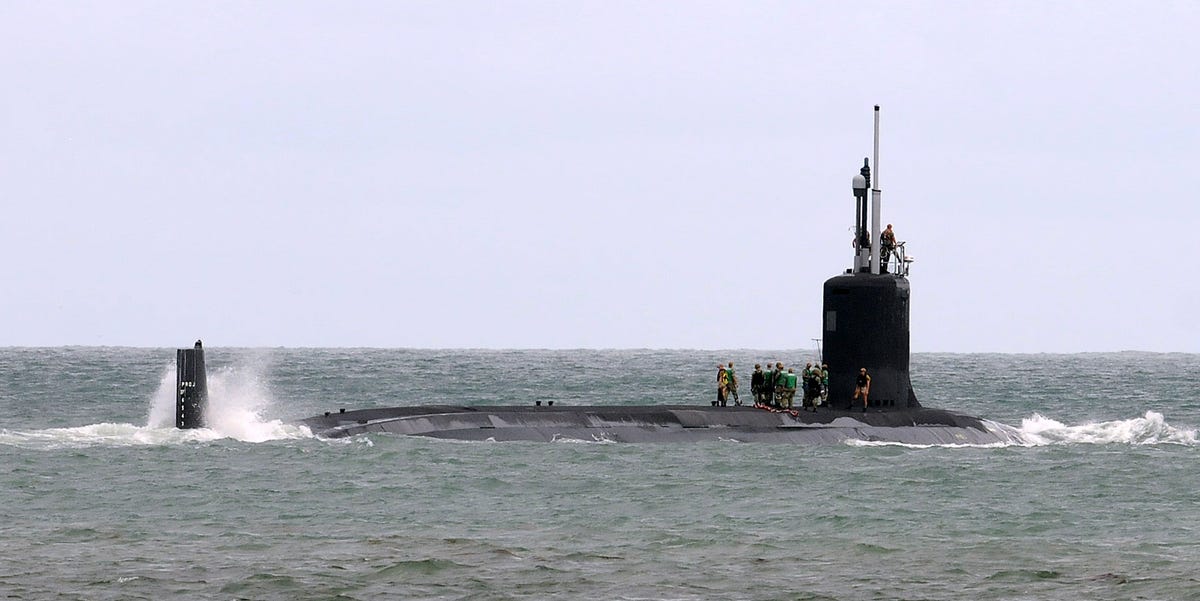

The name Arizona is returning to the U.S. Navy, not on another steel-gray battleship bristling with giant guns, but on a nuclear-powered attack submarine designed to operate quietly beneath the waves. The future USS Arizona, designated SSN-803, will connect one of the Navy’s most sacred names with some of its most advanced undersea technology.
It is an extraordinary combination: a name forever associated with Pearl Harbor, carried by a Virginia-class submarine built for stealth, surveillance, special operations, and long-range strike missions. History, in other words, is not merely being placed in a museum case. It is being fitted with a nuclear reactor and four very large payload tubes.
A New USS Arizona Is Taking Shape
The future USS Arizona is the 30th Virginia-class submarine and the second vessel in the class’s Block V production group. Its hull number is SSN-803, with “SSN” identifying it as a nuclear-powered attack submarine.
Although it is commonly called USS Arizona in headlines and public discussions, the submarine is formally known as Pre-Commissioning Unit Arizona, or PCU Arizona, until it enters active service. The USS prefix officially applies after commissioning. That distinction may sound like paperwork wearing a sailor’s cap, but naval traditions take names and status seriously.
The Navy announced the name in December 2019, selecting Arizona and Oklahoma for two Block V submarines in honor of the battleships and crews associated with the attack on Pearl Harbor. The decision restored two historically significant names to the fleet while giving them a decidedly 21st-century mission.
Why “Over 100 Years” Is Both True and Complicated
The original battleship USS Arizona was commissioned in 1916, making SSN-803 the first newly named Navy vessel called Arizona in more than a century. However, the battleship remained in service until its destruction in 1941. Measured from the loss of the original ship, the name’s absence from active duty spans more than eight decades rather than a full century.
Either way, the gap is enormous. Entire generations of sailors have served without an active USS Arizona in the fleet. Bringing the name back is therefore much more than recycling a popular label. It is a deliberate act of remembrance.
The Original USS Arizona and Its Enduring Legacy
The first USS Arizona, BB-39, was a Pennsylvania-class battleship commissioned on October 17, 1916. Built during an era when naval power was measured partly by the size of a ship’s guns and the thickness of its armor, Arizona represented American industrial strength and the growing importance of the United States at sea.
By 1940, the battleship was based at Pearl Harbor with other elements of the Pacific Fleet. On the morning of December 7, 1941, Japanese aircraft attacked the harbor. Arizona was struck by bombs, including one that penetrated near the forward ammunition magazines. The resulting explosion destroyed much of the ship and caused catastrophic loss of life.
A total of 1,177 sailors and Marines aboard Arizona were killed. More than 900 remain entombed within the wreck, making the ship both a historic site and a war grave. The loss accounted for nearly half of the American service members killed during the attack.
Unlike several other damaged battleships, Arizona could not be raised, repaired, and returned to combat. The wreck remained in place, and the USS Arizona Memorial was dedicated above it in 1962. Today, the white memorial spanning the sunken hull is one of the most recognizable military landmarks in the United States.
The site does not celebrate war. It invites reflection on service, sacrifice, surprise, preparedness, and the human price hidden behind the tidy arrows drawn on military maps. The new submarine will carry that emotional weight wherever it sails.
Why the Navy Chose an Attack Submarine
At first, giving the Arizona name to a submarine may seem like an unusual choice. The original was a massive battleship built to be seen, while the new vessel is designed to disappear. One projected power through armor and enormous naval guns; the other depends on stealth, sensors, precision weapons, and the ability to operate undetected.
That contrast is exactly what makes the selection meaningful. Naval warfare has changed dramatically since the battleship era. Aircraft carriers, submarines, satellites, long-range missiles, unmanned systems, and networked sensors now shape maritime operations. A modern attack submarine represents the kind of capability the Navy considers essential for surviving and fighting in heavily defended waters.
What Virginia-Class Submarines Do
Virginia-class fast-attack submarines are designed for a broad range of missions rather than a single specialized task. Their responsibilities may include:
- Tracking and engaging hostile submarines
- Conducting anti-surface warfare against enemy ships
- Launching precision strikes against land targets
- Collecting intelligence and performing surveillance
- Supporting special operations forces
- Delivering and operating advanced undersea payloads
- Conducting mine warfare and mapping missions
A submarine capable of performing all those jobs is less like one tool in a toolbox and more like the toolbox quietly following an adversary underwater.
What Makes SSN-803 Different
Arizona is especially important because it is scheduled to become the first Virginia-class submarine equipped with the full Virginia Payload Module, commonly shortened to VPM. This added hull section is the defining feature of most Block V submarines.
The module extends the submarine’s length by approximately 84 feet. Inside it are four large-diameter vertical payload tubes, each capable of holding seven Tomahawk cruise missiles in the standard missile configuration. Together, those tubes can add 28 weapons to the submarine’s vertical-launch capacity.
Earlier Virginia-class boats measure approximately 377 feet long. A VPM-equipped submarine stretches to about 461 feet and displaces approximately 10,200 tons while submerged. Its beam remains roughly 34 feet, and the Navy lists the class’s speed as more than 25 knots.
| Hull number | SSN-803 |
|---|---|
| Class | Virginia-class, Block V |
| Type | Nuclear-powered fast-attack submarine |
| Approximate length | 461 feet with the Virginia Payload Module |
| Approximate submerged displacement | 10,200 tons |
| Listed speed | More than 25 knots |
| Typical crew | Approximately 145 officers and enlisted sailors |
| Primary shipbuilders | General Dynamics Electric Boat and HII’s Newport News Shipbuilding |
More Than a Tomahawk Carrier
The VPM should not be viewed as nothing more than a very expensive missile cabinet. Its large tubes are intended to provide flexibility for future weapons, unmanned undersea vehicles, special-operations equipment, and other payloads that may be developed during the submarine’s service life.
That adaptability matters because submarines often remain in service for decades. Engineers cannot predict every mission, sensor, weapon, or robot that will exist 20 years from now. Providing extra space and large ocean interfaces gives the Navy room to adapt without redesigning an entirely new submarine every time technology learns a new trick.
Building the Future USS Arizona
Modern submarines are not built from one end to the other like a canoe in a backyard workshop. They are assembled from enormous modules containing machinery, piping, electrical systems, living spaces, and other components. These sections are constructed in different locations before being transported, joined, tested, and integrated.
General Dynamics Electric Boat is the lead shipyard for the Virginia class, working with HII’s Newport News Shipbuilding under a long-standing construction partnership. In May 2025, Newport News Shipbuilding completed its work on Arizona’s stern unit and prepared the section for shipment by sea shuttle to Electric Boat. It was a major visible step in a process containing millions of less photogenic steps involving welds, cables, valves, inspections, and probably enough checklists to frighten a forest.
The Keel Authentication Ceremony
Arizona’s keel was authenticated on December 7, 2022, at Electric Boat’s Quonset Point facility in North Kingstown, Rhode Island. The date was deliberately chosen: the 81st anniversary of the attack on Pearl Harbor.
In modern modular shipbuilding, keel authentication is largely ceremonial rather than the literal placement of one long structural backbone. During the ceremony, the ship’s sponsor authenticates a plate that will be permanently installed aboard the vessel.
Arizona’s sponsor is Nikki Stratton, granddaughter of Donald Stratton, a sailor who survived the destruction of the original battleship. He suffered severe burns during the attack, was medically discharged, later reenlisted, and returned to combat service in the Pacific. He spent much of his later life preserving the memory of his shipmates before his death in 2020 at age 97.
At the ceremony, Nikki Stratton’s initials were welded onto a steel plate. That plate creates a direct physical connection among the original crew, their descendants, the shipbuilders, and the sailors who will eventually take Arizona to sea.
The Crew Arrives Before the Submarine Does
A warship needs more than a finished hull before it can join the fleet. It needs a trained crew capable of operating complicated systems safely under demanding conditions. For a nuclear-powered submarine, that preparation is extensive.
PCU Arizona already has an organized crew and command structure. In July 2025, Cmdr. Christian Olsen relieved Cmdr. Thomas Digan as commanding officer during a ceremony aboard the historic submarine Nautilus in Groton, Connecticut. The setting was fitting: the crew of an unfinished nuclear submarine changed command aboard the world’s first operational nuclear-powered submarine.
Pre-commissioning sailors work with shipbuilders, inspect equipment, complete qualifications, develop procedures, and gradually take responsibility for their future boat. They must transform thousands of systems and compartments into a functioning warship while also transforming a collection of individuals into a crew.
The responsibility attached to the Arizona name adds another layer. Crew members are not expected to live in the past, but they are expected to understand it. Their conduct, readiness, and professionalism will shape what the name means to a new generation.
When Will USS Arizona Join the Fleet?
As of July 2026, Arizona remains under construction. A December 2025 Navy report stated that builders expected the submarine to be completed in the fall of 2028. Completion, delivery, christening, sea trials, and commissioning are related milestones, but they are not necessarily the same event or guaranteed to happen on one fixed schedule.
Submarine construction across the United States has faced workforce shortages, supplier constraints, rising costs, and schedule delays. Government reviews have found that Block V production has progressed more slowly than the Navy’s desired rate. Arizona’s timeline should therefore be treated as an expectation rather than a date carved into one of its pressure-hull sections.
Quality and safety must come before ceremonial deadlines. A nuclear submarine operates under immense pressure in an environment where small mistakes can become very large problems. Nobody wants a shipyard rushing because the calendar is tapping its foot.
Why the New USS Arizona Matters
The future USS Arizona matters on three levels. Strategically, it will add a highly capable attack submarine to a fleet facing growing demand for undersea surveillance, deterrence, and precision-strike capacity. Technologically, it will introduce the full Virginia Payload Module to the class. Symbolically, it will restore a revered name to active service.
The name also creates a bridge between two very different periods of naval history. The original Arizona belonged to an era of battleship formations, visual-range gunnery, and heavy armor. SSN-803 belongs to an era in which a submarine may gather intelligence, deploy unmanned vehicles, support special operators, or strike a target hundreds of miles away without revealing its location.
Yet the basic purpose of both ships is recognizable: protecting the country, supporting the fleet, and asking sailors to accept responsibilities most civilians will never see.
Experiencing the Arizona Legacy
Standing Above the Original Ship at Pearl Harbor
For many people, the story of SSN-803 begins not at a Connecticut shipyard but at the USS Arizona Memorial in Hawaii. A visit usually involves crossing Pearl Harbor aboard a Navy-operated boat and approaching the low white structure spanning the wreck. The atmosphere changes as the memorial comes into view. Conversations soften. Cameras remain present, but even enthusiastic tourists tend to remember that this is not simply another attraction.
Inside the Shrine Room, visitors see the names of the sailors and Marines who died aboard the battleship. The list communicates the scale of the loss more effectively than a statistic can. Brothers, friends, officers, teenagers, experienced sailors, and men on their first assignment are recorded together on the marble wall.
Looking into the water, visitors may see portions of the sunken ship beneath the surface. Small traces of oil still rise from the wreck. They are sometimes described as the “tears of the Arizona,” although the scientific explanation is less poetic: fuel remains trapped within parts of the deteriorating hull. The emotional effect, however, is difficult to miss.
Watching a New Crew Form
The experience surrounding the future submarine is different but connected. Instead of silence over a war grave, there is the controlled noise of construction: machinery, ventilation, welding, cranes, testing equipment, and teams communicating through tightly managed procedures.
For a sailor assigned to a pre-commissioning unit, joining Arizona is not like reporting aboard an established ship with years of routines already in place. The crew must help create those routines. Compartments that are still construction spaces gradually become work centers, sleeping areas, control stations, and places where sailors will spend months away from daylight.
There is also the unusual experience of receiving a ship’s legacy before receiving the completed ship. Crew members may participate in memorial events, Navy Week appearances, training programs, and community outreach while the submarine remains under construction. They represent Arizona before they can sail Arizona.
What the Name May Mean to Families
For descendants of the original crew, SSN-803 can produce complicated emotions. Pride in seeing the name restored may exist alongside concern that the memory of the battleship could be commercialized, simplified, or separated from the people who died aboard it. The Navy’s involvement of Nikki Stratton as sponsor helps keep the connection personal rather than purely institutional.
Ship sponsors traditionally maintain relationships with their vessels and crews throughout the ships’ service. In this case, the role carries exceptional significance. Stratton is not merely performing a ceremonial function; she represents a family directly linked to the attack and to a survivor who dedicated decades to remembrance.
Seeing History Become a Living Responsibility
The most powerful experience connected with the new Arizona may come when the submarine is finally commissioned. A commissioning ceremony marks the moment a vessel officially becomes a United States Ship and enters active service. The crew runs aboard, the watch is set, and the ship begins its operational life.
For SSN-803, that moment will mean more than adding another submarine to the Naval Vessel Register. The name Arizona will again belong simultaneously to history and to an active crew. One Arizona will remain beneath Pearl Harbor as a memorial. Another will prepare to sail beneath oceans in defense of the country.
The contrast is almost cinematic, although the Navy will presumably avoid adding dramatic background music. The original ship rests where it was lost, visible enough to anchor national memory. The new ship will succeed by being difficult to find. One teaches the cost of unpreparedness and war; the other is intended to strengthen deterrence so potential enemies think carefully before beginning one.
Conclusion: An Old Name With a New Mission
The future USS Arizona is not an attempt to replace the battleship destroyed at Pearl Harbor. No new vessel could do that, and none should try. Instead, SSN-803 will extend the name’s story into a new century of naval service.
Its Virginia Payload Module, nuclear propulsion, advanced sensors, weapons, and special-operations capabilities make it a thoroughly modern submarine. Its name ensures that every deployment will also carry a reminder of the 1,177 people lost aboard BB-39.
When Arizona eventually enters the fleet, it will unite remembrance with readiness. That is a heavy inheritance for a submarine, but submarines are built to carry considerable weight without making much noise about it.