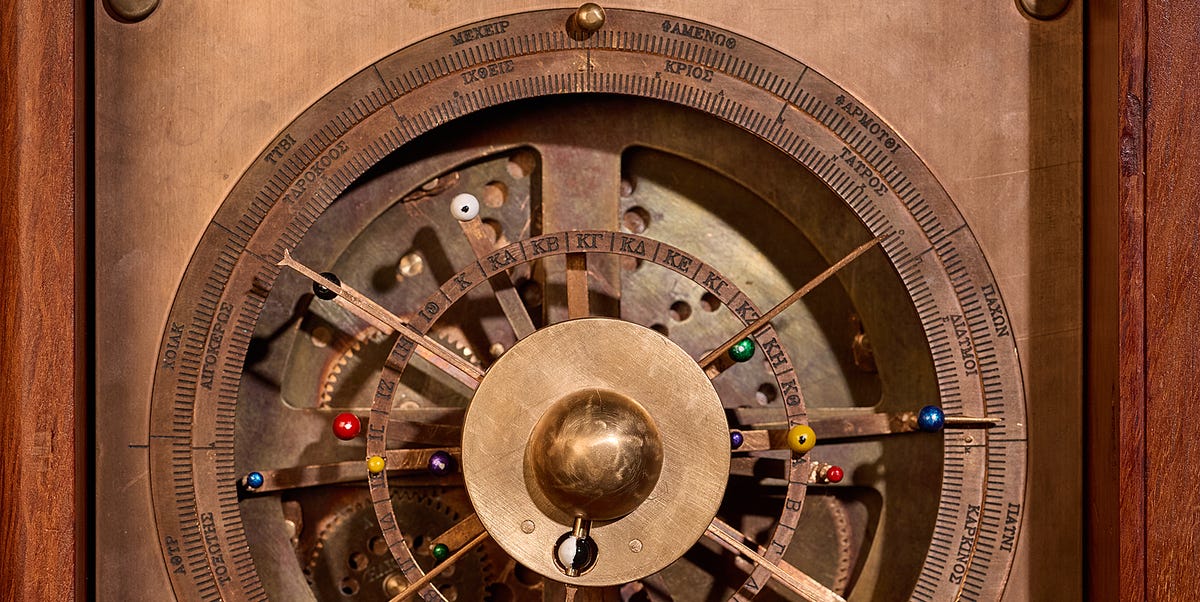

Imagine opening a wooden box roughly the size of a thick book, turning a small handle, and watching the ancient Greek universe move. The Moon changes phase. The Sun advances through the zodiac. Calendar dates slide into place. On the back, a pointer crawls along a spiral and marks months in which a solar or lunar eclipse may occur. No battery, screen, satellite, or “update available” notification is requiredonly bronze gears and a patient hand.
That extraordinary machine is the Antikythera mechanism, an ancient astronomical calculator recovered from a shipwreck near the Greek island of Antikythera. Built more than 2,000 years ago, it is widely described as the earliest known analog computer. Its surviving fragments reveal a device that translated mathematical cycles into mechanical motion, allowing a user to model the sky years or even decades ahead. It did not observe planets directly. Instead, it turned astronomical knowledge into a portable, gear-driven forecast of celestial behavior.
What Was the Antikythera Mechanism?
The wreck was discovered by sponge divers in 1900, and artifacts were recovered in 1901. Among statues, pottery, glassware, and other cargo were corroded bronze lumps that initially looked far less glamorous than the sculptures. In 1902, a visible gear drew attention to one fragment. The “lump” turned out to contain a dense mechanical system with finely cut teeth, engraved scales, pointers, and extensive Greek inscriptions. Today, the remains are divided into 82 fragments; only about one-third of the original device survives, including roughly 30 recognizable bronze gears.
The original mechanism was housed in a wooden case and operated by hand. Researchers generally date its construction to the Hellenistic period, probably during the second or early first century BCE. Calling it a computer does not mean it ran software in the modern sense. It was an analog computer because physical quantitiesgear rotations and pointer positionsrepresented mathematical quantities such as months, years, lunar phases, and planetary cycles. In other words, it calculated by moving metal.
How Bronze Gears Turned Mathematics Into a Moving Sky
A Handle Supplied the Input
A user likely set or turned the mechanism through a crank or knob. That motion rotated a large drive wheel, which transferred movement through trains of interlocking gears. Each pair of gears changed speed according to its tooth count. A gear with 60 teeth driving one with 30 teeth made the smaller gear rotate twice as fast. Combine many carefully chosen ratios, and the machine could reproduce relationships that took place over months, years, or decades.
This was the mechanism’s fundamental trick: astronomy contains repeating patterns. The lunar month repeats. The Moon’s phases repeat. Calendars can be coordinated through long cycles. Eclipses return in recognizable families. Planets appear to speed up, slow down, stop, and reverse against the stars, but those motions can be approximated through geometric models. The builder did not need to squeeze the actual sky into a box. The builder needed gear ratios that behaved like the sky.
A Mechanical Database of Ancient Astronomy
The machine also carried thousands of engraved characters. These inscriptions functioned partly as labels, partly as operating instructions, and partly as an astronomical handbook. Modern imaging has revealed references to the Sun, Moon, and the five planets visible without telescopes: Mercury, Venus, Mars, Jupiter, and Saturn. The mechanism was therefore more than a clockwork display. It combined calculation, visualization, and explanationthe ancient equivalent of a calendar app, planetarium, and user manual sharing one extremely crowded bronze case.
How the Device Predicted Eclipses
The Saros Cycle Did the Heavy Lifting
Eclipses do not happen every month because the Moon’s orbit is tilted relative to the apparent path of the Sun. An eclipse requires the Sun, Earth, and Moon to line up near one of the points where the Moon’s orbit crosses that path. Although the geometry is complicated, eclipse conditions repeat after a long interval known as the Saros cycle: approximately 223 synodic months, or about 18 years, 11 days, and 8 hours.
The lower rear dial of the Antikythera mechanism represented those 223 months on a four-turn spiral. Certain cells contained eclipse glyphs. As the pointer advanced, those markings told the user that a solar or lunar eclipse was expected during a particular month. Surviving inscriptions indicate that the glyphs could include the eclipse type and an estimated time. This was not a perfect local forecastan eclipse predicted by the cycle might not be visible from the user’s locationbut it was an astonishingly compact way to encode recurring celestial events.
The Exeligmos Corrected the Clock
The extra eight hours in a Saros cycle matter. After one Saros, a similar eclipse occurs roughly one-third of a day later, so Earth has rotated and the best viewing region shifts westward. The mechanism included a smaller dial associated with the Exeligmos, a cycle of three Saros periods, or about 54 years. After three repetitions, the eight-hour offsets add to a full day. A user could apply the dial’s correction when interpreting an eclipse time. It was a clever patch for a stubborn fractional dayproof that ancient engineers also had to deal with calculations that refused to land on tidy integers.
How It Modeled the Moon and Organized Time
The Moon Was Mechanically Complicated
The Moon does not move across the sky at a perfectly uniform rate. Its apparent speed changes because its orbit is not a perfect circle. The Antikythera mechanism reproduced this variation with an ingenious pin-and-slot arrangement linked to rotating gears. The system altered the Moon pointer’s speed during each orbit, providing a mechanical approximation of lunar anomaly. A small rotating sphere, probably painted light on one side and dark on the other, displayed the Moon’s changing phase.
The Metonic Dial Reconciled Solar and Lunar Calendars
The upper rear dial represented the Metonic cycle: 235 lunar months, which nearly equal 19 solar years. This relationship helped coordinate lunar months with the seasons. The dial’s five-turn spiral allowed a pointer to identify the current month within the long cycle. Related displays appear to have tracked other calendar corrections and a four-year cycle of major Greek athletic festivals. For ancient communities, those were not decorative extras. Calendars determined when to hold religious ceremonies, organize civic life, and celebrate games.
How It Tracked the Planets
The Front Face Presented a Geocentric Cosmos
The front of the mechanism probably displayed the Sun, Moon, and five known planets moving against rings for the zodiac and calendar. Like other Greek astronomical models of its era, it placed Earth at the center. That geocentric framework was scientifically incorrect as a description of the solar system, yet it could still model what observers saw from Earth with impressive usefulness.
Planetary motion posed a special challenge because planets sometimes appear to reverse directiona phenomenon called retrograde motion. Ancient astronomers represented these irregular paths using combinations of circles, often described through deferents and epicycles. A gear mounted on a rotating gear can imitate similar looping behavior. Pin-and-slot devices can also vary a pointer’s speed. In a tightly packed mechanism, those techniques could translate geometric astronomy into the wandering motions of individual planet indicators.
The Planetary Display Is a Reconstruction, Not a Solved Diagram
Most of the front gearing is missing, so researchers cannot simply open the case and copy the original arrangement. Inscriptions and surviving mechanical clues strongly indicate a planetary display, but the exact gear trains remain debated. A 2021 research model proposed nested coaxial tubes, compact gear systems, and period relationships derived from ancient Greek astronomy to show Mercury through Saturn on the front face. The model demonstrates that a workable planetary cosmos could fit within the device, but it should be understood as a well-supported reconstruction rather than the final word.
Why Build Such an Elaborate Machine?
The mechanism may have served several purposes at once. It could demonstrate astronomical cycles to students or elite audiences, help organize calendars, explore future celestial configurations, and display the prestige of its owner or maker. Eclipse predictions also carried cultural weight in societies where unusual events in the sky could be interpreted politically or religiously. Yet the surviving design suggests calculation and teaching, not magic. It presented eclipses as events arising from orderly cyclesa remarkably rational message in a world that could still find them terrifying.
Its craftsmanship also points to a broader technological tradition. A machine this sophisticated was unlikely to appear without predecessors, specialist workshops, mathematical tables, and experienced metalworkers. Those related devices may have been recycled, melted down, or lost because bronze was valuable. The Antikythera mechanism may be the lone survivor of a larger family rather than a one-time miracle.
How Researchers Recovered Its Secrets
For decades, corrosion hid gears and inscriptions inside the fragments. Early X-rays revealed that the object was far more complex than an ordinary calendar. Later radiography, surface imaging, and microfocus X-ray computed tomography allowed researchers to look through the bronze, separate overlapping gear structures digitally, and read letters buried beneath encrustation. A major 2005 imaging campaign transformed understanding of the rear dials and lunar gearing. Subsequent studies refined the eclipse scheme, calendar interpretation, and possible planetary display.
Reconstruction remains difficult because investigators are effectively reverse-engineering a crushed, incomplete machine from fragments that spent roughly two millennia underwater. Tooth counts may be uncertain. Plates are bent. Parts are missing. Even so, physical replicas and computer models act as experimental arguments: if a proposed design fits the surviving evidence and turns without colliding, it gains credibility. If the gears jam or require impossible craftsmanship, back to the drawing boardan ancient drawing board, admittedly, with considerably less coffee.
Experiencing the Antikythera Mechanism Today
First, Forget the Smartphone Comparison
Standing before the original fragments or a faithful reconstruction requires a mental reset. The corroded remains do not look like a sleek computer. They look like green-brown mineral slabs with hints of circles trapped inside them. The wonder arrives slowly, when you realize that each faint tooth once engaged another tooth and that the whole arrangement was designed to move as one coordinated argument about the cosmos.
A reconstruction makes that argument easier to feel. Turn the input gently and the dials respond at radically different speeds. A date pointer moves enough to notice. The Moon advances more quickly, while indicators tied to long cycles barely seem to shift. That contrast turns abstract time into a physical experience. A month, a year, 19 years, and 54 years occupy the same box, but the gears make each interval move at its own pace.
Then Watch an Eclipse Become a Calendar Event
The rear Saros dial changes the emotional character of an eclipse. Without a model, an eclipse can feel like a dramatic interruption: daylight fades, shadows sharpen, and the sky appears to break its own rules. On the mechanism, an eclipse becomes a marked cell in a repeating spiral. The effect is not to make the event boring. It makes the machine more impressive. Somewhere in the gear train, ratios connect ordinary monthly motion to a prediction almost two decades away.
Following the spiral also exposes the limits of prediction. The mechanism could identify likely eclipse months and estimate characteristics, but it could not provide a modern map of the path of totality. A user still needed interpretation, geographical knowledge, and perhaps prior observations. The experience resembles using an old nautical chart: the information is powerful, but the operator remains part of the system.
Planetary Motion Feels Like Mechanical Theater
On a full reconstruction, the front display is the showstopper. Planet indicators drift around the zodiac at unequal speeds. Some gain on the Sun, some lag behind, and outer planets occasionally reverse their apparent direction. Modern viewers know that planets orbit the Sun, yet the geocentric display still makes visual sense because it represents how their motion appears from Earth.
This is where the mechanism feels less like a calculator and more like mechanical theater. Hidden gears perform backstage while pointers act out the sky on the dial. The user sees a clean celestial story; inside, metal parts negotiate every irregularity. It is the same design principle found in modern technology: complexity is concealed so the interface can remain understandable.
The Most Memorable Experience Is Intellectual
The deepest reaction is not simply “ancient people were smart.” That statement is true but too comfortable. The mechanism forces a more specific realization: Hellenistic astronomers and craftspeople could coordinate theory, observation, arithmetic, geometry, engraving, and precision metalwork in one manufactured object. Their universe was different from ours, but their engineering method feels recognizablemodel the problem, encode the relationships, build a prototype, and make the output readable.
It also changes the usual story of technological progress. History is not a smooth staircase in which every invention survives and leads neatly to the next. Knowledge can disappear when workshops close, texts vanish, economies contract, or useful metal is recycled. Seeing the Antikythera mechanism is therefore both inspiring and unsettling. It shows what people achieved, and it hints at how much else may have been lost.
Conclusion: A Universe Small Enough to Turn by Hand
The Antikythera mechanism tracked eclipses and planets by converting astronomical cycles into gear ratios. Its rear dials organized lunar months, long calendar cycles, and eclipse predictions. Its front likely presented a moving geocentric cosmos containing the Sun, Moon, and five visible planets. The result was not an exact modern observatory, but a portable model that made the logic of the heavens visible.
More than 2,000 years later, the machine remains powerful because it joins imagination with discipline. Its maker looked at a sky full of wandering lights and asked a wonderfully ambitious question: can all of that motion be represented in bronze? The surviving fragments answer with a corroded but unmistakable yes.