
More than half a century after a sharply dressed passenger hijacked an airliner, collected $200,000, and parachuted into a stormy Washington night, the D.B. Cooper mystery still refuses to land. One tiny object may offer the best chance of identifying him: the inexpensive black clip-on tie he left aboard Northwest Orient Flight 305.
Researcher Eric Ulis sued the FBI in 2023 after the agency refused to let him arrange independent DNA testing of the tie. He argued that a small metal spindle inside its clip-on mechanism might hold skin cells overlooked during earlier examinations. Modern forensic methods, he believed, could potentially convert those cells into a genetic profile and finally put a real name to America’s most famous skyjacker.
There is, however, an important update to the headline: the court dismissed Ulis’s lawsuit in December 2023. The decision did not determine whether the tie contains useful DNA. Instead, it held that the Freedom of Information Act, or FOIA, gives the public access to government recordsnot physical evidence such as neckties. The scientific question therefore remains open, sitting in federal custody and wearing a $1.49 price tag.
The D.B. Cooper Hijacking in Brief
On November 24, 1971, a man identifying himself as Dan Cooper bought a one-way ticket from Portland, Oregon, to Seattle. The name “D.B. Cooper” resulted from an early reporting error, but it stuck so firmly that even the mystery’s alias has an alias.
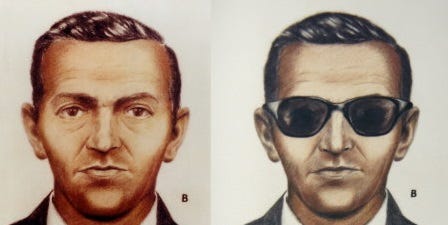
Cooper appeared to be in his mid-40s and wore a dark business suit, white shirt, and black tie. After ordering a bourbon and soda, he handed flight attendant Florence Schaffner a note stating that he had a bomb. He then demanded $200,000 in $20 bills, four parachutes, and a fuel truck waiting in Seattle.
Authorities supplied the ransom and parachutes. Cooper released the 36 passengers when the Boeing 727 landed at Seattle-Tacoma International Airport, but he kept several crew members aboard. He ordered the pilots to head toward Mexico City while flying low and slow with the rear stairway available for use.
Shortly after 8 p.m., Cooper apparently lowered the rear stairs and jumped over southwestern Washington with the ransom strapped to him. He vanished despite an enormous investigation, extensive ground searches, and the examination of hundreds of suspects. No body, parachute, or confirmed personal possession carried away by Cooper has ever been recovered.
In 1980, an eight-year-old boy found $5,800 in deteriorating $20 bills along the Columbia River. The serial numbers matched the ransom, but the discovery raised almost as many questions as it answered. It did not reveal whether Cooper survived, where he landed, or how the money reached the riverbank.
Why D.B. Cooper’s Tie Matters
The clip-on tie was discovered on Cooper’s seat after the hijacking. Unlike the aircraft cabin, which had been occupied by passengers, crew members, investigators, and maintenance workers, the tie was an item Cooper had deliberately worn. That gives it an unusually direct relationship to the unknown hijacker.
Investigators previously recovered DNA from the tie, and the FBI has publicly described it as providing a DNA sample. The scientific value of that material is uncertain, however. Reporting on earlier tests indicates that the tie carried multiple DNA contributors, and investigators could not establish that any particular profile belonged to Cooper.
A tie can collect genetic material from its owner, a store employee, another wearer, a dry cleaner, an evidence technician, or anyone who handled it without modern contamination controls. In other words, finding DNA is the easy part. Proving whose DNA it is can turn the laboratory into a microscopic version of an overcrowded airport terminal.
The Untested Spindle Theory
Ulis focused on the tie’s spindle apparatus, a small metal component concealed within the clip-on mechanism. He reasoned that Cooper may have touched this protected area while putting on or adjusting the tie. Because the spindle is less exposed than the fabric, it might contain skin cells from the wearer while carrying fewer environmental contaminants.
In his FOIA request, Ulis sought limited access to the tie so a laboratory could attempt to obtain a complete genetic sequence from material on the spindle. He offered to pay for the testing himself. After the FBI denied the request, he filed Ulis v. Federal Bureau of Investigation in the U.S. District Court for the District of Columbia.
The theory is scientifically plausible, but it remains unproven. Touch DNA can persist on metal, and contemporary laboratories can sometimes analyze remarkably small samples. Yet a protected surface is not automatically a pristine one. The spindle could contain too little material, degraded DNA, mixtures from several people, or cells deposited long after Cooper handled the tie.
Why the Court Dismissed the FBI Lawsuit
On December 13, 2023, the court ruled that FOIA did not require the FBI to provide access to the necktie. Federal law obligates agencies to disclose qualifying records in reproducible formats. A physical object that cannot be copied or reproduced in the ordinary sense does not become a record simply because it might reveal valuable information.
The court compared the request with earlier cases involving bullets, weapons, and clothing connected to President John F. Kennedy’s assassination. Courts had determined that those tangible objects were outside FOIA’s definition of an agency record. If historically significant assassination evidence did not qualify, the judge reasoned, Cooper’s necktie did not qualify either.
This distinction is crucial: Ulis did not lose because a judge found his DNA theory foolish or scientifically impossible. The lawsuit failed because FOIA was the wrong legal key for opening the evidence locker. The ruling addressed access to the object, not what a laboratory might discover on it.
Could Modern DNA Testing Identify D.B. Cooper?
Potentiallybut “could” is doing some heavy lifting.
Early forensic DNA testing often focused on short tandem repeats, or STRs, used to compare a crime-scene profile with a known person or a profile in a law-enforcement database. Modern sequencing can sometimes recover information from smaller, older, or more complicated samples. Specialized methods may also help separate mixed genetic material from multiple contributors.
If analysts obtained a sufficiently complete single-source profile, investigators could compare it with DNA from a credible suspect or that person’s relatives. A suitable single nucleotide polymorphism, or SNP, profile might support investigative genetic genealogy, the technique that has helped solve numerous cold cases by identifying relatives in permitted genealogy databases.
That process would not instantly print “D.B. Cooper” on a laboratory screen. Genealogists would need to construct family trees, narrow the candidates by age and location, examine their employment and travel histories, and confirm the conclusion with additional DNA. Database rules, privacy policies, legal authorization, and law-enforcement procedures would also shape what testing is permitted.
What a Credible DNA Breakthrough Would Require
| Required Step | Why It Matters | Primary Limitation |
|---|---|---|
| Recover usable DNA | Creates material for sequencing | The sample may be degraded or extremely small |
| Separate contributors | Helps isolate a possible wearer’s profile | Several people may have touched the tie |
| Establish relevance | Connects the profile to the hijacker | DNA on the tie is not automatically Cooper’s |
| Identify a candidate | Provides a real person for investigation | Genealogical matches can point to many relatives |
| Obtain confirmation | Tests the proposed identification independently | A reference sample may no longer exist |
| Corroborate the story | Links DNA findings with historical evidence | Genetics alone cannot reconstruct the hijacking |
Earlier DNA Results Did Not Solve the Case
The tie’s partial DNA evidence has already been used in at least one highly publicized comparison. In 2011, DNA associated with the tie did not match a sample from the daughter of suspect Lynn Doyle Cooper. An FBI spokesperson cautioned that the result did not conclusively eliminate him because the agency could not prove that the tested tie DNA came from the hijacker.
That episode illustrates the central problem. A non-match matters only if investigators know the evidence profile belongs to the offender. If the DNA came from a previous owner, retailer, or evidence handler, comparing it with a suspect’s relative may eliminate the wrong personor eliminate nobody at all.
Fingerprints were also recovered from the airplane, but investigators could not definitively attribute a usable print to Cooper. The cigarette butts he smoked during the flight were collected but later lost or destroyed, removing what might have been an excellent source of saliva DNA. In cold-case terms, that was the forensic equivalent of throwing away a winning lottery ticket before checking the numbers.
Microscopic Particles Add Another Layer to the Mystery
DNA is not the only reason researchers consider the tie important. Scientific examination has identified thousands of microscopic particles, including titanium and unusual metal combinations. Citizen researchers have argued that these materials may connect Cooper to aerospace manufacturing, advanced metalworking, electronics, or a specialized industrial laboratory.
Ulis has explored whether certain titanium and stainless-steel particles could be associated with Crucible Steel, a Pennsylvania company that supplied specialized materials to Boeing. He publicly identified metallurgist Vince Petersen as a person of interest based partly on that industrial theory. Petersen’s family has disputed the suggestion, and no law-enforcement agency has identified him as Cooper.
The particles are intriguing occupational clues, not genetic fingerprints. Contaminants can travel between workplaces, clothing, stores, and households. A rare particle may narrow possibilities, but it cannot prove who wore the tie on November 24, 1971. Responsible reporting must keep “interesting hypothesis” and “solved case” in separate overhead compartments.
What About Richard McCoy and Other Suspects?
Richard Floyd McCoy Jr. remains one of the best-known D.B. Cooper suspects. Less than five months after the Cooper hijacking, McCoy carried out a similar parachute escape from a Boeing 727 after demanding ransom money. He was arrested, convicted, escaped from prison, and died in a confrontation with federal agents.
The FBI historically rejected McCoy as Cooper because flight attendants’ descriptions did not match him and investigators found other inconsistencies. In late 2024, McCoy’s adult children generated new attention by claiming that their father was Cooper and presenting a modified parachute rig found among family belongings. Those claims renewed public interest, but no publicly verified DNA result has established McCoy as the hijacker.
Many other men have been proposed over the decades, including military veterans, pilots, engineers, criminals, and people whose relatives remembered suspicious Thanksgiving behavior. Some theories contain remarkable coincidences. None has satisfied the combined demands of reliable forensic evidence, eyewitness consistency, documentary history, and independent verification.
Current Status of the D.B. Cooper DNA Question
The FBI redirected resources away from the active NORJAK investigation in 2016 after reviewing an enormous number of leads. The agency said it would still consider specific physical evidence connected to the parachutes or ransom money. It has also continued adding historical Cooper records to its public Vault, including a substantial release reported in 2026.
As of July 24, 2026, no authoritative public announcement has confirmed that investigators recovered a complete, single-source DNA profile from the tie spindle. No court ruling has ordered independent testing, and no named suspect has been conclusively identified through DNA.
That leaves the story in an unusual position. The lawsuit is over, but the scientific proposal behind it remains unresolved. The tie might contain the genetic clue researchers hope foror it might hold only a hopeless cocktail of handlers, shoppers, investigators, and one very mysterious bourbon drinker.
Conclusion: The Tie Could Help, but DNA Must Earn the Verdict
Eric Ulis’s lawsuit did not unlock D.B. Cooper’s DNA or force the FBI to release the famous tie. It did, however, spotlight a legitimate cold-case question: could modern forensic technology extract information that earlier testing missed?
A strong DNA profile from a protected part of the tie could transform the investigation. It might exclude suspects, identify relatives, or lead researchers toward Cooper’s real family. But DNA becomes meaningful only when its source is established and the result is supported by flight records, employment history, witness evidence, and other independent facts.
The most accurate verdict is therefore less cinematic than “case solved.” Modern testing offers a promising path, not a guaranteed destination. Until the spindle is examined under appropriate forensic conditionsor another piece of definitive evidence appearsD.B. Cooper remains somewhere between history, science, and America’s most durable disappearing act.
Experience-Based Lessons for Following the D.B. Cooper Case
Following developments in a famous cold case can feel like standing beside an airport arrivals board where every flight says “delayed.” A new suspect appears, a documentary promises answers, and a microscopic clue briefly becomes the most important particle in America. Then uncertainty returns. The experience is exciting, but readers need a practical way to separate genuine progress from an attractive headline.
Start With What the Claim Actually Says
“DNA was found,” “a DNA profile was developed,” and “DNA identified the offender” describe three very different achievements. The first means biological material was detected. The second means analysts recovered enough genetic information for some form of comparison. Only the third connects the evidence to a person with adequate scientific and investigative support.
In the Cooper case, the first two concepts have often been compressed into the third. The tie produced DNA, but investigators have warned that they do not know whether the relevant sample belonged to Cooper. When reading a new report, look for the sample’s location, quality, number of contributors, laboratory method, and chain of custody.
Treat Lawsuits and Scientific Tests as Separate Events
Ulis’s court case is a useful example. A person may have an interesting scientific proposal and still lose a lawsuit for procedural reasons. The court did not test the spindle, evaluate laboratory protocols, or declare that useful DNA could not exist. It decided that a necktie was not a reproducible agency record covered by FOIA.
Readers commonly interpret a legal defeat as proof that the underlying theory failed. Here, it means only that this particular access strategy failed. Understanding that distinction prevents both exaggerated disappointment and exaggerated claims that the government is hiding a solved case.
Use a Three-Layer Evidence Test
A persuasive identification should work on three levels. First comes forensic evidence, such as DNA, fingerprints, or ransom currency. Second comes documentary evidence, including employment records, travel history, military service, addresses, and access to aviation knowledge. Third comes behavioral and eyewitness evidence: appearance, voice, habits, planning, and actions aboard the plane.
A suspect who fits only one layer is a lead, not a solution. An aerospace employee might explain metal particles but not the genetic evidence. A relative’s dramatic memory may fit the timeline but lack physical corroboration. A DNA match could identify someone who touched the tie without proving that person hijacked the aircraft.
Be Careful With Named Suspects
Most prominent Cooper suspects are deceased and cannot answer allegations. Their families may face unwanted attention whenever a new theory circulates. That makes precise language essential. “Person of interest proposed by a private researcher” is not interchangeable with “the man who was D.B. Cooper.”
Readers should favor reports that acknowledge contrary evidence, identify who is making each claim, and explain whether law enforcement has verified it. A theory becomes more credible when its advocate openly discusses weaknesses. Certainty performed for a camera is still performance.
Expect Science to Narrow the Mystery Before Solving It
The most realistic initial benefit of new testing may be exclusion. A reliable profile could show that certain suspects did not contribute DNA to the tie. Mixed-DNA analysis could reduce the number of possible contributors, while particle analysis might refine the range of occupations associated with the wearer.
That incremental progress may sound less thrilling than an instant identification, but careful elimination is how difficult investigations move forward. If the Cooper mystery is ever solved, the final answer will probably emerge from several modest findings that reinforce one anothernot from a laboratory machine flashing the word “Bingo.”
The best experience for anyone exploring this case is therefore one of informed curiosity. Enjoy the theories, examine the evidence, and keep a seat belt fastened whenever a headline promises that the mystery will be solved next Tuesday.
Research basis
This article was cross-checked against reporting and public records from the FBI, U.S. Government Publishing Office, Department of Justice Office of Information Policy, Popular Mechanics, KING 5, ABC News, CBS News, TIME, HISTORY, FOX 13 Seattle, People, Courthouse News Service, and The FOIA Project.