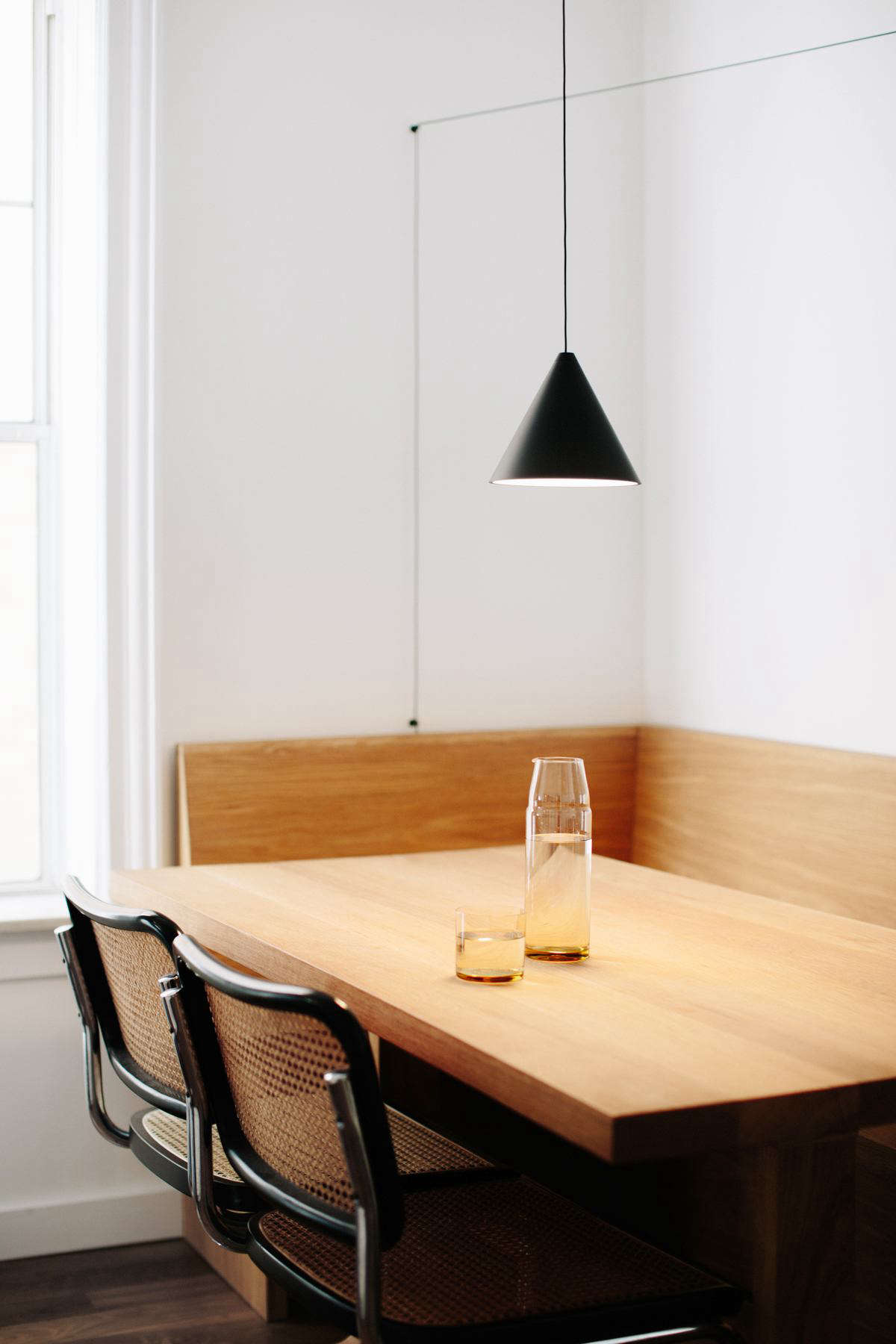

Some chairs politely occupy a room. The Cesca Chair – Armless changes the room’s entire personality while appearing to occupy almost no space at all. Its slim tubular-steel frame traces a bright, continuous line below warm wood and woven cane, creating a seat that feels industrial, handcrafted, nostalgic, and modern at the same time.
Designed by Marcel Breuer in 1928 and originally identified as the B32, the armless Cesca chair emerged from a period when designers were enthusiastically questioning everythingincluding whether a chair really needed four legs. Nearly a century later, it remains equally comfortable in a minimalist apartment, a traditional dining room, a creative studio, or a café where someone has been “finishing one email” for forty-five minutes.
This guide explores the chair’s history, materials, comfort, dimensions, styling possibilities, maintenance needs, and the important differences between an authentic Cesca and the countless Cesca-style chairs inspired by it.
What Is an Armless Cesca Chair?
The armless Cesca is a cantilevered side chair composed of three visually distinct elements: a bent tubular-steel base, a wooden seat-and-back frame, and woven cane panels. Instead of resting on two front legs and two rear legs, the chair’s steel frame runs beneath the seat and bends upward at the front. The sitter’s weight is supported by the strength and controlled flexibility of this continuous structure.
An original 1928 example in the Museum of Modern Art’s collection is made from chrome-plated tubular steel, wood, and cane. MoMA records its design under the name Cesca Side Chair, model B32, confirming both the chair’s historic materials and its place within modern design history.
The authentic current armless model produced by Knoll measures approximately 31.5 inches high, 18.5 inches wide, and 23.5 inches deep, with a seat height of 17.75 inches. At about 14 pounds, it is relatively easy to move around a dining table without requiring the upper-body commitment of relocating a small refrigerator.
The Bauhaus Story Behind the Cesca Chair
Marcel Breuer and the search for lighter furniture
Marcel Breuer studied at the Bauhaus and became head of its carpentry workshop in 1925. The school encouraged designers to unite art, craft, architecture, and industrial production. By the early 1920s, its teaching was increasingly focused on creating practical objects that could be manufactured efficiently rather than reserved for wealthy collectors or one-of-a-kind interiors.
Breuer became fascinated by tubular steel after noticing the strength and lightness of his bicycle. The material was already useful in transportation and industry, but household furniture was still dominated by heavy wooden frames, thick upholstery, and enough carved ornament to keep a dust cloth permanently employed.
His earlier Wassily Chair demonstrated how steel tubing could create open, lightweight furniture. With the B32, later called the Cesca, Breuer softened that machine-age vocabulary by introducing familiar wood and woven cane. The result was less severe than his all-steel experiments and easier to imagine around an everyday table. The Cooper Hewitt Smithsonian Design Museum identifies the B32 as one of Breuer’s best-known tubular-steel designs from his Bauhaus period.
Who invented the cantilever chair?
The Cesca is often described as revolutionary, but Breuer did not invent the basic cantilever-chair concept alone. Dutch architect Mart Stam developed an early chair without rear legs, while Ludwig Mies van der Rohe created his own more elastic interpretations. Breuer’s major contribution was refining the concept into an especially practical and visually balanced combination of tubular steel, bentwood, and cane. Dwell notes that questions of invention and authenticity have followed the B32 since its earliest years.
In other words, modernist designers were passing around the idea of the cantilever chair like an unusually productive group project. Breuer’s version became one of the most enduring because it joined engineering innovation with materials people already associated with comfortable homes and cafés.
From B32 to “Cesca”
The chair was initially manufactured by Gebrüder Thonet and known by its model number, B32. Its later name honors Breuer’s daughter, Francesca, whose nickname was Cesca. Italian manufacturer Gavina produced the design during the mid-20th century, and Knoll assumed production after acquiring Gavina in 1968.
The warmer name helped transform an industrial-sounding model number into a recognizable design identity. “B32” sounds like something assigned to an airport gate. “Cesca” sounds like the sophisticated guest who arrives at dinner wearing excellent shoes and somehow knows the architect who renovated the restaurant.
Why the Armless Version Remains So Popular
A visually light silhouette
The armless Cesca chair has very little visual mass. Light passes through the cane, around the steel frame, and beneath the suspended seat. In a small dining space, that transparency can make the room feel less crowded than it would with solid upholstered chairs or broad wooden armchairs.
Removing the arms also keeps the silhouette clean and narrow. Several chairs can sit around a table without creating a defensive perimeter of projecting armrests. They slide in easily, allow guests to enter from either side, and work with tables that have aprons or limited clearance.
Industrial and natural materials in one design
Many modern chairs commit fully to either industry or craft. The Cesca refuses to choose. Its chrome-plated steel reflects light and communicates mechanical precision, while the beechwood frames and woven cane provide warmth, texture, and subtle variation.
That contrast helps the chair move between decorating styles. It can look appropriately disciplined in a Bauhaus-inspired interior but equally convincing beside an antique farm table. Architectural Digest describes the design as a fusion of Breuer’s tubular-steel interests with Thonet’s established bentwood and cane traditions.
The gentle movement of a cantilever seat
A well-made cantilever chair is not completely rigid. The steel frame flexes slightly as the sitter shifts weight, producing a subtle spring rather than a rocking motion. This controlled movement is one reason the Cesca can feel more forgiving than its slim appearance suggests.
The woven back also distributes pressure across a broad area. Food & Wine has highlighted seating inspired by the armless Cesca for its supportive and accessible form, noting that the design can accommodate a wide variety of diners comfortably.
However, the chair remains an upright dining seat rather than a lounge chair. It is designed for meals, conversation, desk work, and similar activitiesnot for curling into the posture of a sleepy house cat.
Materials and Construction
Tubular-steel frame
The continuous steel base gives the Cesca its recognizable outline. On classic versions, polished or chrome-plated steel creates a reflective surface that looks elegant without becoming ornamental. Some authorized contemporary variations also use powder-coated finishes for a softer or more graphic appearance.
The quality of the bends and joins matters. A good frame should appear smooth and deliberate, sit evenly on the floor, and remain stable when pressure is applied. Uneven tubing, rough welds, flaking finishes, or a chair that rocks on a level surface can indicate poor construction or damage.
Beechwood seat and back frames
Beech is commonly used because it is strong, workable, and well suited to furniture production. Natural finishes emphasize its pale warmth, while darker or ebonized versions provide stronger contrast against the cane and metal.
The wooden frames prevent the chair from feeling overly mechanical. They also provide secure borders for the woven panels, visually dividing the design into clear geometric planes.
Woven cane
Cane comes from the outer portion of the rattan plant and is woven into an open pattern that allows air and light to pass through. Properly tensioned cane feels firm but responsive. Over time, it may gradually darken, developing a patina that many vintage-furniture buyers find appealing.
Cane is durable under normal use, but it dislikes sharp impacts, excessive dryness, standing moisture, and concentrated pressure. Kneeling on the seat, placing heavy boxes on it, or letting children use it as the launching platform for an indoor space program can shorten its life considerably.
Cesca Chair – Armless Versus the Armchair
The armless side chair is about five inches narrower than the current Knoll armchair. Both versions share similar overall height, depth, and seat height, but the armed model measures approximately 23.5 inches wide and includes arms about 27 inches above the floor.
The armless Cesca is generally the more flexible choice for dining rooms and compact spaces. It fits beneath more tabletops, allows easier side entry, and creates a cleaner rhythm when used in a set. It can also serve as a desk chair, bedroom chair, or occasional seat without visually dominating the area.
The armchair offers additional support and a more substantial presence. It may work well at the head of a dining table, in a reading corner, or as an occasional chair. One effective arrangement is to use armless Cesca chairs along the sides of a rectangular table and armchairs at each end.
How to Style an Armless Cesca Chair
Pair it with a wood dining table
A solid wood table brings out the warmth of the chair’s beech and cane while allowing the steel base to add contrast. Oak, walnut, maple, and even rustic reclaimed wood can work. The table does not need to be modern; in fact, the tension between an older table and streamlined Cesca chairs often makes both elements look more interesting.
Use it with stone or glass
Travertine, marble, and glass tables emphasize the chair’s sculptural form. A round pedestal table is particularly effective because it leaves the cantilever bases visible rather than trapping them in a forest of table legs.
Mix rather than match
A complete set creates an orderly, architectural appearance, but a single Cesca can also join a mixed collection of dining chairs. Its open construction prevents it from looking heavy beside upholstered, spindle-back, or molded chairs.
For a calmer arrangement, repeat one element across the group. That connection might be black finishes, natural cane, pale wood, chrome accents, or similar seat heights. The chairs do not have to be identical; they merely need to look as though they have met before.
Add contrast through textiles
The Cesca looks sharp against soft materials such as wool rugs, linen curtains, boucle upholstery, and relaxed tablecloths. These textiles prevent a chrome frame from feeling cold. A thin removable seat pad can add cushioning, although it should fit correctly and avoid hiding the cane’s graphic pattern.
Authentic Cesca Chairs and Cesca-Style Copies
The Cesca is among the most widely imitated modern chairs. As a result, listings frequently use phrases such as “Breuer chair,” “Bauhaus cane chair,” or “Cesca-style dining chair” for products that were not manufactured under the original authorization.
This does not automatically mean a copy is unusable. A well-built inspired chair may offer good value. The important issue is accurate representation. A seller should not market a reproduction as an authentic Knoll, Gavina, or Thonet example.
Current authorized Knoll examples carry identifying marks, including the KnollStudio logo and Breuer’s signature. Vintage Thonet or Gavina chairs may have manufacturer labels or stamps beneath the seat or along the frame. Because labels can disappear and parts can be replaced, authentication may require examining construction details, age, provenance, hardware, and documentation together.
What to inspect when buying vintage
- Cane condition: Look for broken strands, sagging, cracks, holes, or sections pulling away from the wooden frame.
- Frame alignment: Place the chair on a level surface and check whether it sits evenly.
- Rust and pitting: Inspect the underside, floor-level bends, joints, and screw locations.
- Loose components: Gently test the seat and back without forcing them.
- Wood damage: Check for splits, poor refinishing, chipped veneer, or repairs around mounting points.
- Identification: Photograph every stamp, label, signature, screw, and underside detail before purchasing remotely.
Cracking or sagging cane, rusted frames, loosened panels, and discoloration are among the common problems found on secondhand examples. These issues do not always make a chair unworthy of restoration, but repair costs should be considered before the bargain price starts playing heroic music in your head.
Cleaning and Caring for the Chair
Dust the cane regularly with a soft brush, microfiber cloth, or low-suction vacuum attachment. Wipe the wood with a lightly damp cloth and dry it promptly. Avoid saturating the woven panels, since prolonged moisture can affect both the cane and its tension.
Clean chrome gently with a nonabrasive cloth. Harsh scouring pads may scratch the finish, while aggressive chemical cleaners can create unevenness or damage surrounding materials. Any cleaner should be tested in an inconspicuous area first.
Indoor humidity matters. Extremely dry air can make natural cane brittle, while damp conditions encourage swelling, staining, corrosion, or mildew. Keep the chair away from heating vents, persistent direct sunlight, and outdoor exposure unless a specific model is explicitly approved for those conditions.
Lift the chair instead of dragging it. The armless version is light enough that this is rarely difficult, and your floors will appreciate being excluded from an argument with a steel frame.
Is the Armless Cesca Chair Worth It?
For buyers who value design history, visual lightness, flexible styling, and long-term relevance, the authentic Cesca offers more than an attractive profile. It represents a significant moment when furniture designers brought industrial materials into domestic life without completely abandoning craft.
The chair is not ideal for everyone. Natural cane requires more care than molded plastic, and people who prefer deep padding may want an upholstered variation. Authentic examples also command premium prices because of their authorized production and design status.
Still, few dining chairs combine this much history with such an adaptable appearance. Breuer’s early furniture remains in production and continues to appear in contemporary homes because its forms are both distinctive and remarkably easy to live with.
Living With an Armless Cesca Chair: A Realistic Ownership Experience
The first thing most people notice when introducing an armless Cesca chair into a room is not the chair itself but the additional space that seems to appear around it. Replace a bulky upholstered dining chair with a Cesca and the table suddenly looks less crowded. The floor becomes more visible, sightlines open, and even a modest breakfast corner gains a little architectural confidence.
During daily use, the cantilever action is subtle. Sitting down produces a small amount of responsive movement, especially when compared with a conventional four-legged wooden chair. It does not bounce dramatically, but it avoids the completely immovable sensation of a rigid frame. After a few meals, that flexibility feels normal; returning to a stiff chair can make the old seat seem oddly serious.
The armless design proves particularly practical during busy dinners. Guests can turn, reach, and stand without negotiating around side supports. When the table is not in use, the chairs slide inward neatly, keeping narrow walkways clear. The 18.5-inch width is helpful in apartments where every inch already has a job and may be demanding overtime.
Cane also changes the temperature of the seating experience. Unlike a solid plastic or fully upholstered back, the open weave allows air to circulate. That can be pleasant during long meals or in warmer rooms. The texture remains supportive without pressing a single hard surface against the body.
On the other hand, the seat communicates immediately when someone mistreats it. Standing on the cane, dropping a heavy object onto it, or kneeling in the center feels obviously unwise. Owners quickly develop the habit of treating the chair as furniture rather than emergency scaffolding. Households with young children may need to explain this distinction more than once.
Cleaning is generally easy as long as spills are handled promptly. Crumbs occasionally settle into the woven openings, where they wait with the confidence of tenants protected by a strong lease. A soft brush or vacuum attachment removes them without much effort. The chrome frame shows fingerprints more readily than matte wood, but a quick wipe restores its shine.
The chair is also surprisingly useful outside the dining room. At a desk, it provides an upright posture suitable for shorter work sessions. In a bedroom, it holds clothing with considerably more dignity than the average exercise bike. In an entryway, its open frame offers a place to sit without blocking the visual width of the hall.
Stylistically, the Cesca rarely demands that the rest of the room become strictly modernist. Beside an old wooden cabinet, it looks fresh. Under a paper lantern, it feels relaxed. Against colorful art, it becomes a quiet supporting character. Near chrome lighting and glass, it appears crisp and intentional. This ability to cooperate with different periods is one of the strongest arguments for living with it long term.
The most satisfying ownership experience comes from accepting the chair’s materials rather than expecting them to remain frozen in showroom condition. Natural cane may darken slightly. Wood may develop small signs of use. Chrome needs occasional polishing. These changes are not necessarily defects; they can become evidence that a historic design is participating in an actual home rather than posing permanently for a catalog photograph.
Ultimately, the armless Cesca feels light without being anonymous, famous without being difficult, and refined without losing its usefulness. It can make an ordinary dining table look considered, but it still performs the basic assignment Breuer gave it in 1928: support a human body with as little visual and physical material as possible. That is an impressive amount of work for a chair with no rear legs.
Editorial note: Dimensions, markings, finishes, and construction details can differ among authorized contemporary chairs, vintage productions, restored examples, and Cesca-inspired reproductions. Verify specifications and provenance with the manufacturer or seller before purchasing.