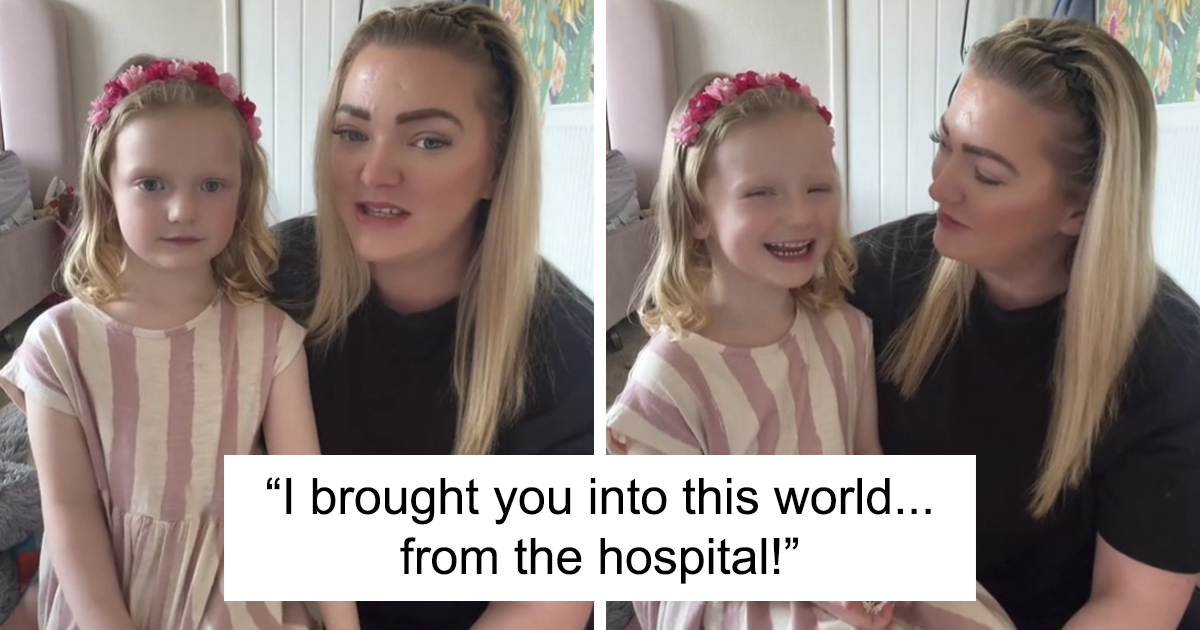

Children are famously unpredictable. Ask one what they want for dinner, and they may request pancakes, noodles, and a single cucumber shaped like a dinosaur. Ask them to complete an old-fashioned parenting threat, however, and their answers can reveal something surprisingly profound about the emotional world in which they are growing up.
That is what made the viral “toxic parenting sentences” trend so compelling. Parents began familiar phrases such as “I brought you into this world…” or “I’ll give you something to…” and invited their children to supply the ending. Adults who grew up hearing threats, shame, or humiliation already knew the traditional conclusions. Many of the children did not. Instead, they imagined snacks, hugs, encouragement, chores, and declarations of love.
A 2025 viral roundup collected 35 of these tender, funny, and occasionally chaotic responses. The clips were not scientific experiments, but they offered a memorable glimpse into how family language can shape expectations. When children automatically assume that a parent’s unfinished sentence will end safely, their answers suggest that warmthnot intimidationhas become their emotional default.
Why the Children’s Answers Feel So Powerful
The trend works because the adults and children are participating in two completely different games.
Many adults hear the opening of an old parenting phrase and immediately recall the original threat. “Stop crying before I…” already has a grim conclusion stored in their memories. The sentence may bring back a kitchen table, an angry voice, a slammed door, or the feeling that love could disappear whenever they became inconvenient.
The children, meanwhile, hear only a blank space. They fill that space with material drawn from their own lives. A child who regularly receives reassurance may expect, “I brought you into this world because I wanted to love you.” A child accustomed to practical caregiving might complete “I’ll give you something to…” with “eat,” “play with,” or “put away.” Their answers may be silly, but the assumptions beneath the silliness are serious.
In a later viral example, one mother asked her 8- and 10-year-old children to complete several phrases she remembered from childhood. When she said, “I’ll give you something to…,” they suggested “snack on” and “put away.” When she began, “I brought you into this world…,” they answered with ideas about being loved and special. The mother became emotional because her children could not imagine the cruel endings that had once seemed normal to her.
What “The Power of Nurture” Really Means
Nurture is not a magic spell that allows parents to manufacture a child’s personality. Children arrive with different temperaments, sensitivities, abilities, and needs. Genetics, peers, schools, neighborhoods, culture, economic conditions, and chance also influence development.
Still, a child’s daily relationships matter enormously. The words adults repeat become part of the environment in which children learn what to expect from other peopleand eventually what to expect from themselves.
Children Learn the Emotional Meaning of Conversation
Early development is built through repeated back-and-forth interaction. When a child gestures, speaks, cries, or shows excitement and a caregiver responds attentively, the exchange supports language, social development, and emotional well-being. Harvard’s Center on the Developing Child describes this process as “serve and return”: the child initiates contact, and the adult responds in a way that keeps the relationship moving.
These exchanges do not need to resemble a parenting seminar conducted beside a tasteful basket of wooden toys. They happen while tying shoes, driving to school, cleaning spilled juice, and answering a 4-year-old’s 700th question about worms.
A child who repeatedly experiences calm responses learns that communication is useful. A child who is mocked, ignored, or threatened may learn that speaking honestly is risky. The sentence-finishing trend is touching because the children appear to expect communication to lead toward connection rather than punishment.
Children Copy More Than Vocabulary
Children imitate the behavior they observe. They copy tone, facial expressions, methods of handling frustration, and ways of talking about mistakes. Parents may instruct children to “use kind words,” but the lesson loses some sparkle when delivered through clenched teeth at maximum volume.
Psychological modeling refers to learning through observation and imitation. Parents are among a child’s earliest and most influential models, which means that everyday conduct can teach as powerfully as explicit rules. Children who see adults apologize, regulate anger, and solve disagreements respectfully receive a practical demonstration of those skills.
This is one reason family language can travel across generations. Adults often discover old phrases exiting their own mouths before their better judgment has found its shoes. Breaking the pattern requires noticing it, stopping it, and practicing a replacement often enough for the new language to become automatic.
Repeated Words Can Become an Inner Voice
A single impatient sentence does not define an entire childhood. Parents are human beings, not emotionally flawless customer-service robots. The concern is repetition: chronic insults, contempt, humiliation, or predictions of failure can teach children to interpret mistakes as evidence that something is wrong with them.
Research has associated parental verbal aggression with poorer self-esteem, psychosocial difficulties, and other adverse outcomes. A systematic review of childhood verbal abuse studies also found links with a range of later mental and physical health problems, although individual outcomes differ and observational evidence cannot prove that every harsh phrase produces a particular result.
The healthier alternative is not nonstop applause. Telling a child that every scribble belongs in the Louvre is neither necessary nor especially convincing. Helpful feedback separates the person from the behavior: “Throwing the toy was not safe” is different from “You are a terrible child.” One teaches a limit. The other turns a mistake into an identity.
Positive Parenting Does Not Mean Permissive Parenting
Whenever compassionate parenting appears online, someone inevitably announces that kindness will produce a generation unable to survive delayed Wi-Fi. This confuses emotional safety with the absence of standards.
Positive parenting includes rules, consequences, responsibility, and correction. The difference is that discipline is used to teach rather than humiliate. The American Academy of Pediatrics recommends reinforcing appropriate behavior, setting expectations, redirecting children, and establishing limits instead of relying on threats, insults, shaming, or physical punishment.
A parent can be warm and firm at the same time:
- “I understand that you are angry, but you may not hit.”
- “You do not have to like the rule. You still have to follow it.”
- “The tablet is finished for today. You may choose a book or help me cook.”
- “You made a mistake. Let’s figure out how to repair it.”
These statements recognize emotion without surrendering authority. The parent remains in charge, but the child is not required to feel frightened or ashamed in order to learn.
Replacing Toxic Parenting Phrases With Useful Language
Many old sayings were designed to end a conflict quickly. They may produce obedience in the moment, but they rarely teach the skill a child needs next time. More constructive language describes the problem, sets a limit, and gives the child a path forward.
Instead of “Stop crying, or I’ll give you something to cry about”
Try: “You are allowed to cry. When you are ready, tell me what happened.”
This does not reward misbehavior. It simply distinguishes emotion from action. A child can be sad while still being expected to clean up, apologize, or accept a consequence.
Instead of “Because I said so”
Try: “The answer is no because this is not safe. I know you are disappointed.”
Parents do not owe a courtroom-length argument for every decision. A short explanation, however, helps children understand that limits have reasons.
Instead of “You’re too sensitive”
Try: “That affected you strongly. Let’s talk about what you need.”
Sensitivity is not a disciplinary offense. Children still need coping skills, but those skills are easier to learn when feelings are acknowledged instead of mocked.
Instead of “You’ll never be good enough”
Try: “This is difficult, and you are still learning. What strategy should we try next?”
Feedback works best when it directs attention toward effort, decisions, and improvement. Research summarized by the American Psychological Association found that praise focused on fixed personal qualities can backfire after failure, particularly for children with low self-esteem. Specific feedback about effort and behavior is usually more useful than declaring that a child is naturally brilliantor naturally hopeless.
Instead of “What is wrong with you?”
Try: “That choice caused a problem. Help me understand what was happening.”
The first version attacks identity. The second invites accountability and information. Sometimes the explanation will be meaningful. Sometimes it will be, “I wanted to see whether the yogurt could fly.” Either way, the parent now has something concrete to address.
Instead of “Big kids don’t get scared”
Try: “Everyone gets scared sometimes. We can take the next step together.”
Courage is not the absence of fear. It is the ability to act while fear is present and support is available.
Instead of “You always ruin everything”
Try: “This did not go well. Let’s clean it up and make a better plan.”
Words such as “always” and “never” turn one event into a permanent character judgment. Describing the specific behavior keeps change possible.
Listening Is Part of Nurture, Too
Healthy communication is not merely about replacing mean phrases with sweeter ones. Children also need adults who listen.
The CDC recommends active listening techniques such as giving a child full attention, getting near the child’s eye level, reflecting what the child said, and helping name emotions. These responses communicate that feelings can be discussed safely and give children language for understanding their internal experiences.
For example, “It sounds like you felt embarrassed when everyone laughed” is more useful than immediately offering a lecture, solution, or story about how the parent once experienced something much worse while walking uphill through snow in both directions.
Listening does not guarantee that a child will agree with a decision. It does make cooperation more likely because the child knows the parent understands the concern, even when the answer remains no.
Why Repair Matters More Than Parenting Perfection
The most hopeful lesson in the trend is not that good parents never say the wrong thing. It is that family patterns can change.
A parent who yells can return later and say, “I was frustrated, but yelling was not the right way to handle it. I am sorry. The rule still stands, and next time I will speak more calmly.” That apology does not weaken authority. It models responsibility.
Supportive relationships are among the strongest protective factors in childhood resilience. Research on resilience emphasizes that children who thrive despite hardship commonly have at least one stable, committed relationship with a caring adult. That adult does not need to be perfect. The relationship needs to be dependable enough to provide safety, encouragement, and help during difficulty.
Caregivers may also need support themselves. Financial strain, isolation, trauma histories, health problems, and chronic stress can make patient parenting much harder. Treating better parenting as a simple matter of “choosing kindness” ignores the conditions under which families are trying to function. Support for parentsmental health care, community resources, practical assistance, and reliable relationshipscan improve the environment surrounding children as well.
Experiences Behind the Trend: What Breaking the Cycle Can Look Like
The following composite experiences reflect situations frequently described by parents, adult children, educators, and family professionals. They are not presented as accounts from the specific children featured in the viral roundup.
The Parent Who Hears an Old Voice
A father is trying to get two children out the door for school. One cannot find a shoe. The other has suddenly remembered a poster project due in 14 minutes. Coffee has become theoretical. As frustration rises, the father hears himself begin a phrase his own parent used: “Why can’t you ever…”
He stops.
The unfinished sentence hangs in the hallway like a coat nobody wants to claim. He takes a breath and starts again: “We are late, and I am getting frustrated. Let’s solve one problem at a time. Find the shoe while I get the poster board.”
The morning is not transformed into a heartwarming breakfast commercial. Someone still cries. The poster includes suspicious amounts of tape. But the parent interrupts the inherited script. That tiny pause is what generational change often looks like in real life: not dramatic perfection, but one sentence redirected before it lands.
The Child Who Assumes the Ending Is Safe
A mother tries the viral challenge with her daughter. She begins, “Children should be seen and…” The mother expects the traditional ending, “not heard,” because she heard it constantly while growing up.
The daughter thinks carefully and replies, “Seen and listened to.”
The answer catches the mother off guard. She realizes that her child has never been taught that age makes her thoughts unimportant. The daughter is still expected to wait her turn, avoid interrupting, and speak respectfully. Yet she assumes her voice belongs in the family.
For the child, the answer is ordinary. For the parent, it is evidence that something painful has not been passed down.
The Apology After a Bad Evening
Another parent has a terrible day and handles bedtime badly. He snaps over spilled water and accuses his son of “never listening.” Later, after the house becomes quiet, guilt arrives with the efficiency of an overnight delivery service.
The next morning, he apologizes without adding, “but you made me angry.” He explains that the spill needed to be cleaned and the bedtime rule still mattered, but his words were unfair. His son listens, shrugs, and asks what is for breakfast.
The response may seem anticlimactic, but the repair matters. The child learns that love can survive conflict, powerful people should admit mistakes, and accountability works in both directions. He also learns that one bad interaction does not need to become the family’s permanent atmosphere.
The Grandparent Learning New Language
Breaking cycles can create tension between generations. A grandparent may interpret new parenting practices as criticism: “I raised you that way, and you turned out fine.” The adult child may feel forced to choose between protecting the child and preserving family peace.
In one common type of experience, the parent sets a specific boundary: “We do not call her dramatic when she cries. You can tell her the behavior must stop, but please do not insult her.” The grandparent initially rolls their eyes. Over time, however, they begin trying different words.
One afternoon the child becomes upset after losing a game. The grandparent starts to say, “Don’t be such a…” then pauses. “You really wanted to win,” they say instead. “Take a minute, and then congratulate your cousin.”
The sentence is not perfect, but it combines empathy with an expectation of sportsmanship. The child learns how to lose. The grandparent learns that validation is not surrender. The parent sees that family culture can evolve even when everyone involved is learning awkwardly.
The Adult Child Rewriting Their Own Inner Script
The trend can also affect adults who do not have children. Hearing kids complete threatening phrases with loving endings may expose how deeply an old sentence has been internalized.
An adult who repeatedly heard “You’ll never amount to anything” may still interpret ordinary mistakes as proof of failure. Watching a child confidently invent a kinder ending can create grief for what was missingbut also possibility.
The adult may begin practicing a different response: “I made a mistake, and I can correct it.” At first, the sentence sounds artificial. With repetition, therapy, supportive relationships, or deliberate self-reflection, it can become more believable.
Nurture does not stop mattering on a person’s eighteenth birthday. New relationships and new habits can challenge old expectations. People cannot rewrite what they heard as children, but they can decide which phrases deserve another generation.
Conclusion: The Best Ending Is the One Children Do Not Fear
The 35 children completing their parents’ “toxic” sentences gave the internet something warmer than another parenting argument. Their unexpected answers showed how children draw meaning from the language surrounding them. When care, respect, and safety are familiar, even an ominous sentence can be interpreted as the beginning of something loving.
The trend should not be mistaken for proof that nurture determines everything. Nor does positive parenting require constant softness, endless negotiation, or praise for breathing successfully. Children need boundaries, honesty, responsibility, and correction. What they do not need is humiliation disguised as discipline.
The larger lesson is practical: repeated family language helps shape a child’s expectations. Parents can describe behavior without attacking identity, validate emotions without abandoning limits, apologize after mistakes, and replace inherited threats with words that teach.
Perhaps the clearest sign of progress is not raising children who can recite the “correct” endings to old toxic phrases. It is raising children who cannot imagine why a parent would finish those sentences cruelly in the first place.