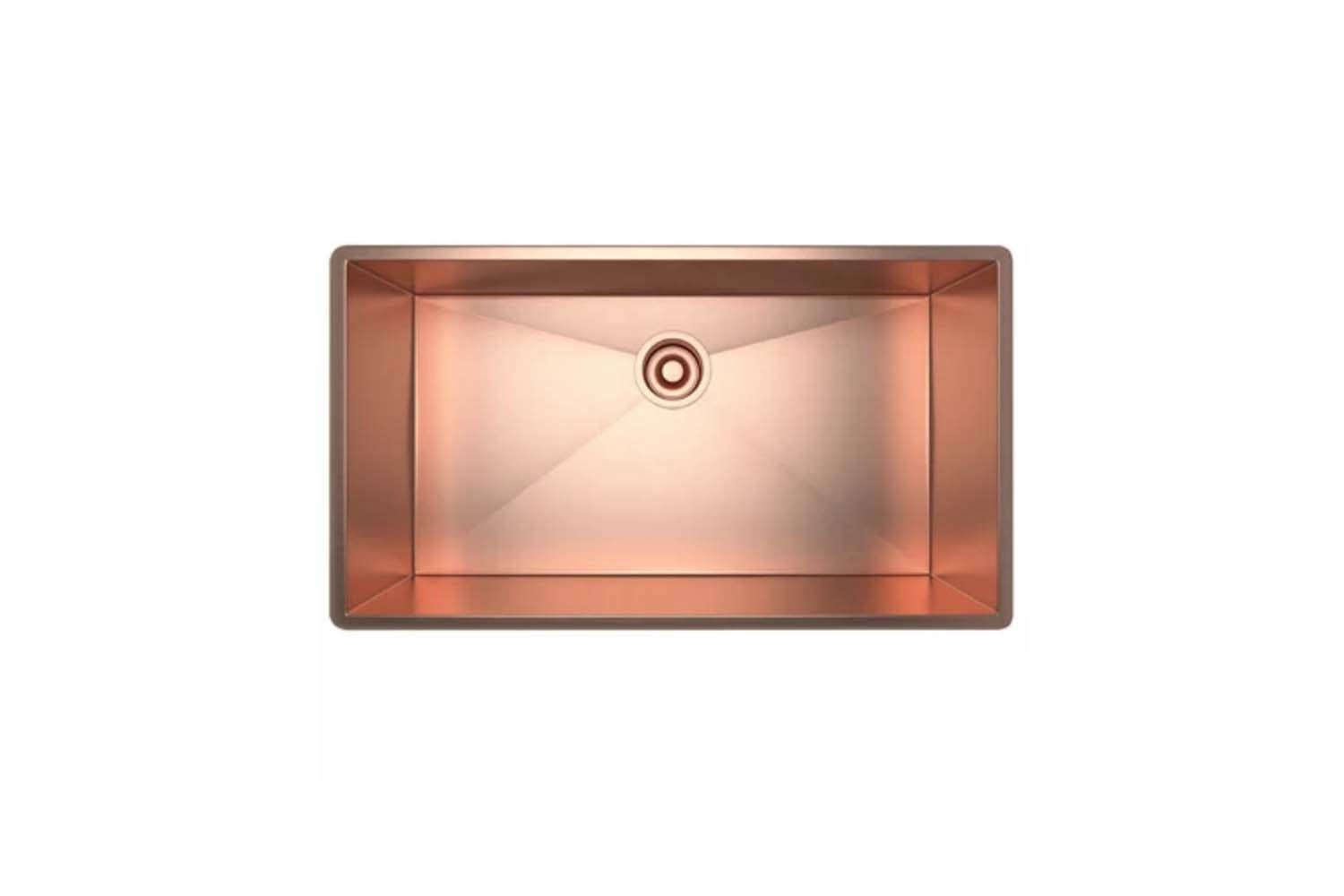

The Rohl Brushed Copper 30 in. SS Single Basin Kitchen Sink is the sort of fixture that makes ordinary dishwashing feel suspiciously upscale. Officially identified as the ROHL Forze 30-inch single-bowl stainless steel kitchen sink in Stainless Copper, model RSS3018SC, it combines a warm copper-toned surface with commercial-grade stainless steel construction.
That distinction matters. This is not a traditional solid-copper basin that gradually develops a dramatic patina. Beneath the copper-colored finish is thick Type 304 stainless steel, giving homeowners the industrial strength of a professional sink without forcing the kitchen to look like a restaurant prep station. ROHL’s technical guidance identifies Stainless Copper as a PVD-coated finish, designed to retain a more controlled appearance than raw copper.
There is one major buying consideration before we begin admiring it like a museum object: ROHL now identifies the RSS3018SC as discontinued. Lowe’s says it is no longer sold on its website, while other dealer listings show it as unavailable. New-old-stock, showroom samples, and secondhand units may still appear, but availability and warranty coverage should be verified before money changes hands.
What Is the Rohl RSS3018SC Kitchen Sink?
The RSS3018SC belongs to ROHL’s Forze collection, a line of handcrafted Italian stainless steel sinks developed for luxury residential kitchens. The collection combines commercial-grade construction with details intended to improve daily use, including sound insulation, near-vertical sidewalls, and rounded transitions along the bottom of the bowl.
Although it is commonly advertised as a 30-inch kitchen sink, its overall dimensions are larger. The 30-inch measurement refers to the interior width of the usable bowl. The exterior body measures approximately 31 1/2 inches wide, 19 1/2 inches from front to back, and 10 inches deep. This is an important detail for anyone measuring a cabinet opening while holding a tape measure, a cup of coffee, and unreasonable optimism.
Rohl RSS3018SC specifications at a glance
| Feature | Specification |
|---|---|
| Official model | RSS3018SC |
| Collection | ROHL Forze |
| Configuration | Single-bowl kitchen sink |
| Installation | Undermount only |
| Exterior dimensions | 31 1/2 x 19 1/2 x 10 inches |
| Approximate interior dimensions | 30 x 18 x 9 3/4 inches |
| Minimum cabinet width | 33 inches |
| Material | 18/10 Type 304 stainless steel |
| Steel thickness | 16 gauge |
| Finish | Stainless Copper PVD coating |
| Drain opening | 3 1/2 inches |
| Mounting hardware | Brackets included |
| Bottom grid | Compatible grid available separately |
| Current status | Discontinued |
These measurements are supported by ROHL’s technical sheet and archived retailer specifications. The manufacturer requires a minimum 33-inch base cabinet and specifies undermount installation only.
A Copper Look Without a Solid-Copper Sink
The most noticeable feature is naturally the Stainless Copper finish. It brings warmth to a material normally associated with cool silver tones. Against white quartz, pale marble, soapstone, black granite, or warm wood cabinetry, the sink can function as a quiet focal point rather than a shiny metal rectangle that politely disappears into the countertop.
Design publications have long treated copper sinks as statement pieces because they bridge rustic, traditional, and luxury interiors. Remodelista included this particular ROHL model among its curated copper kitchen sink selections and historically listed it at $2,848.50. That old price should not be interpreted as current market value, but it confirms where the product originally sat: firmly in the premium category, several floors above “whatever was on sale beside the garden hoses.”
The finish is also less visually unpredictable than unfinished solid copper. Raw copper can darken, spot, and develop patina as it reacts with moisture, food, cleaning products, and air. The RSS3018SC instead uses a copper-colored PVD treatment over stainless steel. It offers the visual warmth of copper while behaving more like a coated stainless steel sink.
That does not make it indestructible. A decorative PVD surface should be protected from metal brushes, harsh chemicals, sharp utensils, and heavy impacts. Scratches may expose or permanently alter the finish, and refinishing a specialized discontinued sink is not as simple as grabbing a silver polishing pad from the junk drawer.
Why 16-Gauge Type 304 Stainless Steel Matters
The RSS3018SC is made from commercial-grade, 16-gauge, 18/10 Type 304 stainless steel. In stainless steel measurements, a lower gauge number indicates thicker material. Sixteen-gauge steel is therefore thicker than common 18-, 20-, or 21-gauge sink material.
Thicker steel generally provides better resistance to denting and may reduce the hollow ringing created by running water, dropped utensils, and enthusiastic pan placement. Kohler’s sink guidance similarly notes that thicker, lower-gauge steel is less likely to dent and tends to provide better sound resistance.
Type 304 stainless steel is widely used for premium kitchen sinks because it offers an effective balance of corrosion resistance, durability, fabrication quality, and everyday maintainability. Comparable premium sinks from Elkay, Kraus, and other established manufacturers also use 16-gauge Type 304 stainless steel for high-use single-bowl models.
The takeaway is not that the sink will survive being used as a blacksmith’s anvil. It is still a finished kitchen fixture. However, its structural foundation is significantly more substantial than a lightweight bargain sink that flexes whenever the garbage disposal starts thinking deeply about its life choices.
Single-Bowl Space for Real Kitchen Work
A large single-basin sink offers one uninterrupted work area. There is no center divider occupying valuable space or preventing a roasting pan from lying flat. The approximately 30-by-18-inch interior can accommodate sheet pans, Dutch ovens, stockpots, refrigerator shelves, cutting boards, and other oversized items more comfortably than many divided sinks.
Single-bowl undermount models are frequently recommended for homeowners who want to maximize usable basin space. Kitchen sink guides from Better Homes & Gardens and Food & Wine highlight the practical appeal of deep, single-basin undermount sinks for washing large cookware and maintaining clean visual lines.
The 10-inch exterior depth also helps contain splashing and conceals a respectable stack of dishes. That last benefit is especially useful when guests arrive early and your “soaking system” is actually just every plate you own.
The compromise is task separation. A double-bowl sink allows one side to hold soapy water while the other remains open for rinsing, draining, or food preparation. With the ROHL single basin, owners may need a removable dishpan, colander, roll-up rack, or countertop drying area when performing several jobs at once. The Spruce and Better Homes & Gardens both note that bowl configuration should be selected according to how a household washes, soaks, rinses, and prepares food.
Undermount Installation and Cabinet Planning
The official ROHL specification states that this sink is designed for undermount installation only. Its rim sits beneath the countertop, creating an uninterrupted transition from the counter into the bowl. Water, crumbs, and flour can be wiped directly into the sink without colliding with a raised drop-in rim. Kraus and other sink manufacturers identify this simplified cleanup as one of the main advantages of undermount installation.
Undermount installation is best paired with a water-resistant solid-surface countertop such as quartz, granite, soapstone, solid surface, concrete, or properly sealed natural stone. Laminate can be more complicated because the exposed cutout edge must be protected from water. The sink is also heavy enough that adhesive alone should never be treated as the entire support strategy.
Measure the cabinet, not just the countertop opening
ROHL specifies a minimum 33-inch cabinet. Before purchasing an existing unit, an installer should confirm the cabinet’s interior width, wall thickness, face-frame clearance, countertop overhang, disposal dimensions, plumbing position, and mounting access. A nominally 33-inch cabinet may be tight if thick framing or neighboring hardware steals interior space.
Mounting brackets were originally included, but a used or showroom sink may no longer have them. The installer should inspect the package before the countertop is cut. Discovering missing hardware while a stone crew waits in the driveway is an exciting experience, but not in the good way.
Trust the official specification sheet
Archived retailer titles are not perfectly consistent. Some identify the product as 30 inches, others round the exterior width to 31 or 32 inches, and at least one listing uses a different collection name or installation description. For fabrication, cabinet planning, and countertop cutting, use the official RSS3018 technical drawing rather than a shortened retail headline.
Sound Control, Drainage, and Everyday Performance
ROHL describes the Forze collection as using an insulating “quiet coat” treatment. Archived product listings also reference sound-deadening coating intended to reduce noise from water, dishes, and disposal operation. Sound control is especially valuable in a 16-gauge single bowl because the basin presents a broad metal surface that could otherwise amplify every dropped teaspoon into a percussion solo.
The Forze design uses steep sidewalls to maximize usable interior space while incorporating rounded lower transitions for easier cleaning. The bottom slopes toward a standard 3 1/2-inch drain opening. Compared with sinks that have sharply squared internal corners, the rounded transition provides fewer narrow crevices in which residue can settle.
Users should still expect to guide occasional droplets or food particles toward the drain. Broad, relatively flat-bottomed sinks prioritize space for cookware and glassware, and no geometric marketing phrase has yet convinced water to abandon the laws of physics.
Accessories and Compatibility
The original specification identifies WSGRSS3018 as the compatible wire sink grid. A grid raises pots and dishes above the basin floor, allows water to circulate beneath them, and helps reduce direct contact between cookware and the decorative finish. Sink manufacturers commonly recommend fitted bottom grids for surface protection and drainage.
However, accessory availability deserves investigation because the sink and the Stainless Copper version of its matching grid have been discontinued. ROHL currently shows stainless steel and black stainless versions for related RSS3018 and RSA3018 sinks, while its Stainless Copper grid is identified as discontinued. Verify dimensions and finish expectations before ordering an accessory based only on a familiar-looking model number.
A basket strainer was not included in at least one archived dealer configuration, so buyers should also confirm whether the drain assembly, disposal flange, clips, template, and grid are present. A copper-toned drain or disposal flange may provide the most coordinated look, but compatibility with the finish and disposal system matters more than creating a perfect metallic family portrait.
How to Clean the Stainless Copper Finish
ROHL’s care guidance for Stainless Copper recommends daily washing with mild dish soap and water, followed by thorough rinsing and drying. For oily residue, the company recommends warm water with a 10% to 15% vinegar solution, again followed by rinsing and drying.
A practical care routine
- Rinse away food residue after cooking or washing dishes.
- Clean with mild liquid dish soap and a soft cloth or nonabrasive sponge.
- Rinse thoroughly so soap does not dry on the finish.
- Dry with a soft microfiber cloth to reduce mineral spotting.
- Use the fitted bottom grid to limit direct cookware contact.
- Remove the grid regularly and clean beneath its feet.
What to avoid
- Steel wool, metal brushes, and highly abrasive scrubbers
- Harsh chemical cleaners or products not approved for PVD finishes
- Dragging cast iron, knives, or heavy cookware across the surface
- Leaving coffee, tomato residue, dairy products, or other food deposits in the sink for long periods
- Allowing wet metal cans or tools to sit on the basin floor
Some ordinary stainless steel sinks can be refinished or blended with an abrasive pad following the grain. That approach should not be casually applied to a colored PVD sink. Abrasive restoration may permanently change the copper-toned coating. When uncertain, consult the manufacturer’s finish-specific guidance rather than trusting a cleaning trick filmed beside someone’s garage refrigerator.
Advantages and Drawbacks
Reasons the Rohl copper stainless steel sink stands out
- Distinctive copper-toned appearance without a solid-copper basin
- Commercial-grade 16-gauge Type 304 stainless steel construction
- Large uninterrupted single-bowl workspace
- Deep basin for oversized cookware and concealed dishes
- Undermount installation with clean countertop lines
- Sound-deadening treatment
- Rounded lower edges intended to simplify cleaning
- Premium Italian Forze collection styling
Potential disadvantages
- The model is discontinued and may be difficult to source
- Replacement accessories in the matching finish may be limited
- The PVD finish requires more cautious care than plain stainless steel
- Professional undermount installation is strongly recommended
- A 33-inch minimum cabinet is required
- The original premium price was considerably higher than mainstream stainless steel sinks
- A single bowl does not provide built-in separation for washing and rinsing
Who Should Consider Buying It?
The RSS3018SC makes the most sense for a homeowner designing a distinctive luxury kitchen who has found a complete unit in excellent condition. It is particularly well suited to transitional, modern European, contemporary, industrial, and refined rustic interiors where ordinary silver stainless steel feels too cold but a hammered solid-copper sink feels too traditional.
It may also appeal to buyers who already own coordinating copper-toned faucets, cabinet hardware, light fixtures, or range details. The finish can tie these elements together without covering the kitchen in so much copper that it begins resembling an unusually elegant penny collection.
More cautious shoppers may prefer a current-production 30-inch, 16-gauge stainless steel undermount sink. The present market includes many single-bowl models with bottom grids, drains, cutting boards, drying racks, and easier access to replacement parts. Current products from major manufacturers also tend to cost substantially less than the ROHL model’s historical luxury price.
A Realistic Ownership Experience: Living With the Rohl RSS3018SC
The following is a practical ownership scenario based on the sink’s documented dimensions, materials, finish requirements, and common single-bowl usage patterns. It is not presented as a claim of personal product testing.
On the first day after installation, the visual effect would probably dominate the conversation. From across the room, the Stainless Copper finish reads warmer and more decorative than conventional stainless steel. Under pendant lights, it can reflect amber and rose tones; under cool daylight, it may appear more muted and bronze-like. The result depends heavily on nearby materials. White quartz creates strong contrast, while butcher block and warm oak produce a softer, more integrated palette.
The practical benefits become obvious during the first serious cooking session. A 12-inch skillet, a stockpot, and a cutting board can occupy the same basin without being balanced against a center divider. A full sheet pan fits at an angle or nearly flat, making it easier to soak baked-on residue. Large refrigerator shelves and oven racks are less awkward to rinse. For anyone moving from a divided sink, the extra continuous space can feel less like an upgrade and more like recovering territory that had been occupied by a useless metal wall.
The 10-inch depth keeps splashes under control, especially when paired with a faucet whose water stream reaches the center of the bowl. Faucet selection matters, however. A very tall faucet combined with excessive water pressure can still create spray, while a short faucet may leave insufficient clearance above large pots. A pull-down spray head with adjustable flow is the most flexible partner.
During cleanup, the undermount edge earns its keep. Crumbs and water wipe directly from the countertop into the sink. There is no exposed rim collecting flour, grease, or the mysterious gritty material that appears whenever someone makes toast. The rounded transitions near the bowl floor are also easier to wipe than perfectly sharp corners, although the large basin still benefits from a quick rinse and wipe after heavy use.
The sound-deadening treatment should make routine use more civilized, but it will not make the sink silent. Metal utensils will still sound like metal utensils. The thicker 16-gauge body and exterior coating mainly reduce resonance, vibration, and the thin metallic boom associated with lighter sinks. A garbage disposal can still announce itself, just with slightly better manners.
The finish changes daily habits more than the basin shape does. With plain brushed stainless steel, many owners casually slide pans around and scrub stubborn marks with the nearest abrasive pad. The copper-colored PVD surface rewards a gentler routine. Heavy cookware should be placed rather than dragged, and a fitted bottom grid becomes less of an optional accessory and more of a sensible insurance policy.
After dinner, a mild-soap wash followed by rinsing and drying takes only a minute or two. Skipping the drying step may leave visible mineral spots, particularly in hard-water areas. Those spots are not evidence that the sink has failed; they are a reminder that water contains minerals and enjoys leaving autographs. A microfiber cloth kept beneath the sink makes the routine easier.
The grid introduces another small maintenance task. Food particles can collect beneath it, and its rubber feet may leave temporary marks if the basin is not rinsed regularly. Lifting the grid every few days prevents buildup and allows the copper-toned floor to remain visible. A grid full of crumbs is not protecting the sink so much as operating a tiny compost program.
Months into ownership, the greatest satisfaction would likely come from the combination of capacity and appearance. The sink is large enough for practical cooking yet unusual enough to remain a design feature. The main anxiety would involve replacement parts and finish damage. Because the model is discontinued, an owner cannot assume that a perfectly matching grid, drain component, or replacement basin will remain available indefinitely.
For that reason, the best ownership experience begins before installation. Photograph the model label, keep the specification sheet, save receipts, document included hardware, and record the accessory numbers. Confirm warranty terms with the seller in writing. A discontinued luxury sink can be a wonderful find, but documentation is what separates a wonderful find from an expensive metal mystery.
Final Verdict
The Rohl Brushed Copper 30 in. SS Single Basin Kitchen Sink is a compelling blend of visual warmth and commercial-grade construction. Its 16-gauge Type 304 stainless steel body, deep uninterrupted basin, sound-deadening treatment, undermount profile, and copper-toned PVD finish make it both a serious working sink and a distinctive design element.
Its discontinued status is the deciding factor. A complete, undamaged RSS3018SC offered by a reputable seller may be an excellent choice for the right kitchen. A unit with missing hardware, unclear warranty coverage, finish damage, or an uncertain accessory package demands much greater caution. Measure twice, verify everything, and remember that “rare luxury fixture” sounds considerably more romantic than “replacement grid unavailable.”