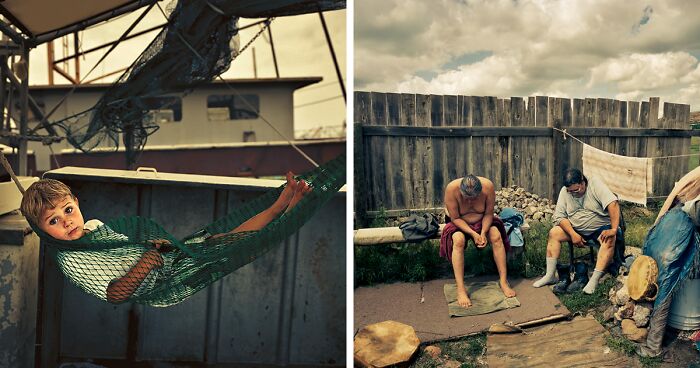
“American Realities” Photo Series Documents the Heartbreaking Stories of Poor People Living in the US (30 Pics)

Behind America’s polished national image lies another countryone where a broken transmission can threaten a family’s food budget, full-time work may not cover rent, and a medical problem can turn an unstable life into an emergency. Photographer Joakim Eskildsen’s American Realities photo series enters that country quietly, through front doors, trailer parks, fishing boats, migrant motels, neglected neighborhoods, and communities rarely represented in glossy versions of the American Dream.
The project does not present poverty as an abstract economic category. It gives poverty a kitchen table, a tired face, a child’s bedroom, and a family history. Across 30 moving photographs, viewers meet people who work, care for relatives, raise children, survive disasters, and make difficult choices with painfully limited options.
There is no dramatic villain twirling a mustache in the background. The pressure comes from low wages, insecure employment, damaged local economies, poor housing, limited health care, environmental disasters, and public systems that are often difficult to navigate. Poverty, these images suggest, rarely arrives alone. It brings several unpleasant friends and expects the household to feed all of them.
How the “American Realities” Photography Project Began
In 2011, TIME commissioned Danish photographer Joakim Eskildsen to document poverty in the United States. Working with journalist Natasha Del Toro, he traveled for seven months through New York, California, Louisiana, South Dakota, and Georgia. The locations were selected partly through census data identifying communities with especially high poverty rates. The resulting work was later expanded into a 120-page photography book published by Steidl in 2016.
At the time of the assignment, approximately 46.2 million Americans were living below the official poverty line. Eskildsen had previously encountered the United States mainly through exported movies, music, advertising, and consumer culture. What he found during the project sharply contradicted that familiar image of endless highways, cheerful suburbs, and refrigerators apparently large enough to qualify as studio apartments.
His subjects included migrant agricultural workers, disabled veterans, single parents, immigrants, Native American families, unemployed workers, people affected by mental illness, and households whose livelihoods had been damaged by natural or environmental disasters. There was no single visual type that represented a person in poverty. That was one of the project’s most important discoveries.
What the 30 Pictures Reveal About Poverty in America
Pictures 1–6: California’s Workers Surrounded by Food but Struggling to Eat
Several photographs follow migrant farmworkers and their children in California’s Central Valley. The setting creates an uncomfortable contradiction: people labor in one of the most productive agricultural regions in the world while struggling to afford nutritious food for their own families.
One documented family lived in a trailer park for agricultural workers near Firebaugh. Their household depended on roughly $350 in weekly income, and a grandmother regularly walked about two miles with her three-year-old grandson to collect free food from a community center. Another image shows two young friends outside a migrant motel in Fresno, where one child’s mother earned around $8 an hour doing farmwork.
These scenes challenge the comforting belief that employment automatically prevents poverty. Work can be physically demanding, socially essential, and still inadequately paid. A paycheck is not a magical force field against hunger when rent, transportation, utilities, child care, and groceries are all competing for the same thin stack of dollars.
Pictures 7–12: Louisiana Families After the BP Oil Spill
In coastal Louisiana, Eskildsen photographed fishing families whose incomes had been devastated following the 2010 Deepwater Horizon oil spill. Some had spent generations catching shrimp, oysters, and fish. Their work was not merely an occupation; it was a skill, a culture, and a family identity passed from one generation to the next.
Darla and Todd Rooks reportedly lost much of their fishing income and had to leave their home, eventually living aboard their 40-foot fishing boat. Another family worried about the safety of the seafood being pulled from waters that had supported them for years. Environmental damage had become economic damage, emotional damage, and a frightening question about whether a traditional way of life had a future.
The images make an important point: poverty can be produced by events far beyond an individual household’s control. A family may work hard, save carefully, and build specialized knowledge over decades. Then one industrial disaster can erase the economic value of nearly everything they know.
Pictures 13–18: Life on the Cheyenne River Reservation
The photographs from South Dakota show another American reality: persistent hardship in Native communities shaped by geographic isolation, inadequate infrastructure, limited employment opportunities, and generations of broken public promises.
In one Eagle Butte neighborhood, residents referred to an area as the “dark side” partly because streetlights did not work. The missing lights were more than a visual detail. They represented the practical consequences of neglected infrastructureless safety, fewer public resources, and a daily message that some neighborhoods receive less attention than others.
Federal reviews continue to identify serious barriers affecting tribal communities, including aging health facilities, inadequate infrastructure, and difficulty accessing money already intended to support Native American and Alaska Native populations. These problems cannot be reduced to personal choices or individual motivation.
Pictures 19–24: Urban Poverty in New York
The New York photographs show how poverty can remain hidden in densely populated neighborhoods. A family may live only a few subway stops from corporate offices, luxury stores, fashionable restaurants, and apartments priced as though the windows were carved from diamonds. Proximity to wealth does not guarantee access to it.
In the South Bronx, Eskildsen photographed immigrant families and communities shaped by several overlapping cultures. The pictures contain hardship, but they also show relationships, neighborhood life, family bonds, and personal dignity. The people are not displayed as anonymous symbols of deprivation. They remain individuals with identities much larger than their bank balances.
This distinction matters. Responsible documentary photography does not ask viewers to stare at “the poor” as though poverty were an exotic species. It asks them to recognize neighbors whose lives are influenced by unequal access to stable housing, good schools, health care, transportation, and secure employment.
Pictures 25–30: Georgia and the Quiet Invisibility of Hardship
The Georgia portion of the series reinforces a central idea running through all 30 photographs: American poverty is not always visually obvious. A household may have a television, microwave, air conditioner, car, or smartphone while remaining one emergency away from collapse.
Possessions do not necessarily indicate financial security. Some items may be old, financed, borrowed, donated, or purchased during a more stable period. A family can own a car and still be unable to pay for a repair. It can have a refrigerator and still lack enough food to fill it. It can have an address and still face eviction next month.
Eskildsen deliberately photographed people inside their everyday surroundings, often using existing light and patient compositions. The warmth of the images prevents the project from becoming a collection of visual accusations against its subjects. The criticism is directed primarily at the conditions and systems surrounding them.
Why These Poverty Photos Feel So Personal
The Subjects Look Back
Many of the portraits are built around direct eye contact. That simple choice changes the viewer’s role. We are not observing distant figures who seem unaware of the camera. We are being seen by the people we are seeing.
The effect can be uncomfortable because it interrupts several popular myths: that poverty happens only to irresponsible people, that struggling families do not work, or that anyone can escape hardship with enough enthusiasm and a sufficiently motivational coffee mug.
Eskildsen spoke with the people he photographed, sometimes for several hours and sometimes for only a few minutes. Many reportedly welcomed the opportunity because they felt ignored and hoped that telling their stories might help decision-makers understand how public systems had failed them.
Beauty Does Not Cancel the Pain
The photographs are visually beautiful, and that beauty is not a betrayal of the subject matter. Warm natural light, thoughtful framing, and rich colors encourage viewers to spend time with each scene instead of quickly turning away.
However, beautiful photography can create an ethical tension. When suffering is composed elegantly, viewers must resist consuming it as decoration. The purpose is not to admire peeling wallpaper, exhausted expressions, or damaged neighborhoods as an aesthetic trend. The purpose is to recognize the lives unfolding within them.
Good social documentary photography preserves dignity without sanitizing reality. It leaves room for tenderness, humor, pride, frustration, boredom, and love. Poor people do not stop being complicated human beings simply because an article places them under a serious headline.
The American Reality Has Not Disappeared
The photographs were taken in 2011, but their central concerns remain relevant. According to the U.S. Census Bureau, 35.9 million people lived below the official poverty line in 2024, representing 10.6% of the population. The number was lower than during the crisis that inspired Eskildsen’s assignment, yet it still represented a population larger than that of many entire countries.
Food insecurity also remains widespread. The U.S. Department of Agriculture estimated that 13.7% of American households experienced food insecurity at some point during 2024. Among households with children, the rate was 18.4%. Food insecurity does not always mean going an entire day without eating. It may involve skipping meals, reducing portions, buying cheaper low-quality food, or repeatedly worrying that groceries will run out before money arrives.
Housing pressure adds another layer. HUD counted 771,480 people experiencing homelessness on a single night in 2024, the highest total recorded in the national point-in-time series at that stage. This count does not capture every person sleeping temporarily with friends, living in overcrowded housing, moving between motels, or facing imminent eviction.
Research on affordable housing also shows that many low-income households remain trapped in “shelter poverty,” meaning housing costs leave too little money for other necessities. Housing instability can disrupt children’s schooling, worsen health, increase stress, and force families to move away from jobs or support networks.
Poverty Is More Than an Income Number
Unstable Work Creates Unstable Lives
Low hourly wages are only part of the problem. Many workers also face unpredictable schedules, fluctuating hours, seasonal employment, and little paid leave. More than half of households earning under $25,000 in 2023 reported that their income changed from month to month at least occasionally. Planning becomes extremely difficult when next month’s paycheck is basically a surprise party, except nobody brought cake.
A reduction of two work shifts can lead to a late utility payment. A sick child can mean lost wages. A car repair can make commuting impossible. Each setback creates additional fees, debts, and delays, making recovery more expensive than the original problem.
Poor Health and Poverty Reinforce Each Other
Low-income households are more likely to delay medical treatment because of cost, transportation problems, lack of coverage, or an inability to miss work. Delayed care can allow manageable conditions to become serious, creating larger bills and further reducing a person’s ability to work.
Research on Medicaid expansion has found improvements in access to care, financial security, earlier diagnosis, and the ability of low-income patients to obtain treatment without catastrophic expenses. In other words, health coverage is not merely a medical issue. It can also function as protection against financial free fall.
Scarcity Consumes Time and Attention
Financial hardship requires constant calculation. Which bill can be delayed? How far can the gasoline stretch? Is the fever serious enough for an emergency room? Can the landlord wait three days? Will the food pantry be open after work?
These decisions consume mental energy. From the outside, an action may appear poorly planned. From inside the household, it may be the least damaging choice among several bad options. Poverty is not simply having less money. It is being forced to make high-stakes decisions with less room for error.
What Viewers Should Take Away From “American Realities”
Replace Stereotypes With Specific People
The series demonstrates why statistics and portraits work best together. Data reveal scale, trends, and inequality. Photographs reveal what those patterns can feel like inside a home or across a person’s face.
Neither should replace the other. A heartbreaking portrait cannot prove how common a problem is, while a national percentage cannot communicate the texture of one family’s life. Together, they make it harder to dismiss poverty as either a rare personal failure or a lifeless spreadsheet category.
Ask Structural Questions
Instead of asking only why a person is poor, viewers can ask why essential work pays so little, why healthy food is difficult to obtain in some neighborhoods, why affordable housing remains scarce, or why a single illness can destroy years of fragile progress.
These questions do not eliminate personal responsibility. They simply recognize that responsibility operates inside an economic environment. A person can make careful decisions and still be trapped by wages that do not match local costs, unreliable transportation, inaccessible health care, or a disaster that destroys an entire industry.
Protect the Dignity of the People Being Seen
The subjects of American Realities should not be remembered only as examples of suffering. They are parents, children, workers, neighbors, veterans, fishers, migrants, and community members. Their stories contain loss, but also endurance and care.
The most respectful response is neither pity nor suspicion. It is attentionfollowed, ideally, by curiosity about policies and community efforts that can improve wages, housing stability, food access, health coverage, education, and local infrastructure.
Related Experiences: Spending Time With the Stories Behind the Photos
Viewing all 30 images slowly creates a different experience from scrolling through another dramatic online gallery. At first, the eye may focus on visible details: a damaged wall, a cramped room, an aging vehicle, a child standing near a trailer, or a family gathered on a fishing boat. After several images, however, the objects become less important than the repeated atmosphere of uncertainty.
That uncertainty is one of the most recognizable experiences associated with financial hardship. It is the feeling that normal life is balanced on one narrow support. The support might be a car that must start every morning, a landlord who has not yet raised the rent, a relative providing child care, or an employer continuing to offer enough shifts. None of these arrangements is guaranteed, yet the entire household may depend on them.
People who have experienced even a short period of financial insecurity may recognize this emotional rhythm. The refrigerator begins to sound different when replacing it is impossible. A dashboard warning light becomes a financial threat. An unopened medical bill seems to grow heavier while sitting on a table. Poverty changes the meaning of ordinary objects because almost everything carries a possible cost.
The series can also remind viewers of experiences that are easy to overlook in public. A parent may tell a child that dinner will be “something fun” while quietly combining the last available ingredients. An adult may say a prescription is unnecessary because the copay competes with the electric bill. A worker may appear unreliable after arriving late, even though the real problem was a bus route, a sick child, or a vehicle held together by optimism and a suspicious amount of tape.
Another important experience is being discussed without being heard. Low-income Americans are frequently described through political slogans, campaign speeches, television debates, and social media arguments. The people themselves may appear only as categories: taxpayers, recipients, workers, dependents, homeowners, renters, or the uninsured.
Eskildsen’s approach slows that process down. The portraits allow people to occupy the center of the frame rather than becoming background material in someone else’s argument. Their expressions do not provide simple answers. Some look guarded, some exhausted, some proud, and some surprisingly calm. That emotional variety is precisely what prevents the series from becoming a stereotype factory.
For viewers with comfortable lives, the experience may involve recognizing how many hidden systems make comfort possible. Stable housing, dependable transportation, paid leave, nearby grocery stores, health insurance, family savings, and access to credit can prevent a minor problem from becoming a catastrophe. These protections often feel invisible until they disappear.
For viewers who have lived through poverty, the photographs may feel validating, painful, or both. Recognition is not always comforting. Seeing familiar living conditions presented publicly can revive embarrassment or anger, especially in a culture that treats financial success as evidence of virtue. Yet the series also communicates that hardship is not an isolated personal secret. Many families face similar pressures across rural areas, cities, suburbs, reservations, agricultural communities, and coastal towns.
The most valuable experience comes after the final photograph. The viewer must decide whether the people in the images will remain temporary objects of sympathy or become part of a more serious understanding of American life. Sympathy fades quickly. Understanding asks harder questions and tends to interfere with convenient myths.
American Realities does not provide a tidy ending because poverty rarely supplies one. It offers something more useful: evidence that looking closely can be the beginning of listening, and listening can be the beginning of refusing to accept preventable hardship as ordinary.
Conclusion: Looking Beyond the American Dream
Joakim Eskildsen’s American Realities series is powerful because it refuses to reduce poor Americans to numbers, symbols, or cautionary tales. The 30 photographs show different regions, cultures, occupations, and family structures, yet they share a common tension: people are trying to build stable lives in conditions that provide almost no margin for error.
The project does not argue that hope is meaningless. It argues that hope needs support. Hard work matters, but so do wages, housing, transportation, health care, education, food access, environmental protection, and functioning public institutions.
These photographs ask viewers to reconsider what poverty looks like. It may look like employment. It may look like a car parked outside a deteriorating home. It may look like a child playing in the afternoon while adults calculate which bill can wait. Most importantly, it looks like peoplepeople whose dignity remains intact even when the systems around them do not.