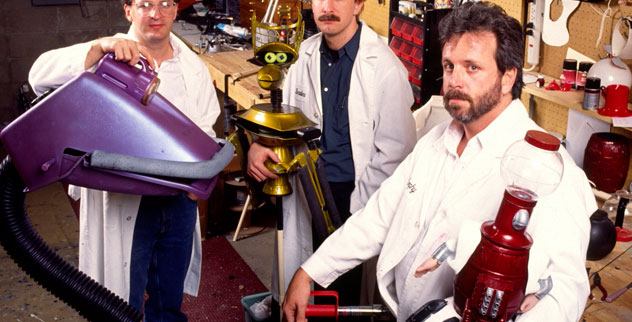

Bad movies. Excellent robots. Enough obscure cultural references to make a trivia champion request a commercial break.
Mystery Science Theater 3000 turned one of humanity’s oldest habitsmaking sarcastic comments during a bad movieinto an enduring television art form. The beautifully ridiculous premise placed a human host aboard the Satellite of Love, where mad scientists forced him and his robot companions, Crow T. Robot and Tom Servo, to watch cinematic disasters. Their only defense was a nonstop barrage of jokes, songs, sketches, impressions, and references that could leap from Shakespeare to breakfast cereal without signaling.
Created by Joel Hodgson and first broadcast on Minnesota television in 1988, the series later developed a national cult following through Comedy Central, the Sci-Fi Channel, revivals, home-video releases, streaming, and the enthusiastic circulation of fan-recorded tapes. Although hosts and cast members changed, the basic appeal remained remarkably consistent: genuinely clever comedians confronting movies that seemed to have been assembled during a power outage.
Choosing the best Mystery Science Theater 3000 episodes is difficult because different eras offer different flavors. Joel Hodgson brought relaxed, almost mischievous warmth. Mike Nelson delivered sharper exasperation and increasingly elaborate character work. Later revivals introduced faster joke rhythms and new performers. This ranking focuses primarily on the original national run and balances joke quality, memorable host segments, rewatchability, cultural impact, and the essential ingredient: a movie strange enough to keep providing ammunition.
The 10 Best MST3K Episodes Ranked
10. I Accuse My Parents Episode 507
I Accuse My Parents follows Jimmy Wilson, a neglected young man who wins an essay contest, lies compulsively, becomes involved with gangsters, and eventually decides that nearly everything is his parents’ fault. The movie was released in 1944 as a moral-warning drama, but its shaky logic makes it feel like a teenager invented an alibi and somehow received a feature-film budget.
The episode succeeds because the movie is earnest rather than aggressively unpleasant. Jimmy keeps making terrible choices while behaving as though fate personally filled out the paperwork. Joel and the Bots transform his self-pity, improbable romance, criminal employment, and suspiciously convenient courtroom story into a running examination of responsibility avoidance. The accompanying short, The Truck Farmer, also gives them an opportunity to make modern agriculture sound like a vegetable-based military campaign.
This is an excellent introductory episode. The jokes arrive steadily, the plot remains understandable, and the movie’s melodramatic confidence makes every mistake funnier. It also produced recurring fan favorites involving Jimmy’s essay and the oddly cheerful song “Are You Happy in Your Work?”
9. Santa Claus Conquers the Martians Episode 321
Few holiday movies begin with worried Martian parents, include a kidnapping plot, and end by asking viewers to accept a man named Dropo as a symbol of hope. Santa Claus Conquers the Martians somehow accomplishes all three.
The Martian children have become listless after watching Earth television, so their leaders decide to kidnap Santa Claus. The plan is absurd, the costumes resemble leftovers from a school pageant, and the North Pole sequences operate according to a toy-manufacturing philosophy best described as “elves plus industrial noise.” Joel and the Bots respond with festive disbelief, turning awkward child acting and bargain-bin science fiction into a deeply strange Christmas celebration.
The episode is particularly enjoyable during December, when polished holiday entertainment starts to feel suspiciously coordinated. MST3K offers the antidote: cardboard machinery, green face paint, a polar-bear costume that inspires no confidence, and a catchy theme song that may occupy your brain until Valentine’s Day. It is not the smoothest episode on this list, but few better demonstrate how the show could turn forgotten cultural debris into an annual tradition.
8. The Pumaman Episode 903
In The Pumaman, mild-mannered professor Tony Farms discovers that he has inherited supernatural powers from ancient aliens. These abilities include enhanced senses, teleportation, and a style of flying that suggests an invisible crane is moving him sideways through a department-store window display.
Donald Pleasence plays the villain, Kobras, with the determined professionalism of an actor refusing to admit that everyone around him is dressed for a different movie. Meanwhile, Tony receives guidance from Vadinho, an Aztec priest whose strategy frequently involves throwing the reluctant hero out of windows. Superhero training has apparently changed since 1980.
Mike and the Bots feast on the unconvincing flight effects, Tony’s complete absence of heroic charisma, and the movie’s vague mythological explanations. The episode also benefits from a delightfully silly host segment in which Mike becomes Coatimundi Man. It is a perfect choice for viewers who enjoy superhero stories but sometimes wish the hero looked confused about why he had been invited. The episode’s popularity was strong enough to place it at the top of a fan poll concerning desired DVD releases.
7. Time Chasers Episode 821
Time Chasers asks a bold question: What would happen if a Vermont inventor built a time machine using a small airplane, a Commodore computer, and the irresistible power of office carpeting?
Nick Miller successfully travels through time but makes the classic inventor’s mistake of partnering with a corporation whose headquarters practically announces, “We will misuse your technology before lunch.” When the future becomes an industrial nightmare, Nick must undo the damage while protecting history, his friends, and his aggressively ordinary wardrobe.
The film is more ambitious and sincere than many MST3K selections. That sincerity makes the episode oddly lovable. Mike and the Bots mock the regional production values, the villainous executive, the hero’s chin, and a revolutionary battle that looks as though it was organized through a community bulletin board. Yet the comedy rarely feels cruel. The filmmakers tried to tell a large science-fiction story with limited resources, and the episode recognizes that effort while still noting that the mall food court may be visible just beyond the apocalypse.
The host segments add another layer by bringing characters resembling the film’s cast onto the Satellite of Love. The result is a warm, highly rewatchable episode that represents MST3K at its most affectionate.
6. Werewolf Episode 904
Werewolf begins when archaeologists uncover a skeleton that may belong to a werewolf. Soon, people are transforming into creatures whose appearance changes dramatically from scene to scene, perhaps because even the makeup department could not agree on the species.
The movie provides a glorious collection of inconsistent accents, scientific nonsense, romantic tension, supernatural exposition, and hair choices that deserve independent billing. Mike, Crow, and Servo seize every opportunity. Their reactions to the lead actors’ pronunciation, the shifting werewolf design, and the film’s profound confidence in nonsense create one of the fastest and most accessible riffing sessions of the Sci-Fi Channel era.
Unlike some older films featured on the show, Werewolf was relatively recent when the episode aired. Its modern production style, brisk movement, explosions, and 1990s atmosphere make it an easy gateway for viewers who struggle with slower black-and-white movies. It also inspired one of the show’s best musical parodies, a closing-credits performance that turns the film’s title into an increasingly elaborate rock anthem. The movie may not explain lycanthropy, but it does inspire excellent harmony.
5. Pod People Episode 303
Pod People feels like two unfinished movies collided in the woods. One concerns an alien creature attacking adults. The other follows a young boy who befriends a smaller alien named Trumpy. The tonal relationship between these stories is roughly the relationship between Alien and a cereal commercial.
The episode gave MST3K fans several immortal moments. A musician hears his own synthesizer-heavy recording and approves it with an enthusiastic hand gesture, prompting Crow’s perfectly timed verdict: “It stinks!” Later, Trumpy performs “magic,” which mainly consists of moving household objects while everyone watches with the emotional urgency of people waiting for a microwave.
Joel and the Bots are in exceptional form. The riffs are playful, musical, and wonderfully odd, while the host segments include affectionate mockery of the movie’s unpleasant pop song. The film is incoherent without becoming exhausting, giving the performers room to build callbacks and absurd side narratives.
For many longtime fans, Pod People represents the classic Joel era in miniature: handmade charm, gentle surrealism, relaxed timing, and a movie that appears to be arguing with itself. It remains a frequent selection on essential-episode lists and an ideal demonstration of how MST3K could convert one peculiar gesture into decades of shared fan vocabulary.
4. Mitchell Episode 512
Joe Don Baker stars as Mitchell, a disheveled police detective investigating organized crime while maintaining a lifestyle built around beer, shouting, and the idea that physical fitness is a government conspiracy.
The movie is not incomprehensible. In fact, it resembles an unusually sleepy television cop drama. That becomes its comic strength. Mitchell’s low-energy pursuits, abrasive personality, romantic interlude with Linda Evans, and car chases that barely exceed parking-lot speed provide a perfect surface for Joel and the Bots.
This episode also carries historical importance because it was Joel Hodgson’s final regular appearance as host during the original run. The storyline sends Joel away from the Satellite of Love through an escape pod, creating a surprisingly emotional farewell without abandoning the show’s homemade absurdity. Mike Nelson, already a head writer and frequent performer, soon takes over as host.
The riffing is relentless but controlled. Rather than simply calling Mitchell unpleasant, the episode gradually constructs an entire mythology around his appetite, clothing, posture, and investigative methods. By the end, the name “Mitchell” itself has become a complete comic sentence. It is both a superb episode and a turning point in MST3K history.
3. The Final Sacrifice Episode 910
Canada contributes one of the greatest gifts in MST3K history: Zap Rowsdower, a beer-loving drifter with an unreliable truck and a name that sounds like a rejected breakfast cereal mascot.
The Final Sacrifice follows teenager Troy McGreggor as he investigates his father’s disappearance and encounters a mysterious cult. He joins forces with Rowsdower, and the pair travel across rural Alberta while being pursued by men in black clothing who appear to have purchased their uniforms from a discount aerobics class.
The film’s limited budget, earnest mythology, regional scenery, villainous speeches, and unusual hero give Mike and the Bots nearly unlimited material. Canadian jokes arrive frequently, but the episode’s real strength is its character-based riffing. Troy’s expressions, Rowsdower’s name, and the villain Satoris become recurring themes rather than isolated targets.
Despite the mockery, Rowsdower becomes genuinely likable. The movie’s sincerity gives the comedy warmth, and its straightforward adventure plot prevents the viewing experience from becoming confusing or tedious. Several major rankings have placed The Final Sacrifice at or near the very top of the entire series. It is easy to understand why: almost every scene contains a memorable joke, visual oddity, or opportunity to shout “Rowsdower!” at a television that cannot defend itself.
2. Space Mutiny Episode 820
Space Mutiny features recycled spaceship footage, glowing floor polishers used as futuristic transportation, interpretive dancing, an immortal crew member who returns to work after apparently dying, and action hero Reb Brown demonstrating the volume control of an emergency siren.
The plot concerns a mutiny aboard the Southern Sun, a massive generational spacecraft. Security officer Dave Ryder must defeat the scheming Commander Kalgan, protect the captain’s daughter, and repeatedly run through industrial corridors while wearing an outfit that leaves little doubt about gym membership.
Mike and the Bots respond by giving Ryder an ever-expanding series of masculine nicknames, including combinations of muscles, impact, meat, slabs, and objects commonly found at construction sites. The gag should become repetitive. Instead, each new name arrives like a tiny wrapped present from a very confused sporting-goods store.
The episode’s brilliance comes from variety. When it is not mocking Ryder, the crew can examine the villains’ facial expressions, the conspicuous use of old Battlestar Galactica footage, the romance between characters with a noticeable age difference, or the futuristic vehicles that resemble mobility scooters decorated for prom night. Kevin Murphy later identified Space Mutiny as one of his favorite movies to riff, noting the production’s recycled sets and famous continuity error involving a supposedly dead character.
1. Manos: The Hands of Fate Episode 424
Some bad movies are boring. Some are confusing. Manos: The Hands of Fate achieves a rarer condition: it feels as though the basic rules of filmmaking were explained over a damaged telephone line.
A vacationing family becomes lost and arrives at a remote lodge maintained by Torgo, a trembling caretaker who serves an unseen figure called the Master. What follows includes endless driving, uncomfortable pauses, repeated musical cues, mysterious wives, a dubious cult, and dialogue delivered with the confidence of people hearing their lines for the first time.
Joel and the Bots initially treat the movie as ordinary bad-film material. Gradually, however, the episode becomes a comedy about their inability to endure it. Even the mad scientists apologize for sending it. Torgo’s posture, the long stretches without action, and the film’s technical accidents become part of an escalating battle between professional comedians and footage that seems actively opposed to entertainment.
Manos is not always the best first episode for a newcomer because the movie moves at the approximate speed of continental drift. For experienced viewers, however, that difficulty is central to its legend. The riffers do not merely decorate the film with jokes; they create a complete alternative experience in which their exhaustion, disbelief, and desperate improvisation become the real story.
The episode transformed an almost forgotten 1966 regional horror film into a permanent piece of cult cinema. It regularly appears at the top of fan and critic rankings, and Torgo became one of the show’s most recognizable figures. Manos is the ultimate example of the MST3K formula: the worse the experiment becomes, the more heroically the comedians fight back.
The Full MST3K Experience: How to Enjoy These Episodes Like a Veteran MSTie
Watching a great MST3K episode is different from watching a conventional comedy. The humor is layered over a complete movie, interrupted by host segments, and packed with references that range from obvious physical jokes to regional advertisements that may have aired once in Minnesota during a snow emergency. Missing a reference is not a failure. It is part of the experience. One moment you feel brilliant for catching a joke about an old television detective; the next, Crow mentions a 1970s commercial and you briefly wonder whether the robots have access to classified documents.
New viewers should begin with an accessible episode such as Space Mutiny, Werewolf, or The Final Sacrifice. Their movies move quickly enough to maintain attention, and the comedy does not depend heavily on knowing the show’s history. Once the rhythm becomes familiar, move toward slower or stranger selections such as Manos. Starting with the most punishing movie is possible, but it resembles learning to swim by being launched from a medieval catapult.
A small group can improve the experience, especially when everyone accepts one rule: the episode already contains professional riffers. Competing with Crow and Servo by talking over every line usually creates a room containing five simultaneous jokes and no survivors. Natural reactions, laughter, and the occasional repeated catchphrase are welcome. A separate amateur commentary track is less helpful unless your friends have spent several years in a writers’ room.
Food should remain simple and strategically quiet. Popcorn is traditional, pizza is dependable, and elaborate crunchy snacks should be approached carefully. Nothing is more tragic than missing the perfect riff because someone is attempting to open a bag designed by the Department of Defense. For a themed marathon, pair episodes with deliberately ordinary comfort food. The Final Sacrifice invites Canadian snacks. Space Mutiny deserves something aggressively high in protein. Manos requires beverages, patience, and perhaps a signed medical waiver.
Watching episodes from different eras reveals how the series evolved. Joel’s delivery is relaxed, often allowing a ridiculous image to breathe before adding a quiet observation. Mike’s era tends to feel sharper and more openly frustrated, particularly during movies that test the crew’s emotional stability. The changing voices of Crow, new villains, different network requirements, and increasingly polished sets alter the texture without destroying the premise.
Repeat viewing is also unusually rewarding. The first watch may be dominated by the movie’s obvious absurdities: Torgo’s knees, Ryder’s shouting, Rowsdower’s magnificent name. Later watches reveal quieter jokes, background reactions, callbacks, and host-segment details. Many fans eventually reach the stage where an episode becomes comforting background entertainment. This sounds strange until one remembers that the alternative is relaxing with an unmocked movie about alien eggs, incompetent cultists, or a flying professor.
Finally, resist the urge to treat any ranking as law. MST3K fandom thrives on personal favorites. Some viewers prefer shorts such as Mr. B Natural or A Date with Your Family. Others champion Hobgoblins, Prince of Space, Overdrawn at the Memory Bank, The Touch of Satan, Jack Frost, or Mitchell with the intensity normally reserved for constitutional disputes.
The best episode is often the one you discovered at the right timewith the right friends, the right late-night mood, and the right inexplicable movie. That communal feeling helped sustain MST3K through tape trading, network changes, cancellations, home video, streaming, and multiple revivals. The show offers more than jokes about bad cinema. It recreates the warm, slightly unruly pleasure of watching something ridiculous with funny people who make the experience better.
Final Thoughts
The greatest Mystery Science Theater 3000 episodes find the ideal balance between a mockable movie and inspired commentary. Manos: The Hands of Fate remains the definitive trial of endurance, while Space Mutiny may be the easiest episode to recommend to a newcomer. The Final Sacrifice, Mitchell, and Pod People complete a top tier filled with unforgettable characters and endlessly reusable jokes.
Yet the real pleasure is exploration. With hundreds of experiments across multiple eras, every viewer can assemble a different top 10. One fan’s forgotten episode is another fan’s annual holiday ritual. All that matters is that the movie is questionable, the silhouettes appear at the bottom of the screen, and somebody remembers to push the button.