
There is a special kind of beauty in old military electronics. Not the glossy, touchscreen, sci-fi kind. More the “this box looks like it could survive a thunderstorm, a coffee spill, and a bad attitude from a crew chief” kind. The C-1282 chaff controller belongs squarely in that club. It is the sort of Cold War hardware that does not try to charm you. It just sits there, full of purpose, with the quiet confidence of something designed by engineers who assumed the stakes were high, the environment was miserable, and failure was not invited to the meeting.
A public look at the C-1282 shows it as a control and monitoring unit associated with a B-52’s automatic chaff dispenser. That alone makes it fascinating. This was not a glamour component. It was not the bomber, not the radar, not the part that made headlines. It was one of those indispensable supporting players that helped the aircraft’s electronic warfare officer manage a defensive countermeasure system while the rest of the crew focused on the mission. In other words, it was exactly the kind of box that proves real aerospace history is often built one rugged panel at a time.
This article is a high-level, safe, engineering-style analysis of what makes the C-1282 interesting. It is not a manual, not a reverse-engineering guide, and definitely not an invitation to cosplay as a 1960s avionics technician with a screwdriver and excessive confidence. Instead, it is a look at what this controller reveals about mil-spec thinking, cockpit ergonomics, reliability culture, and the design priorities of an era when hardware had to work in vibration, darkness, stress, and the occasional moment of global existential drama.
What the C-1282 Actually Was and Why It Matters
The first important point is also the most grounding: the C-1282 was a controller, not the full countermeasure system itself. Public descriptions portray it as the interface that let the B-52’s electronic warfare officer configure and monitor an automatic chaff dispenser. That distinction matters because it tells us what kind of design problem the engineers were solving. They were not building a flashy display computer. They were building a dependable human-machine interface for a defensive subsystem inside a large bomber that already had plenty of other things competing for crew attention.
That context helps explain why the box looks the way it does. The B-52 has long been a large, multi-crew aircraft, and public Air Force material still identifies an electronic warfare officer as part of the bomber’s crew complement. In practical terms, that means the controller had to serve a specialist operator inside a busy, high-workload environment. This was not a gadget for casual use. It had to communicate clearly, survive punishment, and let trained people do their jobs quickly under pressure.
It also matters historically. During the Vietnam era, B-52 operations relied on a mix of route planning, jamming, escort support, and radar-disrupting chaff. Public Air Force and museum accounts of Operation Linebacker II describe both chaff corridors and onboard electronic countermeasures as part of the bomber’s defensive picture. Seen through that lens, the C-1282 is more than a panel with knobs. It is a small artifact from a larger ecosystem of survivability engineering.
Why a Chaff Controller Needed Serious Design Discipline
The human factors problem
One of the easiest mistakes people make when looking at old avionics is assuming that because the electronics were simpler, the design challenge must have been simpler too. Nice try. The human factors problem was brutal. The operator might be working in low light, under stress, surrounded by noise, vibration, and mission demands. Labels had to be readable. Switches had to feel deliberate. Indicators had to be noticeable without being obnoxious. The layout had to make sense to someone who already knew the system, because this was not consumer electronics designed for “discoverability.” It was professional equipment designed for speed, repeatability, and minimal ambiguity.
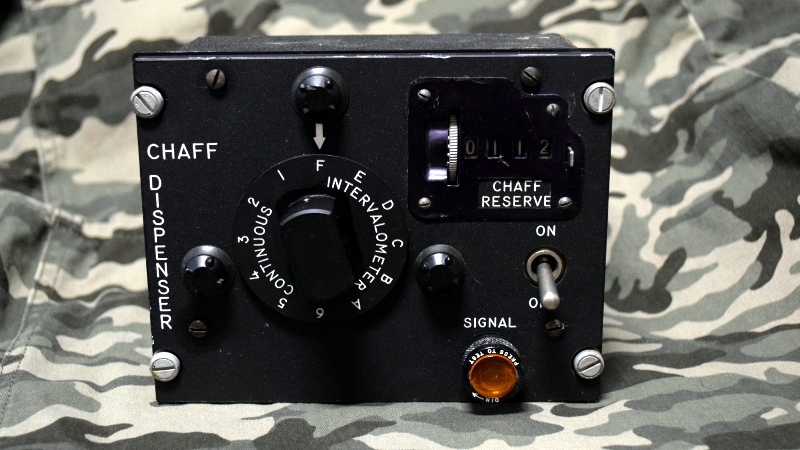
The public teardown of the C-1282 suggests a straightforward control philosophy: a selector for operating mode, a way to monitor remaining chaff, a signal indication, and an enable control. That is exactly the kind of direct, no-nonsense front-panel logic you would expect from military hardware of the period. Every control appears to have a job, and every job appears to exist because somebody, somewhere, once had to use it while their heart rate was not exactly relaxed.
The reliability problem
Defensive countermeasures occupy an unforgiving category of hardware. Nobody applauds them when everything is routine. Everybody cares when they fail. That reality tends to create a very specific design personality: conservative, redundant where needed, and more interested in dependable operation than in elegance for elegance’s sake. A controller like the C-1282 was expected to live among aircraft vibration, thermal swings, maintenance cycles, electrical noise, and long service lives. Mil-spec design guidance has long emphasized exactly those kinds of environmental stresses, along with grounding, shielding, workmanship, connectors, printed wiring, and fail-safe considerations.
In plain English: this was never going to be a flimsy little desktop box held together by optimism.
Reading the Hardware Like an Engineering Archaeologist
An interface built for hands, not marketing photos
Public images and descriptions of the C-1282 make one thing obvious right away: the front panel was built to be used, not admired. The control elements are large, distinct, and physically separated enough to reduce confusion. This is classic mil-spec ergonomics. When the environment is harsh, tactile certainty becomes a feature. A chunky selector knob is not old-fashioned; it is insurance. A clear signal light is not decorative; it is a contract with the operator.
That is one reason vintage military panels still feel so satisfying to modern eyes. Their geometry is honest. They do not hide function behind layers of abstraction. If a control is important, it looks important. If it needs to be read quickly, it gets space. If it needs to survive real hands, not just delicate fingertips, it is built like it means it.
Inside, the lesson is “serviceable ruggedness”
The public teardown also points to a largely open internal layout with point-to-point wiring rather than modern densely packed boards. By current standards, that can look almost quaint. By period standards, it makes perfect sense. Point-to-point construction, soldered connections, generous spacing, and plainly routed wiring all reflect an era when ruggedness and maintainability often outranked miniaturization. Engineers were not trying to win a contest for smallest possible footprint. They were trying to make a device that could survive real service and still be understood by a technician with training and patience.
That kind of construction also has a deeper philosophical appeal. Modern electronics often feel sealed, opaque, and disposable. Older mil-spec hardware feels explainable. You can look at it and understand that every wire, bracket, and lamp holder exists because someone made a decision about reliability, manufacturability, or field maintenance. It is less “magic rectangle” and more “mechanical argument in aluminum.”
Lighting before software had to solve everything
One of the most charming design details visible in the public teardown is the panel illumination approach. Instead of modern LEDs and digital brightness management, the unit used incandescent lighting and a diffuser arrangement to illuminate the front panel. Even better, the signal indicator appears to have used a mechanical shutter-style brightness adjustment. That is peak old-school engineering: solve a human-visibility problem with a physical mechanism that can be seen, understood, and trusted.
It is also a reminder that not every clever solution needs firmware. Sometimes the smartest design move is a robust mechanical answer that does one job extremely well. No boot time. No menu tree. No software bug report. Just light, optics, and a mechanism doing exactly what it was asked to do.
What Makes It “Mil-Spec” Beyond the Buzzword
Mil-spec is not a vibe; it is a stack of constraints
The phrase “mil-spec” gets thrown around so casually today that it sometimes sounds like a marketing flavor, somewhere between “premium” and “tactical-looking.” In real engineering, mil-spec means something more demanding. Department of Defense guidance such as MIL-STD-810 focuses on environmental stresses across a system’s service life, while MIL-HDBK-454 gathers broad design guidance for electronic equipment, including safety, workmanship, connectors, soldering, grounding, shielding, corrosion resistance, enclosures, and more.
That matters because it reframes how we look at the C-1282. The interesting part is not that it looks tough. The interesting part is that its design language reflects a world where toughness had to be engineered across many layers at once: materials, interfaces, wiring practices, panel hardware, electrical grounding, readability, service access, and resistance to vibration and moisture. Mil-spec gear earns its reputation by dealing with the boring details correctly, over and over again.
Connectors tell the story of harsh-environment design
Even without turning the C-1282 into a catalog exercise, its rear connector strategy points to an important mil-aero theme: the connector is never just a connector. Modern harsh-environment aerospace connector families such as MIL-DTL-38999 emphasize secure mating, shock and vibration resistance, environmental sealing, and shielding. Manufacturers still talk about these qualities because the underlying problems have not gone away. Aircraft electronics still hate loose connections, moisture, corrosion, and electromagnetic mischief.
In other words, the connector at the back of a box is a tiny summary of the box’s whole worldview. Is it easy to secure? Does it resist vibration? Does it protect contacts? Does it help preserve shielding continuity? If the answer is yes, you are already speaking fluent mil-spec.
Why Old Avionics Often Looks “Overbuilt”
Modern readers sometimes look at vintage military electronics and ask why everything seems so heavy, mechanical, and stubborn. The answer is simple: because the cost of failure was higher than the cost of extra metal and extra caution. The C-1282 comes from an era when engineers frequently chose robust mechanisms, explicit controls, and conservative construction because the operational environment demanded it.
There is also a cultural difference. Earlier aerospace hardware often assumed long service lives, depot maintenance, and trained operators. Today we celebrate miniaturization and software-defined flexibility. Back then, designers often celebrated access panels, repairable subassemblies, and clearly documented functions. Neither philosophy is automatically better. But for a defensive avionics controller in a bomber, the older philosophy makes immediate sense. Reliability was not just a specification. It was a survival trait.
From Earlier Countermeasure Systems to Later Ones
The broader history of airborne expendable countermeasure systems reinforces that lesson. Public references on the AN/ALE-39 and AN/ALE-47 show an evolution toward better safety, lower operating cost, improved maintainability, and smarter dispensing logic. In fact, public FAS material describing the ALE-47 specifically frames it as a replacement for the ALE-39, with stronger reliability and maintainability. That evolution does not make earlier hardware “bad.” It makes earlier hardware exactly what engineering always produces: a serious answer to the threats, materials, and budgets of its own time.
The C-1282 belongs to that lineage. It represents a moment when defensive avionics still leaned heavily on electromechanical clarity, physical controls, and rugged panel hardware. Later systems gained more automation, more integration, and more digital intelligence. But the core design goal stayed the same: let the crew trust the box.
What Modern Designers Can Learn from the C-1282
Clarity beats cleverness
The C-1282 is a great reminder that the best interface is not always the most futuristic one. In demanding environments, clarity wins. Make the important control obvious. Make the status indication unambiguous. Make the operator’s mental model as short as possible. Fancy is optional. Clear is mandatory.
Physical design is part of system safety
We sometimes talk about safety as if it lives only in software logic or operating procedures. Old mil-spec hardware argues otherwise. Panel spacing, switch feel, lighting behavior, connector retention, and enclosure design all contribute to safe, correct use. The physical design of a control box is part of the system’s reliability story.
Maintainability is not glamorous, but it ages beautifully
One reason vintage avionics earns so much respect is that it often looks repairable. Even when it is not convenient by modern standards, it feels intentional. Designers thought about access, assembly, replacement, and inspection. That mindset still matters. A product that can be understood, serviced, and trusted will always outclass one that is sleek but disposable.
Final Verdict: A Beautifully Boring Box
The C-1282 chaff controller is not famous because it is flashy. It is interesting because it is disciplined. Publicly available evidence suggests a controller that did exactly what a bomber crew needed: present essential functions clearly, survive a harsh environment, and embody the mil-spec obsession with dependable operation. Its front panel speaks the language of human factors. Its construction speaks the language of reliability. Its place in B-52 history speaks the language of mission support.
And honestly, that is why it is so cool. The C-1282 is a beautifully boring box. It is the kind of hardware that reminds us engineering greatness is often quiet. Sometimes the most impressive machine in the room is not the one making the biggest noise. Sometimes it is the old gray controller in the corner, calmly doing its job while history thunders around it.
Experience Notes: What Handling a Milspec Controller Like This Feels Like
Spending time with a piece of hardware like the C-1282, even through public teardown photos and the broader culture of vintage avionics collecting, creates a very specific impression. The first thing that hits you is not complexity. It is seriousness. Everything about the object looks intentional. The panel does not waste space. The controls do not beg for attention. The box has the visual attitude of a machine that assumes you already know why you are here.
That experience is very different from opening modern consumer electronics. A phone or laptop usually feels like a sealed puzzle that does not really want you inside. A vintage mil-spec controller feels more like meeting an old mechanic who does not smile much but explains everything with perfect logic once you ask the right question. The screws look like they belong there. The brackets look like they were sized by someone who distrusted flex. The wiring layout, even when not pretty in a modern minimalist sense, tends to feel purposeful rather than decorative.
There is also a sensory imagination that comes with this kind of equipment. You can almost picture the tactile rhythm of using it in service: the solid turn of a selector, the deliberate resistance of a switch, the subtle glow of incandescent panel lighting in a dim crew station, the simple reassurance of a signal indicator that means exactly one thing. That matters because old avionics was deeply physical. It communicated through shape, force, light, spacing, and muscle memory. A lot of modern interface design tries to simulate that confidence. Vintage mil-spec hardware often had the real thing.
Another experience people often describe with old aerospace equipment is respect for the maintenance mindset behind it. Even when the internal construction is dense or old-fashioned, you can sense that somebody expected this device to be inspected, repaired, and returned to service. It was not designed around annual upgrade cycles or disposable convenience. It was designed around continuity. That creates a strange emotional effect: the box feels less like a product and more like a participant in a larger system of crews, procedures, checklists, and technical orders.
And then there is the emotional contrast that makes these teardowns so memorable. On one level, the C-1282 is just a controller with knobs, lamps, wiring, and connectors. On another level, it is a survivor from a time when engineering decisions were shaped by strategic anxiety, rapid technological change, and very real operational consequences. That tension gives the object weight. You are not just looking at old electronics. You are looking at a material snapshot of how a particular era thought about danger, reliability, and human performance.
That is probably the most lasting experience of all. A controller like this does not impress because it is rare or dramatic. It impresses because it feels honest. It tells you, without saying a word, that somebody once had a problem, understood the problem, and built a tool that was supposed to keep working when conditions got ugly. There is something timeless about that. Whether you love aerospace history, industrial design, restoration culture, or just the stubborn dignity of machines built to last, the C-1282 leaves the same final impression: this is what engineering looks like when excuses are not part of the spec.