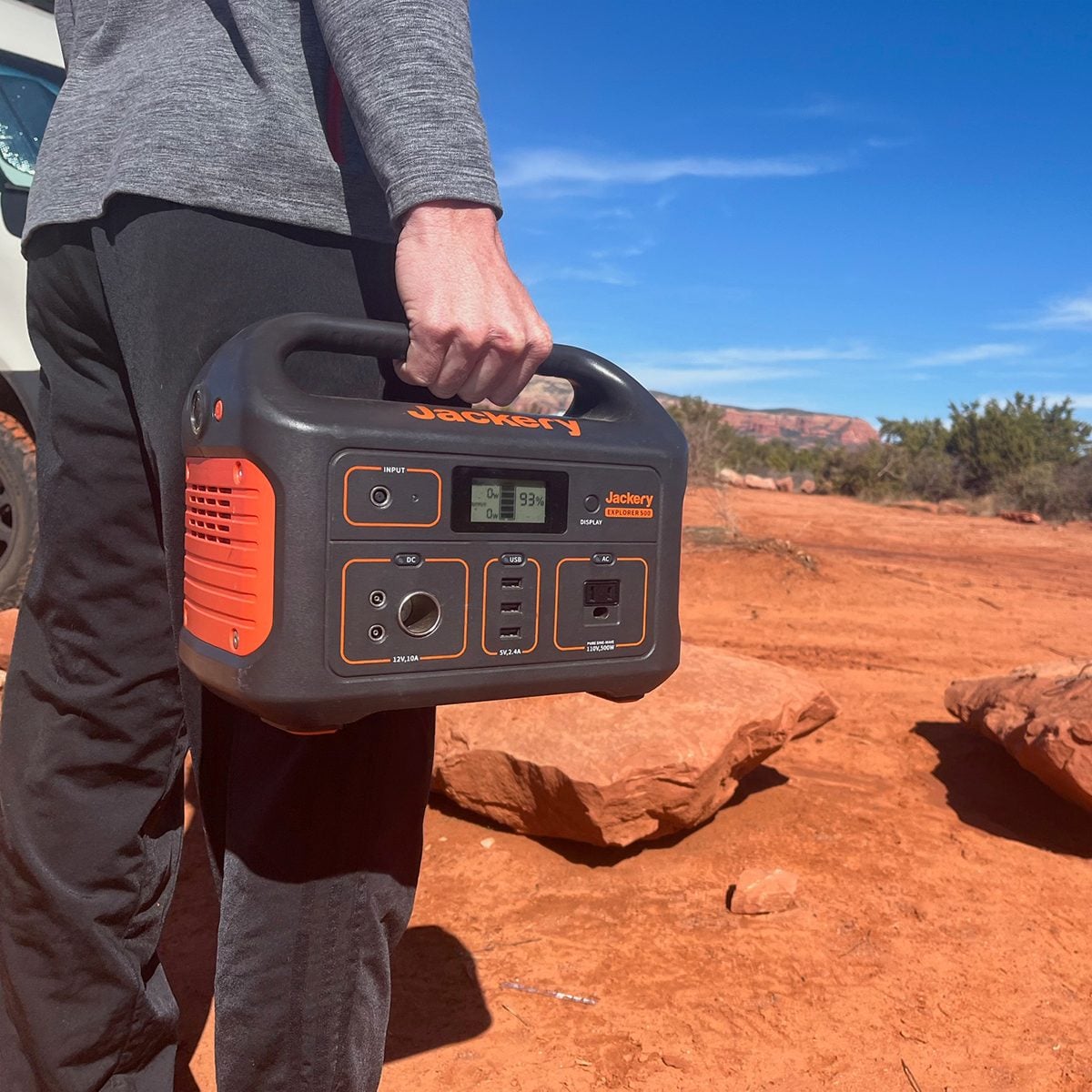

Van life has a funny way of changing your definition of luxury. In a house, luxury might mean heated bathroom floors or a refrigerator that makes perfectly spherical ice. In my van, luxury means waking up with a charged phone, making coffee without starting the engine, and finishing a day’s work before my laptop begins issuing desperate low-battery warnings.
That is why my Jackery portable generator has become one of the most valuable pieces of equipment in my tiny rolling home. Technically, it is a portable power station, not a fuel-burning generator. There is no gasoline, no pull cord, no exhaust, and no engine rattling beside the van like an angry lawn mower. When paired with solar panels, Jackery markets the setup as a solar generator.
Whatever you call it, the result is wonderfully simple: I can store electricity, carry it wherever I park, and use it to power the devices that make van living comfortable, productive, and slightly less primitive.
Why Electricity Becomes a Big Deal When You Live in a Van
A van may be a tiny home, but it still contains a surprising number of power-hungry residents. My laptop wants electricity. My phone wants electricity. The refrigerator, lights, camera batteries, fan, router, water pump, and rechargeable toothbrush all line up for their share.
Without a dependable off-grid power system, every day becomes an awkward negotiation. Do I charge the laptop or run the fan? Can I use the blender, or will breakfast knock out the fridge? Should I drive thirty minutes simply to recharge my batteries?
A permanently installed electrical system with roof-mounted solar panels, a house battery bank, fuses, wiring, an inverter, and a DC-to-DC charger can be excellent. It can also be expensive and intimidating. A portable Jackery power station offers a far easier entry point. Charge the unit, press a button, plug in your device, and enjoy the rare pleasure of an electrical system that does not require an engineering degree.
Why I Chose a Jackery Portable Power Station
It Works Without a Complicated Installation
The biggest attraction was simplicity. I did not have to drill additional holes in the roof, route thick cables behind wall panels, or spend an afternoon wondering whether a mystery wire would charge my batteries or turn the van into a toaster.
The battery, inverter, display, charging controller, outlets, and protective electronics are housed inside one portable unit. That makes a Jackery especially appealing for renters, weekend campers, minivan conversions, temporary builds, and anyone who wants usable off-grid power immediately.
Independent van-life guides have reached a similar conclusion: portable power stations are convenient, modular solutions for simple builds, although their fixed capacity and proprietary components may be limiting for people creating large permanent electrical systems.
It Is Quiet Enough for Real Camping
A traditional generator announces itself to the entire campground. A battery power station mostly minds its own business. The cooling fan may run under heavier loads or while the battery is charging, but normal operation is dramatically quieter than using a fuel-powered generator.
That matters when I am parked near other campers, working late, or trying to enjoy a peaceful morning. It also matters in campgrounds with restricted generator hours. National Park Service campgrounds commonly impose quiet hours or limit when engine-driven generators may operate. A battery station lets me charge small electronics without introducing engine noise into the evening. Campground rules still vary, so I always check local regulations.
It Fits the Van-Life Sweet Spot
Jackery sells models ranging from compact units for phones and cameras to large expandable systems for demanding appliances. For many van dwellers, a roughly 1-kilowatt-hour model offers a practical balance between capacity and portability.
The current Jackery Explorer 1000 v2, for example, has a rated capacity of 1,070 watt-hours, a 1,500-watt continuous AC output, a 3,000-watt surge rating, multiple AC and USB outlets, and a weight of about 23.8 pounds. It uses lithium iron phosphate battery chemistry and supports wall, vehicle, and solar charging. Jackery rates the battery for 4,000 cycles before it declines to approximately 70% of its original capacity.
Those numbers vary among Jackery models, so buyers should check the exact product page and manual rather than assuming every orange-and-black box performs identically.
What My Jackery Can Realistically Power
A power station’s capacity is measured in watt-hours, while its maximum output is measured in watts. The difference sounds boring until you plug in an appliance.
Watt-hours indicate roughly how much energy the battery stores. Output wattage determines whether it can operate a particular appliance at all. A 1,070Wh station may hold plenty of energy for several laptop charges, but an appliance that requires more than the inverter’s output limit can still overload the system.
Real usable capacity is usually lower than the number printed on the box because the inverter and internal electronics consume some energy. Appliance startup surges, ambient temperature, battery age, and duty cycles also affect runtime.
| Device | Typical Power Use | Practical Van-Life Expectation |
|---|---|---|
| Smartphone | 10–20Wh per full charge | Dozens of charges |
| Laptop | 40–100Wh per charge | Several full charges |
| LED lights | 5–20W | Many evenings of lighting |
| 12V compressor refrigerator | Variable; commonly 30–60W while cycling | Often a day or longer, depending on temperature and cycling |
| Ventilation fan | 10–40W | Many hours of operation |
| Electric blanket | 40–100W | Several hours, depending on setting |
| Small coffee maker | 600–1,200W | Possible on a suitable model, but energy-intensive |
| Induction cooktop | 800–1,800W | Possible only within output limits; drains the battery quickly |
The lesson is simple: small electronics are easy. Heating and cooking appliances are the battery bullies of van life. Anything designed to create heatspace heaters, electric kettles, hair dryers, hot plates, and toaster ovenscan consume a large portion of a portable battery surprisingly quickly.
How I Recharge It on the Road
Wall Charging
Whenever I stay at a campground with hookups, visit friends, or spend time in a building with permission to use an outlet, I plug in the Jackery. Newer models can charge much faster than earlier generations. The Explorer 1000 v2 includes an emergency charging mode that can reach a full charge in about an hour under suitable conditions, while its standard mode is intended to be gentler for routine charging.
Fast charging is wonderfully convenient when I have a limited window near an outlet. I still use the manufacturer’s recommended standard mode when I am not in a hurry.
Charging While Driving
The vehicle charging cable is my dependable backup. I connect the Jackery to the van’s 12-volt outlet while driving, secure the unit so it cannot slide around, and let the alternator contribute while I move to the next campsite.
Vehicle charging is generally slower than wall charging. It may not fully replenish a large battery during a short drive, but it can offset the energy used by my refrigerator, laptop, and lights. I also avoid charging from a starter battery while the engine is off unless the vehicle and charging setup are specifically designed to prevent battery depletion.
Solar Charging
Solar is where the system begins to feel magical. I unfold a compatible panel, aim it toward clear sunlight, connect it to the Jackery, and watch free energy flow into the battery.
Of course, solar panels have not read the marketing brochure. Clouds, shadows, panel angle, heat, season, and available daylight all affect output. A panel rated at 200 watts will not deliver exactly 200 watts every minute of the day.
Portable panels also require storage space and regular setup. A van-life reviewer using a larger Jackery system noted that folding panels stored conveniently behind a seat but still occupied meaningful room, while accidentally leaving output ports switched on could contribute to gradual battery drain.
Even with those inconveniences, portable solar works well for my travel style. I can park the van in shade while placing the panels in sunlight, something a fixed roof array cannot always do.
What I Love Most About the Jackery
The Display Makes Power Management Easy
The screen tells me the remaining battery percentage, incoming power, outgoing power, and estimated operating time. That information turns vague battery anxiety into a manageable calculation.
If the fridge is running and the estimated runtime suddenly drops, I can check whether I accidentally left the inverter active or plugged in something power-hungry. In van life, knowledge is poweroccasionally in the most literal sense possible.
The USB-C Port Reduces Cable Clutter
High-output USB-C charging lets me power a compatible laptop directly without using its AC power brick. Direct DC charging can reduce conversion losses and eliminates another bulky adapter from the van.
The Explorer 1000 v2 includes USB-C, USB-A, AC, and 12-volt outputs, although port counts and power ratings differ by region and model. Independent reviewers have consistently identified its mixture of capacity, output, portability, and modern connections as a strong all-purpose combination.
I Can Move It Outside the Van
A fixed electrical system remains attached to the vehicle. A portable power station can follow me to a picnic table, campsite, photography location, backyard workspace, or emergency shelter.
I have used portable power to charge camera batteries outside, run lights beneath an awning, and keep devices operating when I did not want to sit inside the van. That flexibility is difficult to quantify on a specification sheet, but it is one of the product’s best features.
The Drawbacks Nobody Should Ignore
It Is Not Cheap
Portable power stations can cost more per watt-hour than a carefully planned do-it-yourself battery system. Solar panels increase the total investment, and expansion batteries are available only for certain models.
The value comes from convenience, portability, warranty support, and integrated components. For a permanent full-time build with heavy electrical use, a custom system may provide more capacity and flexibility for the money.
Capacity Is Fixed on Many Models
The Explorer 1000 v2 is not expandable. Once its stored energy is gone, I need sunlight, a wall outlet, or the vehicle charging cable. Jackery’s 1000 Plus and larger systems offer expansion options, but they are heavier and occupy more precious van space.
Independent testing of larger Jackery models often praises their reliable operation and durable battery chemistry while noting familiar trade-offs: extra capacity adds weight, proprietary connectors may limit panel choices, and large systems become less pleasant to carry.
It Cannot Replace Sensible Energy Planning
Owning a portable generator does not mean I can behave as though I am connected to the grid. Running electric heat all night, cooking every meal on a high-powered appliance, and operating a portable air conditioner for hours can overwhelm a modest battery.
I still use propane or another appropriate cooking method where permitted, choose efficient 12-volt appliances, switch off unused outputs, and monitor daily consumption. The Jackery provides power, but it does not repeal the laws of physics.
Safety Rules I Follow Inside My Van
A battery power station does not produce combustion exhaust during normal operation, but it still stores a substantial amount of electrical energy. I keep it dry, allow room for ventilation, use undamaged cables, follow the temperature limits in the manual, and never cover the unit while it is charging or powering a large load.
I secure it before driving because a 20- or 30-pound battery becomes a dangerous projectile during a sudden stop. I also inspect the case and connectors regularly. A swollen, cracked, unusually hot, leaking, or damaged lithium battery should not be used casually.
Safety certification and proper battery-management systems matter when purchasing portable energy equipment. UL Solutions emphasizes that battery packs and energy-storage products should be evaluated against appropriate safety standards and protected against hazards such as overheating, electrical faults, and thermal runaway.
I also distinguish a battery station from a fuel generator. Gasoline, diesel, or propane generators must never operate inside a van or other enclosed space because carbon monoxide can be deadly. Federal emergency guidance recommends operating combustion generators outdoors and well away from doors, windows, and vents.
Which Jackery Is Best for Van Life?
The right size depends on the appliances you own, how often you drive, whether you carry solar panels, and how long you camp away from outlets.
Choose a Small Model When:
- You mainly charge phones, tablets, cameras, lights, and a small laptop.
- You travel on weekends rather than living in the van full-time.
- Low weight and compact storage are more important than running appliances.
Choose a Mid-Sized 1kWh Model When:
- You run a compressor refrigerator, laptop, lights, fan, and communication equipment.
- You work remotely and need a meaningful reserve.
- You want enough AC output for occasional kitchen appliances.
- You still need one person to carry the unit comfortably.
Choose a Large or Expandable Model When:
- You use electric cooking frequently.
- You power professional equipment or multiple computers.
- You remain off-grid for extended periods.
- You want the station to serve as both van power and home emergency backup.
Before buying, I recommend making a list of every device, its operating wattage, its startup surge, and the number of hours it will run each day. Add the expected watt-hours together, allow a margin for conversion losses and cloudy weather, and select a station with adequate output as well as adequate capacity.
My Final Verdict
I swear by my Jackery not because it creates unlimited electricity, but because it makes limited electricity remarkably easy to manage.
It lets me work from quiet campsites, keep food cold, charge communication devices, illuminate the van, and maintain a few modern comforts without building an elaborate electrical system. It is clean at the point of use, simple to operate, portable, and compatible with several charging methods.
It is not the perfect solution for every van. Serious full-time builds may benefit from larger permanent battery banks, fixed solar arrays, and alternator charging. People who rely heavily on electric heat or air conditioning will probably need substantially more capacity.
For my mixture of remote work, road trips, dispersed camping, and daily electronics, however, the Jackery hits the sweet spot. My van may not contain a dishwasher, walk-in closet, or marble countertop, but it has dependable electricityand out here, that feels much more luxurious.
Van-Life Field Notes: 500 More Words From the Road
The moment I truly appreciated my portable generator was not dramatic. There was no blizzard, roadside emergency, or cinematic lightning strike. I was parked on public land, miles from the nearest outlet, trying to submit a project before sunset.
My laptop was at 14%. My phone was at 22%. The cellular router had been running all afternoon, and the refrigerator was quietly protecting a collection of groceries that had cost far too much in the nearest tourist town.
In my pre-Jackery days, this situation would have triggered a ridiculous chain of events. I would start the van, drive toward civilization, search for a café, buy an overpriced beverage as rent for an outlet, and attempt to work while someone conducted a speakerphone conversation at the next table.
Instead, I reached behind the passenger seat, pressed the Jackery’s power button, connected the laptop, and kept working. The entire crisis lasted approximately six seconds.
That quiet convenience is what specification charts often miss. The best feature is not the battery chemistry or surge rating. It is the ability to solve ordinary problems before they become travel-day disasters.
I have used the station during rainy mornings when solar production was disappointing. I have carried it to a picnic table so I could work outside. I have charged drone batteries after a long day of filming and powered decorative lights when a campsite needed a little personality. Nothing says “rugged wilderness explorer” quite like carefully arranged string lights.
I have also learned what not to do. The first lesson was to switch off the AC inverter when I am not using it. Inverters consume some energy even when no appliance is drawing meaningful power. The second lesson was to check the forecast before depending on solar. Optimism is not a recognized charging method.
The third lesson was to secure everything before driving. My early van organization system consisted of placing objects where they looked convenient and hoping gravity remained cooperative. It did not. The Jackery now rides in a stable, ventilated location where it cannot tip, slide, or collect blankets around its cooling vents.
Seasonal temperature changes have influenced my routine as well. In summer, I keep the station shaded and avoid leaving it in the hottest part of a sealed vehicle. During cold weather, I bring it into the warmer living area and follow the charging-temperature guidance for my model. Lithium batteries are impressive, but they are not magical bricks immune to weather.
My favorite routine happens on clear mornings. I park the van beneath a tree, place the folding solar panel in direct sun, connect it to the power station, and make breakfast while the battery charges. By the time I have answered email and planned the day’s route, the sun has replaced a meaningful portion of yesterday’s electricity.
There is a satisfying rhythm to it: charge while sunlight is abundant, use efficient devices, watch the display, and avoid wasting energy. Living with a finite battery has made me more aware of electricity than I ever was in a house. Every watt has a job.
Would I recommend a Jackery to every van dweller? I would recommend calculating your needs first. A small model can be wonderful for weekend travel but frustrating for a full-time remote worker. A giant expandable system can run more equipment but may consume too much money and floor space for a minimalist build.
For the right person, though, a Jackery portable power station turns van electricity from a construction project into an appliance. You charge it, carry it, and use it. That simplicity gives me more time for the reasons I moved into a van in the first place: exploring new places, working with a better view, and occasionally spending an entire morning doing absolutely nothing beside a lake.