My 25 Illustrations Sum Up The Events That Have Happened During The Coronavirus Pandemic

The coronavirus pandemic did not enoved the office onto the dining table, and somehow convinced millions of people that toilet paper was a form of emergency currency.
As the weeks of uncertainty became months and then years, ordinary objects acquired strange new meanings. A face mask became both protection and a political symbol. A laptop became a classroom, conference room, birthday venue, and occasionally a very expensive tray for snacks. A grocery delivery left on the porch could feel like a gift from civilization itself.
My series of 25 coronavirus pandemic illustrations turns these shared experiences into visual snapshots. Some drawings are humorous, because laughter helped people survive the absurdity. Others are deliberately quiet, reflecting the loneliness, exhaustion, grief, and inequality hidden behind daily statistics. Together, they tell the story of quarantine life, social distancing, remote work, frontline workers, vaccination, and a world learning how fragile normal life can be.
The Sudden Arrival of a New Reality
1. The Calendar That Lost Its Purpose
The first illustration shows a calendar watching its appointments disappear one by one. Weddings, concerts, vacations, school events, and family dinners are crossed out until every day looks suspiciously like Sunday. In the corner, a pair of sweatpants celebrates an unexpected promotion to formalwear.
2. The Great Toilet Paper Tournament
A supermarket aisle becomes an Olympic arena where shoppers race toward the final package of toilet paper. The humor comes from the mismatch between the actual threat and the product people chose to hoard. Empty shelves became one of the earliest and strangest visual symbols of pandemic panic.
3. Hand Sanitizer Becomes Liquid Gold
In this drawing, a tiny bottle of sanitizer sits inside a museum display while security guards protect it. During the early outbreak, sanitizer, disinfectant, masks, and cleaning supplies became difficult to find. Products once tossed casually into shopping carts suddenly received the treatment normally reserved for precious jewels.
4. Six Feet Apart, Emotionally Much Farther
Two friends stand on opposite sides of an enormous measuring tape. They can see one another, but every attempt at a hug is blocked by a giant ruler. Social distancing helped reduce close contact, yet it also turned simple human gestures into complicated calculations involving space, risk, and guilt.
5. The Mask Learns Every Fashion Trend
The fifth illustration presents masks preparing for a fashion show. There are floral masks, homemade masks, medical masks, masks that match shirts, and one rebellious mask worn beneath the nose like a tiny chin hammock. Face coverings became an everyday object, an identity statement, and a frequent source of public disagreement.
When Home Became the Entire World
6. The Kitchen Table Corporate Headquarters
A family eats breakfast around a table buried beneath monitors, chargers, notebooks, coffee cups, and one confused cat. Remote work arrived rapidly for employees whose jobs could be performed online. Between 2019 and 2021, the share of Americans primarily working from home tripled from 5.7% to 17.9%. to the Video Meeting Grid
This illustration turns a video call into an apartment building. Each square contains a tiny drama: a frozen face, a barking dog, a child demanding snacks, and a colleague speaking passionately while muted. Video calling became a lifeline for work and relationships, although it also introduced “Can you hear me?” as an unofficial national greeting.
8. School Moves Into the Living Room
A teacher appears on a laptop while students attend class from beds, couches, and blanket forts. In spring 2020, 77% of U.S. public schools moved some or all classes to online distance learning. The transition kept lessons going, but access to devices, reliable internet, quiet rooms, and adult support varied dramatically. <Receive Seventeen New Job Titles
One exhausted parent is pictured wearing badges that read employee, teacher, cook, cleaner, technician, counselor, referee, and snack manager. School closures exposed how much daily life depends on teachers, childcare providers, cafeteria workers, and extended family networks. Many parents tried to maintain productivity while someone nearby shouted about a missing password.
10. The Sourdough Starter Takes Control
A jar of sourdough starter grows until it occupies the entire kitchen and demands to be fed on schedule. Baking offered comfort, structure, and a small sense of accomplishment. When the outside world felt uncontrollable, producing a respectable loaf of bread felt like defeating chaos with flour.
11. The Quarantine Haircut Experiment
A nervous family member holds clippers while the customer studies an online tutorial titled “Professional Haircut in Three Easy Steps.” A second browser tab asks, “How long does hair take to grow back?” Closed salons inspired home haircuts ranging from surprisingly decent to historically significant.
12. Birthdays Through Glass and Screens
A birthday cake sits on one side of a window while relatives wave from the sidewalk. Other guests appear on a tablet balanced beside the candles. Technology allowed people to mark important occasions, but digital celebrations could not completely replace shared meals, handshakes, kisses, or the chaos of everyone singing at a different speed.
13. Pets Win the Pandemic
A delighted dog presents a schedule filled with walks, treats, naps, and constant companionship. Behind it, the owner tries to finish a report with one hand. Many pets seemed thrilled that humans had finally accepted the obvious truth: leaving home every morning had always been a terrible idea.
Fear, Work, Technology, and Unequal Burdens
14. The Window Becomes a Social Network
An older adult sits beside a window while neighbors wave from below. The scene is gentle but intentionally spacious, emphasizing how isolation could be physically safe and emotionally painful at the same time. Pandemic-era research documented increased loneliness, anxiety, depression, and social disconnection across multiple age groups. olling Until Two in the Morning
A person lies in bed beneath a phone that has transformed into a waterfall of headlines, charts, rumors, arguments, and alarming notifications. People needed reliable information, but continuous exposure could intensify fear. The news cycle never seemed to sleep, largely because everyone kept checking to make sure it was still terrible.
16. The Misinformation Megaphone
A tiny rumor enters one end of a social-media machine and emerges as a giant monster wearing a lab coat. False cures, conspiracy theories, fraudulent products, and impersonation scams spread alongside legitimate public-health guidance. The Federal Trade Commission tracked pandemic-related fraud and acted against sellers making unsupported treatment claims. rstep Delivery Ritual
A delivery driver places groceries beside a door while the customer waits behind it like a contestant in an extremely cautious game show. Contactless delivery helped households obtain food and supplies while reducing close interaction. Drivers, warehouse employees, postal workers, and store staff became essential links between isolated homes and the wider economy.
18. Grocery Shelves Play Hide-and-Seek
Packages of pasta, canned soup, yeast, and paper towels hide behind price labels as shoppers search for them. The supply problem was not simply a lack of food; demand shifted suddenly from restaurants to homes, creating packaging, transportation, staffing, and distribution challenges. U.S. grocery sales briefly surged as households stocked up. loyment Elevator Falls
An office elevator labeled “Employment” drops sharply while workers cling to résumés and unpaid bills. The economic shock was immediate: the U.S. unemployment rate reached 14.7% in April 2020, the highest level recorded in the series dating back to 1948. Behind that percentage were millions of disrupted careers and anxious households. <al Does Not Mean Invincible
A grocery clerk, bus driver, nurse, cleaner, warehouse worker, and caregiver stand beneath the word “essential,” using it as an umbrella against a storm. The illustration questions how society praises necessary workers while often providing them with limited protection, uncertain schedules, low pay, or inadequate access to support.
21. Healthcare Workers Carry the Weight
A nurse walks through a hospital corridor carrying oxygen tanks, paperwork, protective equipment, and the emotional weight of several families. Frontline medical workers faced exposure fears, staffing shortages, repeated loss, and concern about bringing the virus home. Surveys found substantial mental-health consequences among workers providing direct care. tion>
Hope, Grief, and the Complicated Road Forward
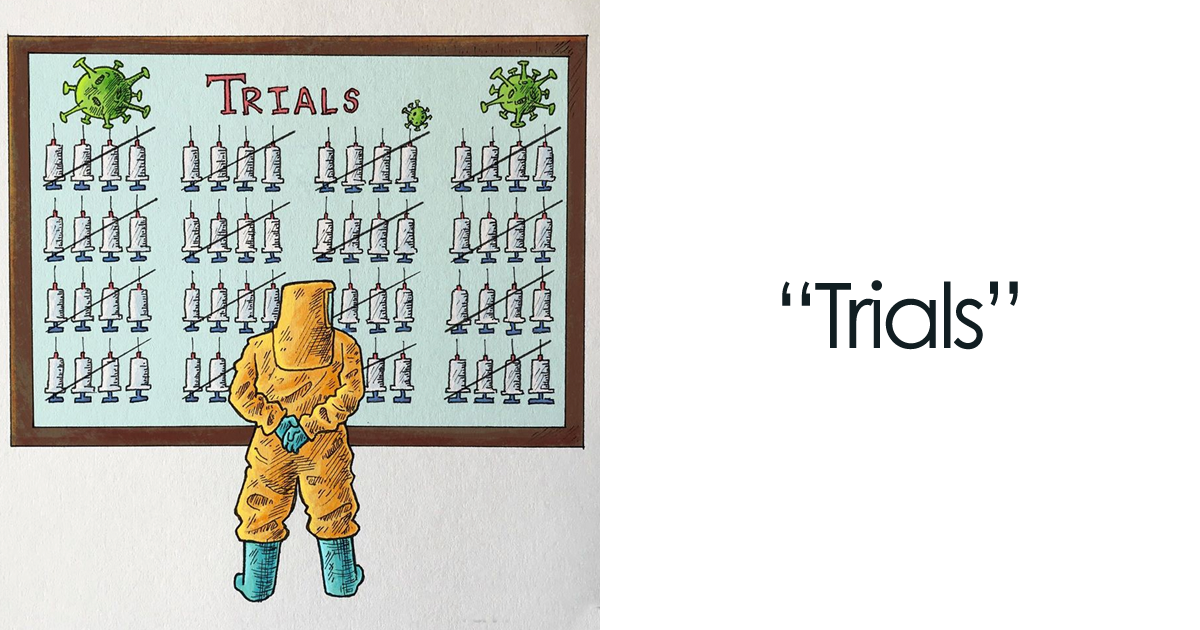
22. Scientists Race Against the Clock
Researchers run around a giant clock carrying test tubes, data sheets, and vaccine coolers. The picture recognizes the collaboration behind clinical trials, manufacturing, regulation, and distribution. The FDA issued the first U.S. emergency use authorization for a COVID-19 vaccine in December 2020, creating a major turning point in the pandemic response. <cination Selfie
A rolled-up sleeve poses for a photograph beside a vaccination card. For many people, the first dose represented hope of seeing parents, returning to work, or entering public places with less fear. For others, vaccination became another subject of uncertainty, mistrust, access barriers, and intense public debate.
24. The Variant Alphabet Refuses to End
Greek letters stand in line outside a casting office, each auditioning to become the next alarming headline. Just as routines began to feel stable, new variants changed risk calculations and public guidance. The illustration uses humor to capture the emotional exhaustion of repeatedly hearing that the pandemic had entered yet another phase.
25. The Door Marked “Normal” Opens Differently
The final drawing shows people walking through a door labeled “normal,” only to discover that the room on the other side has been rearranged. Remote work remains common in many industries. Telehealth expanded. Some families continue to grieve. Others live with persistent post-COVID symptoms that may last months or years. The destination was never the old normal; it was a changed world carrying visible and invisible reminders of what happened. tion>
Why Coronavirus Pandemic Illustrations Still Matter
Statistics are necessary, but they can flatten complicated lives into neat rows of numbers. COVID-19 art preserves smaller details: the elastic marks left by masks, chairs spaced apart in waiting rooms, grandparents waving through glass, and children learning beside piles of laundry. These images help future viewers understand not only what policies were introduced, but how those policies felt.
Humor also deserves a place in the record. Laughing about failed haircuts or chaotic video meetings does not minimize illness and loss. It shows how people created moments of relief while carrying fear. Comedy was often a pressure valve, releasing enough tension to make another day indoors feel manageable.
At the same time, an honest pandemic retrospective cannot be entirely cute. Experiences differed according to health, income, occupation, housing, disability, caregiving responsibilities, and access to technology. One person gained commuting time while another lost a job. One family ordered groceries online while another delivered them. One home contained a peaceful office; another held several people competing for one device and a reliable connection.
That contrast is the heart of these 25 illustrations. They are not intended to declare that everyone experienced the same pandemic. Instead, they assemble recognizable pieces of a global event whose burdens were shared unevenly.
My Experience Creating and Reflecting on These 25 Illustrations
When I began developing this series, I assumed the funniest memories would dominate. There was no shortage of material. People held meetings wearing business shirts and pajama pants. Pets interrupted serious presentations with impeccable timing. Homemade bread became a personality trait. Every household seemed to contain at least one chair that had been unwillingly promoted to office furniture.
As I sketched, however, the quieter memories kept entering the drawings. I remembered the unusual silence of streets that had once been noisy, the careful choreography of passing another person on a sidewalk, and the way a simple cough could make an entire room suddenly alert. Humor remained important, but it could not tell the whole story.
The hardest illustration was the one about healthcare workers. It was tempting to draw them as invincible superheroes because that was a familiar public image. Yet the superhero label sometimes concealed the fact that real people were frightened, exhausted, and working under enormous pressure. I wanted the character to look courageous without suggesting that courage eliminated human limits. Bravery is not the absence of exhaustion; sometimes it is continuing while admitting that the load is too heavy.
The remote-school drawing also changed several times. My first version focused on children appearing in amusing video-call squares. That scene was real, but incomplete. Online education also revealed major differences in internet access, equipment, home environments, and parental availability. I added tangled cables, shared devices, and a parent attempting to work nearby because the chaos was not simply comic. For many households, it was an exhausting daily puzzle.
Creating the empty-shelf illustration brought back the strange emotional power of ordinary objects. Before the pandemic, a bag of flour or package of paper towels was almost invisible. During periods of scarcity, finding one could produce genuine relief. The drawing exaggerates products hiding from shoppers, yet the underlying memory is serious: uncertainty changed how people evaluated risk, planned purchases, and trusted supply systems.
I also noticed that screens appeared in nearly every sketch. They connected families, delivered medical appointments, provided entertainment, supported work, and carried breaking news. They also delivered rumors, arguments, and an endless stream of alarming information. Technology was neither the hero nor the villain. It was more like an extremely energetic roommate who helped with important tasks but never understood when everyone needed a little quiet.
The final illustration took the longest because I did not want it to show a tidy finish line. The federal COVID-19 public health emergency ended on May 11, 2023, but an administrative ending could not erase grief, economic disruption, educational setbacks, changed workplaces, or long-term illness. therefore opens into a familiar room whose furniture has moved. Life continues, but not in exactly the same arrangement.
Looking at the completed series, I see a record of adaptation. People learned unfamiliar technologies, cared for neighbors, produced protective equipment, supported local businesses, taught children at kitchen tables, and found creative ways to remain connected. None of these responses makes the pandemic romantic. They simply show that even during a frightening and unequal crisis, people searched for practical solutions and moments of kindness.
My greatest hope is that viewers recognize their own memories without assuming their experience was universal. One person may laugh at the sourdough illustration, while another connects most strongly with the lonely figure at the window. Someone else may see the essential-worker drawing and remember reporting to work while the rest of the city stayed home.
That is what illustration can preserve better than a timeline alone: contradiction. The pandemic was frightening and ridiculous, isolating and digitally crowded, technologically impressive and socially divisive. It created grief alongside gratitude, innovation beside confusion, and remarkable solidarity beside deep inequality. These 25 COVID-19 illustrations are my attempt to keep all those truths in the same frame.
Conclusion
The coronavirus pandemic reshaped work, education, healthcare, relationships, consumer behavior, and the meaning of personal space. It gave the world a new visual language made of masks, charts, laptop grids, delivery boxes, vaccination cards, and empty chairs.
These illustrations capture only a fraction of that history, but together they show why the period remains difficult to summarize with a single emotion. We laughed, worried, adapted, argued, helped, grieved, and kept going. The pandemic may no longer organize every hour of daily life, yet its influence remains visible in our workplaces, technologies, health systems, habits, and memories.
Editorial note: This creative retrospective was informed by documented pandemic records and research from the CDC, FDA, HHS, NIH, NIMH, U.S. Census Bureau, Bureau of Labor Statistics, National Center for Education Statistics, USDA, FTC, KFF, and Pew Research Center. It is intended as cultural commentary rather than medical guidance. tion class=”seo-data”>
SEO Information