
Teaching can sometimes feel like performing a one-person play, managing a weather system, and solving a mystery novelall before lunch. Teachers make hundreds of decisions every day, yet too often they receive feedback only during formal evaluations, when everyone is wearing their “please do not make this awkward” face. That is where instructional rounds can be wonderfully useful.
Using instructional rounds to guide teachers is not about catching mistakes, ranking classrooms, or turning school leaders into clipboard-wielding hall monitors. At its best, instructional rounds are a structured, collaborative way for educators to study teaching and learning together. Teachers and leaders visit classrooms, collect evidence, analyze patterns, and decide what the school’s “next level of work” should be. In plain English: they look carefully, talk honestly, and improve together.
Inspired by medical rounds, instructional rounds bring groups of educators into real classrooms to examine a shared problem of practice. Instead of asking, “Is this teacher good or bad?” the better question is, “What are students being asked to do, how are they responding, and what does that tell us about instruction across the school?” That small shift changes everything. Suddenly, observation becomes professional learning instead of professional sweating.
What Are Instructional Rounds?
Instructional rounds are a disciplined process in which educators observe classrooms using a specific focus, gather nonjudgmental evidence, debrief as a team, and identify action steps for improving teaching and learning. The method is often associated with the work of Elizabeth City, Richard Elmore, Sarah Fiarman, and Lee Teitel, whose instructional rounds framework helped schools think more systematically about classroom practice, teacher collaboration, and school improvement.
The process usually includes four major parts: defining a problem of practice, observing classrooms, analyzing evidence, and identifying the next level of work. Each part matters. Skip one and the whole thing can turn into a school tour with snacks. Pleasant? Sure. Transformational? Not exactly.
Instructional Rounds Are Not Traditional Teacher Evaluation
This point deserves a flashing neon sign: instructional rounds are not meant to be teacher evaluation. Evaluation typically focuses on one teacher’s performance. Instructional rounds focus on patterns of teaching and learning across classrooms. The goal is not to decide whether Mrs. Johnson’s Tuesday lesson deserves three stars or four. The goal is to understand how students experience instruction and what adults can do next to improve learning schoolwide.
When rounds are used properly, they reduce isolation. Teachers get to see other teachers work, notice strategies they might adapt, and discuss instruction with colleagues using shared language. Instead of professional development being something that happens in a hotel ballroom with weak coffee, it happens in the place that matters most: the classroom.
Why Instructional Rounds Help Guide Teachers
Instructional rounds guide teachers because they make teaching visible. Much of teaching is invisible from the outside: the planning, the questioning choices, the split-second decision to reteach, the way a teacher notices that one student is drifting into outer space during independent work. Rounds give educators a structured way to see, name, and discuss those moves.
They also help schools move from opinion-based feedback to evidence-based learning. Instead of saying, “The lesson felt engaging,” observers might say, “During the ten-minute discussion, eight students contributed ideas, and three students built on a peer’s response.” That second statement is more useful because it gives teachers something concrete to analyze. Feelings are nice; evidence pays the rent.
They Build a Shared Vision of Good Instruction
One of the biggest challenges in schools is that educators may use the same words but mean different things. “Engagement,” for example, can mean students are talking, writing, listening, collaborating, asking questions, using academic vocabulary, or simply not throwing pencils. Instructional rounds help teams define what strong instruction looks like in observable terms.
When teachers observe together and debrief together, they develop a common language. Over time, the faculty becomes better at identifying high-quality tasks, student thinking, questioning patterns, checks for understanding, and classroom conditions that support learning. This shared language makes coaching, planning, and professional learning more precise.
They Keep the Focus on Students
The strongest rounds do not simply ask, “What is the teacher doing?” They ask, “What are students doing as a result?” This is a crucial distinction. A teacher can deliver a beautiful explanation while students politely practice the ancient academic art of looking awake. Rounds push observers to examine the instructional core: the relationship among teacher, student, and content.
For example, a team might notice that students are compliant but not cognitively challenged. They complete worksheets, copy notes, and answer recall questions, but rarely explain their reasoning. That pattern suggests a next step: increase opportunities for students to justify answers, discuss strategies, and engage in higher-order thinking.
The Core Components of Effective Instructional Rounds
1. A Clear Problem of Practice
A problem of practice is a focused, instruction-related challenge that the school wants to understand more deeply. It should be observable, connected to student learning, and within the school’s ability to influence. A weak problem of practice sounds like, “Students need to try harder.” That may be emotionally satisfying after a long Wednesday, but it is not very actionable.
A stronger problem of practice might be: “Students are completing assigned tasks, but their written responses often lack evidence and explanation.” Another example: “Teachers are asking questions during whole-group instruction, but only a small group of students consistently participate.” These problems are specific enough to guide observation and broad enough to reveal patterns across classrooms.
2. A Nonjudgmental Observation Protocol
Observers should collect descriptive evidence, not judgments. “The teacher asked five questions in six minutes” is evidence. “The teacher asked excellent questions” is a judgment. “Four students used text evidence in their responses” is evidence. “Students were really into it” is a vibe, and while vibes are enjoyable at concerts, they are slippery in instructional analysis.
A simple protocol might ask observers to record teacher questions, student responses, task directions, student work samples, grouping patterns, or evidence of academic talk. The key is alignment: collect evidence that directly relates to the problem of practice.
3. Classroom Visits With a Learning Stance
Rounds work best when everyone enters classrooms as learners. That includes administrators, coaches, veteran teachers, new teachers, and specialists. No one is there to perform expertise. The purpose is to understand what is happening and what it means for the school’s improvement efforts.
Visits are usually short, often ten to twenty minutes per classroom. Teams may visit several classrooms in one cycle. The goal is not to capture a full lesson or judge the teacher’s entire practice. The goal is to gather enough evidence to identify patterns connected to the focus area.
4. A Structured Debrief
The debrief is where rounds become powerful. Teams sort evidence, identify patterns, make predictions about student learning, and discuss implications. A good debrief avoids gossip, hero worship, and “I would have taught it this way” speeches. The conversation should stay anchored in evidence.
A helpful debrief sequence might include: describe what was observed, identify patterns, connect patterns to the problem of practice, discuss what students appear to be learning, and name the next level of work. This keeps the team from wandering into every educational topic ever invented, including cafeteria duty, copy machines, and why the laminator is always somehow broken.
5. A Concrete Next Level of Work
The most important question after rounds is: “Now what?” If the process ends with interesting conversation but no action, it becomes educational sightseeing. The next level of work should identify what teachers, teams, coaches, and leaders will do next.
For example, if rounds reveal that students rarely explain their thinking, the next step might be a month-long focus on academic discourse. Teachers might plan discussion stems, model evidence-based responses, use partner rehearsal before whole-group sharing, and bring student work samples to professional learning communities. Leaders might provide coaching, schedule peer observations, and protect planning time.
How to Use Instructional Rounds to Guide Teachers Step by Step
Step 1: Prepare the Culture Before the Calendar
Before scheduling rounds, leaders must build trust. Teachers need to know that rounds are not a secret evaluation system wearing a fake mustache. Be transparent about the purpose, the process, who will participate, what evidence will be collected, and how the findings will be used.
Invite teachers into the design. Ask what instructional challenges they see. Clarify that the focus is schoolwide learning, not individual blame. If teachers feel rounds are being done “to” them, resistance is likely. If they experience rounds as being done “with” them, the process becomes much more powerful.
Step 2: Choose a Narrow Instructional Focus
The focus should connect to school goals and student needs. A school might choose questioning, writing across the curriculum, mathematical reasoning, student discourse, formative assessment, differentiation, or academic vocabulary. Avoid choosing a focus so broad that observers need binoculars and a philosophy degree to interpret it.
For instance, “improve rigor” is too vague. “Increase the percentage of students who explain their reasoning using evidence during discussion and writing” is better. It tells observers what to look for and gives teachers a clearer path forward.
Step 3: Train Observers to Collect Evidence
Calibration matters. Without it, five observers can walk into the same classroom and produce five wildly different interpretations, plus one person who only noticed the anchor charts. Training helps observers distinguish evidence from inference, stay connected to the focus, and use common language.
Schools can practice with videos, sample classroom scenarios, or short learning walks. Observers should learn to record low-inference notes, such as exact teacher questions, student statements, task directions, and visible student work. The more specific the notes, the better the debrief.
Step 4: Visit Classrooms Respectfully
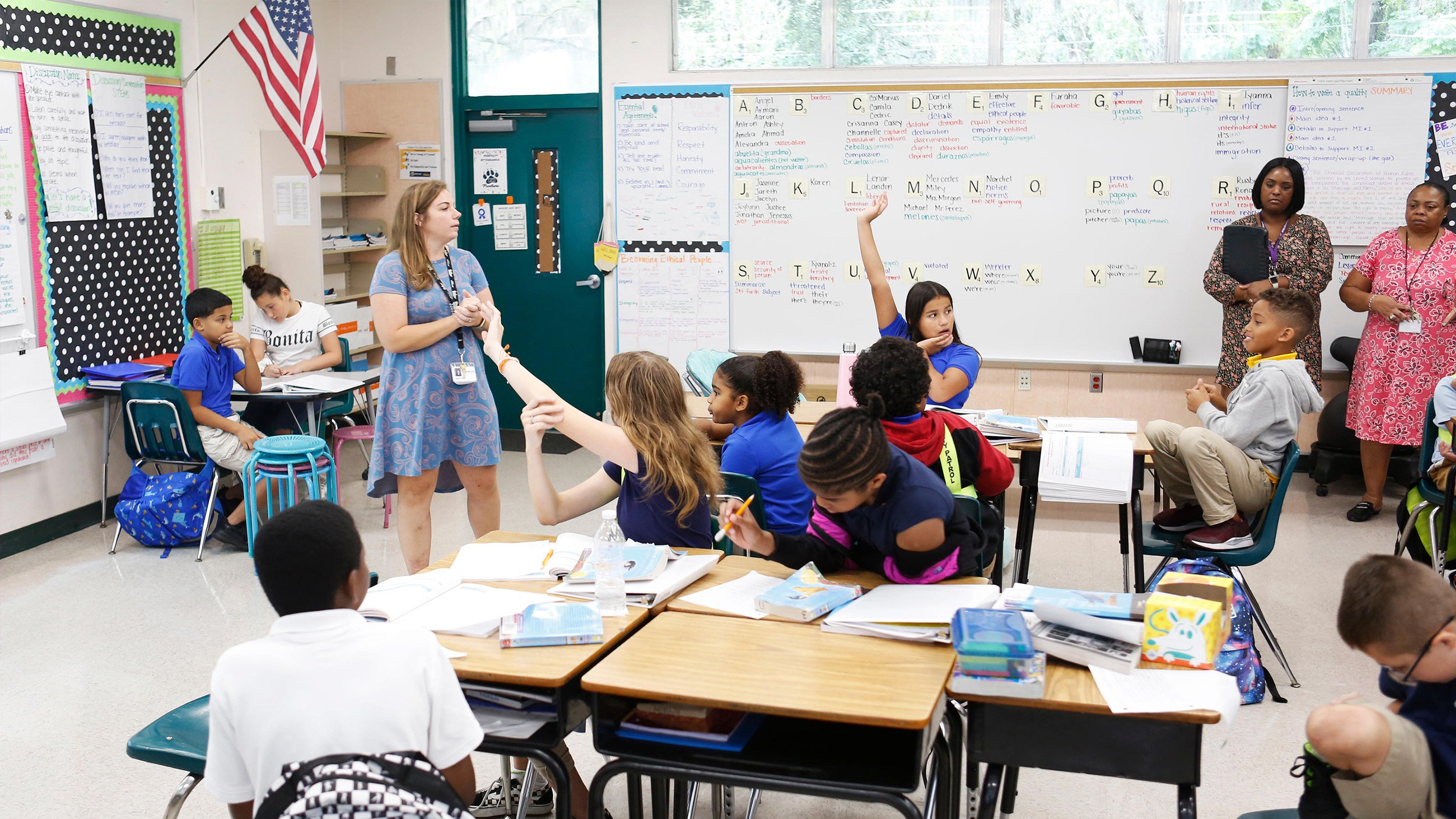
During visits, observers should be quiet, courteous, and unobtrusive. The classroom belongs to the teacher and students, not the observation team. Observers should avoid side conversations, dramatic facial expressions, or standing in the back like a row of educational gargoyles.
It is often helpful to explain the process to students in simple language: “Some educators are visiting today to learn more about how students think and learn. They are not here to grade you or your teacher.” This reduces mystery and keeps the classroom atmosphere normal.
Step 5: Analyze Patterns, Not People
After observations, the team should look across classrooms. What patterns emerged? What did students spend most of their time doing? What kinds of questions were asked? Who participated? What evidence showed students were thinking deeply? What barriers appeared?
This pattern-based approach protects trust and increases usefulness. The team is not saying, “Teacher A did this wrong.” The team is saying, “Across classrooms, we noticed students had limited opportunities to explain their reasoning. What adult practices might create more opportunities?” That is a much healthier and more productive conversation.
Step 6: Turn Findings Into Teacher Support
Instructional rounds should lead directly to support. That might include coaching cycles, demonstration lessons, collaborative planning, peer observation, student work analysis, professional learning communities, or shared instructional resources. Teachers should leave the process with practical next steps, not just a beautifully formatted report that quietly retires inside a Google Drive folder.
If rounds identify a need for stronger formative assessment, for example, the school might create common exit tickets, practice analyzing responses, and adjust instruction based on student misconceptions. If rounds reveal uneven student discussion, teams might develop norms for academic talk and rehearse discussion protocols.
Specific Examples of Instructional Rounds in Action
Example 1: Improving Student Discussion
A middle school notices that classroom discussions are dominated by the same confident students. The problem of practice becomes: “How are teachers structuring opportunities for all students to participate in academic conversation?” During rounds, observers track wait time, student talk moves, partner rehearsal, and participation patterns.
The evidence shows that teachers ask thoughtful questions, but students are often expected to answer immediately. Only a few students raise their hands quickly enough to participate. The next level of work becomes increasing structured talk: think-pair-share, response stems, cold call with preparation time, and small-group discussion roles. Teachers try these strategies, then review student participation data during team meetings.
Example 2: Strengthening Writing With Evidence
An elementary school sees that students can state opinions but struggle to support them with evidence. During instructional rounds, observers look for writing prompts, teacher modeling, use of text evidence, and student explanations. They collect samples of task directions and student responses.
The team notices that many prompts ask students what they think, but fewer ask them to explain why using evidence. The next step is to design common writing frames, model evidence selection, and use quick peer review checklists. The school also creates grade-level examples of strong responses so teachers and students share a clearer target.
Example 3: Making Math Thinking Visible
A high school math department wants students to explain problem-solving strategies instead of simply hunting for the answer like it is buried treasure. Rounds focus on mathematical discourse, representation, and error analysis. Observers record whether students use diagrams, equations, verbal explanations, or peer critique.
The team finds that students solve problems individually but rarely compare strategies. The next level of work includes gallery walks, “which one doesn’t belong?” prompts, and teacher questioning that asks students to explain, defend, and revise their thinking. Over time, math class becomes less about answer-chasing and more about reasoning.
Common Mistakes to Avoid
Mistake 1: Turning Rounds Into Evaluation
If teachers believe rounds will be used against them, the process loses its learning power. Keep individual names out of debrief summaries. Focus on patterns. Use rounds to guide professional learning, not to create a shadow evaluation system.
Mistake 2: Choosing a Fuzzy Focus
A vague focus produces vague evidence. “Student engagement” might be useful if the school defines what engagement means. Are observers looking for discussion, writing, collaboration, persistence, questioning, or use of academic language? Define the target before entering classrooms.
Mistake 3: Skipping Follow-Up
Instructional rounds without follow-up are like buying a treadmill and using it as a laundry rack. The tool is not the problem; the lack of use is. Schools should connect rounds to coaching, planning, professional learning communities, and leadership decisions.
Mistake 4: Collecting Too Much Data
More data is not always better. Sometimes it is just more. A focused observation tool helps teams collect evidence they can actually analyze. If the form has seventeen categories, three rating scales, and a comments box the size of a postage stamp, it may be time to simplify.
How School Leaders Can Make Instructional Rounds Work
Leaders play a major role in whether instructional rounds become meaningful professional learning or another initiative teachers politely survive. The first leadership move is clarity. Explain why the school is using rounds, how the process connects to existing goals, and what will happen with the findings.
The second move is protection. Teachers need time to participate, observe, debrief, and act on what they learn. If rounds are squeezed between lunch duty and emergency copier repair, the process will not reach its potential. Leaders should create schedules that make participation realistic.
The third move is humility. Leaders should participate as learners, not as judges. When principals and district leaders ask evidence-based questions, listen carefully, and avoid quick fixes, they model the learning stance that rounds require.
How Teachers Benefit From Instructional Rounds
Teachers benefit from instructional rounds because they get access to the professional knowledge living right down the hallway. In many schools, excellent teaching happens behind closed doors. Rounds open those doors in a respectful, structured way.
New teachers can see classroom routines, questioning strategies, transitions, and student support in action. Experienced teachers can test assumptions, gather ideas, and reflect on their own practice. Teacher leaders can help guide schoolwide improvement without needing to pretend they have a magic binder full of answers.
Most importantly, rounds can make teachers feel less alone. When educators realize that colleagues are wrestling with similar challenges, the conversation shifts from “my classroom problem” to “our instructional challenge.” That shift is where professional culture begins to change.
Using Instructional Rounds With Professional Learning Communities
Instructional rounds become even stronger when connected to professional learning communities, or PLCs. Rounds provide classroom evidence; PLCs provide the structure for ongoing action. A team might conduct rounds in October, identify a pattern related to student explanation, plan new strategies in November, examine student work in December, and revisit the focus in January.
This cycle keeps improvement alive. Teachers are not simply told what to change; they investigate practice, try strategies, study results, and refine their approach. That is the heart of continuous improvement.
Experience-Based Reflections: What Instructional Rounds Feel Like in Real Schools
In real school life, instructional rounds rarely begin with everyone cheering and tossing confetti. Many teachers are understandably cautious. Some have experienced observations that felt punitive, vague, or disconnected from daily classroom realities. So when a school introduces rounds, the first reaction may be, “Wonderful, another initiative with a form.” That skepticism is not a character flaw; it is professional pattern recognition.
The turning point usually comes when teachers see that the process is genuinely non-evaluative and useful. Imagine a group of teachers visiting four classrooms with a focus on student questioning. In one room, students write their own questions before reading a text. In another, students use discussion stems to challenge ideas respectfully. In a third, the teacher pauses after a student answer and asks, “What evidence makes you say that?” No single classroom is presented as perfect. Instead, each room offers something to notice.
During the debrief, the team does not say, “That lesson was good” or “That teacher needs help.” They say things like, “When students had sentence stems, more of them entered the discussion,” or “When the task required evidence, student responses were longer and more specific.” These observations feel different because they are useful. Teachers can take them back to their own classrooms the next day.
One common experience is that teachers begin rounds looking for strategies and end up thinking more deeply about student learning. At first, they may notice visible moves: anchor charts, grouping arrangements, warm-ups, exit tickets, or technology tools. Over time, their attention becomes sharper. They start asking, “What thinking did this task require?” “Which students had access to the discussion?” “How did the teacher know students understood?” That shift is powerful because it moves the conversation from activity to learning.
Another experience is the relief of shared responsibility. A teacher who struggles with student writing may discover that the challenge is not isolated. Across classrooms, students may need stronger modeling, clearer success criteria, or more opportunities to revise. This does not excuse weak instruction, but it does create a more honest and supportive path forward. Instead of one teacher feeling like the village disaster, the faculty can design a village solution.
Instructional rounds also help leaders see school improvement from ground level. A strategic plan may say, “Increase student engagement,” but classroom evidence reveals what that actually means. Are students talking about content or just talking near content? Are they writing complete explanations or filling blanks? Are they collaborating or dividing the work so one student does everything while another guards the markers? Rounds give leaders the kind of detail that spreadsheets alone cannot provide.
The best experiences with instructional rounds usually include follow-up that teachers can feel. After rounds, a coach might model a questioning routine. A grade-level team might redesign writing prompts. A principal might adjust meeting agendas so teachers analyze student work instead of reviewing announcements that could have been an email. When teachers see action after observation, trust grows.
Of course, rounds are not magic. They do not fix instruction by Thursday or turn every classroom into a documentary-worthy learning space with soft lighting. They require planning, trust, time, and discipline. But when done well, they create a professional habit schools desperately need: looking carefully at student learning before deciding what adults should do next.
Conclusion: Instructional Rounds Guide Teachers by Making Learning Visible
Using instructional rounds to guide teachers is one of the most practical ways to connect professional learning with real classroom practice. The process helps educators define a problem of practice, observe instruction through a shared lens, analyze evidence, and identify the next level of work. Done well, rounds create a culture where teachers learn from one another, leaders make better instructional decisions, and students benefit from more thoughtful teaching.
The secret is to keep the process focused, respectful, and action-oriented. Instructional rounds should not be another compliance activity or a fancy walk-through with matching folders. They should be a disciplined routine for professional curiosity. When educators ask better questions about teaching and learning, they make better decisions. And when teachers are guided by evidence, collaboration, and trust, improvement stops being a slogan on a poster and starts becoming something students can actually experience.