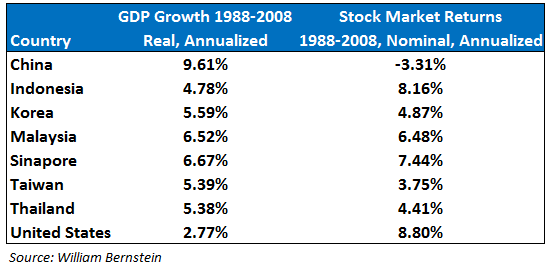

Few phrases can empty an investment room faster than “growth is slowing.” Add the words “emerging markets,” and some investors start reaching for the sell button as if it were a fire alarm. Yet slower economic growth, by itself, is not a sound reason to abandon emerging market stocks.
Economic growth and stock market returns are related, but they are not joined at the hip. A country can produce impressive gross domestic product growth while delivering disappointing shareholder returns. Another can experience a slowdown while its companies become more profitable, better governed, and more valuable. Markets are complicated that way. They apparently missed the memo requesting a simple plot.
A sensible emerging markets investment decision must consider valuations, corporate earnings, currencies, capital allocation, political risks, and portfolio diversification. The GDP headline is only one piece of that larger puzzle.
Economic Growth Is Not the Same as Stock Market Performance
GDP measures the value of goods and services produced in an economy. A stock index measures the performance of publicly traded companies included in that index. Those are different things.
An emerging economy may grow because new privately owned businesses are opening, government infrastructure spending is rising, or multinational companies are expanding local production. Existing public shareholders do not automatically receive all the benefits. Much of the growth may flow to workers, consumers, private companies, the government, or newly issued businesses rather than the corporations already represented in an emerging market index.
Long-term research has repeatedly found that the relationship between real economic growth and equity returns across countries is weak, inconsistent, or sometimes negative. That does not mean economic growth is irrelevant. It means investors cannot convert a GDP forecast directly into a reliable stock return forecast.
Shareholders Own Earnings, Not GDP
Stock returns are more closely connected to the cash that companies can generate for their owners. Over time, returns generally come from dividends, earnings-per-share growth, share repurchases, and changes in valuation multiples.
Suppose an economy grows 6% annually, but listed companies continually issue new shares to finance expansion. Total corporate earnings might rise, while earnings per share barely move because the ownership pie is being cut into more slices. The bakery is booming; your slice is not.
Now consider an economy growing at 3%. If its leading companies improve productivity, strengthen margins, reduce debt, and repurchase undervalued shares, earnings per share could rise considerably faster than GDP. Investors may do well even though the macroeconomic headline sounds sleepy.
Starting Valuation Can Matter More Than the Headline
A wonderful company or rapidly growing economy can still be a poor investment when its expected success is already embedded in the price. Conversely, a slower-growing market may produce attractive returns when pessimism has pushed valuations too far down.
Imagine that investors once expected an emerging economy to grow by 7%, but the forecast falls to 5%. That is a slowdown, yet 5% may remain stronger than the growth expected in many developed economies. If stock prices have already fallen as though a recession were guaranteed, merely acceptable results can trigger a recovery.
Markets respond primarily to the difference between expectations and reality. “Slower than last year” and “worse than investors expected” are not interchangeable statements.
Why Emerging Market Growth Naturally Slows
Rapidly developing economies cannot maintain early-stage growth rates forever. When a country begins with low income, limited infrastructure, and underused labor, it can expand quickly by adopting existing technology, building roads, moving workers into more productive industries, and increasing access to education and finance.
As the economy becomes wealthier, the comparison base grows larger and easy productivity gains become harder to find. Growth may slow even while living standards, corporate sophistication, and financial stability continue to improve.
A Slowdown Can Signal Maturation
Moderating growth is not always evidence of deterioration. It can accompany a shift from debt-fueled construction toward household consumption, services, technology, health care, and higher-value manufacturing.
Slower credit creation may reduce property speculation and financial instability. Lower inflation may give central banks more flexibility. More disciplined investment can improve returns on capital. In those circumstances, the economy may produce fewer fireworks but better-quality corporate earnings.
That distinction matters. Unsustainable 9% growth financed by wasteful lending is not necessarily more desirable than durable 5% growth supported by productivity and healthy balance sheets.
Emerging Markets Are Not a Single Economy
The label “emerging markets” covers countries with dramatically different industries, demographics, policies, and financial systems. Treating the group as one homogeneous trade is like reviewing every restaurant in America after eating one airport sandwich.
China has a large manufacturing base and considerable exposure to property, domestic policy, and consumer demand. India is driven more heavily by services, infrastructure development, financial inclusion, and a growing domestic consumer market. Taiwan and South Korea play major roles in global semiconductor and electronics supply chains. Brazil combines commodities, banks, utilities, and consumer businesses. Mexico benefits from manufacturing integration with the United States and interest in relocating supply chains closer to North American customers.
Growth can weaken in one country while accelerating elsewhere. Commodity exporters may benefit from conditions that hurt energy importers. A strong technology cycle may lift semiconductor-heavy markets even when global manufacturing data look mediocre.
Before selling an emerging markets allocation, investors should identify what they actually own. A broad index may have substantial concentrations in a few countries, sectors, or large companies. The relevant question is not simply, “Are emerging markets slowing?” It is, “What earnings, valuations, currencies, and risks are represented in my portfolio?”
Lessons From China and India
China and India provide a useful reminder that economic expansion does not translate mechanically into equity performance. Both economies have grown substantially over the long term, yet their stock markets have followed very different paths during various periods.
China has sometimes delivered faster economic growth while its equities struggled with property debt, regulatory intervention, weak investor confidence, and inefficient capital allocation. India has periodically generated stronger equity results because of corporate profitability, financial development, domestic investment flows, and enthusiasm about its long-term potential. At other times, high Indian valuations have raised the risk that excellent expectations leave little room for disappointment.
The lesson is not to prefer one country permanently. It is to recognize that GDP growth, business quality, governance, and the price paid for stocks are separate variables. Investors must examine all of them.
What Can Drive Emerging Market Stock Returns?
Corporate Earnings and Capital Discipline
Look for companies that can turn economic activity into sustainable earnings per share. Useful indicators include returns on invested capital, free cash flow, profit margins, debt levels, dividend policies, and management’s record of treating minority shareholders fairly.
A company that grows sales aggressively while destroying capital is not creating genuine shareholder value. Revenue can be glamorous; free cash flow pays the bills.
Currency Movements
For a U.S. investor, local stock performance is only part of the return. Currency changes can increase or reduce results when they are translated into dollars.
A strong U.S. dollar often creates headwinds for emerging market assets, particularly in countries with large dollar-denominated debts or dependence on foreign financing. A stable or weakening dollar can relieve those pressures. However, currency outcomes depend on inflation, trade balances, fiscal policy, foreign-exchange reserves, interest rates, and market expectationsnot solely on GDP growth.
Valuation Changes
If investors become less pessimistic, a market’s price-to-earnings ratio can rise even while economic growth slows. The reverse is also true: excellent growth may fail to produce gains if valuations contract from excessively optimistic levels.
Valuation is not a precise timing tool, but it affects the margin of safety. Investors paying modest prices need fewer things to go perfectly than investors buying a market priced for a flawless decade.
Technological and Structural Change
Modern emerging market indexes are no longer simple collections of oil producers, miners, and state-controlled banks. Technology hardware, semiconductor manufacturing, digital payments, e-commerce, online entertainment, and communications platforms now have meaningful roles.
Demand for advanced chips and artificial intelligence infrastructure can support companies in Taiwan and South Korea independently of a broad emerging economy slowdown. Digital banking can expand in countries where millions of consumers remain underserved by traditional branches. Supply-chain diversification can create opportunities for manufacturers across Asia and Latin America.
Valid Reasons to Reduce Emerging Market Exposure
Rejecting a simplistic growth argument does not mean emerging market stocks should be held under every condition. There are legitimate reasons to reduce or restructure an allocation.
- Valuations no longer justify the risks: Prices may imply unrealistic growth, margins, or political stability.
- Corporate fundamentals are deteriorating: Falling earnings, weak cash flow, excessive leverage, or persistent shareholder dilution can undermine returns.
- Institutions are weakening: Capital controls, unpredictable regulation, expropriation, accounting problems, or reduced legal protections deserve serious attention.
- Currency and debt vulnerabilities are rising: Large external deficits, insufficient reserves, high inflation, and heavy foreign-currency borrowing can create painful adjustments.
- The portfolio has become unbalanced: Strong performance in one country or sector may leave an investor with more concentration than intended.
- Personal circumstances have changed: A shorter investment horizon, lower risk tolerance, or upcoming need for cash may justify reducing volatile assets.
These reasons focus on price, fundamentals, risk, and suitability. “The growth forecast dropped from 5.4% to 4.9%” does not carry the same analytical weight without additional context.
A Better Framework for Emerging Market Investing
Rather than making an all-or-nothing prediction, investors can use a disciplined process.
Separate the Economy From the Index
Review the index’s country weights, sectors, largest companies, and sources of revenue. Some emerging market corporations earn substantial income from developed countries. Meanwhile, much of a fast-growing domestic economy may be represented by private businesses that index investors cannot own.
Compare Expectations With Prices
Ask what level of growth and profitability the current valuation appears to assume. Bad news is not automatically bearish when investors already expect something worse. Good news is not automatically bullish when perfection is priced in.
Diversify Across Countries and Strategies
A broad emerging markets fund can reduce company-specific risk, although capitalization-weighted indexes may still be concentrated. Investors can complement broad exposure with strategies emphasizing value, quality, dividends, smaller companies, or reduced country concentration, provided they understand the additional costs and risks.
Rebalance Instead of Reacting
Set a target allocation consistent with the portfolio’s time horizon and risk tolerance. Rebalancing periodically can prevent fear and excitement from becoming unofficial portfolio managers. They are enthusiastic employees, but their attendance record is terrible.
Experience-Based Lessons: What Market Cycles Teach Investors
Investors who have lived through several emerging market cycles often learn that the most emotionally comfortable decision can be the least financially useful one. When economic headlines are strong, money pours in, forecasts rise, and valuations become expensive. When growth slows, investors leave after prices have already absorbed much of the damage.
The late-1990s Asian financial crisis demonstrated how currency mismatches, short-term foreign debt, and fragile banking systems could turn rapid growth into financial distress. The lesson was not that emerging markets were permanently uninvestable. Many affected countries subsequently accumulated larger reserves, improved banking supervision, developed local-currency bond markets, and adopted more flexible exchange-rate systems.
The early-2000s cycle delivered a different experience. Emerging market stocks benefited from improving balance sheets, rising commodity demand, a weaker dollar, and comparatively modest valuations. Investors who waited for every country to look safe missed a substantial portion of the recovery. Markets tend to start moving before the economic report card has been signed by everyone in the principal’s office.
China’s later slowdown supplied another lesson. Investors who relied only on national GDP growth overlooked the importance of regulation, property leverage, state influence, and the treatment of minority shareholders. The headline growth rate was never enough to evaluate the opportunity. Company-level economics and investor protections mattered enormously.
Recent semiconductor cycles have also shown why broad labels can mislead. Taiwan and South Korea may be classified as emerging markets by major index providers, yet many of their leading companies occupy advanced positions in global technology supply chains. Their fortunes can depend more on chip inventories, artificial intelligence spending, and global electronics demand than on a generic emerging market GDP forecast.
Another recurring experience concerns the U.S. dollar. Emerging market equities often struggle when the dollar rises sharply and global liquidity tightens. Yet selling solely after a long period of dollar strength can amount to betting that the trend will continue indefinitely. Currency cycles reverse, and the change can occur before investors feel confident enough to return.
Perhaps the most practical lesson is that position size matters more than bravado. An investor does not have to declare emerging markets either a spectacular bargain or a financial swamp. A measured allocation can preserve diversification and long-term upside while recognizing volatility, governance problems, political intervention, and currency risk.
Experience favors humility. Forecasts will be revised. Countries will surprise in both directions. Some celebrated growth stories will disappoint shareholders, while unpopular markets will recover without sending engraved invitations. A diversified portfolio, sensible valuation discipline, and periodic rebalancing are usually more dependable than a dramatic macroeconomic prediction.
Conclusion
Slowing economic growth deserves investigation, but it is not an automatic sell signal for emerging market stocks. Investors own claims on corporate earnings and cash flowsnot units of national GDP. Returns depend on the price paid, earnings-per-share growth, dividends, currency movements, capital allocation, and changes in market expectations.
A slowdown can expose serious weaknesses, including excessive debt or poor policy. It can also represent healthy normalization as an economy matures. The correct response is to examine individual countries, companies, and portfolio exposures rather than fleeing an entire asset class because of one gloomy headline.
Emerging markets remain volatile and carry greater political, currency, liquidity, disclosure, and governance risks than many developed markets. Those risks support careful diversification and appropriate position sizing. They do not support investing by slogan.