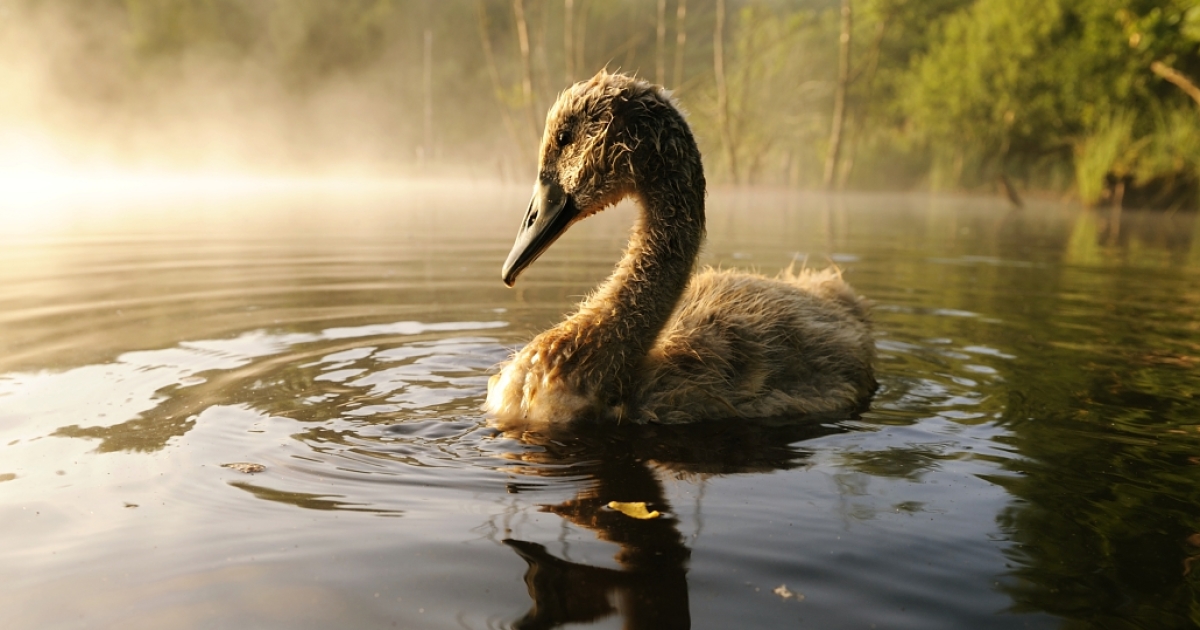
The True Story Of An Ugly Duckling Who Was Abandoned By Its Parents And Adopted By Ducks

Every so often, nature writes a story that sounds as if it escaped from a children’s book, flapped across a pond, and decided to become real. This is one of those stories. It begins with a small, gray, slightly awkward baby swana cygnetwho looked very much like the famous “ugly duckling” from the fairy tale. He was not ugly, of course. He was simply in that fluffy, muddy, long-necked baby-bird stage where elegance is still under construction.
The little cygnet, later affectionately called Stefek by one of the people who followed his progress, was born at a quiet pond where swans did not live year-round. His parents had come there for breeding, and at first, everything seemed normal. A mother swan had several babies, the kind of soft gray puffballs that make even serious adults say things like “aww” in public. But the pond soon became the setting for a much harder story: the father disappeared, a predator attack reduced the brood, and eventually the lonely cygnet was left without his mother.
Then came the twist worthy of a nature documentary with a surprisingly wholesome ending: the abandoned baby swan was seen moving among ducks. In the human retelling, he had been “adopted by ducks.” Was there paperwork? No. Did the ducks hold a tiny family meeting and vote him in? Probably not, although one hopes the meeting had snacks. But in practical pond terms, the ducks accepted his presence, and the little swan found company, safety, and a place in the everyday rhythm of the water.
A Real-Life Ugly Duckling, But With Feathers and Feelings
The phrase “ugly duckling” usually brings to mind Hans Christian Andersen’s classic tale of a young bird mocked for looking different until he grows into a beautiful swan. Stefek’s story feels similar, but it is not a fairy tale. It is a real account of a young swan observed by photographer Sebastian Luczywo, who first noticed the cygnet during a cycling trip near a pond.
At first glance, the bird looked like a small, lonely fluffball trying to make sense of a very large world. A mother swan was still nearby during the first sighting, helping him toward shore. That detail matters because swan parents are usually attentive and protective. Mute swans, the species most people picture when imagining a white swan with an orange bill and curved neck, commonly raise their young together. Both parents may defend territory, guide the cygnets, and help them learn how to forage.
But life at a pond is not a greeting card. It is beautiful, yes, but also full of snapping beaks, weather, predators, competition, and sudden changes. The cygnet’s family had reportedly hatched five young birds. After the father left for another body of water, the mother continued caring for the brood. Then a predator attack struck. By the time the story truly caught public attention, only one cygnet remained.
What Happened to the Cygnet’s Parents?
In the story, the male swan left the pond after the babies hatched, while the mother stayed with the young. Later, after the predator attack, she cared for the last cygnet until he appeared more independent. Eventually, she too disappeared from his daily life. To people watching from shore, it looked heartbreaking. To nature, it may have been a mix of instinct, survival, timing, and the practical pressures of being a wild bird.
Swan parenting is often admired because swans form strong pair bonds and can be fiercely defensive. Still, wild animals do not follow the emotional scripts humans wish they would. A parent may leave because the habitat is temporary, food is limited, danger is high, or the remaining young bird seems capable enough to survive. That does not make the scene any less sad. It simply reminds us that the natural world is not always gentle, even when it is photogenic.
Predation is also a normal part of wetland life. Eggs and young waterfowl can be vulnerable to mammals, large fish, turtles, crows, gulls, herons, and other opportunistic animals depending on the region. A lone cygnet on open water is especially exposed. Young swans are not yet the powerful adults that can hiss, posture, strike, and send smaller animals reconsidering their life choices.
How Ducks Became His Unexpected Pond Family
When observers returned and saw no mother swan nearby, they noticed that the baby swan was spending time among young ducks. This is the part of the story that made people melt into puddles, which is fair, because a lonely cygnet drifting beside ducklings is almost aggressively adorable.
However, “adopted by ducks” should be understood in a natural, observational sense. The ducks did not become swan parents in the same way a mother swan would. They likely provided social cover, companionship, and a loose flock environment. For a young bird, that can matter. Waterfowl often depend on group movement, alertness, and familiar routines. A bird alone is easier to overlook by friends and easier to spot by trouble.
Ducks and swans belong to the same broad waterfowl order, Anseriformes, but they are very different in size, behavior, and future plans. A cygnet grows into a large bird with a long neck, powerful wings, and a very clear opinion about personal space. Ducklings grow into smaller, quicker birds with their own flock behaviors. Yet on a pond, especially when young birds are feeding, resting, and moving through similar habitat, temporary mixed groups can form. Stefek’s duck companions may not have known they were starring in a real-life inspirational article, but they played their part beautifully.
The Science Behind “Adoption” in Waterfowl
Waterfowl behavior can be more flexible than people expect. Ducklings are famous for imprinting, the early-life learning process that helps them recognize and follow a parent or parent-like figure. In many species, the first days after hatching are crucial for learning who to follow, where to go, and what safety looks like. This is why wildlife rehabilitators are careful with orphaned waterfowl: too much human handling can cause young birds to identify with people instead of their own species.
In the wild, unusual family arrangements can happen. Some ducks lay eggs in the nests of other ducks, a behavior known as brood parasitism or egg dumping. Sometimes ducklings of different species hatch in the same nest and are led away by the same female. Birds are not sentimental in the human sense, but they can be surprisingly tolerant when the timing, size, and circumstances are right.
Stefek’s situation was not a classic case of nest parasitism. He was already a cygnet, and the ducks were not incubating him. Instead, the story appears to be one of social acceptance after abandonment. The ducks became his moving neighborhood: a small, feathered community that helped him avoid total isolation.
Why the Story Touched So Many People
People respond strongly to stories about rejected or orphaned animals because they reflect emotions we understand: loneliness, vulnerability, survival, and belonging. Stefek’s story has all of that, plus a fluffy protagonist with oversized feet. The combination is powerful.
There is also something symbolic about a young swan being accepted by ducks. The original “Ugly Duckling” story is about being misunderstood before becoming what you were always meant to be. Stefek’s real-life version adds another layer: sometimes survival does not come from proving everyone wrong immediately. Sometimes it comes from finding company while you are still awkward, gray, and figuring out how your neck works.
That is a surprisingly useful life lesson from a bird who probably never intended to become a motivational speaker.
From Lonely Cygnet to Beautiful Swan
As weeks passed, Stefek grew. The tiny fluffball became larger, stronger, and more recognizably swan-like. Young swans often keep gray or brownish juvenile plumage for much of their first year, so they do not immediately look like the snowy adults that glide across lakes in postcards and ballet posters. Their beauty arrives in stages.
Observers and fishermen at the pond became attached to him. They gave him names, brought food, watched his progress, and worried about winter. That community interest is one of the most charming parts of the story. A single young bird turned casual visitors into a loose support team. The pond had gained a celebrity, even if the celebrity mostly wanted snacks and peace.
Still, feeding wild waterfowl requires caution. Bread, for example, is not a healthy diet for ducks or swans. It fills them up without giving proper nutrition and can contribute to water pollution. Better choices, when feeding is allowed and appropriate, include chopped greens, peas, corn, grains, or specialized waterfowl feed. Even then, the best help often comes from protecting habitat, keeping dogs leashed near nesting areas, avoiding litter, and calling licensed wildlife rehabilitators when an animal is injured or truly orphaned.
What This Story Teaches About Wildlife Rescue
One important lesson from this story is that not every baby bird seen alone needs immediate human rescue. Many young animals spend time away from their parents as part of normal development. In waterfowl, however, a very young duckling, gosling, or cygnet alone for a long period can be in danger. The challenge is knowing the difference.
Wildlife organizations generally recommend observing first from a distance. Is the parent nearby but hidden? Is the young bird injured, bleeding, shivering, weak, or being attacked? Is it trapped in a storm drain, road, courtyard, or pool? If the animal appears injured or truly abandoned, the safest step is to contact a licensed wildlife rehabilitator, animal control office, nature center, or local wildlife agency. Well-meaning people can accidentally cause harm by feeding the wrong foods, handling too much, or raising a wild bird in a way that prevents proper release.
In Stefek’s case, observers did what many caring people do: they watched, worried, and helped as best they could. His story spread because it felt hopeful. But the broader message is not “take every orphaned bird home.” It is “pay attention, care responsibly, and know when expert help is needed.”
The Difference Between a Swan and a Duckling
At birth, a cygnet can look duck-like to the untrained eye. It is small, soft, and often gray. But as it grows, the differences become obvious. Swans develop long necks, larger bodies, and stronger wings. Mute swans can become among the largest waterfowl on a pond, and adult birds are known for territorial behavior, especially during breeding season.
Ducks, by contrast, tend to be smaller and more social in groups. Many duck species are excellent at quick movements, dabbling for food, and blending into busy pond life. A cygnet growing up among ducks would eventually stand out dramatically, like a teenager who suddenly becomes six feet tall while all his childhood friends remain compact and waterproof.
That visual transformation is why Stefek’s story feels so satisfying. The “ugly duckling” was never ugly and was never a duck. He was a young swan in progress. The ducks simply gave him room to survive until the swan part became impossible to miss.
Why the Ugly Duckling Theme Still Works
The reason this story keeps attracting readers is simple: everyone understands what it feels like to be out of place. Maybe you were the quiet kid in a loud classroom, the new employee at a confident office, or the person at a family gathering who brought a salad while everyone else brought opinions. Being different can feel lonely.
The ugly duckling theme works because it reverses the judgment. What looks awkward now may become graceful later. What looks like rejection may become the beginning of independence. What looks like a strange little bird among ducks may become a swan strong enough to claim open water.
Stefek’s real-life story adds a beautiful detail: he did not survive alone. He found a temporary flock. That matters. Growth is often presented as a solo journey, but many creatures need company while they become themselves.
Experience-Based Reflections: Watching an “Ugly Duckling” Grow Into Himself
There is a particular kind of patience that comes from watching wildlife. You cannot rush a cygnet into becoming a swan. You cannot stand at the edge of a pond and shout, “Please develop mature plumage by Thursday.” Nature does not care about your editorial calendar. It works slowly, feather by feather, meal by meal, swim by swim.
People who observe ponds regularly often describe a similar experience: at first, one bird catches your attention because something seems unusual. Maybe a duckling is alone. Maybe a goose is limping. Maybe a young swan is moving with ducks instead of swans. You tell yourself you are only stopping for a minute. Then, somehow, you become emotionally invested in the life of a bird who does not know your name and would absolutely judge your swimming ability.
That is what makes stories like Stefek’s so memorable. Watching an orphaned or abandoned young animal survive can change how we see ordinary places. A pond becomes more than water and reeds. It becomes a neighborhood. The ducks are not background decoration; they are characters. The fishermen are not just passing time; they become witnesses. The person with a camera is not simply taking pictures; they are documenting a small act of resilience.
One practical experience many pond watchers learn quickly is that helping wildlife is rarely dramatic. It is not always a rescue scene with music swelling in the background. Sometimes help means keeping distance so parents return. Sometimes it means preventing dogs from chasing birds. Sometimes it means picking up fishing line before it tangles around a leg. Sometimes it means calling a rehabilitator instead of improvising a rescue with a laundry basket and heroic confidence.
Another lesson is that animals do not need to be perfect to be worth caring about. Stefek was not the polished white swan of paintings when people first noticed him. He was gray, vulnerable, and a little odd-looking in the way all young birds are odd-looking. Yet that awkward stage made the story more powerful. His beauty was not instant. It had to grow through danger, abandonment, unlikely companionship, and time.
There is also an emotional experience here for anyone who has ever felt temporarily misplaced. The cygnet among ducks becomes a gentle image of belonging before identity is fully formed. He did not need to match the ducks to benefit from their presence. He did not need to become a duck to survive among them. He only needed enough acceptance, enough food, enough safety, and enough time to become what he already was.
That is why this true ugly duckling story lingers. It is not just cute. It is quietly wise. It suggests that awkward beginnings do not decide the ending, that community can appear in unexpected shapes, and that sometimes the most beautiful transformations happen while everyone is simply paddling forward, pretending they know exactly what they are doing.
Conclusion: A Small Swan, a Big Lesson, and a Pond Full of Hope
The true story of an ugly duckling abandoned by its parents and adopted by ducks is more than a sweet animal tale. It is a reminder that nature can be harsh, strange, funny, and tender all at once. Stefek began life as a vulnerable cygnet in a risky pond. He lost his siblings, then his parents, and might have remained alone. Instead, he found safety among ducks and became a beloved figure to the people who watched him grow.
His story works because it is both real and symbolic. A young swan survived not by looking perfect, but by continuing forward. The ducks did not turn him into something he was not; they simply gave him a place in the flock while he grew into himself. In the end, that may be the best version of the ugly duckling lesson: belonging can save us before transformation is complete.