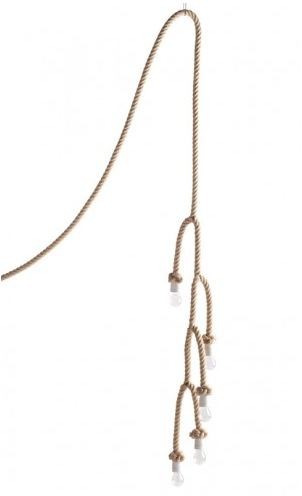

Some light fixtures try very hard to impress you. They arrive dripping in chrome, polished into submission, and practically begging for applause. FLAX FIVE LIGHT by Christien Meindertsma takes a very different route. It shows up like a clever old soul: calm, tactile, quietly bold, and fully aware that good design does not need to shout when it can simply be honest.
At first glance, FLAX FIVE LIGHT looks almost disarmingly simple. It is made from flax and shaped through techniques tied to rope-making, then transformed into a five-light fixture with a distinctly handmade presence. But the deeper you go, the more the design reveals itself as a serious piece of thinking disguised as a beautiful object. This is not just lighting. It is a conversation about raw material, local knowledge, craft, geography, and the long-forgotten life story of things we usually call “products” once they land in our homes.
That bigger idea is exactly why Christien Meindertsma matters. She has built her reputation by tracing where materials come from, how they move through production, and what gets lost when supply chains become too distant to see. In FLAX FIVE LIGHT, those concerns are not hidden behind theory. They are right there in the object itself. The material is the message, and luckily, it also happens to look fantastic hanging in a room.
What Is FLAX FIVE LIGHT?
FLAX FIVE LIGHT is a lighting design by Dutch designer Christien Meindertsma, created for Thomas Eyck as part of her wider flax-focused body of work. The piece uses flax as its core material and turns it into a long, rope-like form that supports five lights. The 10-meter length gives the design a sculptural flexibility that is unusual for conventional pendant lighting. Instead of behaving like a rigid object, it feels more like a material gesture suspended in space.
That matters because the fixture is not just something you switch on. It is something you arrange, interpret, and live with. In a room, FLAX FIVE LIGHT reads partly as lighting, partly as textile, partly as craft, and partly as installation. It can create drama in a stairwell, softness in a lofty interior, or a sense of grounded warmth in a minimalist home that might otherwise feel a little too proud of its own emptiness.
The appeal lies in that tension. It is rustic, but not rough. It is refined, but not precious. It is organic, yet designed with great control. Many lighting products try to imitate nature through color or shape. FLAX FIVE LIGHT does something smarter: it works with an actual natural material and lets the character of that material remain visible.
Who Is Christien Meindertsma?
To understand FLAX FIVE LIGHT, it helps to understand the designer behind it. Christien Meindertsma is known internationally for research-driven design that investigates raw materials, production systems, and the hidden networks behind everyday objects. Rather than designing surfaces alone, she studies origins. That may sound academic, but in her hands it becomes surprisingly poetic.
Her best-known projects often begin with a deceptively simple question: where does this material come from, and where does it go? That curiosity led to the celebrated project PIG 05049, in which she traced the many products made from one pig. The work became famous not because it was flashy, but because it made invisible systems visible. That same instinct runs through her flax work. She does not treat materials as anonymous inputs. She treats them as stories with consequences.
Over the years, her work has been shown and collected by major institutions, and she has earned a reputation for connecting design, research, and material culture in a way that feels both intellectually rigorous and visually compelling. In plain English: she makes you look at ordinary stuff and suddenly realize it was never ordinary at all.
The Flax Project Behind the Light
FLAX FIVE LIGHT belongs to a larger exploration of flax in Meindertsma’s practice. This matters because the piece was not designed as a one-off decorative flourish. It came out of a sustained investigation into flax as a local material with cultural history and future potential. In other words, the lamp is not a random pretty idea. It is one chapter in a much larger material argument.
Historically, flax has deep roots in Zeeland and in parts of Dutch material culture. Meindertsma researched the origins of Dutch rope-making and traced them back to flax. That historical thread became a design opportunity. Rather than treating heritage as something to frame politely on a museum wall, she brought it into contemporary design by asking what flax could become now.
This is one of the most compelling aspects of the work. Many designers borrow from tradition as a styling tool. They extract the “look” of craft while leaving behind the actual knowledge, labor, and local context. Meindertsma does the opposite. She begins with the material, the makers, and the production logic. The aesthetics emerge from that deeper foundation. The result feels more authentic because it is more connected.
Why flax?
Flax is one of those materials that can seem humble until someone really pays attention to it. Most people know it loosely through linen, but Meindertsma sees more than fabric. She sees a versatile plant fiber, a regional resource, and a link between agriculture, making, and design. In a world crowded with synthetic materials and globally outsourced production, flax offers a refreshing alternative: renewable, tactile, and full of history.
That does not mean flax is some magical saint of the design world that can do no wrong. Good sustainable design is never that simple. But flax does open the door to a different set of priorities. It invites questions about locality, biodegradability, durability, and low-tech beauty. It also reminds us that innovation does not always mean inventing a new material from scratch. Sometimes it means looking more intelligently at one that has been in front of us all along.
From rope-making to lighting
One of the most distinctive qualities of FLAX FIVE LIGHT is the way it translates rope-making traditions into a contemporary lighting form. The flax fibers are spun into yarn and then worked through processes such as weaving, braiding, and knotting to create a sturdy, expressive structure. That handmade logic gives the piece a physical richness that machine-perfect fixtures often lack.
There is also something wonderfully subversive about using a material associated with utility, labor, and maritime craft in a lighting object meant for interiors. Rope is usually expected to work hard, not look elegant. Meindertsma lets it do both. The result is a fixture that feels grounded in function while still reading as artful and unexpected.
Why FLAX FIVE LIGHT Still Feels Fresh
Design trends come and go with the emotional stability of a squirrel on espresso. One year everything is boucle. The next year every lamp looks like a mushroom. FLAX FIVE LIGHT has aged better than most because it is rooted in material intelligence rather than trend-chasing. Its beauty is tied to process, proportion, and meaning, not just surface fashion.
That makes the piece especially relevant today. Contemporary conversations around sustainable design, regenerative thinking, local sourcing, and material transparency have only grown louder. Long before those ideas became common marketing vocabulary, Meindertsma was already asking serious questions about what we make things from, who makes them, and how far they travel before they reach us.
FLAX FIVE LIGHT therefore feels current in two ways. First, it aligns with today’s interest in natural materials and warmer interiors. Second, it still challenges the design industry to think beyond aesthetics alone. It asks whether a product can be visually compelling because it respects material origins, rather than despite them.
Material honesty
One of the best qualities of the design is its honesty. FLAX FIVE LIGHT does not pretend to be made from something else. It does not hide its construction under layers of finishing. It does not smooth away every irregularity in the name of sterile perfection. Instead, it lets flax be flax.
That honesty gives the fixture emotional warmth. You can sense the fiber. You can imagine the twisting, the braiding, the human touch behind the form. In a market full of objects that feel optimized for catalog photography and not much else, that tactile sincerity is powerful.
Sculpture with a practical job
Another reason the piece stands out is that it occupies a smart middle ground between sculpture and utility. Some decorative lighting looks amazing but performs like a moody diva. Some functional lighting is efficient but about as exciting as office carpeting. FLAX FIVE LIGHT lands in a more interesting place. It delivers illumination, but it also shapes atmosphere, draws the eye upward, and gives a room texture and movement.
Because of its long rope form and five-light format, the piece can function almost like a line drawn through space. It can soften architecture, introduce rhythm, and create a focal point without relying on shiny theatrics. That is a rare skill for a light fixture, and a useful one.
How the Piece Works in Real Interiors
FLAX FIVE LIGHT is particularly effective in interiors that need warmth without clutter. In a minimal setting, it adds softness and material depth. In a rustic-modern room, it feels perfectly at home. In a more eclectic space, it can serve as the bridge between handmade objects, natural textiles, and cleaner architectural lines.
It is also the kind of design that benefits from air around it. This is not a fixture you tuck into a visual corner and hope nobody notices. It works best when allowed to drape, fall, and occupy volume. Stairwells, double-height spaces, dining areas with breathing room, and open-plan interiors are especially natural fits.
Color-wise, the flax material brings a warm, neutral tone that plays well with wood, plaster, stone, muted paint, black accents, and even sharper contemporary materials like steel or glass. That versatility is part of its genius. The fixture is memorable without being bossy. It has personality, but it does not hijack the room.
What FLAX FIVE LIGHT Says About Sustainable Design
If you want a neat little label for FLAX FIVE LIGHT, you could call it sustainable lighting. That would not be wrong, but it would be incomplete. The piece is more interesting than a slogan. It represents a broader model of design in which material sourcing, local knowledge, and production methods are treated as creative material, not boring footnotes.
That distinction matters. Truly responsible design is rarely just about swapping one material for another. It is about rethinking relationships: between maker and material, product and place, use and meaning. FLAX FIVE LIGHT hints at that bigger framework. It suggests that design can be more thoughtful without becoming less beautiful. A radical concept, apparently.
It also reminds us that sustainability is cultural as well as environmental. Preserving craft knowledge, honoring regional materials, and making supply chains more visible are not side issues. They shape what kinds of products exist, what values they carry, and whether they feel rooted or generic. Meindertsma’s work consistently pushes that point, and FLAX FIVE LIGHT expresses it with unusual clarity.
Specific Design Lessons Writers, Designers, and Buyers Can Take From It
1. Start with the material, not the mood board
FLAX FIVE LIGHT is a strong reminder that compelling design does not always begin with a Pinterest fantasy. It can begin with one material, one region, one old technique, and one very good question. That approach often produces objects with more depth and less visual cliché.
2. Let process shape appearance
The fixture’s beauty comes from how it is made. That is a useful lesson in any field. When process and form are aligned, objects tend to feel more convincing. When appearance is disconnected from production, things often look stylish for six months and silly for the next six years.
3. Natural materials do not have to feel nostalgic
FLAX FIVE LIGHT proves that natural fiber can look contemporary, sculptural, and sophisticated. Designers do not have to choose between innovation and material tradition. The best work often comes from combining them intelligently.
A Longer Reflection on the Experience of FLAX FIVE LIGHT
To really appreciate FLAX FIVE LIGHT, it helps to think about experience rather than just specifications. Yes, the material is flax. Yes, the form stretches to 10 meters. Yes, there are five lights. Those details matter, but they are only the beginning. The real power of the piece shows up in how it changes a room and the way a person feels inside that room.
Imagine entering a space lit by FLAX FIVE LIGHT for the first time. Before you even process the designer name or the material story, you notice something softer than a standard pendant and more human than a factory-perfect chandelier. The rope form does not sit there like a polished command center. It drifts, hangs, and settles into space with the ease of something grown rather than assembled. It feels less like hardware and more like presence.
That sensory quality is important. Many contemporary interiors struggle with a strange problem: they are technically beautiful but emotionally chilly. The floors are perfect, the walls are clean, the furniture is curated, and somehow the room still feels like it might ask you not to touch anything. FLAX FIVE LIGHT can interrupt that stiffness. The flax introduces texture that reads as approachable. It gives the eye something fibrous, irregular, and alive to land on.
There is also an almost narrative quality to the fixture. Because it resembles rope, people tend to read it before they fully understand it. They ask what it is made of. They look again. They move around it. In that sense, the piece creates a slower experience of design. It invites curiosity. It rewards attention. It does not dump its entire personality on you in the first half-second like an overenthusiastic social media ad.
Living with a design like this would likely sharpen your awareness of materials in everyday life. You might start noticing the difference between synthetic smoothness and natural texture. You might begin paying more attention to linen, cordage, woven surfaces, and the quiet intelligence of objects made through skilled hands. That is one of Meindertsma’s real talents: she does not only give you a product to look at. She changes how you look at products in general.
The five-light format also contributes to the experience in a meaningful way. One light could feel like an object. Five lights feel like a small environment. The piece can create spread, rhythm, and atmosphere, which means the glow is not just functional but spatial. It has the potential to make a room feel gathered, especially in tall or open areas where ordinary fixtures can disappear or feel too small.
And then there is the emotional contrast built into the design. FLAX FIVE LIGHT feels both ancient and contemporary, both practical and poetic. That duality is rare. It lets the fixture work across very different interiors because it never reads as trendy in a narrow way. Instead, it feels anchored by something deeper: the logic of material, the history of making, and the appeal of form that does not need decorative excuses.
Ultimately, the experience of FLAX FIVE LIGHT is not just about illumination. It is about atmosphere, curiosity, tactility, and memory. It is about living with an object that keeps reminding you that design is not separate from agriculture, labor, place, and time. That is a lot to ask from a light fixture. This one actually delivers.
Conclusion
FLAX FIVE LIGHT by Christien Meindertsma is memorable because it does more than decorate a room. It reconnects lighting to material history, local craft, and thoughtful production. Made from flax and shaped through rope-making logic, the piece transforms a humble plant fiber into something sculptural, useful, and unexpectedly moving.
For readers interested in sustainable design, contemporary lighting, natural materials, or Christien Meindertsma’s work, this fixture offers a rich case study. It shows how a product can be elegant without losing honesty, modern without rejecting tradition, and visually striking without turning into empty spectacle. In an era of endless stuff, that kind of clarity feels like a genuine luxury.