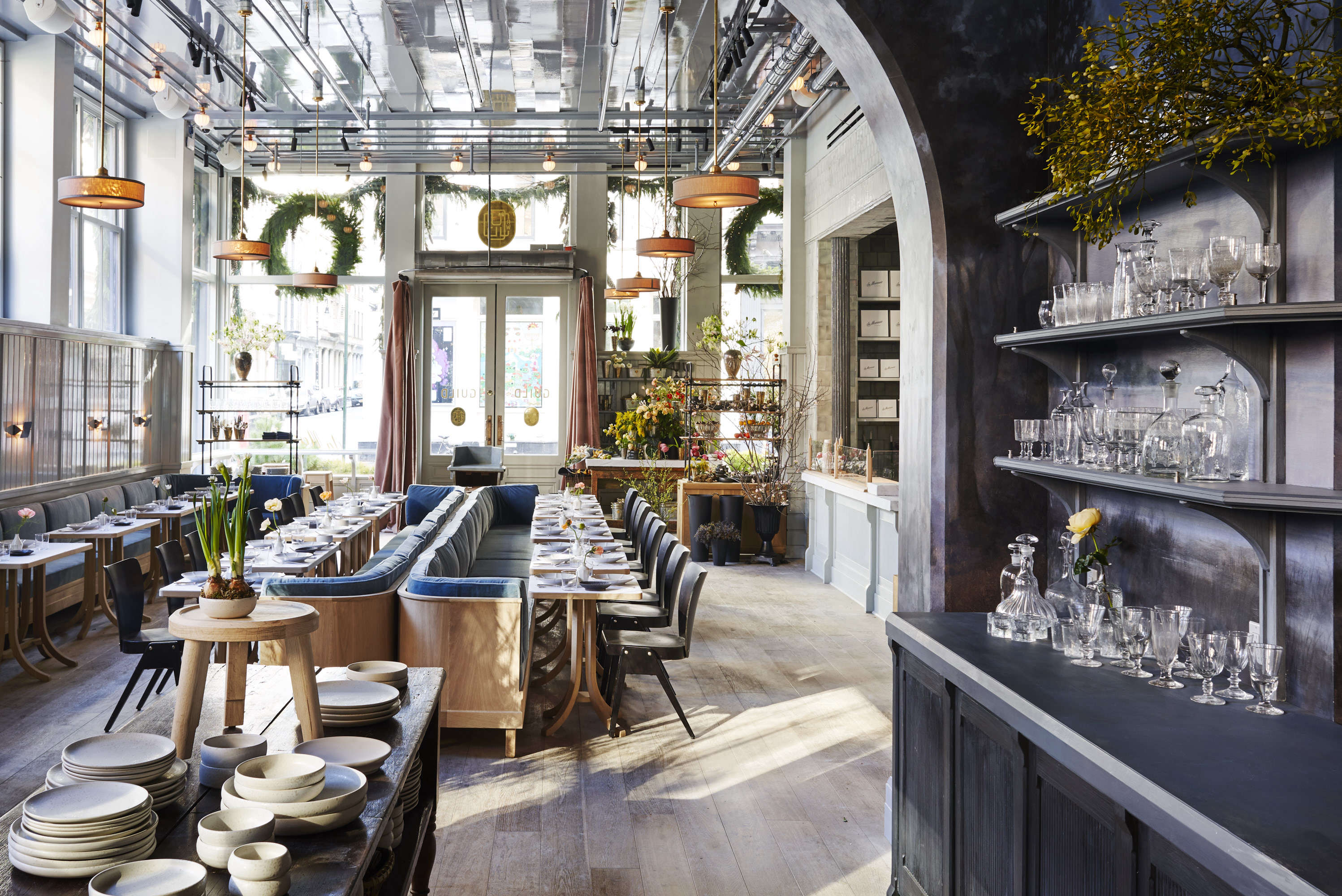

In a neighborhood where a designer chair can cost more than a used car and a cappuccino may arrive with the confidence of a runway model, Roman & Williams Guild still manages to feel surprising. Tucked into SoHo at 53 Howard Street, The Guild is not simply a luxury home store, not merely a French restaurant, and not just another polished Manhattan concept space. It is a full-bodied world: part showroom, part café, part flower-filled fantasy, part artisan marketplace, and part reminder that physical retail can still make people stop scrolling and start touching things.
Created by the celebrated husband-and-wife design duo Robin Standefer and Stephen Alesch, Roman & Williams Guild turns shopping into a sensory event. You can sit in a room designed by the people who made some of downtown New York’s most memorable interiors, eat French food on tableware you might later buy, admire handmade lighting, study the grain of a wooden chair, and wonder whether your apartment deserves a complete personality transplant. Spoiler: after ten minutes inside, it probably does.
The magic of The Guild is that it treats design as something lived with, not just looked at. The pieces are not staged like museum relics behind invisible velvet ropes. They are part of a working environment where coffee cups, linen napkins, banquettes, flowers, books, glassware, and carved wood all participate in the same conversation. The result is one of SoHo’s most glamorous retail experiencesand one of the clearest examples of Roman & Williams’ belief that beauty should have weight, texture, memory, and a little drama.
A SoHo Design Destination with Serious Atmosphere
Roman & Williams Guild opened as a bold answer to a very modern question: what should a store be when everyone can buy furniture online in pajamas? Standefer and Alesch answered by creating a place that cannot be flattened into a product grid. The Guild is immersive, layered, and intentionally slow. It asks visitors to wander, linger, look up, look closer, and maybe cancel whatever sensible errand they had planned afterward.
The space occupies a historic building in SoHo, a neighborhood already loaded with cast-iron architecture, cobblestone-adjacent romance, and the kind of storefronts that make window-shopping feel like cardio with better lighting. Inside, Roman & Williams restored and reimagined the building as an emporium for objects with soul. Instead of chasing the cold perfection of minimalism, The Guild leans into warmth: wood, marble, metal, glass, linen, ceramic, candlelight, and flowers. It is luxurious, but not sterile. Elegant, but not allergic to fingerprints.
Who Are Roman & Williams?
Roman & Williams Buildings and Interiors was founded by Robin Standefer and Stephen Alesch, whose background in film set design helped shape their cinematic approach to interiors. Their work often feels as if a room has a backstory. Nothing is placed simply because it is pretty; it appears to have arrived through travel, use, memory, or a slightly mysterious inheritance from a relative with excellent taste.
The firm has designed influential hospitality and cultural spaces, including restaurants, hotels, residences, and museum environments. Their signature is not a single “look” so much as a philosophy: respect the past, build for longevity, use honest materials, and create rooms that feel emotionally inhabited from day one. In that sense, The Guild is not a side project. It is a manifesto with a cash register.
Inside The Guild: Shop, Restaurant, Library, Flower Shop, and Dream Sequence
The Guild originally debuted as a 7,000-square-foot concept where furniture, lighting, accessories, books, flowers, and food could live together. That combination might sound like a lot, because it is. But Roman & Williams makes the abundance feel orchestrated rather than chaotic. Think of it as a dinner party hosted by a design genius who owns too many beautiful things and refuses to apologize.
The Founding Collection
At the center of the store is Roman & Williams’ own Founding Collection, a serious body of original furniture, lighting, and accessories. The pieces are substantial in both construction and attitude. Chairs have posture. Tables have presence. Lighting fixtures do not simply illuminate; they enter the room like supporting characters with excellent lines.
Many items reflect the firm’s longstanding interest in craft, natural materials, and forms that improve with age. A Roman & Williams chair is not trying to look perfect forever. It is trying to become more itself over time, gathering marks, polish, and memory. This is design for people who believe patina is not damageit is a résumé.
Global Artisan Objects
The Guild also features objects from master artisans around the world. Visitors may encounter Japanese ceramics, Swedish linens, French silverware, handmade glass, sculptural lighting, and tableware with the quiet confidence of objects made by people who know exactly what they are doing. The curation is not random. It reflects Roman & Williams’ belief that a home should be a conversation between original design, found treasures, craft traditions, and everyday use.
La Mercerie: Dining as Design Theater
The restaurant inside the Roman & Williams Guild world is La Mercerie, a French all-day café where culinary art and interior design are intentionally intertwined. Led by chef-partner Marie-Aude Rose with executive chef Heloise Fischbach, La Mercerie serves a modern expression of French hospitality in a dining room defined by soft blue banquettes, tile, high windows, elegant table settings, and the irresistible feeling that you have accidentally wandered into a Parisian daydream with a SoHo ZIP code.
One of La Mercerie’s smartest ideas is also one of its most seductive: many of the objects used in the dining experience are connected to The Guild’s retail universe. Ceramics, glassware, linens, lighting, and furniture are not background props. They are part of the meal. The fork, the table, the candleholder, the chaireverything is allowed to make its case. By dessert, you may find yourself emotionally attached to a napkin. This is normal. The Guild planned it.
Why The Guild Still Feels Fresh
When The Guild opened, retail was already deep into its “is the store dead?” panic era. Roman & Williams responded by making a store that behaves less like a store and more like a physical argument for why stores matter. The Guild is not built around speed. It is built around experience. It rewards curiosity. It turns shopping into education, dining into testing, and browsing into a form of aesthetic daydreaming.
That approach has only become more relevant. In a world of endless thumbnails, The Guild offers scale, texture, and atmosphere. You can feel the weight of a glass. You can see how linen behaves in real light. You can understand why a handmade object costs more than its mass-produced cousin. You can sit in a chair instead of trusting a product description that says “generously proportioned,” which, as we all know, can mean anything from throne-like to “good luck, knees.”
The Design Language: Romantic, Weighty, and Built to Last
The Roman & Williams aesthetic often combines old-world romance with muscular construction. At The Guild, that means carved wood, curved forms, expressive stone, crafted metal, tactile fabrics, and objects that seem to belong to both the past and the future. The mood is glamorous, but it is not flimsy. This is glamour with elbows on the table.
The designers are especially good at creating rooms that feel collected rather than decorated. Nothing feels as if it was ordered in a panic two weeks before installation. The layers are purposeful: a chair with a strong silhouette, a vase with handmade irregularity, flowers that look slightly wild, a glowing lamp, a book that suggests someone in the room has opinions. The effect is aspirational, but not airless.
Guild Bar and the Expansion of the Sensory Concept
The later addition of Guild Bar deepened the experience even further. This intimate bar, tucked into the world of La Mercerie and The Guild, centers on craft cocktails, Champagne, and rare glassware. With only a handful of seats, a marble counter, dramatic lighting, and a moody mural, Guild Bar feels like a secret whispered by someone wearing very good shoes.
Its concept is perfectly Roman & Williams: do not just display beautiful glasswarelet people drink from it. Let the hand understand what the eye admires. Let taste, touch, sight, and atmosphere work together. The bar reinforces the larger idea behind The Guild: design is not an abstract category. It is how life feels while you are living it.
What Visitors Can Learn from The Guild
Even if your decorating budget is currently more “carefully chosen candle” than “custom walnut bed,” The Guild offers plenty of practical inspiration. First, it shows the power of material honesty. Wood should look like wood. Metal should have depth. Ceramics can reveal the hand that shaped them. Rooms become more interesting when materials are allowed to behave naturally.
Second, The Guild proves that lighting is not an afterthought. Lamps, pendants, sconces, and candlelight shape the emotional temperature of a room. Bad lighting can make even expensive furniture look like it is waiting at the DMV. Good lighting, on the other hand, gives everything a pulse.
Third, The Guild makes a strong case for mixing categories. A home does not need to be entirely modern, entirely antique, entirely neutral, or entirely anything. The most memorable interiors often combine new pieces, inherited objects, handmade items, books, flowers, art, and tableware that looks like it has survived at least one excellent dinner party.
Why SoHo Is the Right Home for The Guild
SoHo gives The Guild the perfect stage. The neighborhood has long balanced commerce and creativity, high fashion and old architecture, polished boutiques and gritty ghosts of industry. Roman & Williams taps into that tension beautifully. The Guild feels refined, but it does not feel suburban or sealed off from the city. It belongs to downtown New York’s tradition of reinvention.
There is also a pleasing defiance in transforming a former bank-like environment into a temple of craft, food, and beauty. Where money was once counted, objects are now studied. Where transactions once happened quickly, visitors now linger over coffee, glassware, and the shape of a chair leg. It is capitalism, yesbut at least this version comes with better flowers.
Current Context: From SoHo to a Larger Roman & Williams World
The Guild has grown from a single destination into the center of a broader Roman & Williams universe. The shop remains a SoHo anchor for furniture, lighting, tableware, accessories, and artisan work. La Mercerie continues to connect French dining with object craft. Guild Gallery, nearby, extends the brand’s commitment to artists and material experimentation. The Roman & Williams hospitality world has also expanded uptown through Marcel and La Mercerie Pâtisserie at the Breuer Building, showing that the original SoHo formula was not a noveltyit was a blueprint.
Restaurant operations have evolved over time, including a shift after the end of the earlier Starr Restaurants partnership, but the essential identity of La Mercerie remains tied to Roman & Williams’ design-led vision. For readers planning a visit, it is smart to check current hours, reservation availability, and dining details before going. Beautiful places, like beautiful people, sometimes change their schedules.
Experience Notes: What It Feels Like to Visit The Guild
Visiting The Guild is best approached with the mindset of a flâneur, not a shopper in a hurry. Do not arrive with only seven minutes before your next appointment unless you enjoy emotional pain. The space deserves time. Start outside, where SoHo’s street energy gives the building a sense of urban theater. Then step in and let your eyes adjust from New York’s bright commercial chaos to Roman & Williams’ warmer, slower rhythm.
The first impression is usually texture. You notice wood grain before price tags, flowers before floor plans, candlelight before categories. The Guild does not shout, “Buy this now!” It murmurs, “Wouldn’t life be better if your breakfast table had more dignity?” That is more dangerous, frankly. A hard sell is easy to resist. A beautiful spoon with quiet self-possession is another matter entirely.
One of the pleasures of the space is how naturally it encourages comparison. You might see a chair in the shop, then sit in a similar design at La Mercerie. You might admire a ceramic piece on a shelf, then recognize the same spirit in the restaurant’s table setting. This is where The Guild becomes more than retail. It demonstrates how objects perform in real life. A glass is not just a sculptural shape; it has balance, clarity, weight, and sound. A table is not just a surface; it changes the posture of a meal. A lamp does not simply light a room; it decides whether everyone looks cinematic or mildly exhausted.
Dining at La Mercerie adds another layer. The room is elegant without becoming stiff, and the French menu gives visitors a reason to stay long enough to notice details. You may begin by thinking about food and end by studying the curve of a banquette, the softness of linen, or the way flowers alter the mood of a table. That is the point. The Guild collapses the distance between design and daily pleasure. It suggests that interiors are not background scenery. They shape appetite, conversation, memory, and even the confidence with which one orders dessert.
The experience can also be humbling in the best way. Not everyone can recreate The Guild at home, and honestly, most apartments would revolt if asked to become full Roman & Williams environments overnight. But visitors can borrow the principles: choose fewer things with more character, mix handmade objects with practical ones, use flowers generously, improve lighting, and stop treating the dining table like a laptop storage facility. Glamour, The Guild quietly argues, is not only about expense. It is about attention.
By the time you leave, SoHo may look a little harsher and your own living room may suddenly seem under-seasoned. That is the risk of visiting a place this considered. The reward is bigger: The Guild reminds you that design is not reserved for glossy spreads or celebrity homes. It can be tasted in a café, held in a cup, felt in a chair, and carried home in a single beautifully made object.
Conclusion
The Guild: A Glamorous New Emporium in SoHo from Roman & Williams remains one of New York’s most persuasive arguments for experiential retail. It blends luxury home design, global craftsmanship, French dining, flowers, books, and atmosphere into a destination that feels both theatrical and deeply livable. Robin Standefer and Stephen Alesch did not simply open a store; they built a world where objects earn their place through use, beauty, and emotional resonance.
For design lovers, The Guild is a master class in materiality and mood. For diners, La Mercerie is a chance to experience French hospitality inside one of the city’s most carefully composed rooms. For casual visitors, it is proof that browsing can still feel magical when a space is designed with intelligence, generosity, and a little mischief. In a retail landscape crowded with sameness, Roman & Williams Guild offers something rare: a place where every chair, glass, flower, lamp, and pastry seems to be part of the same glamorous sentence.
Note: This article is an original, human-style synthesis based on public information from reputable design, dining, retail, and travel sources. It is written for web publication in standard American English and does not include source-link markup inside the publishable body content.