“I Would Sue Will Smith For 200 Million Dollars”: Jim Carrey Is Sickened By Hollywood’s Reaction To The Oscars Fiasco

Hollywood has survived flops, feuds, wardrobe disasters, and acceptance speeches that seemed to last long enough to qualify for a limited series. But the 2022 Oscars fiasco hit a different nerve. It was not just shocking. It was clarifying. In one messy, surreal burst of live television, the film industry had to reveal what it actually believed about celebrity, power, violence, and accountability. And when the dust settled, Jim Carrey was one of the loudest voices saying the quiet part out loud.
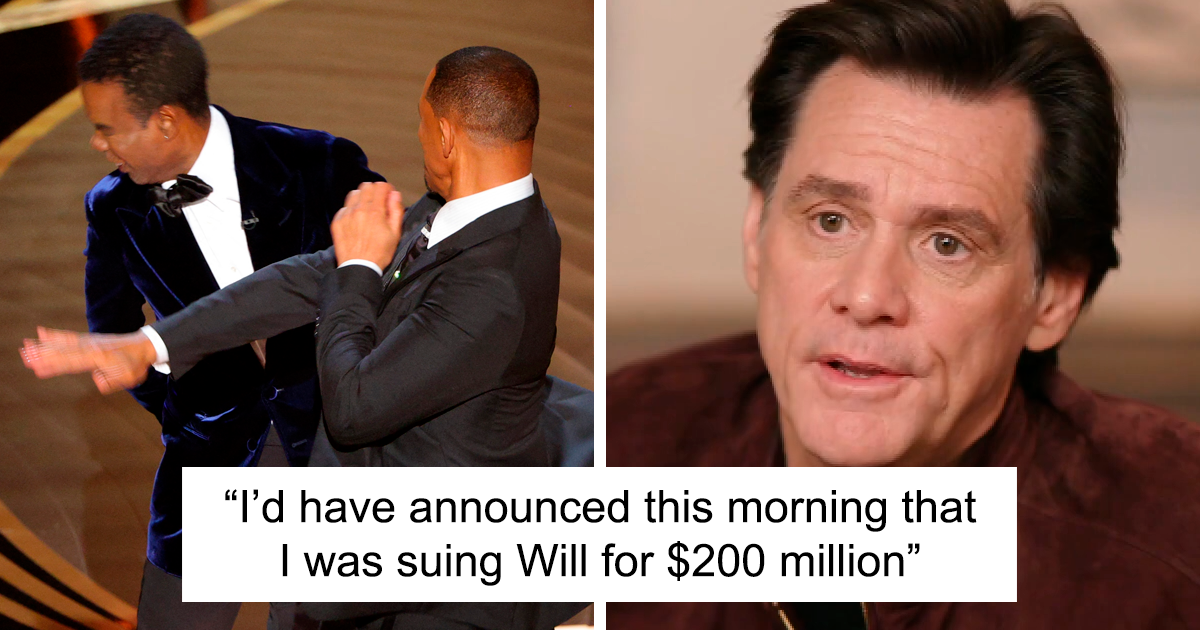
Carrey did not merely criticize Will Smith for slapping Chris Rock onstage after Rock’s joke about Jada Pinkett Smith. He went after the entire ecosystem around the moment. He was furious at the standing ovation Smith received later that night after winning Best Actor for King Richard. He was disgusted by what he saw as institutional weakness. And he delivered the kind of quote that immediately set the internet on fire: if he had been Chris Rock, he said, he would have sued Smith for $200 million.
That line was flashy enough to dominate headlines, but it was not the most interesting thing Carrey said. The real story was his frustration with Hollywood’s reaction. In Carrey’s view, the slap was ugly, but the room’s response was worse. That is why his comments kept circulating long after the ceremony ended. He was speaking to a larger discomfort many viewers felt in real time: not just what happened, but how many powerful people seemed willing to shrug, wince, then carry on with the show.
The Night the Oscars Went Off the Rails
By now, the sequence is burned into pop-culture history. Chris Rock walked onstage to present the Oscar for Best Documentary Feature. He made a joke comparing Jada Pinkett Smith’s shaved head to G.I. Jane. Pinkett Smith, who has spoken publicly about living with alopecia, was not amused. Will Smith marched onto the stage, struck Rock, returned to his seat, and shouted for Rock to keep his wife’s name out of his mouth.
It was one of those live-TV moments that instantly breaks the normal rules of attention. Viewers at home were confused. Some thought it was staged. Others realized, with a sinking feeling, that this was very real. The room seemed frozen in a strange blend of shock, etiquette, and career self-preservation. Rock, to his credit, steadied himself and pushed forward. The show did, too, though it suddenly looked like an elegant dinner party where somebody had thrown a chair through the dessert table.
Then came the part that made the whole thing even more unbelievable. Less than an hour later, Smith won Best Actor. He accepted the award through tears, apologized to the Academy and his fellow nominees, but did not apologize to Rock in that speech. The audience gave him a standing ovation. That was the image that haunted the fallout. Not just the slap, but the applause.
Why Jim Carrey’s Quote Hit So Hard
When Carrey spoke to Gayle King after the ceremony, he did not sound like a man trying to split the difference. He sounded appalled. He said Smith should have been arrested. He said he would have announced a $200 million lawsuit the next morning if he were in Rock’s shoes. And he argued that the viral clip would live forever, meaning the humiliation would not fade the way a private insult might. In Carrey’s framing, this was not some overheated celebrity spat that deserved gentle handling. It was a public assault preserved in the digital amber of the internet.
That is a big reason his remarks spread so quickly. Carrey was saying what many viewers were already thinking but what many industry figures were avoiding. He was not interested in the usual awards-season diplomacy. He was not trying to protect the event’s image or soften the edges of the moment with careful publicist-approved phrasing. He used the kind of blunt, unmistakable language that cuts through a media storm.
But his strongest criticism was aimed beyond Smith. Carrey said he was sickened by the standing ovation and described Hollywood as spineless. That word stuck because it targeted the part of the story that made people feel the most queasy. It was not that celebrities had no reaction. Plenty of them did. It was that the room, collectively, seemed unable to say in the moment that violence on a stage, at work, on live television, is still violence. Fame had bent the atmosphere.
Hollywood’s Reaction Was the Real Scandal
Carrey’s central point was not that every single person in Hollywood approved of Smith’s behavior. That would be too simple, and it would not be true. Many people in and around the industry condemned what happened. SAG-AFTRA called the incident unacceptable and stressed that violence in the workplace is never appropriate. Oscars co-host Wanda Sykes later said she felt physically ill and was angry Smith was allowed to remain in the room and collect his award. Amy Schumer said she was still triggered and traumatized by the chaos. In other words, condemnation existed.
Still, the public memory of the night did not center on those criticisms. It centered on the image of Smith being celebrated after crossing a line in front of millions of viewers. That is what made the room seem morally scrambled. Hollywood is very good at giving speeches about values. It is less consistent when those values collide with a beloved star, a career narrative, and the emotional momentum of a major award.
This is where Carrey’s outrage resonated beyond celebrity gossip. He was pointing to a familiar pattern: institutions often get very principled right after they have finished hesitating. The Academy later launched disciplinary proceedings. Smith resigned from the Academy. He was eventually banned from Academy events, including the Oscars, for 10 years. But the immediate response felt muddled, reactive, and painfully late. Even the Academy would later admit its handling of the crisis was inadequate.
Power Changes the Temperature of a Room
One reason the slap became such a durable cultural story is that it exposed how status works in elite spaces. If an unknown guest had walked onstage and struck a presenter, nobody would have been debating subtle emotional context for very long. Security would have been involved. The tone would have been clear. But Smith was not just anybody. He was a nominee, a star, a longtime industry favorite, and a likely winner on one of the biggest nights of his career. Power does not always erase consequences, but it often delays them. That delay can say more than the punishment that eventually arrives.
Carrey seemed to understand that immediately. His disgust was not just moral; it was sociological. He was reacting to a room full of people behaving differently because the person at the center of the scandal was powerful enough to make people second-guess the obvious.
The Academy’s Slow-Motion Cleanup Job
After the ceremony, the Academy entered full damage-control mode. Reports emerged that Smith had been asked to leave and refused. The organization initiated disciplinary proceedings. Smith apologized publicly to Rock the next day, resigned his Academy membership days later, and said he would accept any further consequences. The Board of Governors ultimately barred him from Academy events for a decade.
Those steps mattered, but they never fully solved the main problem: the optics of the moment itself. Once the audience stood and applauded, the industry had already told the public something important about its reflexes. The later punishments looked like institutional correction, not institutional clarity. They were the cleanup after the spill, not proof that the floor had been dry all along.
That gap between the live response and the later response is exactly why Carrey’s comments still feel relevant. He did not wait for committees, statements, or corporate language. He reacted to the raw image everybody else saw. And that image was not a disciplined industry protecting workplace norms. It was an industry wobbling under the gravitational pull of celebrity.
Chris Rock’s Restraint Made the Contrast Even Sharper
Another reason Carrey’s remarks landed is that Chris Rock did not escalate the situation. Rock looked stunned, but he did his job. He stayed onstage. He delivered the category. He kept the ceremony moving. In a bizarre way, his professionalism made the surrounding reaction look even weaker. The person who had just been hit was the one acting like a professional broadcaster in a crisis, while the institution hosting the event seemed unsure whether to behave like a workplace, a fan club, or a hostage to the schedule.
Rock also refused to immediately turn the aftermath into a media circus. He did not launch a public campaign. He did not spend every waking hour narrating his pain to cameras. When he first addressed the incident at a comedy show a few days later, he said he was still processing what happened. A year later, in his live Netflix special, he finally hit back in his own medium: stand-up. That slow burn only made Carrey’s earlier fury look less like grandstanding and more like an honest reaction to an obviously absurd situation.
Why the Story Refused to Die
Celebrity scandals usually burn hot and fast. This one lingered because it touched several uncomfortable nerves at once. It was about violence, but also masculinity, race, fame, institutional weakness, public humiliation, comedy, marriage, and the weirdly medieval logic of defending honor on a stage sponsored by luxury jewelry. It was a cultural Rorschach test in tuxedos.
Some observers focused on Pinkett Smith’s alopecia and argued that the joke was cruel or insensitive. Others focused on Rock’s role as a comedian and argued that words, even tasteless words, do not justify physical retaliation. Still others fixated on Hollywood itself: the crowd, the producers, the Academy, and the way powerful rooms often protect their own until the public backlash becomes impossible to ignore. Carrey’s comments mattered because they cut directly into that third lane.
His outrage also survived because it was refreshingly unvarnished. Hollywood commentary often comes wrapped in disclaimers, careful balancing acts, and those eerily bloodless statements that sound as if they were drafted by a committee in a beige conference room. Carrey sounded like a human being who had watched something ugly happen and had no interest in pretending it was just another awkward awards-show hiccup. He did not offer the industry a flattering mirror. He handed it a fluorescent one.
The Experience of Watching the Oscars Fiasco in Real Time
If you watched the slap live, you probably remember the sensation before you remember the facts. It felt like the room had slipped sideways. There was the joke, then the walk, then the hit, then that collective half-second where everyone on Earth seemed to ask the same question: Wait, was that real? Live television almost never gives us anything truly unscripted anymore. Even chaos tends to arrive with branding. This did not. It arrived raw, awkward, and impossible to package in the moment.
Part of the experience was technical confusion. In the United States, the broadcast muted some of Smith’s shouted words, which only made the incident feel stranger. International and uncensored clips spread almost instantly online, creating a split-screen public experience: one audience saw a bizarre interruption, another heard the full fury, and social media stitched the whole thing together in real time. That is one reason the moment detonated so fast. It was not just a scandal. It was a collective digital reconstruction project.
Then there was the emotional whiplash. Awards shows are built like glossy machines. You are supposed to move from joke to montage to envelope to tears to orchestra swell. The slap broke that rhythm. Suddenly viewers were not watching a celebration of movies. They were watching an institution try, and fail, to act normal after something deeply abnormal had just happened. Every camera cut felt loaded. Every celebrity reaction shot became evidence. Every hug looked political.
For comedians and comedy fans, the experience carried another layer of dread. Rock was doing a job comics have done forever: telling a risky joke in a room full of powerful people. Whether the joke was good, bad, mean, lazy, or dated is a fair debate. But the physical response shattered a basic expectation of the profession. A bad joke is supposed to be answered with a groan, a complaint, a sharper joke later, maybe a tense backstage exchange. Not a slap on a global stage. That is why so many comedians reacted with alarm. They were not just defending Rock. They were defending the line between heckling and assault.
For ordinary viewers, the discomfort went beyond celebrity fascination. The incident activated a familiar social fear: what happens when everyone in a room sees something wrong, but nobody knows who is willing to say it first? That is why the standing ovation became such a powerful image. It transformed the moment from one man losing his temper into a broader commentary about group behavior. People were no longer just asking what Smith had done. They were asking what the room had revealed about itself.
And maybe that is why the story still feels oddly alive. The slap was shocking, yes, but the aftertaste came from recognition. Most people have, at some point, been in a workplace, family, school, or friend group where the obvious truth gets smothered because the wrong person has too much status. Watching the Oscars that night was like seeing that dynamic performed in designer formalwear under perfect lighting. It was glamorous, ridiculous, and uncomfortably familiar all at once.
Final Take
Jim Carrey’s reaction endured because it refused to let Hollywood hide behind the excuse of complexity. Yes, the Oscars fiasco involved emotions, context, history, and a joke that hit a personal nerve. But it also involved a very simple fact: a presenter was struck onstage, and the industry’s immediate response looked weak, confused, and star-struck. Carrey’s outrage was not elegant, and that was exactly the point. He cut through the spin.
The quote about suing for $200 million made headlines, but his deeper argument is what gave the story staying power. He believed Hollywood exposed its own moral softness in the way it reacted after the slap. Looking back, that critique still stings because it was not entirely about Will Smith. It was about a room full of people, an institution built on image, and a culture that still struggles to decide when fame stops being charisma and starts becoming insulation.
In the end, the Oscars fiasco was not merely a scandal. It was a stress test. Jim Carrey thought Hollywood failed it. Judging by how often his remarks still resurface, a lot of people think he had a point.