
Some friendships begin at school, at work, or during an awkward neighborhood barbecue where everyone pretends to remember everyone else’s name. The friendship between Delvar Dopson and a little girl named Brooklyn Andracke began with a garbage truck, a weekly wave, and one carefully saved birthday cupcake.
In 2016, three-year-old Brooklyn lived with her family in Bloomington, Illinois. Thursday was her favorite day of the weeknot because a new cartoon premiered or because someone had declared it National Unlimited Ice Cream Day. Thursday was garbage day, which meant Delvar Dopson would drive his sanitation truck past her home.
The story soon traveled far beyond the neighborhood, touching people across the United States and around the world. Yet, like many viral stories, several online retellings mixed up important details. The real story is not about a lonely garbage collector receiving his only birthday present. It is about a child sharing her own birthday celebration and a public worker returning that kindness in a wonderfully thoughtful way.
Who Is Delvar Dopson?
Delvar Dopson was a sanitation worker employed by the City of Bloomington and a member of AFSCME Local 699. By the time his friendship with Brooklyn became famous, he had spent years serving the community through a job most residents depended on but rarely stopped to think about.
Garbage collection tends to become visible only when it does not happen. When the cans are emptied on schedule, the process can feel almost magical: put trash by the curb, go to work, return home, andpoofit is gone. Behind that little suburban magic trick are workers operating large vehicles, following demanding routes, handling unpleasant materials, and keeping neighborhoods clean.
Dopson brought something extra to his route: an enormous smile. He also honked his horn, flashed the truck’s lights, and waved to children who waited to see him. Brooklyn was one of his most enthusiastic fans. According to Dopson, he enjoyed the weekly greeting so much that he would tell his wife about it.
Why Brooklyn Waited for the Garbage Truck
For approximately a year, Brooklyn eagerly watched for Dopson’s truck every Thursday. The routine began with her waving from a window. Eventually, Brooklyn and her mother, Traci Andracke, started going outside so she could see the truck more clearly.
If they missed it, Traci sometimes drove through the neighborhood to find the truck. That may sound like an unusually determined garbage-day strategy, but parents understand. Once a toddler decides that a sanitation truck is the greatest thing ever invented, the family calendar must respectfully cooperate.
Dopson always responded with a smile, wave, honk, or flash of the headlights. What Brooklyn and her mother did not initially know was that the ritual mattered just as much to him. Dopson reportedly attended a meeting on Thursday mornings and tried to leave promptly so he would not miss seeing them during his route.
A Hero Without a Cape
To Brooklyn, Delvar was not simply the person collecting the neighborhood’s trash. He was a weekly celebrity arriving in a giant truck equipped with lights, mechanical equipment, and a horn. That is a difficult entrance for any movie star to compete with.
Her excitement also illustrates something adults often forget: children do not automatically rank people according to job title, income, or social prestige. Brooklyn saw someone who smiled at her, acknowledged her enthusiasm, and made Thursday mornings fun. In her world, that was more than enough to qualify him as a hero.
The Cupcake That Started a Friendship
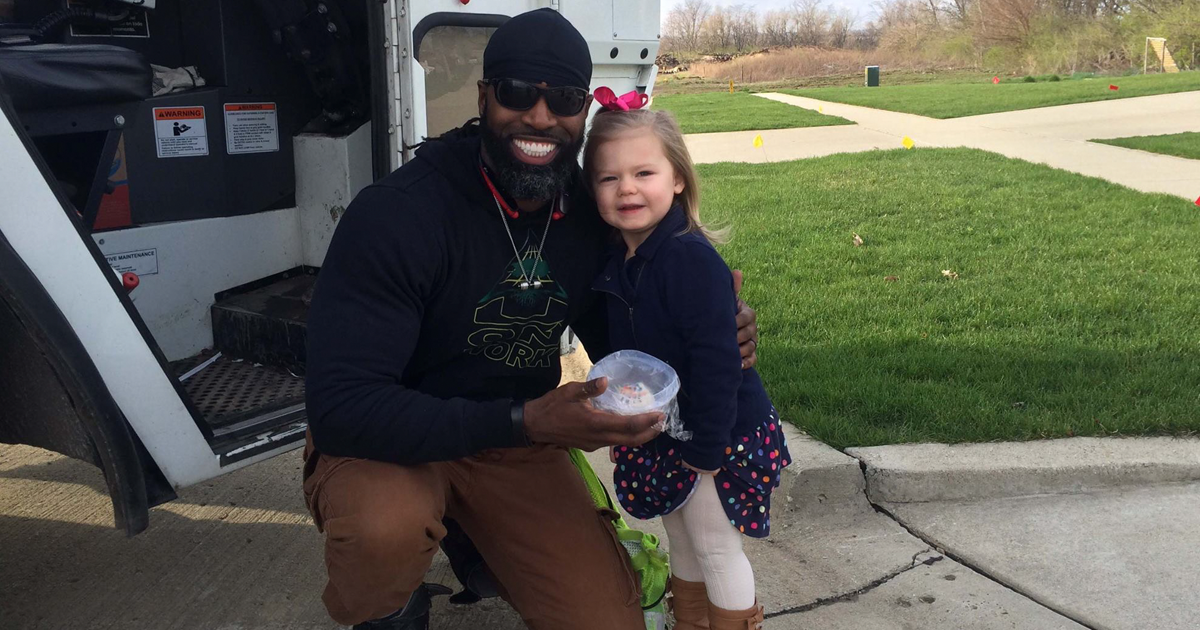
When Brooklyn celebrated her third birthday in April 2016, she wanted to share the occasion with her favorite sanitation worker. She saved one of her birthday cupcakes, wrapped it, and waited outside with her mother for Delvar’s truck.
When he arrived, Traci motioned for him to stop. Dopson pulled over, stepped down from the truck, and walked toward them with his familiar smile. Brooklyn, who was normally talkative, became completely speechless. Meeting the man she had admired from a distance was apparently the preschool equivalent of meeting a global superstar.
Brooklyn handed him the cupcake while her mother explained how much his weekly honks and waves meant to them. Dopson told Traci that he also looked forward to seeing Brooklyn every Thursday. He said he did not have children of his own at the time but mentored several young people and loved making children happy.
After the meeting, Brooklyn remained unusually quiet in the car. When her mother asked whether something was wrong, Brooklyn gave a simple answer: “Mommy, I’m so happy.”
What Gift Did Delvar Dopson Get?
The physical gift Delvar received was one of Brooklyn’s birthday cupcakes. More importantly, he received recognition, friendship, and proof that his daily work had a personal impact on someone in the neighborhood.
Some later social media posts incorrectly claimed that it was Delvar’s birthday and that Brooklyn’s cupcake was the only present he received. That version is more dramatic, but it is not accurate. It was Brooklyn’s birthday. She was sharing her celebration with him rather than rescuing him from a forgotten birthday.
The corrected version is arguably better. Brooklyn offered a gift without believing Delvar needed pity. She simply liked him and wanted him included in her special day. The exchange was between two people who genuinely brightened each other’s week, not between a heroic child and a helpless adult.
Delvar Returned With a Frozen Surprise
The cupcake might have ended the story with a smile and a sugar rush, but Dopson was not finished. The following Thursday, he returned to Brooklyn’s home carrying birthday presents.
Delvar and his wife, Bonnie, had learned that Brooklyn loved Disney’s Frozen. They prepared a gift basket filled with themed toys and another collection of coloring, painting, and drawing supplies. For a three-year-old fan, it was less a present and more a complete delivery from the kingdom of Arendelle.
Brooklyn thanked him and later made a colorful sign that read, “Thank You Delvar.” Dopson displayed the sign on his truck, transforming an ordinary sanitation vehicle into what may have been Bloomington’s most emotionally significant mobile art gallery.
A Friendship Built on Reciprocity
The exchange mattered because the kindness traveled in both directions. Brooklyn gave Delvar a cupcake. Delvar gave Brooklyn thoughtful gifts. She responded with a handmade thank-you sign. Each person noticed the other and answered generosity with more generosity.
That pattern is what made the story more powerful than a one-time charitable gesture. Neither person was merely a giver or receiver. They created a relationship through repeated moments of attention.
How the Story Went Viral
Traci shared the experience with the City of Bloomington, which published it on its Facebook page. Photographs of Brooklyn and Delvar quickly attracted thousands of reactions and shares. News organizations including ABC News, Fox affiliates, Cox Media Group stations, Scripps stations, NBC Chicago, and industry publications reported on their unlikely friendship.
Dopson later appeared on national programs such as Good Morning America and Inside Edition. Messages arrived from public workers, celebrities, athletes, and readers outside the United States. AFSCME described the response as a global internet sensation and emphasized how the story humanized sanitation workers whose contributions are frequently overlooked.
It is easy to understand why the photographs spread so widely. The story contained no elaborate rescue, expensive donation, or carefully choreographed campaign. Its main ingredients were a wave, a cupcake, some toys, and two people being delighted to see each other. Apparently, the internet occasionally takes a break from arguing and remembers that it has a heart.
Why Delvar Dopson’s Story Still Matters
It Recognized an Often-Invisible Worker
Dopson used the attention to speak about the value of sanitation employees and other public service workers. He noted that residents expect their trash to disappear but may never consider the people making that happen.
The viral story placed a name and personality behind a familiar service. Delvar was no longer “the garbage man.” He was a mentor, husband, neighbor, municipal employee, and friend who understood that a two-second wave could shape a child’s entire week.
It Challenged Social Barriers
Dopson also reflected on the differences between himself and Brooklyn’s family. He was a tall Black man with dreadlocks, while Brooklyn was a young white girl. He observed that some adults might have approached him with assumptions based on race, appearance, class, or occupation.
Brooklyn had not absorbed those barriers. Her family encouraged her to connect with someone who treated her kindly, and Dopson praised that parenting. The friendship did not erase serious social divisions, but it demonstrated what can happen when people encounter one another as individuals rather than categories.
It Showed That Kindness Can Be Part of a Job
Dopson did not need a special community-outreach budget to wave at Brooklyn. The gesture cost nothing and required only a moment. Yet it turned a routine route into a relationship that brought joy to both of them.
That does not mean workers must constantly perform cheerfulness. Everyone is entitled to a difficult morning, especially when operating heavy equipment before many people have found their coffee. The lesson is simply that ordinary work can carry human meaning when people acknowledge one another.
What Happened to Delvar After the Viral Story?
A later chapter added an unexpected game-show twist. The viral attention contributed to Delvar and Bonnie Dopson being featured in a promotional video that eventually caught the attention of NBC Universal. The couple was invited to compete on the television game show The Wall.
In 2017, AFSCME reported that the Dopsons won $399,792. They planned to use the money to purchase their first home, start a family, and support youth-focused community work. Despite the winnings, Delvar said he intended to continue serving Bloomington through his sanitation job.
Winning nearly $400,000 would persuade many people to resign before the studio confetti reached the floor. Delvar’s decision to keep working reinforced the message that his job was not merely a paycheck or a temporary stop on the road to something respectable. Public service was already respectable to him.
Experiences and Lessons Inspired by Delvar and Brooklyn
Many communities have their own quieter version of the Delvar Dopson story. It may involve a mail carrier who always greets the family dog, a crossing guard who remembers every child’s name, a bus driver who waits a few extra seconds for a running passenger, or a grocery clerk who asks an elderly customer how the grandchildren are doing.
These relationships rarely begin with formal introductions. They develop through repetition. A person appears at roughly the same time each week. Someone waves. The wave becomes a greeting. The greeting becomes a short conversation. Eventually, both people notice when the other is missing.
Children are especially good at creating these connections because they pay attention to details adults have trained themselves to ignore. A child notices the truck’s flashing lights, the driver’s smile, the sound of a familiar horn, and the excitement of a machine lifting a trash container into the air. Adults mostly notice whether they remembered to put the bin outside.
The experience of giving a simple thank-you can also be surprisingly powerful. Imagine handing a cold drink to a delivery driver on a hot afternoon or writing a note to a custodian who keeps a shared building clean. The object itself may be inexpensive, but the message is valuable: “I see what you do, and I do not take it for granted.”
Recognition can be particularly meaningful for people whose jobs are socially essential but publicly undervalued. Sanitation workers, maintenance crews, school cafeteria employees, nursing assistants, warehouse staff, and many others often perform difficult work in the background. People may recognize the service while overlooking the person providing it.
Brooklyn reversed that pattern. She was originally fascinated by the garbage truck, but her attention gradually shifted toward the person driving it. The machine attracted her; Delvar’s kindness kept her waiting every Thursday.
The story also offers a useful parenting lesson. Traci did more than observe her daughter’s enthusiasm. She made room for it. She took Brooklyn outside, occasionally searched the neighborhood when they missed the truck, saved a cupcake, and helped her approach Delvar respectfully. In doing so, she showed Brooklyn that gratitude should become an action rather than remain a pleasant thought.
Adults often dismiss children’s interests as temporary or silly. A sanitation truck may not seem important compared with educational toys, carefully planned activities, or the latest enrichment program. Yet Brooklyn’s fascination produced lessons about work, friendship, generosity, race, respect, and communityan impressive curriculum for one weekly garbage route.
There is also an important lesson about telling true stories responsibly. The inaccurate version of the event made Delvar appear poor, forgotten, and dependent on a child’s charity. The verified account presented him as an active participant who returned kindness with generosity and who was already mentoring young people in his community.
Accuracy matters because changing small details can change the dignity of the people involved. A story does not need invented sadness to become meaningful. The real events were already warm, funny, and memorable.
Perhaps the best way to apply the experience is wonderfully simple: learn the names of people you regularly encounter. Wave to the driver. Thank the custodian. Speak to the crossing guard. Ask the delivery worker how the day is going. These gestures will not automatically become viral sensations, and that is perfectly fine.
The most valuable part of Brooklyn and Delvar’s friendship happened before the cameras, interviews, television appearances, and game-show winnings. It happened during ordinary Thursday mornings when a little girl waved and a sanitation worker made sure to wave back.
Conclusion
The story of Delvar Dopson and the gift he got is often summarized as a cute tale about a garbage collector receiving a cupcake. The truth is richer. Brooklyn shared one of her own birthday cupcakes with the man who made her happy every Thursday. Delvar responded with personalized Frozen gifts, and their exchange grew into a genuine friendship.
What began beside a curb in Bloomington reminded millions of people that kindness does not require wealth, status, or a complicated plan. Sometimes it needs only a wave, a smile, and perhaps a cupcake with enough frosting to survive a morning sanitation route.