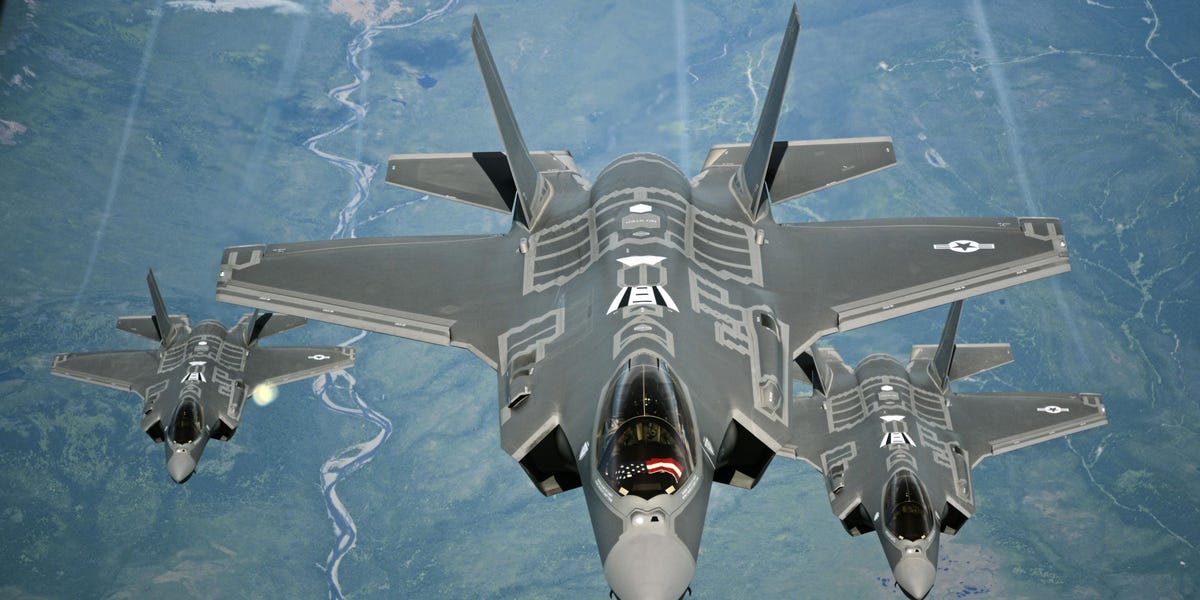

When the U.S. Air Force declared the F-35A Lightning II “combat ready,” it was more than a ribbon-cutting moment with expensive aviation confetti. It was the point at which America’s most ambitious fighter program moved from promise to operational reality. After years of testing, delays, criticism, training, software work, and enough engineering meetings to make a coffee machine file for retirement, the Air Force said the F-35A had reached Initial Operational Capability, or IOC.
In plain English, the Air Force was saying: this jet can deploy, fight, support commanders, and survive in dangerous airspace where older aircraft may have a much rougher day. The declaration did not mean the F-35 was perfect. No modern fighter is perfect, and if one ever claims to be, check whether it also sells miracle vitamins. What it meant was that the F-35A had crossed a formal military threshold: trained airmen, aircraft, weapons, logistics, maintenance, mission systems, and deployment capability were all in place.
The F-35 was designed as a fifth-generation multirole fighter, combining stealth, advanced sensors, data fusion, electronic warfare, and precision strike. Unlike older fighters that often depend on separate aircraft for sensing, jamming, targeting, and command support, the F-35 acts like a flying intelligence node with weapons. It does not just enter the fight; it tries to understand the fight faster than everyone else.
What “Ready for War” Actually Meant
The phrase “ready for war” sounds dramatic, but the military uses a more precise term: Initial Operational Capability. For the F-35A, IOC meant the aircraft could conduct basic close air support, interdiction, and limited suppression or destruction of enemy air defenses in a contested environment. It also meant the Air Force had an operational squadron of aircraft, trained pilots and maintainers, required weapons, mission systems, and logistics support ready to deploy.
The first operational F-35A squadron was the 34th Fighter Squadron of the 388th Fighter Wing at Hill Air Force Base, Utah, working alongside Air Force Reserve personnel from the 419th Fighter Wing. That matters because combat readiness is not just about shiny aircraft lined up on a runway. It is about people, spare parts, mission planning, software, weapons loading, refueling, security, command networks, and the thousand invisible tasks that make a jet more than a museum exhibit with afterburners.
The Air Force’s declaration also sent a message to allies and adversaries. To allies, it said the United States was serious about building a common fifth-generation fighter ecosystem. To adversaries, it said American airpower was moving deeper into the era of stealth, sensors, and networked warfare. In other words: the future had arrived, and it was shaped like a very expensive gray triangle.
Why the F-35A Was Built
The F-35A is the conventional takeoff and landing version used by the U.S. Air Force. It was built to replace aging F-16 Fighting Falcons and A-10 Thunderbolt IIs while complementing the F-22 Raptor. The broader F-35 family includes three variants: the Air Force’s F-35A, the Marine Corps’ short takeoff and vertical landing F-35B, and the carrier-capable F-35C used by the Navy and Marine Corps.
The core idea behind the Joint Strike Fighter program was ambitious: create a family of aircraft that could serve multiple U.S. services and allied nations while sharing common technology. That commonality was supposed to control costs and simplify logistics. In practice, the program became one of the largest and most complex weapons efforts in modern history. The F-35 had to satisfy different missions, different services, different basing needs, and different partner nations. That is less like building one aircraft and more like building three siblings who all want separate bedrooms, different snacks, and the same college fund.
Stealth Is Only the Beginning
Many people hear “F-35” and immediately think “stealth.” That is understandable, but stealth is only one part of the aircraft’s value. The F-35A is designed to reduce detection by enemy radar, but its bigger advantage comes from combining stealth with sensor fusion. It gathers information from onboard sensors, electronic systems, other aircraft, satellites, ground stations, and command networks, then helps the pilot see a cleaner picture of the battlefield.
That is a big deal because modern air combat is not only about who turns tighter or flies faster. It is about who detects first, understands first, shoots first, and survives the enemy’s response. The F-35’s Distributed Aperture System gives pilots a broad view around the aircraft, including missile warning and night operations support. Its Electro-Optical Targeting System helps with long-range detection and precision targeting. The aircraft’s radar and electronic warfare systems allow it to find threats, share information, and help other friendly aircraft operate more effectively.
In older air campaigns, a package might require separate fighters, jammers, command aircraft, reconnaissance assets, and strike aircraft. The F-35 does not replace every one of those roles, but it blends several of them into one platform. That is why pilots and commanders often describe the jet as a force multiplier. Translation: it makes other assets smarter, safer, and more dangerous to the enemy.
The First Combat Test
The Air Force declaration in 2016 was not the final proof of battlefield usefulness. That came later. In April 2019, U.S. Air Force F-35As conducted their first combat employment in Iraq, striking an entrenched ISIS tunnel network and weapons cache in the Hamrin Mountains with a Joint Direct Attack Munition. The mission showed that the F-35A had moved beyond exercises and PowerPoint slides into real operational use.
That first combat strike was symbolically important. It demonstrated that the jet could deploy to the U.S. Central Command area of responsibility, integrate with coalition airpower, and deliver precision weapons against a hostile target. It also reinforced one of the F-35’s main selling points: it is not just a stealth fighter for the opening night of a major war; it can also support day-to-day operations against irregular threats.
From Initial Capability to Full-Rate Production
Initial Operational Capability was a major milestone, but the F-35 program continued to evolve afterward. In 2024, the Department of Defense approved Milestone C and full-rate production for the F-35 program. That decision signaled that the aircraft had completed the required testing and evaluation process needed to move into a mature production phase.
By 2026, the global F-35 enterprise had grown dramatically. Lockheed Martin reported more than 1,300 aircraft delivered, more than one million flight hours, dozens of bases worldwide, and thousands of trained pilots and maintainers. Reuters also reported that Lockheed delivered a record 191 F-35s in 2025 to the United States and allied nations. Those numbers show that the aircraft is no longer a boutique stealth project. It is now a central pillar of U.S. and allied airpower.
The F-35 and Allied Airpower
One of the most important parts of the F-35 story is international adoption. U.S. allies and partners including the United Kingdom, Italy, the Netherlands, Norway, Denmark, Australia, Japan, South Korea, Israel, Poland, Belgium, Finland, Switzerland, Germany, Canada, and others have invested in the aircraft or joined the broader F-35 ecosystem. This creates a shared network of training, maintenance, tactics, software, supply chains, and operational planning.
In a NATO or coalition conflict, that shared ecosystem can matter as much as the aircraft itself. If multiple allied air forces operate the same stealth fighter, they can exchange data, use common tactics, support each other’s logistics, and present a more unified deterrent. The F-35 is not just a plane; it is a club, a network, and occasionally a very expensive group chat with missiles.
The Controversy: Cost, Delays, and Readiness
No serious analysis of the F-35 can ignore the criticism. The program has faced years of complaints about cost overruns, technical delays, software issues, maintenance challenges, and sustainment expenses. The Congressional Research Service has described the F-35 as the Department of Defense’s largest procurement program. GAO has warned that long-term costs to develop, modernize, maintain, and operate the planned fleet could exceed $2 trillion over the program’s life cycle.
Readiness has also been a persistent concern. GAO has reported mission-capable rates below program goals, citing problems such as slow depot maintenance, spare parts shortages, repair backlogs, and contractor-heavy sustainment arrangements. The Congressional Budget Office found that programwide F-35 operating and support costs exceeded $5 billion in 2023, with F-35A operating and support costs approaching $3.2 billion that year.
These criticisms do not mean the aircraft is useless. They mean the aircraft is complicated. Stealth coatings, advanced sensors, software-driven mission systems, and specialized engines create maintenance demands that older fighters do not face in the same way. The F-35’s challenge is not simply to win a fight in the air. It must also prove that it can be available often enough, affordable enough, and upgradeable enough to justify its central role in U.S. defense planning.
Technology Refresh and Block 4 Modernization
The F-35 is often described as a flying computer, which is mostly accurate, except that most computers do not require tanker support and hardened shelters. Because the aircraft depends heavily on software and processing power, modernization is a constant requirement. Technology Refresh 3, commonly called TR-3, and Block 4 modernization are intended to improve computing power, displays, weapons integration, sensors, and electronic warfare capability.
These upgrades are essential because the threat environment is changing quickly. China and Russia are fielding better air defenses, longer-range missiles, electronic warfare systems, drones, and sensor networks. A fighter that was cutting-edge in 2016 cannot stand still. In modern warfare, standing still is just a slower way of becoming obsolete.
Why Commanders Wanted the F-35
For commanders, the F-35A offers something older aircraft cannot easily provide: survivable access. In a heavily defended battlespace, aircraft must deal with radar-guided missiles, enemy fighters, electronic attack, cyber effects, and layered air defenses. A fourth-generation fighter can still be highly effective, especially with upgrades and support. But against advanced integrated air defense systems, stealth and sensor fusion become extremely valuable.
The F-35A can help open corridors for other aircraft, identify threats, attack high-value targets, and pass data to the rest of the force. In some missions, its most important contribution may not be the bomb it drops, but the information it shares. That changes how air campaigns are planned. The F-35 is not just a spear; it is also a scout, a quarterback, and a translator for the battlefield’s digital noise.
What the Declaration Changed
The Air Force’s declaration that the F-35A was combat ready changed the aircraft’s political and military status. Before IOC, critics could argue that the program was still mostly theoretical. After IOC, the Air Force could assign operational missions, deploy the aircraft, integrate it into combatant command plans, and train pilots under real-world assumptions.
It also changed expectations. Once a system is declared ready, it must perform. The F-35 no longer had the luxury of being judged only by test points and future promises. It had to meet deployment schedules, support exercises, participate in combat operations, and satisfy commanders who care less about brochure language and more about whether the jet shows up ready to fight.
Specific Examples of F-35 Impact
One example is the 2019 combat strike in Iraq, where Air Force F-35As used precision-guided munitions against ISIS targets. Another is the aircraft’s growing role in major exercises such as Red Flag, where fifth-generation fighters practice against realistic threats and learn how to coordinate with fourth-generation aircraft. In these exercises, the F-35 often acts as a sensor and command node, helping less stealthy aircraft survive and strike more effectively.
A third example is the aircraft’s value in allied deterrence. European F-35 operators strengthen NATO’s ability to respond to crises with a common fifth-generation platform. In the Pacific, F-35s operated by the United States, Japan, Australia, and South Korea contribute to a more connected allied air network. That network matters because modern deterrence is not just about having powerful weapons; it is about convincing an opponent that those weapons can be coordinated quickly and effectively.
Is the F-35 Worth It?
The honest answer is complicated. The F-35 is extraordinarily capable, widely adopted, and central to U.S. airpower strategy. It gives pilots better situational awareness, improves survivability, supports coalition operations, and brings stealth into everyday tactical aviation. At the same time, it is expensive to buy, expensive to maintain, and still wrestling with modernization and readiness challenges.
Supporters argue that no other Western fighter combines stealth, sensors, networking, production scale, and allied adoption in the same way. Critics argue that the program’s cost and sustainment problems make it a risky foundation for future airpower. Both sides have evidence. The F-35 can be a remarkable combat aircraft and still be a frustrating acquisition program. Those two truths can fit in the same hangar.
The Bigger Lesson for Modern Warfare
The F-35’s combat-ready declaration marked a shift in how air forces think about dominance. Speed, altitude, and maneuverability still matter, but information has become the main weapon. The aircraft that can find, process, share, and act on data faster has a major advantage. The F-35 was designed around that idea.
This is why the jet’s readiness for war mattered beyond one squadron or one service announcement. It represented the operational arrival of networked stealth aviation. The Air Force was not merely adding another fighter to the inventory. It was adding a new way to fight, one built around information advantage, survivability, precision, and coalition connectivity.
Experience-Based Perspective: What the F-35 Readiness Milestone Feels Like in Practice
To understand the meaning of the Air Force declaring the F-35 ready for war, imagine the experience from several practical viewpoints. For a pilot, the milestone is not about a press release. It is about trust. Trust that the aircraft will start, launch, connect, detect, defend, strike, and return. In a fifth-generation cockpit, the pilot is not just flying the aircraft; the pilot is managing a flood of information. The jet may show radar contacts, infrared detections, electronic emissions, friendly aircraft, ground threats, and mission updates in one fused picture. That can feel less like traditional flying and more like playing high-speed chess while sitting on a controlled explosion.
For maintainers, readiness has a different meaning. A combat-ready F-35 is not ready because it looks sharp on a poster. It is ready because crews have inspected panels, managed stealth coatings, checked weapons systems, handled fuel, updated software, diagnosed faults, and prepared the jet for another sortie. Maintenance is where military ambition meets reality with a wrench in its hand. Every hour in the air depends on many hours on the ground, and every mission-capable jet represents a team that solved problems most people will never see.
For mission planners, the F-35 changes the shape of an operation. Instead of asking only which aircraft can drop a weapon, planners ask which aircraft can enter defended airspace, identify hidden threats, share targeting data, and protect the rest of the package. A planner may use the F-35 to collect information before other aircraft arrive, to suppress enemy defenses, or to guide weapons from another platform. In that sense, the F-35 is not always the loudest player in the orchestra, but it may be the one keeping everyone on tempo.
For allied forces, operating the F-35 creates a shared language. A Norwegian, American, Japanese, British, Italian, or Australian F-35 pilot may serve different national goals, but the aircraft gives them common tactics, systems, and expectations. That makes coalition training more realistic and coalition combat more practical. In a crisis, allies do not want to discover that their systems communicate with all the elegance of two printers arguing over Wi-Fi. The F-35 helps reduce that problem by building interoperability into the aircraft community.
For taxpayers and policymakers, the experience is more conflicted. The F-35 represents cutting-edge capability, but also enormous cost. It inspires pride, skepticism, frustration, and strategic calculation all at once. A serious observer can admire the aircraft’s technological achievements while still demanding better sustainment, stronger accountability, and clearer cost control. That is not anti-defense; it is responsible defense.
The readiness milestone therefore feels different depending on where one stands. In the cockpit, it means confidence. On the flight line, it means workload. At headquarters, it means planning options. For allies, it means shared deterrence. For Congress, it means oversight. For adversaries, it means a harder problem. The F-35’s story is not a fairy tale where everything works perfectly after one declaration. It is a long, noisy, expensive, and strategically important journey from development to combat credibility. The Air Force declaring the F-35 ready for war was not the end of that journey. It was the moment the aircraft had to stop being a promise and start proving itself.
Conclusion
The Air Force’s declaration that the F-35A was ready for war was a historic turning point for American airpower. It confirmed that the aircraft had reached a usable combat threshold, with trained crews, operational squadrons, weapons, mission systems, logistics, and deployment capability in place. Since then, the F-35 has moved from initial readiness to real combat employment, full-rate production approval, global expansion, and deeper integration with allied forces.
Still, the F-35 story is not simple. It is both a technological success and a management challenge. It offers stealth, sensor fusion, precision strike, and networked warfare capability that older aircraft cannot match. It also brings high sustainment costs, modernization delays, and readiness concerns that demand continued scrutiny. The best way to understand the F-35 is not as a flawless superjet or a failed boondoggle. It is a powerful, imperfect, evolving weapons system that now sits at the center of U.S. and allied airpower strategy.