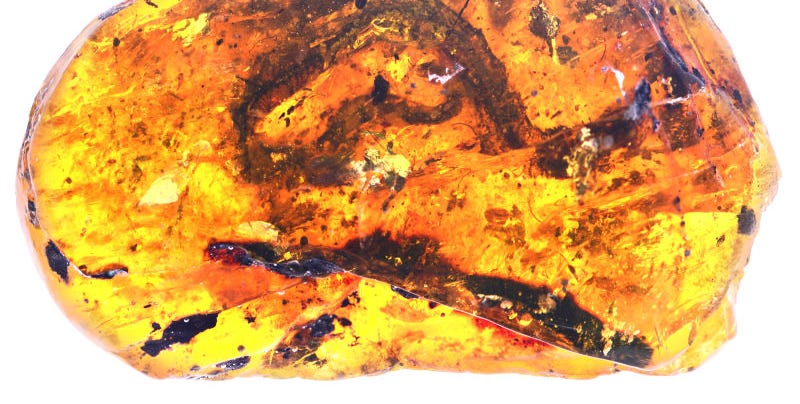

Some fossils arrive with thunder: a giant dinosaur skull, a mammoth tusk, a tooth the size of a banana. Others show up quietly, tucked inside a golden pebble of tree resin, no bigger than something you might almost mistake for a fancy cough drop. That is exactly why the discovery of the oldest ever baby snake in forest amber feels so extraordinary. It is not dramatic because it is huge. It is dramatic because it is tiny, fragile, ancient, and almost absurdly lucky to have survived 99 million years.
The fossil, named Xiaophis myanmarensis, was discovered in amber from Myanmar’s Kachin region and described by an international research team in 2018. It dates to the Cretaceous Period, the age of dinosaurs, when flowering plants were spreading, insects were thriving, and snakes were still early in their evolutionary story. The baby snake was preserved not in ordinary rock, but in amberancient tree resin that hardened into a time capsule. And what a time capsule it turned out to be.
This tiny specimen is widely recognized as the first known fossilized baby snake preserved in amber and one of the most important snake fossils ever found. It offers rare clues about how ancient snakes developed, where they lived, and how their bodies compare with modern snakes. It also proves something wonderfully cinematic: sometimes, the forest floor has better archival skills than a climate-controlled museum.
What Was Actually Found?
The fossil belongs to a baby snake, likely an embryo or newborn, preserved inside a piece of Burmese amber. The preserved portion is about 4.75 centimeters long, or roughly 1.8 inches. Scientists estimate the full animal may have measured close to 8 centimeters, or about 3.1 inches, if complete. The skull is missing, but the remaining skeleton includes around 97 tiny vertebrae. For a creature smaller than a shoelace, that is a remarkable amount of anatomical information.
The specimen was identified as a new species and given the scientific name Xiaophis myanmarensis. The name honors Xiao Jia, who originally acquired the amber piece and donated it to a research collection, while “myanmarensis” refers to Myanmar, where the amber was found.
At first glance, the fossil did not scream “snake.” In fact, tiny vertebrate remains in amber can look like mysterious bits of biological confetti. Some observers reportedly thought the specimen might be an arthropod, such as a centipede or millipede. But advanced scanning changed the story. Using high-resolution imaging, researchers saw the delicate chain of vertebrae and recognized the structure as that of a very young snake.
Why This Baby Snake Matters So Much
Snake fossils are not exactly common. Snakes have slender bones, delicate skeletons, and bodies that do not always fossilize politely. A baby snake is even less likely to survive the fossilization process. In ordinary sediment, such a fragile animal could be crushed, scattered, or reduced to a few pieces too tiny to identify confidently.
Amber changes the rules. When sticky resin flows from a tree, it can trap small organisms and seal them away with astonishing detail. Insects are the classic amber celebrities, but amber from Myanmar has also preserved pieces of birds, lizards, frogs, feathers, and even bits of dinosaur-era ecosystems. The baby snake fossil joins that exclusive club.
What makes Xiaophis myanmarensis so valuable is not simply that it is old. It is old, young, and well preserved at the same time. That rare combination allows scientists to compare ancient snake development with the development of modern hatchlings. The preserved vertebrae show patterns of bone formation that resemble those seen in newborn snakes today. In other words, this tiny Cretaceous snake suggests that some aspects of snake growth have remained surprisingly consistent for nearly 100 million years.
A Forest Snake From the Age of Dinosaurs
One of the most exciting parts of the discovery is where the snake lived. Amber comes from tree resin, and tree resin comes from forests. That may sound obvious, but in paleontology, habitat evidence can be difficult to pin down. A fossil bone found in rock may have been washed from one place to another before burial. Amber, however, often preserves a more intimate snapshot of the local environment.
The amber piece containing the baby snake also preserved plant fragments, insects, and other forest-floor debris. That surrounding material suggests the snake lived in or near a forest ecosystem. This matters because the fossil provides strong evidence that snakes were already living in forested environments during the Cretaceous Period.
That detail helps broaden our picture of early snake evolution. Ancient snakes were not limited to one narrow habitat. By around 99 million years ago, they appear to have been ecologically diverse enough to occupy forests, along with other environments. The baby snake, therefore, is not just a cute fossil curiosity. It is a little ambassador from an ancient rainforest.
Meet Xiaophis myanmarensis: Small Snake, Big Scientific Personality
The baby snake’s scientific importance comes from its anatomy. The preserved skeleton lacks a head, but the backbone is extremely informative. The vertebrae show distinctive features that allowed researchers to identify it as a snake and compare it with other fossil and living species.
Scientists linked Xiaophis to ancient snake lineages known from regions such as Argentina, Africa, India, and Australia. That connection is important because those places were once associated with Gondwana, the ancient southern supercontinent. The Myanmar amber fossil therefore raises fascinating questions about how early snakes spread across the world.
During the Cretaceous, landmasses were shifting, oceans were opening, and island arcs were moving like pieces on a very slow geological chessboard. The presence of a primitive snake in what is now Southeast Asia may support the idea that some snake lineages moved from southern continents toward Asia through complex tectonic and island routes. That is a lot of global drama packed into a fossil smaller than your pinky finger.
How Scientists Studied a Snake Inside Amber
You cannot simply crack open a valuable amber fossil and start poking around with tweezers. That would be the paleontological equivalent of opening a rare book with a chainsaw. Instead, researchers used advanced imaging techniques, including CT scanning, to look inside the amber without destroying it.
CT scans allow scientists to build three-dimensional views of hidden structures. In this case, scanning revealed the position and shape of the baby snake’s vertebrae. Because the amber was cloudy in places, the scans were essential. They helped researchers see what the naked eye could not.
This technology has transformed the study of amber fossils. A specimen that once looked like a murky blob can now become a digital model. Scientists can rotate it, measure it, compare it, and examine details that would otherwise remain invisible. The baby snake discovery is a perfect example of how old fossils and modern technology can team up like an odd but brilliant buddy comedy.
Was It an Embryo or a Hatchling?
One of the charming mysteries of Xiaophis myanmarensis is whether it was still inside the egg, recently hatched, or just about to hatch. Researchers describe it as an embryonic-to-neonate snake, meaning it was either very close to birth or newly born.
The size of the fossil and the degree of bone development suggest a very young animal. Its vertebrae had not fully developed in the same way an adult snake’s bones would have. That developmental stage is one reason the specimen is so scientifically valuable. It gives researchers a rare look at early snake growth in deep time.
Modern snakes reproduce in different ways. Some lay eggs, while others give birth to live young. The amber fossil does not fully answer which method this ancient species used. Still, it gives researchers a window into early life stages that are almost never preserved in the fossil record.
The Role of Burmese Amber in Paleontology
Burmese amber has become famous among paleontologists because it preserves Cretaceous life in stunning detail. Fossils from Myanmar amber have included insects, spiders, feathers, lizards, frogs, birds, and plant material. These discoveries help scientists reconstruct ancient forest ecosystems with unusual precision.
Amber fossils are different from typical stone fossils. A dinosaur bone in rock may tell us about anatomy, size, or injury. Amber can sometimes preserve behavior, soft tissue, color patterns, skin, feathers, parasites, and entire microhabitats. It is less like a tombstone and more like a paused nature documentary.
However, Burmese amber also comes with ethical concerns. In recent years, researchers, museums, and journals have paid closer attention to the trade in Myanmar amber, especially because mining and sales have been linked to conflict and human rights concerns. The baby snake fossil was described before many of these debates became central in scientific publishing, but modern discussions of Burmese amber now often include questions about provenance, legality, and research responsibility.
What the Fossil Tells Us About Snake Evolution
Snakes are one of evolution’s most fascinating success stories. They lost their limbs, stretched their bodies, specialized their skulls, and spread across deserts, forests, oceans, grasslands, and wetlands. Today, snakes range from tiny threadsnakes to giant anacondas. But their early evolution remains difficult to study because the fossil record is incomplete.
The baby snake in amber helps fill part of that gap. It shows that by the mid-Cretaceous, some snakes had already entered forest environments. It also suggests that developmental patterns seen in modern snakes may have deep evolutionary roots.
The fossil does not solve every mystery. It does not tell us exactly when snakes first evolved, precisely how they lost their limbs, or whether this particular baby had siblings nearby. But science often advances by adding small, reliable pieces to a much larger puzzle. Xiaophis is one of those piecessmall enough to fit inside amber, important enough to reshape discussion.
Why the Discovery Captured Public Imagination
Part of the appeal is obvious: it is a baby snake in amber from the dinosaur age. That sentence sounds like it was engineered in a laboratory to make science fans click faster. But the fascination goes deeper than novelty.
The fossil makes deep time feel personal. Ninety-nine million years is difficult to imagine. Most people can picture a decade. Some can picture a century. But 99 million years? That number is so large it practically needs its own parking lot. Yet when we look at a tiny baby snake, preserved mid-existence, that vast distance becomes more intimate.
It reminds us that the ancient world was not only filled with roaring giants. It also had hatchlings, insects, leaves, forest litter, and small animals trying to survive ordinary days. The baby snake was not trying to become famous. It was simply living in a Cretaceous forest. Then resin caught it, time buried it, and scientists eventually found it.
Amber as a Natural Time Capsule
Amber begins as resin, a sticky substance produced by trees. Resin can protect trees from insects and damage, but it can also trap unlucky organisms that touch it. Over millions of years, buried resin hardens and chemically changes into amber.
That process can preserve fine details that ordinary fossilization often destroys. Insects may retain wings, hairs, eyes, or mouthparts. Plant material may remain recognizable. Small vertebrates may preserve bones, skin, feathers, or scales. The baby snake fossil shows how amber can capture creatures that would otherwise vanish from the fossil record.
Still, amber preservation is selective. It favors small organisms living near resin-producing trees. That means amber does not show every part of an ancient ecosystem equally. It is a brilliant snapshot, not a complete census. Even so, when the snapshot includes a baby snake from the age of dinosaurs, scientists are understandably excited.
Specific Examples of What Researchers Learned
1. The Snake Was Extremely Young
The size, incomplete bone formation, and delicate structure show that the animal was either embryonic or newly hatched. This gives researchers a rare look at early snake development in the fossil record.
2. The Fossil Preserved Around 97 Vertebrae
The preserved backbone allowed scientists to identify the animal as a snake even without the skull. The vertebrae also helped researchers compare it with other ancient and modern snakes.
3. The Habitat Was Forested
Because the fossil was trapped in tree resin alongside forest debris, it provides strong evidence that this ancient snake lived in a forest environment.
4. It May Help Explain Snake Dispersal
The fossil’s similarities to ancient snakes from Gondwanan regions suggest complex movement patterns among early snakes, possibly tied to shifting landmasses and island arcs.
5. It Shows the Power of Modern Imaging
Without CT scanning, researchers might not have been able to study the fossil in such detail. The discovery highlights how technology can reveal hidden anatomy inside ancient materials.
Common Questions About the Oldest Baby Snake in Amber
How old is the baby snake fossil?
The fossil is generally reported to be about 99 million years old, placing it in the mid-Cretaceous Period. Some descriptions round the age to roughly 100 million years.
Where was it found?
It was found in amber from the Kachin region of northern Myanmar, an area famous for Cretaceous amber fossils.
What species is it?
The fossil was named Xiaophis myanmarensis, a new species described from the amber specimen.
Was the entire snake preserved?
No. The preserved skeleton includes much of the body but not the skull. Scientists estimate the complete snake would have been longer than the preserved portion.
Why is it called the oldest baby snake?
It is considered the first known fossilized baby snake preserved in amber and one of the oldest known specimens documenting such an early life stage in snakes.
Experiences Related to the Discovery: Why This Fossil Feels So Human
Although most of us will never hold a 99-million-year-old amber fossil in a lab, the discovery connects with everyday experiences in surprising ways. Think about the last time you found something small and unexpected outdoors: a feather on a sidewalk, a shed snakeskin near a garden wall, a beetle shell under a leaf, or a fossil-shaped stone on a trail. These little findings make people stop, crouch down, and wonder. The baby snake in amber is the ultimate version of that momentthe forest-floor surprise that waited nearly 100 million years for someone to notice.
For nature lovers, this discovery is a reminder to slow down. Forests are full of tiny dramas. A leaf falls. A spider builds. A lizard darts. A snake hatchling slips through debris, invisible to nearly everything except perhaps a hungry bird or a patch of sticky resin. Modern forests still hold these miniature stories. Anyone who has walked through woods after rain knows that the ground seems alive with movement. The Cretaceous forest that trapped Xiaophis was different in many ways, but the basic feeling is familiar: life happening everywhere, even underfoot.
For students, the fossil is a perfect example of why science rewards curiosity. The specimen could have been overlooked. It could have been misidentified. It could have stayed in a private collection without careful study. Instead, researchers used technology, comparative anatomy, and patient observation to unlock its meaning. That is an encouraging lesson: discoveries do not always begin with giant “eureka” moments. Sometimes they begin with someone saying, “Wait a second, what exactly is inside this cloudy piece of amber?”
For writers, educators, and science communicators, the oldest baby snake in amber is storytelling goldliterally and figuratively. It has everything: dinosaurs in the background, a mysterious amber tomb, a tiny newborn animal, international researchers, advanced scans, and a plot twist about ancient forests. It shows how science writing can be accurate without becoming dry. You do not need to exaggerate the fossil to make it interesting. The truth is already doing cartwheels.
For parents or teachers explaining evolution to children, this fossil offers a friendly entry point. A baby snake is less intimidating than a giant predator and more relatable than a technical chart of vertebrae. Children can understand that young animals existed long ago, just as they do today. From there, the conversation can expand to fossils, extinction, forests, geological time, and how scientists study the past. One tiny snake can open a door to the entire Cretaceous world.
For anyone who has ever felt small in a huge world, the fossil also carries a quiet emotional punch. This baby snake lived briefly, perhaps only for a moment, yet it became important millions of years later. It reminds us that small things matter. A small fossil can change scientific understanding. A small observation can lead to a major discovery. A small creature can become a messenger from deep time.
That may be the most powerful experience connected to this discovery: wonder. The amber does not just preserve bones. It preserves a feelingthe shock of realizing that the ancient world was not abstract. It was alive, detailed, messy, beautiful, and full of tiny beings with their own brief lives. The oldest baby snake in forest amber is a scientific specimen, yes. But it is also a golden postcard from a vanished forest, stamped by time and delivered 99 million years late.
Conclusion
The discovery of the oldest ever baby snake in forest amber is one of those rare scientific stories that feels both delicate and enormous. The fossil of Xiaophis myanmarensis is physically tiny, yet its importance stretches across continents, ecosystems, and nearly 100 million years of evolutionary history. It provides evidence that ancient snakes lived in forests, helps researchers understand early snake development, and adds a valuable clue to the global journey of snake evolution.
Most fossils tell us that something existed. This one does more. It shows us a moment: a newborn or nearly newborn snake in a Cretaceous forest, caught in resin and preserved with astonishing detail. It reminds us that paleontology is not only about giants. Sometimes the smallest discoveries carry the biggest stories.