
Some comics make you laugh. Some make you think. And then there are the ones that make you stare at the screen, whisper “oh no, that’s my life,” and immediately send them to three friends with the message: “This. Exactly this.” That is the sweet spot where Lainey Molnar’s work lives.
In her latest collection of comics about social stereotypes for women, Molnar turns everyday pressure into bright, sharp, painfully relatable illustrations. Her drawings do not need dramatic villains or complicated plots. The villain is usually a sentence women have heard a thousand times: “You’ll change your mind.” “You’re too emotional.” “You’re too old for that.” “You’re not old enough for that.” “You’re selfish if you don’t want kids.” “You’re boring if you do.” Congratulations, society has once again invented a game where the rules change every five minutes and somehow women are still expected to win gracefully.
The appeal of these comics is not only that they are pretty, colorful, and easy to share. It is that they name the invisible little pressures that often hide inside compliments, family questions, dating advice, beauty standards, office politics, and casual comments from strangers who apparently woke up and chose unpaid consulting.
Who Is Lainey Molnar?
Lainey Molnar is a Hungarian-born, Amsterdam-based illustrator known for creating comics about womanhood, feminism, body image, relationships, self-worth, and social double standards. Her work became popular online because it takes complex emotional and cultural issues and translates them into simple scenes: two women standing side by side, a woman looking in the mirror, a couple having a conversation, or a character quietly rejecting a rule she never agreed to follow.
That simplicity is the point. Molnar’s comics are not trying to bury readers under academic language. They work like visual “aha” moments. In one frame, a woman is praised for something another woman is judged for. In another, two life choices are shown as equally valid, even though society treats one as normal and the other as suspicious. The message is direct: women do not need to live identical lives to deserve respect.
Why Social Stereotypes About Women Still Hit So Hard
Social stereotypes are powerful because they often arrive dressed as tradition, concern, humor, or advice. Nobody says, “Hello, I am here to enforce a restrictive gender norm.” Instead, they say, “Don’t you want to settle down?” or “You’d look prettier if you smiled.” Much sneakier. Much more annoying.
Molnar’s comics expose these expectations by pulling them out of the background and putting them in the center of the frame. The result is funny, but not fluffy. The humor works because the situations are recognizable: the woman who is expected to be ambitious but not intimidating, attractive but not vain, nurturing but not “too soft,” independent but not “difficult,” confident but not “full of herself,” youthful but also mature, maternal but also effortlessly productive. Basically, a human Swiss Army knife with perfect hair.
The Milestone Checklist
One major theme in the 23 new pics is the idea that women are often judged by a timeline they did not write. Date by this age. Marry by that age. Have children before it is “too late.” Buy the house. Maintain the career. Look young while doing it. Smile in photos. Host holidays. Remember everyone’s birthdays. Never let the basil plant die.
Molnar challenges the idea that adulthood has one correct route. A woman who does not want children is not broken. A woman who wants children is not boring. A woman who marries young is not automatically naive. A woman who stays single is not a tragic side character waiting for the plot to begin. These comics make room for the radical possibility that personal decisions are personal. Shocking, yes. Apparently still necessary.
Body Image and the Impossible Beauty Contract
Another recurring subject is body image. Women are constantly told to love themselves, but also to improve themselves, shrink themselves, smooth themselves, cover this, reveal that, age naturally, prevent aging, wear makeup, look natural, stay fit, do not obsess, be confident, but not too confident. It is less a beauty standard and more a full-time unpaid internship in contradiction management.
Molnar’s illustrations often push back against the idea that a woman’s body is public property for commentary. A body can be soft, strong, aging, changing, disabled, scarred, pregnant, not pregnant, dressed up, dressed down, or simply existing on a Tuesday. It does not need to submit a performance review.
This is why her comics resonate with readers who are tired of seeing “body positivity” reduced to another aesthetic trend. The stronger message is body neutrality and body respect: you do not have to adore every angle of yourself every day to deserve peace. Sometimes the win is simply eating lunch without turning it into a moral courtroom drama.
Motherhood, Choice, and the Great Double Standard
Few subjects reveal social stereotypes faster than motherhood. Women who want children may be told they are giving up freedom. Women who do not want children may be told they are selfish. Mothers who work are accused of missing out. Mothers who stay home are accused of lacking ambition. Women who delay parenting are warned. Women who start early are judged. Somewhere, a spreadsheet of impossible expectations is probably glowing in a dusty basement.
Molnar’s comics often reject this trap by showing different women making different choices without ranking them. The point is not that one lifestyle is more empowered than another. The point is that empowerment means having a real choice without being punished for choosing “wrong.” A life built around motherhood can be meaningful. A life without motherhood can be meaningful. A life that changes direction can be meaningful too.
Women at Work: Too Much, Too Little, Never Just Right
Workplace stereotypes also appear naturally in conversations about women’s lives. A direct woman may be called bossy. A quiet woman may be overlooked. A warm leader may be treated as less authoritative. A firm leader may be labeled cold. The office version of the double standard is basically a maze with fluorescent lighting and calendar invites.
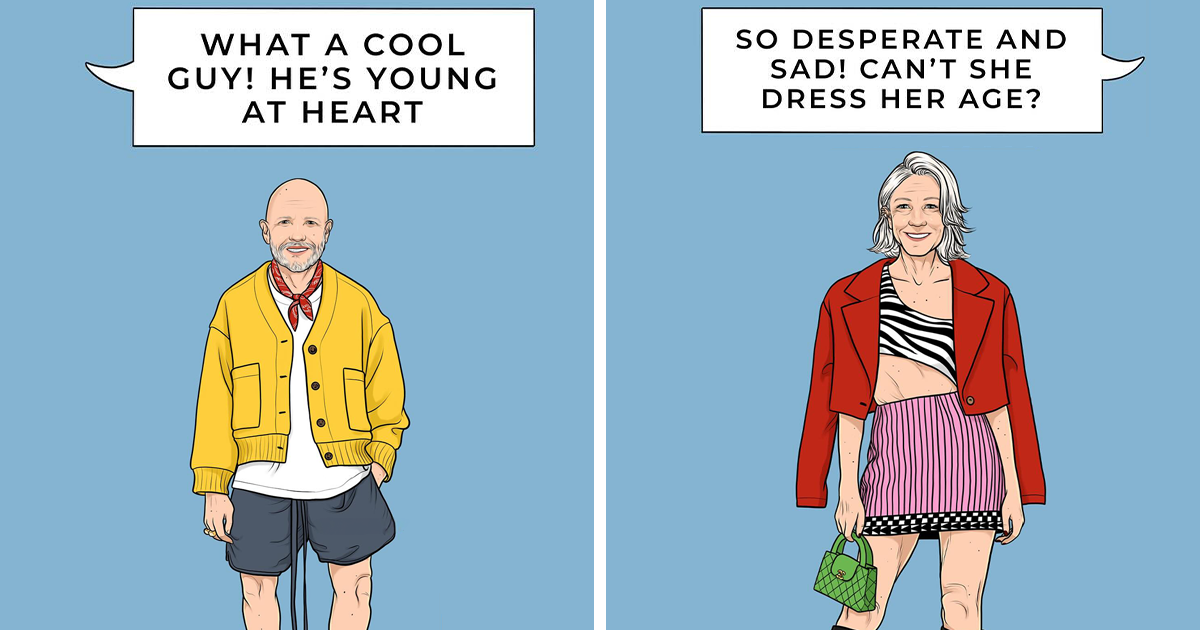
Molnar’s style works well for this subject because comics can reveal the absurdity quickly. Put the same behavior on two characters and give them different social reactions: suddenly the bias becomes obvious. A man is “confident”; a woman is “intense.” A man is “focused”; a woman is “unfriendly.” A man is “strategic”; a woman is “calculating.” The joke writes itself, which is convenient, because women are already busy doing the extra emotional labor.
Why Comics Are So Effective at Challenging Stereotypes
Comics are uniquely good at exposing social rules because they compress a whole argument into a visual moment. A long essay can explain a double standard; a comic can make you feel it in three seconds. That speed matters online, where attention spans are often shorter than the time it takes to decide whether a text message needs an exclamation point.
Molnar’s illustrations use color, fashion, body language, facial expression, and contrast to create instant recognition. She often places two women beside each other to show how society praises one version of femininity and punishes another. This side-by-side structure is powerful because it removes the excuse that judgment is neutral. It asks readers to notice the pattern.
The art is also approachable. It does not scold the reader from a distance. It invites them in with humor and then quietly rearranges the furniture in their brain. The best panels feel like a conversation with a friend who has had enough but still brought snacks.
The Bigger Cultural Conversation Behind the 23 New Pics
The reason this collection feels timely is that conversations about gender roles are everywhere: in workplaces, families, schools, dating apps, entertainment, social media feeds, and group chats that probably deserve their own therapist. Women are speaking more openly about the pressure to be everything at once, while also questioning why “everything” was assigned to them in the first place.
Molnar’s comics fit into a larger movement of artists using digital platforms to challenge old assumptions. Instead of waiting for permission from galleries, magazines, or institutions, illustrators can post directly to audiences who recognize themselves in the work. That direct connection is part of the power. A woman in one country can see a comic about body shame, marriage pressure, or professional bias and think, “Wait, this happens there too?” The internet can be a chaos machine, but sometimes it is also a mirror with Wi-Fi.
The 23 new pics are not just about individual feelings. They are about systems of expectation that become so normal people stop noticing them. A joke about makeup is also about beauty labor. A panel about marriage pressure is also about social approval. A comic about motherhood is also about autonomy. A drawing about aging is also about how women are taught to treat time like an enemy instead of evidence that they are alive.
Common Themes Readers May Recognize
1. The “Perfect Woman” Myth
The perfect woman is supposed to be confident but humble, beautiful but effortless, successful but available, caring but never needy, independent but not intimidating. She is also fictional. Molnar’s comics often puncture this myth by showing that the demand for perfection is not inspiration; it is control wearing lip gloss.
2. The Smile Requirement
Women are often expected to make other people comfortable, even when they are tired, angry, focused, or simply existing with a neutral face. A comic about this kind of expectation works because nearly every woman has heard some version of “smile more.” As if the world might collapse without decorative cheerfulness.
3. The Aging Panic
Aging is treated differently depending on gender. Men may be called distinguished, while women are urged to fight time like it stole their wallet. Molnar’s work challenges the idea that youth is women’s rent payment for being visible. Wrinkles, gray hair, style changes, and new priorities are not failures. They are chapters.
4. The Relationship Scoreboard
Single women are often treated as unfinished. Married women may be treated as settled. Divorced women may be judged. Women who date freely may be criticized; women who are cautious may be called picky. The scoreboard is rigged. Molnar’s comics remind readers that a relationship status is not a character assessment.
5. The Emotional Double Bind
Women’s emotions are often used against them. Express sadness and you are dramatic. Express anger and you are scary. Stay calm and you are cold. The healthier question is not, “How can women express emotion in a way nobody judges?” The better question is, “Why is judgment the default setting?”
Experiences Related to “Artist Makes Comics About Social Stereotypes For Women”
One reason this topic connects with so many readers is that these stereotypes rarely appear as one giant dramatic event. They usually arrive as tiny moments that stack up over time. A woman mentions she does not want children, and someone laughs like she has just announced she wants to become a mailbox. A young professional speaks clearly in a meeting, and suddenly she is “a bit much.” A teenager wears makeup and is told she is trying too hard; the next day she skips it and is asked if she is sick. The outfit changes, the judgment stays.
These experiences are exhausting because they make ordinary choices feel like public debates. Hair length becomes a statement. Weight becomes a discussion. Dating becomes a progress report. Ambition becomes a personality flaw if it is not wrapped in enough softness. Even rest can be judged: relax too much and you are lazy; work too much and you are neglecting your personal life. Somewhere between those extremes, women are expected to locate a magical balance that satisfies everyone except, very often, themselves.
Molnar’s comics feel comforting because they turn private frustration into shared language. When a reader sees a panel about being pressured to hit life milestones, the comic does not solve the problem, but it does something important: it removes the loneliness from it. The reader can say, “I am not imagining this.” That recognition matters. People often underestimate how powerful it is to feel accurately seen.
Another familiar experience is the way women learn to edit themselves before anyone else gets the chance. They soften emails with extra exclamation points. They apologize before asking reasonable questions. They choose clothes by calculating not only style and comfort, but also how strangers might interpret them. They practice being agreeable, not because they lack opinions, but because the social cost of having opinions can be weirdly expensive.
And yet, these comics are not only about frustration. They are also about release. They give readers permission to laugh at the absurdity. They suggest that rejecting a stereotype does not always require a grand speech under dramatic lighting. Sometimes it begins with a smaller decision: wearing the outfit, saying no, not explaining your life plan at dinner, letting your body be a body, allowing your ambition to take up space, or refusing to treat someone else’s expectations as a legal contract.
That is the deeper experience behind the popularity of these illustrations. They do not tell women to become someone new. They remind them that many of the rules were never fair to begin with. And once a rule is seen clearly, it becomes much easier to question, bend, ignore, or toss into the emotional recycling bin where it belongs.
Conclusion: Why These Comics Matter
“Artist Makes Comics About Social Stereotypes For Women (23 New Pics)” is more than a catchy headline. It points to a larger reason people keep sharing Lainey Molnar’s work: her comics make everyday gender stereotypes visible, understandable, and easier to challenge. They are funny enough to travel online, honest enough to start conversations, and clear enough to make readers pause before accepting old assumptions as normal.
The strongest message in the collection is not that every woman must live boldly in the same way. It is that women deserve the freedom to define their own lives without being squeezed into someone else’s template. Whether the subject is body image, aging, motherhood, career, dating, emotion, or personal style, Molnar’s comics say what many people have been thinking for years: being a woman should not require passing an endless social inspection.
And if a colorful comic can make that truth easier to see, share, and laugh about, then yes, please keep the new pics coming.