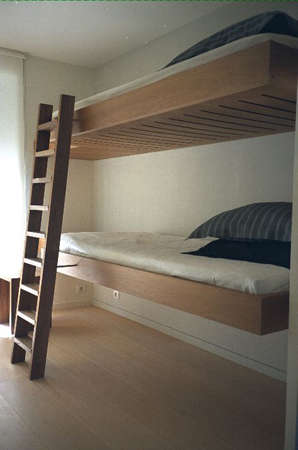

Some architects introduce themselves with towers, manifestos, and buildings that look as if they have been arguing with gravity since breakfast. Philippe Allaeys takes another path. The Belgian architect and furniture designer works with a quieter kind of confidence: solid wood, crisp lines, flexible objects, and interiors that feel calm without becoming sleepy. His work does not shout, “Look at me!” It leans against the wall, perfectly proportioned, and lets you slowly realize it has solved three problems at once.
An architect visit to Philippe Allaeys in Belgium is less about spectacle and more about noticing. You notice a table that expands without drama. You notice a bed whose extended frame becomes a shelf. You notice a bench that behaves like architecture. You notice the Belgian habit of making minimalism warm, tactile, and human instead of cold enough to store fish. That is the charm of Allaeys’ world: rigor, usefulness, and a little design magic hiding in plain sight.
Based in Ghent, Belgium, Allaeys has built a career across architecture, interiors, furniture, exhibitions, public spaces, and material-driven design. His studio ALPH’ is strongly associated with wood-based furniture, modular tables, clean forms, and an architectural approach to everyday objects. In other words, he designs the kind of pieces that make a room feel smarter without requiring the room to wear a black turtleneck.
Who Is Philippe Allaeys?
Philippe Allaeys is a Belgian architect, furniture designer, and creative director whose career began in architecture and gradually expanded into furniture and interior design. Born and raised in Belgium, he studied architecture at Sint-Lucas in Ghent, a city with a deep design culture and a long relationship with craft, industry, and contemporary interiors.
His professional path includes freelance architecture, work with Belgian architecture offices, residential projects, offices, shops, renovations, hospitality-related work, industrial design, color design, exhibitions, and furniture. That wide range matters because Allaeys does not treat a chair, a table, or a room as isolated objects. He thinks like an architect even when the project is small enough to fit under your coffee cup.
In the late 1980s and early 1990s, Allaeys became involved with ZO Group, a creative venture connected to architects, designers, artists, and furniture production. This later developed into the world of ALPH’, a Ghent-based design identity often described with the phrase “the alphabet for good living.” The phrase is not just poetic branding. His work really does feel like a vocabulary: table, bed, bench, shelf, rail, hook, surface, joint, shadow. Each element is simple, but together they create a complete design language.
Belgian Minimalism, But With a Pulse
To understand Philippe Allaeys, it helps to understand Belgium’s design personality. Belgian architecture and interiors are often admired for their balance of old and new: historic brick, pale plaster, oak, linen, concrete, limestone, steel, and a gentle affection for restraint. Belgian minimalism is not the blank, echoing kind where you are afraid to place a coffee mug on the table. It is warmer, earthier, more forgiving.
Allaeys fits naturally into that tradition. His furniture often favors honest materials, especially wood, and avoids unnecessary ornament. Yet the work is not plain. The interest lies in proportion, engineering, modularity, and the small surprise of function. A Philippe Allaeys table is not merely a horizontal board on legs; it may fold, extend, transform, or adapt. A bed is not just a bed; it becomes a platform, shelf, and architectural plane. A bench is not just seating; it becomes a landscape element.
This is where the Belgian sensibility shines. Instead of asking design to perform acrobatics, Allaeys asks it to behave beautifully. The result feels refined but not precious, practical but not boring, and minimalist without looking as if joy has been banned by municipal ordinance.
The ALPH’ Studio: A Wood-Based Design Language
ALPH’ is central to understanding Philippe Allaeys’ work. The studio’s collection includes tables, beds, benches, storage pieces, outdoor furniture, mirrors, lighting, and architectural objects. Wood appears again and again, not as decoration but as structure. Oak, elm, padoek, wengé, walnut, and other materials become part of a design system built around tactility and durability.
One of the strongest ideas in the ALPH’ universe is that furniture can be flexible without becoming gimmicky. The P007 “tables of alph,” for example, is described as a modular table system using loose planks and dovetail connections. Its variants range from bistro tables to conference tables and even long festive tables. That range tells you a lot about Allaeys’ thinking: one system, many lives.
The best modular design does not look modular in the cheap, wobbly sense. It looks inevitable. It feels as though the object always wanted to become exactly what the room needed. Allaeys’ tables are especially good at this. They suggest gatherings: dinner, work, debate, celebration, the suspiciously long meeting that somehow improves when the table is beautiful.
Signature Works: Beds, Tables, Trays, and Benches
The NOAH Bed for e15
Among Philippe Allaeys’ best-known pieces is the NOAH bed, designed for e15. It is often admired for its architectural form and the way its extended frame becomes useful shelving along the short sides. The bed appears low, calm, and grounded, yet the proportions create a floating visual effect. It is a good example of Allaeys’ ability to make a functional object feel spatial.
NOAH is minimal, but not empty. The extended platform gives the bed a built-in rhythm. Books, glasses, a lamp, or a morning cup of coffee can settle naturally on the frame. The design avoids the fuss of bedside clutter while quietly admitting that human beings do, in fact, read in bed, lose pens in blankets, and need somewhere to put their phone.
The ISAAC Table
Another important Allaeys design for e15 is the ISAAC table. This foldable dining or conference table can extend at both ends, turning a compact table into a much longer surface. Its genius lies in how ordinary the transformation feels. There is no circus trick, no mechanical drama. The table simply adapts.
The ISAAC table works because it understands modern life. Dining rooms become offices. Offices become dining rooms. A family table becomes a project table, then a holiday table, then a place where someone spreads out paperwork and insists they are “almost done.” Allaeys designs for that reality with elegance.
ALEX, LEILA, and THEO
Allaeys also designed smaller pieces for e15, including the ALEX and LEILA side tables and the THEO tray. These designs reveal the same architectural instinct at a smaller scale. A tray can be more than a tray when its proportions, material, and edges are considered with care. A side table can become a small architectural object, a punctuation mark beside a sofa or bed.
In many interiors, small objects create the daily experience more than grand gestures do. You touch the tray. You move the side table. You slide a book onto a shelf. Allaeys’ smaller works recognize that design is intimate. Architecture may shape the room, but furniture shapes the habits inside it.
The ALPH-Bench for Atelier Vierkant
The ALPH-Bench, designed by Philippe Allaeys for Atelier Vierkant, combines clay volumes with a wooden Iroko top structure. It is available in different colors and finishes, and its modular nature allows it to fit many architectural contexts. This piece is especially interesting because it sits between furniture, landscape, and architecture.
The clay base gives the bench mass and permanence, while the Iroko top gives it warmth and comfort. It can belong in a garden, courtyard, public space, or architectural interior. It is not a bench that apologizes for being outside. It has presence. It says, “Yes, I am seating, but I also have a strong opinion about composition.”
Why His Work Feels Architectural
Philippe Allaeys’ furniture feels architectural because it is governed by structure, proportion, and use. Many designers begin with silhouette. Allaeys seems to begin with behavior. How will the object be used? How can it change? Where does the hand go? How does wood meet wood? What happens when the piece moves from a private home to a public project?
This approach produces furniture that does not rely on trend. Trend-based design often looks exciting for about ten minutes, then starts aging like milk in the sun. Allaeys’ work is quieter and more durable. It looks rooted in decisions, not decoration. That is one reason his designs continue to appear relevant years after their original release.
His attention to joints is also important. Dovetailing, folding mechanisms, modular planks, extended frames, clay-and-wood combinationsthese are not just technical details. They are the design. The connection is the ornament. The structure is the style.
Philippe Allaeys and the Art of Useful Restraint
“Less is more” is one of the most overused phrases in design, right up there with “timeless elegance” and “curated sanctuary.” But in Allaeys’ case, restraint has real substance. He removes excess so that function becomes clearer. His objects rarely look stripped for the sake of being severe. They look edited.
Useful restraint means a bed frame becomes shelving instead of needing extra furniture. A table expands instead of requiring a second table. A bench adapts to different layouts instead of demanding one fixed position. A wood surface is allowed to be beautiful without being buried under decorative noise.
This is especially valuable in contemporary interiors, where people want spaces that work hard but feel calm. The modern home may need to support remote work, family life, entertaining, storage, rest, and the occasional heroic attempt at sourdough. Allaeys’ designs respond by being adaptable, not flashy.
How to Bring the Philippe Allaeys Look Into Your Own Space
Choose Real Materials
Start with materials that improve with use: solid wood, natural stone, linen, clay, plaster, and honest metal. Allaeys’ work is strongly associated with material character, especially wood. The goal is not to make a room look expensive. The goal is to make it feel grounded.
Let Furniture Do More Than One Job
Look for pieces that solve multiple problems. A platform bed with integrated surfaces, a table that expands, a bench that works indoors and outdoors, or a modular shelving system can bring Allaeys’ spirit into a home even without using the exact products.
Use Negative Space Like a Design Tool
Belgian minimalist interiors often depend on breathing room. Do not crowd every wall, corner, and tabletop. Space is not emptiness; it is the pause that lets good objects speak. Think of it as visual punctuation. Without it, the room becomes one long sentence with no commas, and nobody wants to live inside that.
Focus on Proportion Before Decoration
Allaeys’ work proves that proportion can carry a room. A long table, a low bed, a broad bench, or a thick wood plane can create drama without pattern overload. Before adding more accessories, ask whether the existing pieces are the right scale. Often, the answer is hiding in plain sight.
Why Designers Still Pay Attention to Philippe Allaeys
Philippe Allaeys remains interesting because his work avoids the trap of novelty. He is not designing objects that depend on shock value. Instead, he focuses on clarity, usefulness, and material intelligence. That makes his work particularly appealing to architects, interior designers, collectors, and homeowners who prefer depth over drama.
His designs also bridge categories. He is not only an architect, not only a furniture designer, and not only a creative director. He operates between those roles. That hybrid position gives his work a distinctive strength. A table can behave like a room. A bench can behave like a landscape. A bed can become a small architectural platform.
In a design culture often obsessed with the new, Allaeys reminds us that the best ideas are sometimes old-fashioned in the best way: build well, use honest materials, respect the hand, solve real problems, and do not add a decorative squiggle unless it has paid rent.
Experience Notes: Visiting the World of Philippe Allaeys in Belgium
A visit connected to Philippe Allaeys’ work in Belgium is best approached slowly. This is not design that reveals itself in one dramatic camera pan. It rewards the kind of looking that notices edges, shadows, thickness, grain, and the small intelligence of a joint. Imagine arriving in Ghent, a city where medieval streets, industrial traces, student energy, and contemporary design all seem to share the same table. That setting already prepares you for Allaeys’ approach: old and new, useful and poetic, sturdy and refined.
The first experience is tactile. You want to touch the furniture before you describe it. A solid wooden table by Allaeys has visual weight, but it is not heavy in spirit. The surface invites use. You can imagine coffee cups, drawings, laptops, dinner plates, elbows, flowers, and the occasional very serious Belgian beer. The object does not become precious. It becomes part of life, which is much harder to achieve than simply making something photogenic.
The second experience is spatial. His furniture changes how a room behaves. A long modular table turns a narrow interior into a gathering place. A low bed makes a bedroom feel calmer and more horizontal. A bench in clay and Iroko wood gives a garden or courtyard a sense of order. These pieces do not merely fill space; they organize it. That is the architect’s hand at work.
The third experience is emotional, though it is quiet. Allaeys’ work does not perform sentimentality. It creates comfort through confidence. You feel that the object has been resolved. The dimensions make sense. The material makes sense. The detail makes sense. In a world full of objects that seem designed mainly to be replaced, there is something almost rebellious about furniture that feels patient.
Spending time with this kind of design also changes the way you look at your own home. Suddenly, you may notice that a table is too small for the way you actually live, or that a bed with integrated ledges would solve the nightly avalanche on your bedside table. You may start craving fewer objects but better ones. You may become the sort of person who says “the joint is beautiful” at dinner parties. This can be socially risky, but spiritually rewarding.
The final impression of an architect visit to Philippe Allaeys in Belgium is that design does not need to be loud to be memorable. His work suggests that good architecture can live in a piece of furniture, a bench, a tray, or a room where every object has earned its place. It is Belgian design at its most persuasive: calm, practical, warm, disciplined, and just witty enough to keep minimalism from taking itself too seriously.
Conclusion
Philippe Allaeys in Belgium represents a thoughtful form of architecture and furniture design: precise, material-rich, adaptable, and deeply human. His career connects Ghent’s design culture with an international audience through works for ALPH’, e15, Moca, Atelier Vierkant, and other creative collaborations. From the NOAH bed to the ISAAC table and ALPH-Bench, his designs show how simplicity can be active rather than empty.
What makes Allaeys worth studying is not only the beauty of individual pieces but the attitude behind them. He designs as if everyday life deserves intelligence. A table should adapt. A bed should support more than sleep. A bench should belong to architecture. A material should be allowed to speak. That is a powerful lesson for architects, interior designers, and anyone trying to create a home with fewer distractions and better decisions.
In the end, an architect visit to Philippe Allaeys is a reminder that quiet design can leave the strongest impression. No fireworks, no gimmicks, no desperate trend-chasingjust proportion, wood, clay, structure, use, and the kind of calm that makes a space feel genuinely alive.