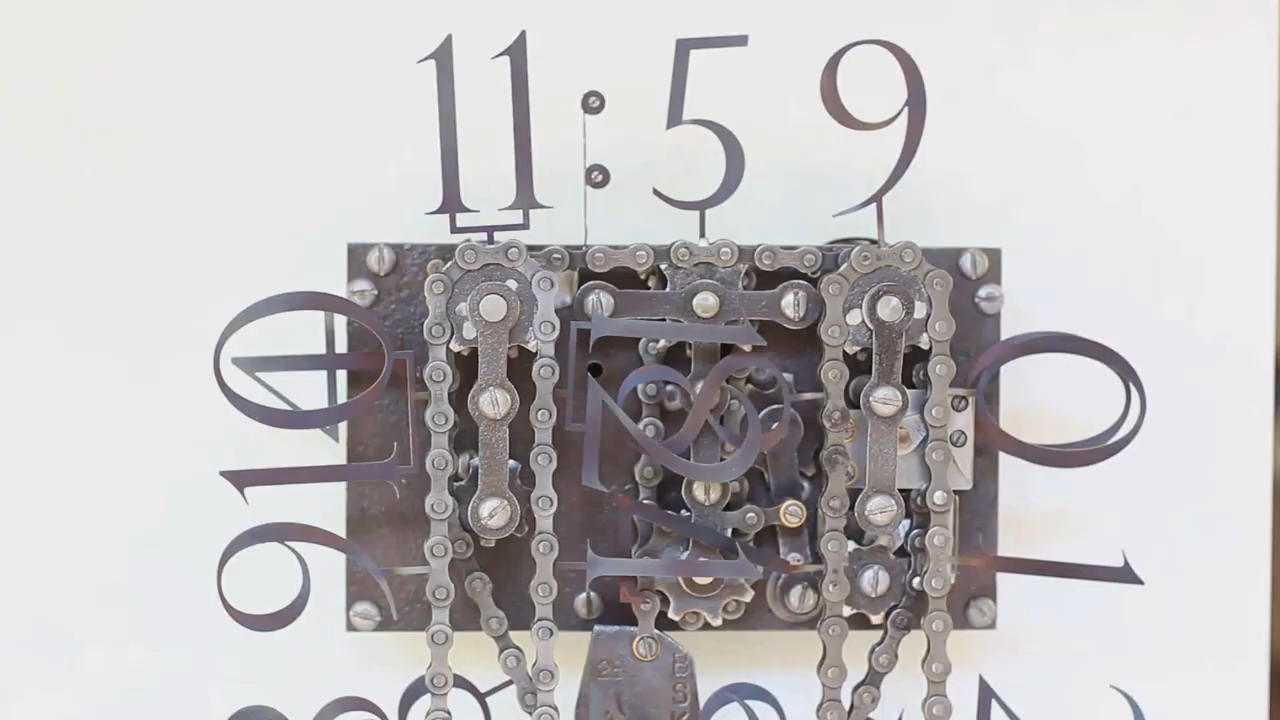

Most digital clocks are quiet little squares that glow on a nightstand, blinking away like they have a spreadsheet to finish. Then there is the mechanical digital clock driven by sprockets and chains: loud enough to have a personality, clever enough to make engineers grin, and strange enough to make visitors stop mid-sentence and ask, “Wait, is that telling time?”
This unique mechanical digital clock, often discussed under the name “Time Machine,” turns the ordinary act of checking the hour into a miniature industrial performance. Instead of relying on LED segments, LCD panels, or a generic quartz module hidden inside a plastic shell, it uses roller chains, sprockets, geared-down motors, welded numerals, microswitches, and a microcontroller. In other words, it tells time with the energy of a bicycle, the attitude of a factory conveyor, and the precision of a very patient robot.
The result is not just a clock. It is a moving sculpture, a lesson in mechanical power transmission, and a reminder that digital does not always mean electronic. Sometimes “digital” simply means the time is displayed as numbers. How those numbers get there is where the fun begins.
What Makes This Mechanical Digital Clock So Different?
A traditional mechanical clock usually hides its beauty behind a dial. Inside, gears, escapements, springs, pendulums, or weights do the heavy lifting. You see hands moving around a face, but the machinery remains mostly private. This sprocket and chain clock does the opposite. It puts the drivetrain front and center, turning every tick, clack, and advance into part of the show.
The clock uses three loops of roller link chain. Each loop carries a sequence of numerals attached directly to the chain links. As the chains move around sprockets, the correct digits rise into view at the top of each loop, standing upright so the time can be read. One loop handles the hours, while the other loops handle the minute digits. The display is digital in appearance, but the presentation is completely physical.
That is the charming contradiction at the heart of the design. It looks like a digital clock because it shows numbers. But it behaves like a mechanical machine because those numbers are literal pieces of material being moved into position. There is no glowing pixel pretending to be a number. The number is actually there, riding around on a chain like it is commuting to work.
How Sprockets and Chains Tell Time
To understand the appeal of this clock, it helps to understand the basic relationship between sprockets and chains. A sprocket is a toothed wheel designed to engage with a chain. As the sprocket rotates, its teeth pull the chain forward. This allows rotary motion from a motor or shaft to become controlled linear movement along the chain path.
In everyday life, the most familiar example is a bicycle. Push the pedals, turn the front sprocket, move the chain, rotate the rear sprocket, and away you go. In industrial machinery, chain drives move conveyors, synchronize shafts, transfer torque, and keep equipment operating at predictable ratios. In this clock, the same basic principle is used not to move a wheel or a product line, but to move digits.
Every minute, the clock needs to update its display. Rather than lighting a new segment, a geared-down motor advances the proper chain. The sprockets guide the loop, the chain carries the numerals, and the control system decides when motion should occur. The digits appear at the top of the chain path, where they can be read clearly.
The beauty is in the translation. Time is abstract. The clock turns it into motion. Minutes become motor pulses. Hours become chain positions. A number becomes a steel or metal form rising into view with a click. It is almost theatrical, as if the clock is saying, “Yes, it is 3:47, and I will now demonstrate the evidence.”
The Role of the Microcontroller and Microswitches
Although the clock has a wonderfully mechanical personality, it is not purely mechanical in the old tower-clock sense. A microcontroller keeps track of time and triggers the mechanism to advance when needed. This small electronic brain does not steal the spotlight; it simply acts as the stage manager.
The more interesting control detail is the use of microswitches. As the chain moves, physical features on the mechanism activate switches that tell the system when a loop has reached the correct position. That means the clock is not blindly spinning motors and hoping for the best. It receives feedback from the machine itself.
This hybrid approach is what makes the clock practical. A purely mechanical version would require a more elaborate gear train, escapement, carry mechanism, and careful ratio design. A purely electronic version would be far easier but much less entertaining. By combining a microcontroller with physical chain movement and mechanical switching, the builder gets the best of both worlds: accurate timing and visible machinery.
Why Roller Chain Is a Smart Choice
Roller chain is not delicate. It was built for work. It can transmit force, handle repetitive motion, and maintain a reliable relationship with sprockets when properly aligned. That makes it a surprisingly good candidate for a mechanical digital clock display.
Unlike a belt, a chain does not depend on friction alone. It engages with sprocket teeth, which helps maintain positioning. For a clock that must land on specific numerals, this matters. A slipping display would be funny for about three minutes, then quickly become a wall-mounted liar.
Roller chains are made from repeating links, typically involving pins, bushings, rollers, and plates. This repeating structure gives the designer convenient intervals for attaching objects. In the case of the sprocket and chain clock, numerals can be welded or fixed to selected links, allowing the chain itself to become the display medium.
Of course, chains come with responsibilities. They need alignment, tension, and sometimes lubrication. They can wear, elongate, rattle, and object loudly if mistreated. But those quirks are also part of the clock’s appeal. This is not a sterile gadget. It is a little machine with opinions.
A Digital Clock Without a Typical Digital Display
When people hear “digital clock,” they usually imagine seven-segment displays. Each digit is formed by lighting combinations of seven bars. This format is everywhere: ovens, alarm clocks, calculators, gas pumps, scoreboards, and electronics projects that begin with someone saying, “This should be simple,” shortly before ordering fourteen more jumper wires.
The sprocket and chain clock takes a different route. It does not form digits from segments. Instead, it uses complete numerals attached to chains. The number 5 is not assembled from bars; it is a physical 5. That makes the display bold, readable, and wonderfully literal.
This approach places the clock in the broader family of electromechanical displays. Split-flap boards, flip clocks, mechanical seven-segment displays, servo-driven digits, and cam-actuated displays all share the same fascination: they use motion to show information. The sprocket clock belongs in that lineage, but its chain-driven arrangement gives it a more industrial personality.
Why the Sound Matters
Modern devices are often designed to disappear. Silent operation is treated as a virtue. A phone updates the time without drama. A smart speaker displays the weather without moving a single visible part. Even appliances try to beep politely, as if apologizing for existing.
This clock is not interested in disappearing. It whirs. It clicks. It advances with a mechanical sound that makes the change of time feel real. That sound is not a flaw; it is feedback. It tells you the machine is alive, or at least as alive as a clock with chains and motors can reasonably be before your insurance agent gets nervous.
The sound also creates emotional weight. A minute passing on a phone is nothing. A minute passing on this clock is an event. You hear the motor, see the chain move, and watch a new number arrive. It is timekeeping with a tiny bit of ceremony.
Industrial Design Meets Kinetic Art
One reason this mechanical digital clock attracts attention is that it sits comfortably between engineering and art. It performs a practical function, but practicality is clearly not the only goal. If all you need is accurate time, a cheap quartz clock will do the job. If you want the time to arrive with choreography, sprockets and chains suddenly make sense.
The exposed mechanism gives the piece a strong industrial design language. Chains suggest bicycles, motorcycles, production lines, garage tools, and heavy machinery. Sprockets imply torque, rhythm, and movement. When these parts are repurposed for a clock, they create visual tension. The components look powerful, but the task is gentle: advancing a few digits once per minute.
That contrast is delightful. It is like using a forklift to deliver a cupcake. Excessive? Absolutely. Memorable? Also absolutely.
The Engineering Challenge Behind the Charm
A clock like this may look simple after it is finished, but the design challenges are serious. First, each chain loop must index accurately. The correct numeral needs to stop in the correct position, upright and readable. If the chain stops too early or too late, the display becomes sloppy.
Second, the chains must be tensioned properly. Too loose, and they may sag, skip, or wobble. Too tight, and friction increases, parts wear faster, and the motor has to work harder. The mechanism needs enough freedom to move smoothly but enough discipline to stop precisely.
Third, the numerals must be balanced and durable. Adding metal numbers to chain links changes the weight distribution. If the numbers are too heavy, the motor and sprockets feel it. If they are too flimsy, they may bend, vibrate, or look cheap. The best version of this idea requires the digits to be strong enough for repeated motion and clean enough to read at a glance.
Fourth, the control logic has to handle carries. When the minute digit rolls from 9 to 0, the tens-of-minutes digit may need to advance. When the minutes roll from 59 to 00, the hour loop must change. This is easy in software but still requires the mechanical system to obey every command reliably.
Why Makers Love Machines Like This
Maker culture has a soft spot for devices that do simple things in complicated ways. That may sound like an insult, but it is actually a compliment. A machine like this teaches through exaggeration. It makes hidden principles visible.
A normal digital clock hides timekeeping inside a chip. A sprocket and chain clock exposes the entire act of updating time. You can see indexing, feedback, power transmission, mechanical alignment, and control logic working together. It becomes an educational object as much as a decorative one.
For students, hobbyists, and mechanical design fans, that visibility is valuable. The clock demonstrates how digital information can be represented physically. It shows why tolerances matter. It reveals the difference between motion and controlled motion. It also proves that a project does not need to be efficient to be brilliant. Sometimes the best projects are the ones that make you laugh, then make you think.
Comparing It With Other Mechanical Digital Clocks
The sprocket and chain design is part of a larger trend of mechanical digital clocks. Some makers build seven-segment clocks with servos, where each segment flips or moves into place. Others use cams, gears, and rods to create numerals without electronics. Split-flap clocks use rotating cards or flaps to display numbers and letters. Each approach has its own personality.
Servo-driven seven-segment clocks are flexible and relatively easy to control with microcontrollers. Cam-driven clocks are mechanically elegant and can run with minimal electronics. Split-flap clocks deliver nostalgia, especially for anyone who remembers airport departure boards clattering like a caffeinated typewriter. Chain clocks, however, offer something different: continuous loops, visible travel, and the rugged charm of power transmission hardware.
That is why the sprocket and chain clock stands out. It does not merely imitate a digital display. It invents a new display behavior. The numerals travel, rise, pose briefly for the audience, and then continue around the loop. It is not just showing time; it is circulating it.
Where This Clock Would Look Best
This clock is not for every room. In a minimalist bedroom, it might look like a bicycle repair shop moved in overnight. In a quiet library, the clicking could earn judgmental stares from people who alphabetize their tea. But in the right setting, it would be spectacular.
A workshop is the obvious home. So is a maker studio, engineering lab, design office, garage, bike shop, robotics classroom, or industrial-style living room. It belongs anywhere people appreciate visible mechanics and are willing to trade absolute silence for character.
It would also make an unforgettable conversation piece in a lobby or creative office. Most wall clocks are ignored until someone is late. This one invites people to look closer. They will ask how it works, whether it is accurate, who built it, and whether the chains need maintenance. That last question is when you know the clock has successfully become part of the room.
Maintenance: The Price of Mechanical Personality
A chain-driven mechanical digital clock will never be as maintenance-free as a basic battery clock. That is not a weakness; it is the bargain you accept when you choose moving parts over invisible electronics.
The mechanism may need occasional cleaning, inspection, and adjustment. Chain tension should be checked. Sprockets should remain aligned. Dust and debris should be kept away from moving parts. If metal-on-metal contact is significant, lubrication may be needed, though the exact requirements depend on the design, materials, speed, and environment.
Owners should also listen. Mechanical systems often announce problems before they fail. A new squeak, scrape, hesitation, or irregular click can reveal misalignment or wear. In that sense, the clock has a voice. It may not speak English, but it definitely knows how to complain.
Why This Design Feels So Human
The funny thing about mechanical clocks is that they often feel more human than digital ones, even when they are less convenient. We understand motion. We understand cause and effect. A gear turns, a chain moves, a number appears. There is honesty in that sequence.
Electronic devices are magical, but they can be emotionally flat. They work until they do not. Mechanical devices reveal effort. They show us the process. Their imperfections make them relatable. A slight click, a pause, a vibration, or a visible transfer of motion gives the object character.
That is the deeper reason this sprocket and chain clock is so appealing. It makes time feel physical again. In a world where time is usually displayed by silent screens, this clock reminds us that minutes are not just numbers. They are events passing through a system.
Experiences Related to Sprockets And Chains Drive This Unique Mechanical Digital Clock
Seeing a sprocket and chain mechanical digital clock for the first time feels a little like walking into a workshop and discovering that the machinery has learned manners. The parts are familiar, but the purpose is unexpected. Chains normally suggest motion with muscle behind it: a bicycle climbing a hill, a garage door opener pulling its load, a conveyor moving parts through a factory. Here, the same mechanical language is used for something poetic. It moves numbers. It moves attention. It moves curiosity.
Imagine standing near the clock at the change of a minute. For fifty-nine seconds, everything feels calm. The digits wait in place. The sprockets hold their position. The chains rest like coiled thoughts. Then the controller wakes the system, the motor turns, and the mechanism performs its tiny ritual. A chain advances. A numeral rises. A microswitch confirms the position. The clock settles again. You do not merely read the new minute; you witness it arrive.
That experience changes how people interact with time. With a phone, checking the time is a reflex. With this clock, it becomes observation. You might find yourself waiting for the next minute just to see the movement. That is not very efficient, of course, but efficiency is not the point. A fireplace is also an inefficient way to stare at heat, yet people keep doing it because visible processes are comforting.
There is also a hands-on maker lesson hidden in the experience. Anyone who has worked with chains knows that alignment is everything. A chain that looks fine on the bench can behave differently once weight, vibration, and repeated motion enter the picture. Sprockets must match the chain pitch. Shafts must stay square. Mounting points must resist flex. The clock makes these lessons visible without requiring a lecture. When it runs smoothly, you see good design. When it hesitates, you can almost diagnose the issue by watching where the motion loses confidence.
The sound is part of the experience too. Many modern products treat noise as failure, but mechanical sound can be meaningful. A clean click tells you a switch has engaged. A steady whir suggests the motor is comfortable. A harsh scrape says something wants attention. In a sprocket and chain clock, sound becomes a diagnostic tool and an aesthetic feature at the same time. It is not background noise; it is the clock narrating its work.
For a home workshop or studio, that narration can be strangely motivating. The clock does not nag. It does not flash notifications. It simply advances, one mechanical decision at a time. Watching it can remind a builder that complicated projects are completed the same way: one measured movement, one correction, one successful index after another. The clock becomes a small symbol of persistence, except with more sprockets and fewer inspirational posters.
Visitors tend to react with delight because the clock violates expectations. People know what chains do. People know what clocks do. They do not usually expect those two ideas to shake hands. That surprise creates instant engagement. A person may not care about horology, microcontrollers, or roller chain specifications, but they can still appreciate a number physically riding into position. The mechanism explains itself through motion, which is the best kind of explanation.
That is the lasting experience of this unique mechanical digital clock: it makes time visible, audible, and slightly theatrical. It turns a routine display into a small machine performance. It proves that useful objects can also be witty, overbuilt, educational, and beautiful. And perhaps most importantly, it reminds us that sometimes the long way around the sprocket is the most interesting way to get to the next minute.
Conclusion
Sprockets and chains drive this unique mechanical digital clock in a way that feels both old-fashioned and futuristic. It borrows the rugged reliability of chain drives, the readability of digital numerals, and the cleverness of microcontroller-based timing. The result is a clock that does not hide how it works. It celebrates the process.
In practical terms, it may never beat a cheap quartz clock for silence, simplicity, or low maintenance. But that comparison misses the point. This is a clock for people who enjoy mechanisms, visible motion, kinetic art, industrial design, and the satisfying clack of a machine doing exactly what it was built to do.
Time is usually invisible. This clock gives it teeth.