
Few backyard wildlife moments create instant detective energy like spotting a red, black, and yellow snake. One second you are admiring nature; the next second your brain is frantically replaying that old rhyme your uncle taught you beside a grill: “Red touch yellow…” wait, was that the dangerous one? Or was it “red touch black”? And why does every snake suddenly look like it majored in optical illusions?
Learning how to tell the difference between a king and coral snake matters because the two can look remarkably similar, especially in the southeastern United States. Coral snakes are venomous elapids with powerful neurotoxic venom, while scarlet kingsnakes and other kingsnake relatives are nonvenomous constrictors. The problem is that nature, apparently bored one afternoon, dressed several harmless snakes in coral-snake colors. This mimicry helps protect them from predators, but it also confuses humans, pets, hikers, gardeners, and anyone trying to identify a snake from six feet away while holding a rake like a medieval spear.
The good news: you can learn the major differences. The better news: you do not need to pick up the snake, poke it, or test your bravery for social media. In fact, please do not. The safest snake identification rule is simple: observe from a distance, take a clear photo if possible, and leave the animal alone.
King Snake vs. Coral Snake: The Quick Answer
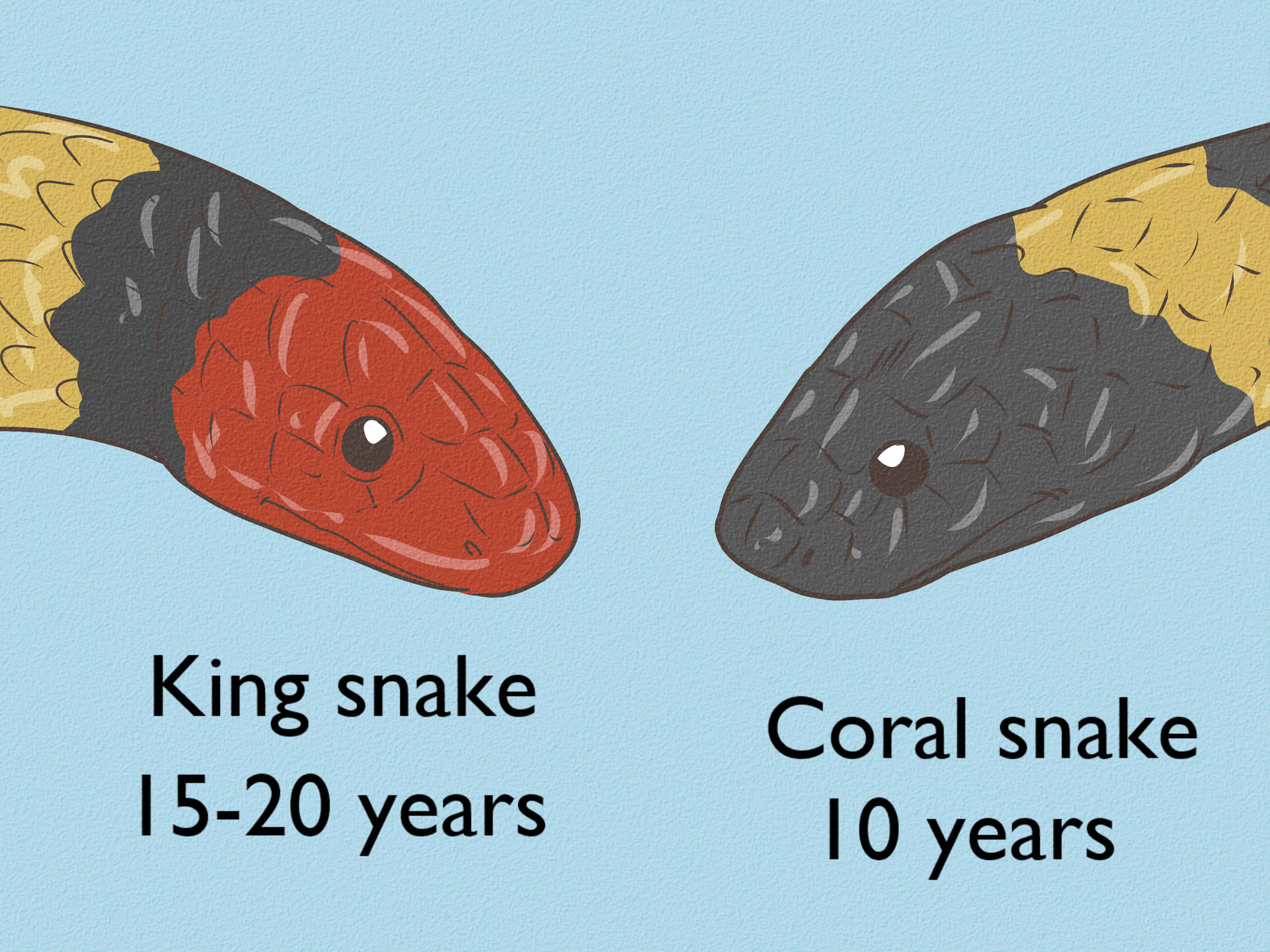
In the United States, the classic difference between many coral snakes and scarlet kingsnakes is the order of the colored bands. Coral snakes typically have red bands touching yellow bands. Scarlet kingsnakes usually have red bands touching black bands, with yellow or white bands separated from red by black.
That is where the famous rhyme comes from:
Red touches yellow, kill a fellow. Red touches black, venom lack.
Another version is:
Yellow, red, stop!
These memory tricks can be helpful for native coral snakes in the United States, especially the eastern or harlequin coral snake and Texas coral snake. However, rhymes are not universal laws of nature. Color mutations, faded bands, regional variation, imported exotic snakes, and poor lighting can all make identification harder. Use the rhyme as one clue, not as permission to handle the snake.
Why Coral Snakes and Kingsnakes Look So Similar
Scarlet kingsnakes and coral snakes are often discussed together because of mimicry. A coral snake is venomous, so its bright colors work like a warning sign. A harmless snake that resembles it may gain protection because predators hesitate before attacking anything wearing the “danger uniform.” It is basically the reptile version of borrowing a security guard’s jacket.
The scarlet kingsnake, a nonvenomous species, has red, black, and yellow or whitish rings. In many areas, it overlaps with coral snakes and benefits from looking like something predators should avoid. This does not mean scarlet kingsnakes are aggressive or dangerous. They are shy, secretive, and far more interested in small reptiles, snakes, lizards, and other prey than in bothering humans.
Coral snakes are also secretive. They often hide under leaf litter, logs, soil, or debris and are not commonly encountered despite their memorable colors. Most snake problems happen when people try to capture, kill, or handle a snake. The snake was not looking for drama. It was probably looking for shade.
The Main Visual Differences
1. Band Order: Red-Yellow vs. Red-Black
The most famous identification clue is band contact. In many U.S. coral snakes, the red bands touch yellow bands. In scarlet kingsnakes, red bands touch black bands, and the yellow or white bands do not touch red.
Think of it this way:
- Coral snake: red touches yellow.
- Scarlet kingsnake: red touches black.
For example, a typical eastern coral snake has broad red and black rings separated by narrow yellow rings. A scarlet kingsnake has red bands separated from yellow or white bands by black. If the red and yellow are neighbors, be especially cautious.
2. Snout Color
Snout color is another useful clue. Coral snakes in the eastern United States commonly have a black snout or black head area. Scarlet kingsnakes usually have a red snout. That means if you see a red, black, and yellow snake with a distinctly black nose, you should treat it as a possible coral snake.
Again, do not get close just to inspect the nose. A smartphone photo taken from a safe distance can help. Zoom with your camera, not your face. Your face has no optical zoom and is expensive to repair.
3. Body Shape and Head Shape
Coral snakes are slender, smooth-scaled snakes with small rounded heads that are not very distinct from the neck. Scarlet kingsnakes are also slender and smooth-scaled, so body shape alone is not enough for a quick identification. However, scarlet kingsnakes often have a slightly more noticeable red snout and a small head that blends into the body.
Many people are taught that venomous snakes have triangular heads and vertical pupils. This rule is unreliable for coral snakes. Coral snakes do not look like pit vipers such as rattlesnakes, copperheads, or cottonmouths. They have small heads and round pupils. So do many harmless snakes. Do not use head shape as your only clue.
4. Ring Pattern Around the Body
Coral snakes usually have complete rings that encircle the body. Scarlet kingsnakes also generally have rings that encircle the body, although related look-alikes such as scarlet snakes may have bands that do not fully wrap around the belly. This makes ring completeness helpful for separating scarlet kingsnakes from scarlet snakes, but less helpful for separating scarlet kingsnakes from coral snakes.
If you can see the underside safely from a photo, a plain pale belly may point toward a scarlet snake rather than a scarlet kingsnake. But if you are close enough to flip the snake over, you are too close. Let professional herpetologists and wildlife experts do the close-contact gymnastics.
5. Size
Size can help, but it is not perfect. Adult scarlet kingsnakes are often around 14 to 20 inches long, though some grow longer. Eastern coral snakes are commonly around 20 to 30 inches long, with larger individuals occasionally recorded. Texas and Arizona coral snakes vary as well. Young snakes can confuse the size clue, so do not assume a small snake is harmless.
Baby venomous snakes can still be venomous. Tiny danger is still danger. A compact car can still hit your mailbox.
Where You Are Matters
Location is one of the most underrated tools in snake identification. Coral snakes are not found everywhere in the United States. In general, native U.S. coral snakes occur in parts of the Southeast, Texas, and the Southwest. The eastern or harlequin coral snake is associated with Florida and parts of the southeastern coastal plain. The Texas coral snake occurs in Texas and nearby regions. The Arizona or Sonoran coral snake occurs in the Southwest.
If you are in Missouri, for example, a red-marked milksnake may be mistaken for a coral snake, but native coral snakes are not part of Missouri’s snake fauna. If you are in Florida, southern Georgia, Alabama, South Carolina, or parts of Texas, the possibility becomes more realistic. Local field guides, state wildlife agencies, university extension services, and regional herpetological societies are excellent identification resources because they focus on what actually lives near you.
Do Not Trust the Rhyme Outside Its Region
The rhyme is famous, but it has limits. It is most useful for distinguishing common U.S. coral snakes from native U.S. look-alikes such as scarlet kingsnakes and scarlet snakes. It may not work for coral snake species outside the United States. It may not work for escaped exotic pets. It may not work on unusually colored individuals. It may not work if the snake is dirty, wet, shadowed, injured, faded, or partly hidden under leaves.
So yes, learn the rhyme. Just do not make it your entire snake safety plan. A good rule is: if you are not 100 percent certain, leave it alone. Even if you are certain, leave it alone anyway. Snakes do not need your handshake.
Behavior Differences Between King Snakes and Coral Snakes
Behavior can offer clues, though it should never replace visual identification. Scarlet kingsnakes are secretive and often found under logs, rocks, bark, or debris. They are nonvenomous constrictors and may feed on small snakes, lizards, and other small animals. Kingsnakes as a group are famous for eating other snakes, including venomous species in some cases.
Coral snakes are also secretive and spend much time hidden underground, under vegetation, or beneath surface cover. They are not aggressive animals. They usually try to escape rather than confront a person. However, if stepped on, grabbed, or restrained, they can bite. Coral snake bites may not always look dramatic at first because the fangs are small and puncture marks can be hard to see. That is one reason suspected coral snake bites should be treated seriously.
What to Do If You See One
Step 1: Stop Moving Toward It
The safest distance is the one you already have. Step back slowly and give the snake room to move away. Most snakes do not want contact with humans. They are not guarding treasure. They are trying to survive Tuesday.
Step 2: Take a Photo From a Distance
If it is safe, take a photo using zoom. A clear picture can help wildlife professionals, poison centers, or local experts identify the snake. Do not chase it for a better angle. The “perfect photo” is not worth a hospital visit.
Step 3: Keep Pets and Children Away
Dogs, cats, and curious children may approach snakes quickly. Move them indoors or away from the area. Teach children not to touch snakes, even colorful or small ones.
Step 4: Let It Leave
Most snakes will move away if given time and space. If the snake is inside a home, garage, school area, or high-traffic workplace, contact local animal control, a licensed wildlife removal expert, or your state wildlife agency for guidance.
What to Do After a Possible Coral Snake Bite
If someone may have been bitten by a coral snake, treat it as a medical emergency. Call 911 or Poison Control at 1-800-222-1222 in the United States. Keep the person calm and still, remove tight jewelry or clothing near the bite area, and get medical help immediately.
Do not cut the wound. Do not suck out venom. Do not apply ice. Do not use a tourniquet. Do not drink alcohol. Do not try to catch or kill the snake. A photo from a safe distance is useful, but the emergency room does not need the snake delivered like a cursed party favor.
Coral snake venom can affect the nervous system. Symptoms may be delayed, and a bite may not cause dramatic swelling at first. That delay can fool people into thinking everything is fine. Medical evaluation is still important because weakness, breathing problems, and other serious symptoms can develop later.
Common Mistakes People Make
Mistake 1: Getting Too Close for Identification
You do not need to identify every snake at close range. If you cannot tell what it is from a safe distance, the correct answer is “unknown snake; leave alone.” That is a perfectly respectable field identification.
Mistake 2: Assuming All Colorful Snakes Are Coral Snakes
Many harmless snakes have bright colors. Scarlet kingsnakes, scarlet snakes, milksnakes, and juvenile forms of other species can confuse people. Color alone is not enough. Look at band order, snout color, location, and body pattern.
Mistake 3: Assuming All Venomous Snakes Have Triangular Heads
Coral snakes break this popular rule. They have small rounded heads and round pupils. If you rely only on head shape, you may misidentify a coral snake as harmless.
Mistake 4: Trying to Kill the Snake
Many snakebites occur when people attempt to handle, kill, or move snakes. Snakes also play important roles in ecosystems by controlling rodents, lizards, insects, and other small animals. The safest and most humane choice is usually to back away and let the snake go.
Simple Identification Table
| Feature | Coral Snake | Scarlet Kingsnake |
|---|---|---|
| Venom | Venomous | Nonvenomous |
| Band order | Red often touches yellow | Red touches black |
| Snout | Usually black | Usually red |
| Head shape | Small, rounded, not distinct from neck | Small, not very distinct from neck |
| Behavior | Secretive, often hidden | Secretive, often under cover |
| Safety rule | Do not handle; seek help after suspected bite | Do not handle unless trained; leave alone |
Field Experiences: Real-World Lessons From Coral Snake Look-Alikes
One of the most practical experiences people have with king snake and coral snake identification happens not on a dramatic wilderness expedition, but in ordinary places: beside a flower bed, under a porch step, near a woodpile, or while moving a damp garden hose that suddenly appears to have opinions. The first lesson is that lighting changes everything. A snake seen in bright midday sun may look crisp and easy to identify, while the same pattern under leaves at dusk can become a moving blur of red, black, and yellow. That is why calm observation beats panic every time.
Imagine walking through a piney yard in Florida and seeing a small banded snake slide from under a board. Your first reaction may be to recite the rhyme. But the snake is moving, the bands are bending, and half the body is hidden in grass. Instead of stepping closer, the better move is to freeze, back up, and use your phone camera. Later, zooming in on the image, you may notice the red snout and red bands touching black. That points toward scarlet kingsnake. The identification is useful, but the behavior was more important: distance first, diagnosis second.
Another common experience comes from homeowners who find a colorful snake near mulch or leaf litter. Coral snakes are secretive, and so are scarlet kingsnakes. Both may use cover where small prey lives. People sometimes assume that a snake near the house is “coming after” them. In reality, the snake is usually following food, shelter, temperature, or moisture. Removing clutter, sealing gaps, keeping grass trimmed, and managing rodents can reduce unwanted snake encounters without harming beneficial wildlife.
Hikers and campers learn another lesson: local knowledge matters. In the Southeast, the coral snake question is realistic. In areas where coral snakes do not naturally occur, a similar-looking snake may be a milksnake or kingsnake relative. But travelers should be careful with assumptions. A person who learned the rhyme in Georgia may repeat it confidently in another country where the color rule does not apply. That confidence can become dangerous. Regional field guides and official local wildlife resources are better than one-size-fits-all folklore.
Parents often use coral snake look-alikes as a teaching moment. Children do not need a full taxonomy lecture, but they can learn simple rules: never touch a snake, step back, call an adult, and admire wildlife from a safe distance. This is more useful than teaching kids that “only certain snakes are bad.” Young children may misremember colors, and even harmless snakes can bite defensively if grabbed. Respect is easier to remember than a rhyme under pressure.
Gardeners may have the most frequent close calls. A gloved hand reaches under a planter, and a small snake darts out. The surprise is usually worse than the danger. The best habit is to look before reaching into dark, hidden spaces. Use a tool to move boards or debris, wear gloves, and give wildlife an escape route. If you regularly work outdoors in coral snake range, keep Poison Control’s number saved in your phone and know the location of the nearest emergency facility.
The biggest real-world lesson is humility. Even experienced naturalists sometimes avoid a firm identification from a poor photo. Snakes can be muddy, faded, partially hidden, or unusually patterned. A safe answer is better than a confident wrong one. When in doubt, do not handle the snake. That single decision prevents most bad outcomes and lets both human and reptile continue their day with dignity intact.
Conclusion
Telling the difference between a king and coral snake comes down to careful observation, not bravery. In many U.S. species, coral snakes have red bands touching yellow bands and a black snout, while scarlet kingsnakes have red bands touching black bands and a red snout. The rhyme can help, but it is not a universal rule. Location, snout color, band order, and safe distance all matter.
The smartest approach is simple: learn the clues, respect the limits of those clues, and never handle a snake you cannot identify with certainty. Coral snakes are venomous but secretive. Scarlet kingsnakes are harmless mimics but still deserve space. Both belong outdoors, doing snake things, preferably far away from your ankles.
If you see a red, black, and yellow snake, step back, take a safe photo if possible, and contact local wildlife experts if identification is necessary. If a bite is suspected, call emergency services or Poison Control immediately. In the king snake vs. coral snake mystery, the best detective is the one who solves the case from a safe distance.