
“`
Choosing the best A/B testing tools used to be simple: install Google Optimize, test a button color, celebrate a 2.3% lift, and pretend the marketing department had discovered electricity. Those days are gone. Google Optimize has been discontinued, customers are pickier, privacy rules are tighter, and “let’s just test it” now means something very different depending on whether you run an ecommerce store, SaaS product, mobile app, or enterprise personalization engine.
The good news? A/B testing software has grown up. The best platforms today do much more than split traffic between Version A and Version B. They help teams build hypotheses, segment visitors, personalize experiences, test product features, analyze behavior, reduce risk, and decide what actually deserves to go live. In other words, they help you stop arguing in meetings about whether the hero button should say “Start Free Trial” or “Get Started Today.” Let the data suffer through that debate instead.
Below is a practical, in-depth look at the seven best A/B testing tools for modern conversion rate optimization, experimentation, growth marketing, and product development. Each tool has a different personality. Some are built for enterprise marketing teams. Some are loved by product managers and engineers. Some are perfect for agencies. One or two are powerful enough to make a dashboard enthusiast weep with joy.
What Makes a Great A/B Testing Tool?
Before ranking the best A/B testing platforms, it helps to define what “best” actually means. A strong tool should help you create experiments without making your team feel like they need a computer science degree and a calming herbal tea. It should support reliable statistical analysis, easy audience targeting, clean reporting, and integrations with analytics, customer data, ecommerce, or product systems.
The best A/B testing software usually includes:
- Visual editing for landing pages, CTAs, forms, banners, and page layouts
- Server-side or feature experimentation for product and engineering teams
- Audience targeting and segmentation by behavior, device, location, traffic source, or customer attributes
- Reliable statistics, confidence reporting, Bayesian or frequentist analysis, and guardrail metrics
- Quality assurance tools so a broken variation does not greet your best customers like a raccoon in a tuxedo
- Personalization capabilities for tailoring experiences beyond a single winning variation
- Integrations with analytics, data warehouses, customer data platforms, CMS tools, and marketing stacks
There is no single perfect platform for every business. The best choice depends on your traffic, technical resources, privacy requirements, budget, and experimentation maturity. A small ecommerce brand needs something very different from a global SaaS company running feature flags across multiple product teams.
1. Optimizely: Best Overall Enterprise A/B Testing Platform
Best for: Enterprise teams, mature CRO programs, personalization, web experimentation, and complex digital experience optimization.
Optimizely is one of the most recognized names in A/B testing, and for good reason. It is built for organizations that take experimentation seriously and want a platform that can support web testing, feature experimentation, personalization, and broad digital experience optimization.
For marketing teams, Optimizely Web Experimentation is useful for testing landing pages, checkout flows, navigation changes, messaging, form layouts, and campaign experiences. For product and development teams, its experimentation features help connect testing with feature rollouts and product decisions. That makes Optimizely especially valuable when experimentation is not just a marketing side project but a company-wide operating system.
Why Optimizely Stands Out
Optimizely is excellent when you need scale, governance, and advanced experimentation workflows. Large companies often need permissions, collaboration tools, campaign management, and reliable reporting across many teams. Optimizely is built for that world. It is not the lightest or cheapest tool, but it is powerful enough for organizations that want testing to influence revenue, retention, user experience, and product strategy.
The platform is also strong for teams that want to move beyond simple A/B tests. Multivariate testing, advanced targeting, personalization, and feature experimentation help companies test not only page designs but also product logic, user journeys, and digital experiences across different audiences.
Potential drawback: Optimizely can be more than smaller teams need. If your business only wants to test two headlines per month, this may feel like buying a commercial airplane to visit the grocery store.
2. VWO: Best A/B Testing Tool for CRO Teams
Best for: Conversion rate optimization teams, ecommerce businesses, agencies, and marketers who want testing plus behavior insights.
VWO is a favorite among CRO professionals because it combines A/B testing with practical research tools. Instead of simply asking, “Which version won?” VWO helps answer, “Why did users behave that way?” That matters because a winning test without insight is just a lucky guess wearing a lab coat.
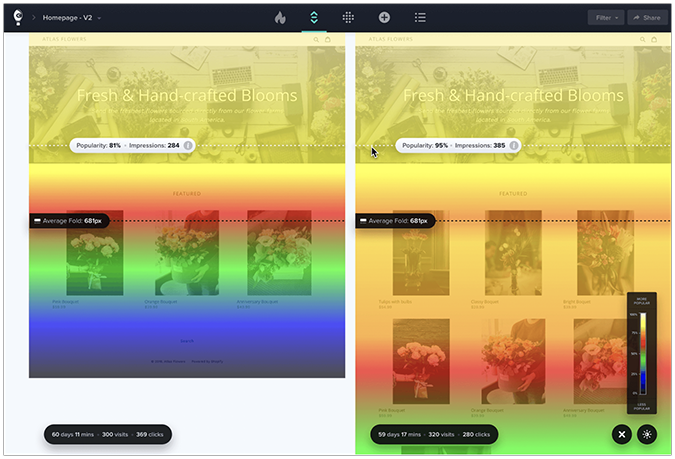
VWO supports A/B testing, split URL testing, multivariate testing, visual editing, code editing, segmentation, funnel tracking, heatmaps, clickmaps, session recordings, and visitor behavior analysis. This makes it especially useful for marketers who want to identify friction before launching tests and then validate changes with real data.
Why VWO Stands Out
The strength of VWO is its all-in-one CRO workflow. You can research user behavior, build a hypothesis, create variations, run the experiment, analyze results, and use segmentation to understand how different audiences reacted. That makes it a practical choice for teams that do not want to stitch together five separate tools just to test a pricing page.
VWO’s visual editor is friendly for marketers, while the code editor gives technical teams more control. Its reporting features are also designed to help users interpret test performance without turning every dashboard review into a statistics seminar.
Potential drawback: Like many full CRO platforms, VWO requires a disciplined testing process. Without clear hypotheses and enough traffic, teams may end up collecting pretty heatmaps instead of useful decisions.
3. AB Tasty: Best for Personalization and Experience Optimization
Best for: Ecommerce, retail, travel, media, and marketing teams that want A/B testing plus personalization.
AB Tasty is built for brands that want to optimize customer experiences across digital touchpoints. It offers web experimentation, feature experimentation, personalization, audience targeting, and AI-powered optimization features. In plain English, it helps teams test ideas, tailor experiences, and avoid making every visitor walk through the same digital hallway.
One of AB Tasty’s biggest appeals is that it balances marketer-friendly tools with more advanced experimentation capabilities. Teams can test banners, copy, layouts, recommendations, checkout improvements, and personalized campaigns without relying on developers for every tiny change. Developers can still participate when tests require deeper technical implementation.
Why AB Tasty Stands Out
AB Tasty is strong for businesses that care about experience optimization, not just isolated A/B testing. For example, an ecommerce brand might test different product page layouts, personalize promotions for returning visitors, target mobile users with a simplified checkout, and roll out winning experiences to selected segments.
The tool also fits teams that want to move from “one winning version for everyone” toward personalized experiences by audience. That is important because the best variation for a first-time visitor may not be the best variation for a loyal customer who already knows your brand better than your intern knows the snack drawer.
Potential drawback: Smaller websites with low traffic may not get the full value from AB Tasty’s broader personalization and experimentation capabilities.
4. Convert Experiences: Best Privacy-Friendly A/B Testing Tool
Best for: Agencies, privacy-conscious businesses, ecommerce brands, and teams that want strong testing without enterprise bloat.
Convert Experiences has earned a loyal following among CRO agencies and privacy-focused teams. It supports A/B testing, split testing, multivariate testing, audience targeting, advanced goals, integrations, and performance-conscious implementation. It is often praised for flexibility, support, and privacy awareness.
For businesses operating in environments where privacy, consent, and data handling matter, Convert is especially attractive. Modern experimentation cannot ignore compliance. The days of casually collecting every data point like a digital squirrel hoarding acorns are over.
Why Convert Experiences Stands Out
Convert is a strong choice for teams that want professional-grade experimentation without feeling trapped inside an enormous software ecosystem. Agencies appreciate its client-friendly setup, flexible targeting, and practical testing workflows. Businesses appreciate that it can support serious CRO work while keeping speed and privacy in focus.
It is also a good option for teams migrating away from discontinued or limited tools. If you previously relied on Google Optimize and now need a dedicated A/B testing platform, Convert deserves a serious look.
Potential drawback: Convert may require more strategic setup than beginner tools. It is best when used by teams that already understand testing basics or have CRO expertise available.
5. Adobe Target: Best for Large Brands Using Adobe Experience Cloud
Best for: Enterprise marketing teams, omnichannel personalization, Adobe Experience Cloud users, and advanced testing programs.
Adobe Target is a heavyweight platform for experimentation, optimization, and personalization. It supports A/B testing, multivariate testing, experience targeting, automated personalization, AI-powered recommendations, and customer journey optimization. For companies already using Adobe Analytics, Adobe Experience Manager, or other Adobe Experience Cloud tools, Adobe Target can become a central part of the optimization stack.
Adobe Target is particularly useful for brands that need to personalize experiences across large customer bases. It is not just about changing a button. It is about using customer data and experimentation to decide what content, offer, layout, or recommendation should appear for different users.
Why Adobe Target Stands Out
The biggest advantage of Adobe Target is its fit inside an enterprise marketing ecosystem. Large organizations often need deep integrations, advanced audience management, testing governance, and personalization at scale. Adobe Target is designed for that kind of complexity.
Its multivariate testing and AI-assisted personalization features are helpful when teams want to test combinations of elements or automate experience delivery based on performance. For example, a financial services brand could test different hero messages, product recommendations, and audience-specific offers while connecting results to broader customer analytics.
Potential drawback: Adobe Target is not the simplest option for small teams. It works best when a company has the budget, traffic, data infrastructure, and people needed to manage enterprise optimization.
6. Statsig: Best for Product Experimentation and Feature Flags
Best for: Product teams, engineering teams, SaaS companies, data teams, and organizations running feature experiments.
Statsig is a modern experimentation platform built for product development. It combines feature management, experimentation, product analytics, session replay, metrics, and data infrastructure. If traditional web A/B testing tools are built for marketers, Statsig is built for teams that ship product changes and want to know whether those changes actually improved user behavior.
Statsig is especially useful for SaaS companies and technical organizations that run experiments on product features, onboarding flows, pricing logic, ranking systems, recommendation models, or backend changes. Instead of simply testing a landing page headline, teams can test how a feature affects activation, retention, revenue, engagement, or long-term usage.
Why Statsig Stands Out
Statsig is powerful because it connects experimentation to product analytics and feature management. That means teams can launch a feature behind a flag, assign users to variations, measure outcomes, detect issues, and make rollout decisions based on data.
This is especially valuable when experiments involve real product behavior rather than surface-level page edits. For example, a SaaS team might test a new onboarding checklist. Marketing might care about sign-ups, but product cares about activation, feature adoption, and retention. Statsig helps measure those deeper product outcomes.
Potential drawback: Statsig is best for teams with technical resources. If your main goal is to let a nontechnical marketer change button copy on a landing page, a CRO-focused visual editor may be easier.
7. LaunchDarkly: Best for Feature Experimentation and Controlled Rollouts
Best for: Engineering-led teams, product releases, feature flags, progressive rollouts, and experiments tied to software delivery.
LaunchDarkly is best known for feature management, but its experimentation capabilities make it a strong A/B testing tool for product and engineering teams. It allows teams to test features, target audiences, control rollouts, monitor performance, and quickly turn features on or off.
This matters because not every experiment is a landing page experiment. Sometimes the real question is whether a new recommendation algorithm improves engagement, whether a checkout feature reduces drop-off, or whether an AI-powered workflow actually helps users instead of politely confusing them.
Why LaunchDarkly Stands Out
LaunchDarkly shines when experimentation is part of shipping software. Teams can test feature variations, validate metrics, use audience targeting, monitor experiment health, and roll out winning versions without redeploying code. That gives companies more control and less risk when launching new functionality.
For engineering teams, this is a big deal. A failed landing page test is embarrassing. A failed product release can be expensive, stressful, and capable of producing Slack messages written entirely in capital letters. LaunchDarkly helps reduce that risk by separating deployment from release and making experimentation part of the development workflow.
Potential drawback: LaunchDarkly is not primarily a marketer-first visual website testing tool. It is strongest when your team wants feature flags, controlled releases, and product experimentation.
Quick Comparison of the 7 Best A/B Testing Tools
| Tool | Best For | Main Strength | Ideal User |
|---|---|---|---|
| Optimizely | Enterprise experimentation | Scalable web and feature testing | Large marketing and product teams |
| VWO | CRO programs | Testing plus behavior insights | Marketers, agencies, ecommerce teams |
| AB Tasty | Experience optimization | Personalization and testing | Retail, ecommerce, media, travel brands |
| Convert Experiences | Privacy-friendly testing | Flexible CRO and strong support | Agencies and privacy-conscious teams |
| Adobe Target | Enterprise personalization | AI-powered testing and Adobe integration | Large Adobe Experience Cloud users |
| Statsig | Product experimentation | Feature flags, analytics, experimentation | SaaS, product, data, and engineering teams |
| LaunchDarkly | Feature rollouts | Controlled releases and experiment flags | Engineering-led product teams |
How to Choose the Right A/B Testing Software
The smartest way to choose an A/B testing tool is to start with your actual workflow, not the fanciest feature list. Every platform looks heroic on a demo call. The real test is whether your team will use it consistently after the salesperson disappears into the sunset.
Choose Based on Team Type
If your team is mostly marketers and CRO specialists, look at VWO, AB Tasty, Convert Experiences, Optimizely, or Adobe Target. These tools are strong for website optimization, landing page testing, personalization, and conversion rate optimization.
If your team is mostly product managers, engineers, or data scientists, look at Statsig and LaunchDarkly. These tools are better suited for feature flags, server-side tests, product experiments, and controlled rollouts.
Choose Based on Traffic Volume
A/B testing needs enough traffic to produce useful results. If your website has low traffic, focus on high-impact pages, bigger changes, and qualitative research before running tiny tests. Testing whether a comma improves conversions is not strategy. It is punctuation with a clipboard.
High-traffic businesses can run more granular tests, segment results by audience, and experiment more frequently. Low-traffic businesses should prioritize bold hypotheses, such as testing different offers, pricing structures, page layouts, or onboarding flows.
Choose Based on Experiment Complexity
For simple web tests, a visual editor and clean reporting may be enough. For advanced programs, you may need server-side experimentation, mutual exclusion groups, feature flags, traffic allocation, data warehouse integration, and advanced statistical controls.
Ask yourself: Are we testing marketing pages, product features, algorithms, recommendations, personalization rules, or all of the above? The answer will narrow your shortlist quickly.
Common A/B Testing Mistakes to Avoid
Even the best A/B testing tools cannot fix bad experimental thinking. A shiny dashboard will not rescue a weak hypothesis. Before launching a test, define what you are changing, why you believe it matters, which metric will prove success, and what decision you will make after the test ends.
Common mistakes include stopping tests too early, testing too many things at once, ignoring mobile users, changing live experiments midway, celebrating tiny lifts without enough data, and focusing only on conversion rate while ignoring revenue, retention, or customer quality.
Another mistake is treating A/B testing as a magic trick. It is not. It is a decision-making process. The goal is not to “win tests.” The goal is to learn what improves the business. A losing test can be valuable if it prevents a bad idea from being rolled out to everyone. That is not failure. That is your data politely tackling you before you run into traffic.
Real-World Experiences With A/B Testing Tools
After working with A/B testing concepts across marketing, ecommerce, SaaS, and content optimization, one lesson becomes obvious: the tool matters, but the testing culture matters more. A great platform in the hands of a team with no process becomes an expensive button-color casino. A simpler tool in the hands of a disciplined team can produce meaningful conversion gains, cleaner user experiences, and smarter product decisions.
One common experience is that teams often start too small. They test a headline, a button color, or a minor image swap and then feel disappointed when results are inconclusive. Micro-tests can work on high-traffic websites, but many businesses need bigger changes to generate measurable impact. Testing a completely different offer, clearer pricing page, shorter form, stronger guarantee, or redesigned onboarding flow usually teaches more than debating whether blue or green is “more trustworthy.” The customer does not care about your internal color psychology argument. The customer wants clarity.
Another practical lesson is that research should come before testing. Heatmaps, session recordings, surveys, customer interviews, sales call notes, support tickets, and analytics reports can reveal where users hesitate. Without that research, teams often test random ideas. That creates a backlog full of “CEO saw this on a competitor’s website” experiments, which is not exactly the scientific method.
For ecommerce teams, the most valuable tests often happen close to revenue. Product pages, cart pages, checkout flows, shipping messages, trust badges, product recommendations, and promotional offers usually matter more than homepage decorations. A homepage carousel may be fun, but checkout friction is where money quietly leaks out wearing tiny sneakers.
For SaaS teams, product experimentation often provides deeper insights than landing page testing alone. A new onboarding checklist, trial activation prompt, upgrade message, or feature discovery flow can have a direct effect on retention and lifetime value. This is where tools like Statsig and LaunchDarkly become especially useful because they connect experiments to actual product behavior.
For agencies, the challenge is often communication. Clients love the phrase “conversion lift,” but they may not understand sample size, statistical confidence, or why an experiment needs time. A good A/B testing platform helps, but clear reporting and expectation setting matter just as much. The best agencies explain that testing is not a vending machine where you insert traffic and receive revenue. It is a learning system.
The best experience comes when teams build a testing rhythm: research, prioritize, launch, QA, monitor, analyze, document, and share learnings. Over time, a company develops an internal knowledge base of what customers respond to. That knowledge becomes more valuable than any single winning variation. Eventually, A/B testing stops being a one-off tactic and becomes a habit of making decisions with evidence instead of opinions. And frankly, opinions have had a long enough run in conference rooms.
Final Verdict: What Is the Best A/B Testing Tool?
The best A/B testing tool depends on your business model and team structure. Optimizely is the strongest all-around choice for enterprise experimentation. VWO is excellent for CRO teams that want research and testing in one workflow. AB Tasty is a smart pick for personalization and customer experience optimization. Convert Experiences is great for agencies and privacy-conscious teams. Adobe Target is ideal for large brands already invested in Adobe Experience Cloud. Statsig is built for product and data-driven experimentation. LaunchDarkly is the best fit for feature flags, controlled rollouts, and engineering-led testing.
The real winner is not the platform with the longest feature list. It is the one your team can use consistently to make better decisions. Start with your goals, match the tool to your workflow, and remember: the best A/B testing software does not replace strategy. It simply prevents your loudest meeting participant from becoming the official source of truth.