
In the grand museum of internet clapbacks, few exhibits are as quietly savage as Greta Thunberg changing her Twitter bio after Donald Trump mocked her United Nations climate speech. No dramatic press conference. No 14-part thread. No caps lock cannon. Just one tiny profile edit that turned a presidential jab into a boomerang.
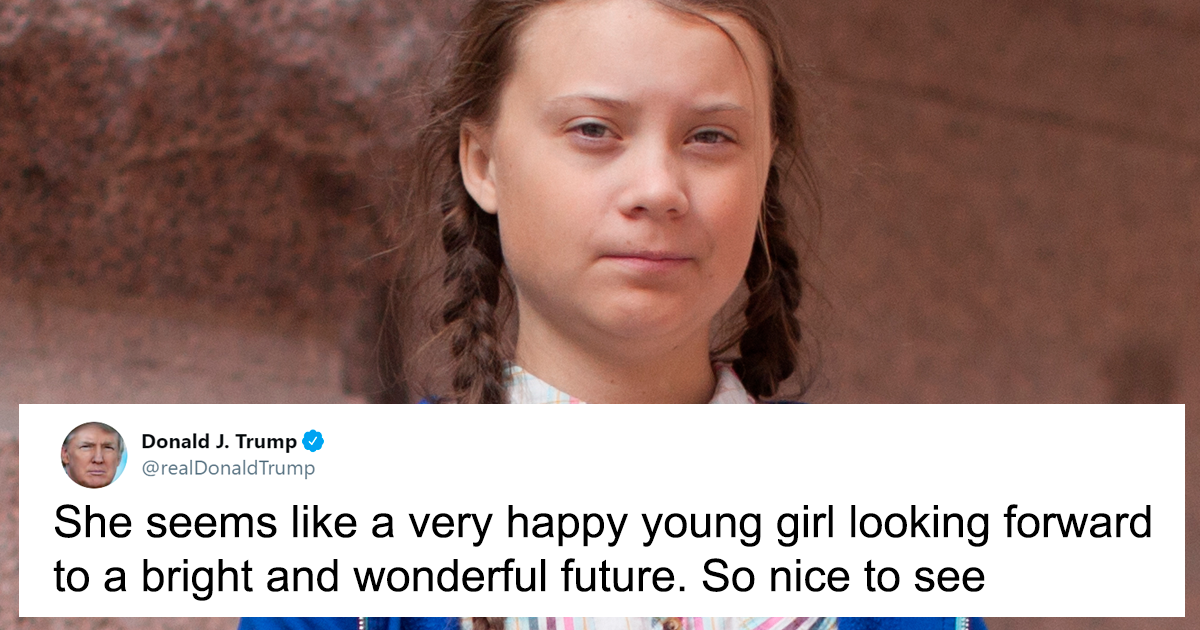
The moment unfolded in September 2019, after Thunberg, then a 16-year-old Swedish climate activist, delivered her now-famous “How dare you?” speech at the United Nations Climate Action Summit in New York. Her message was intense, emotional, and pointed: world leaders had spent decades talking about climate change while young people inherited the consequences. Trump responded on Twitter with a sarcastic comment calling her “a very happy young girl looking forward to a bright and wonderful future.”
Instead of firing back directly, Thunberg simply made his words her Twitter bio: “A very happy young girl looking forward to a bright and wonderful future.” It was the social media equivalent of catching a tomato thrown from the crowd, slicing it, and putting it in a sandwich.
The Speech That Started The Viral Moment
Greta Thunberg’s UN speech was not designed to be cute, polite, or comfortable. It was a climate emergency alarm delivered by a teenager who believed adults had kept hitting the snooze button. Speaking before world leaders, she said she should have been in school across the ocean, not standing at a summit begging powerful people to listen to climate science.
The most memorable line, “How dare you,” became a global headline because it captured something bigger than one speech. It expressed frustration from a generation watching wildfires, heat waves, floods, rising seas, and policy delays pile up like unread emails from the planet. Thunberg accused leaders of offering empty words while ecosystems suffered and future generations faced risks they did not create.
Her speech also came at a strategically loaded moment. Millions of young people had recently participated in global climate strikes, inspired by the school strike movement Thunberg helped launch. The UN summit was supposed to encourage stronger climate action, but many activists argued that major governments were still moving too slowly. In other words, the stage was already covered in dry tinder. Thunberg brought the match.
Trump’s Tweet: Sarcasm Meets Climate Activism
Trump’s response arrived in classic Trumpian fashion: short, sarcastic, and engineered for attention. After a video of Thunberg’s emotional speech circulated online, he wrote that she seemed like “a very happy young girl looking forward to a bright and wonderful future,” adding, “So nice to see!”
Supporters saw the tweet as typical Trump humor. Critics saw it as the president of the United States mocking a teenage activist for expressing fear about climate change. Either way, the message instantly became part of the news cycle. Trump had not merely disagreed with Thunberg’s position; he had commented on her demeanor, her age, and her emotional delivery.
The irony was hard to miss. Thunberg’s speech had focused on science, emissions, political responsibility, and intergenerational justice. Trump’s tweet focused on whether she appeared happy enough. It was like responding to a fire alarm by reviewing the alarm’s tone of voice.
Greta’s Twitter Bio Shade Was Small But Surgical
Thunberg’s response worked because it refused to play the usual outrage game. She did not quote-tweet Trump. She did not insult him. She did not write a long explanation of why mocking teenagers is a questionable leadership strategy. She simply copied his phrase into her Twitter bio.
That tiny edit did several things at once. First, it neutralized the insult by owning it. Second, it made Trump’s sarcasm look even more childish by placing it in a deadpan context. Third, it reminded everyone that Thunberg understood the internet very well, thank you very much. For someone often portrayed by critics as humorless, she showed a dry comic timing that could make a late-night writer nod respectfully.
The move also fit a pattern. Thunberg has often responded to public criticism by turning insults into profile descriptions. When powerful figures tried to define her, she recycled their words as self-description, stripping them of sting. It is a simple trick, but a good one: take the label, wear it sideways, and walk away.
Why The Exchange Became Bigger Than A Tweet
The Trump-Greta exchange went viral because it was not really about one tweet. It symbolized a wider cultural fight over climate change, political power, youth activism, and public tone. Thunberg represented a new style of activism: blunt, science-focused, impatient, and deeply online. Trump represented a style of politics built on provocation, personality, and media dominance.
When those two styles collided, the internet naturally grabbed popcorn. But beneath the meme energy was a serious question: how should leaders respond when young people accuse them of failing the future?
Thunberg’s critics often focused on her age, her facial expressions, or her emotional delivery. Her supporters argued that those attacks avoided the substance of her message. Climate science is not dependent on whether a teenager smiles during a speech. Carbon dioxide does not check Twitter before trapping heat. Sea levels do not wait for everyone to become more comfortable with the messenger.
That is why the bio change landed so well. It redirected attention back to the imbalance: a teenage activist warning about climate change, and a powerful adult choosing mockery over meaningful engagement.
The Climate Context Behind The Viral Clapback
To understand why Thunberg’s speech resonated, it helps to remember the scientific backdrop. Climate researchers have long warned that human-caused greenhouse gas emissions are warming the planet. NOAA and other scientific agencies have documented rising global temperatures, with recent decades ranking among the warmest in the modern record.
Thunberg’s argument was never that she personally invented climate concern. Her point was that scientists had been warning leaders for decades, yet political action remained far slower than the scale of the problem. That is why her speech was so angry. It was not teenage moodiness. It was moral math: if the evidence is clear and the risks are enormous, delay becomes a choice.
The UN summit itself highlighted the gap between promises and action. Some governments and companies announced climate commitments, but observers noted that several major emitters did not bring the kind of aggressive new pledges activists wanted. In that environment, Trump’s sarcastic tweet became more than a personal swipe. It looked, to many people, like a symbol of official indifference.
How Social Media Turned The Moment Into A Cultural Snapshot
Social media loves contrast, and this story had contrast in bulk packaging. A 16-year-old climate activist gave a tearful speech at the UN. A U.S. president mocked her online. She replied by editing her bio with the exact phrase used against her. The whole thing was simple enough to understand in five seconds and layered enough to analyze for years.
It also revealed how modern public relations works. In an earlier era, Thunberg might have needed a spokesperson, a scheduled interview, or a formal statement. On Twitter, a bio update was enough. It was fast, funny, and impossible to misquote because it used Trump’s own words.
That is the strange beauty of the internet: sometimes the smallest gesture becomes the loudest response. A profile bio is usually where people put job titles, coffee preferences, or mysterious quotes from songs they loved in high school. Thunberg turned hers into a political mirror.
Public Reaction: Applause, Criticism, And A Lot Of Memes
Reactions split along familiar lines. Many climate activists and Thunberg supporters praised the move as clever, restrained, and elegant. They saw it as a young activist refusing to be bullied off message. Others dismissed it as performative, arguing that both Trump and Thunberg were using social media attention to strengthen their own brands.
But even critics had to admit the move was effective. It kept the story alive while making Thunberg appear composed. She did not need to raise the temperature; she let the quote do the work. Meanwhile, supporters turned the episode into memes, jokes, and commentary about generational politics.
The exchange also fed a broader debate about how adults speak to young activists. Youth movements often face a strange double bind. If young people are quiet, they are told they do not care. If they speak forcefully, they are told they are too emotional. If they are polite, they are ignored. If they are angry, they are scolded. Thunberg’s speech cut through that trap by being direct, and her bio response cut through it by being funny.
Why Greta Thunberg’s Communication Style Works
Thunberg’s communication style is unusually effective because it is plain. She does not bury her message under corporate fog or diplomatic oatmeal. She says leaders are failing. She says the science is clear. She says young people are watching. Whether someone agrees with every tactic or not, the message is hard to misunderstand.
Her Twitter bio response worked for the same reason. It was short. It was clear. It did not over-explain itself. The joke trusted the audience to understand the context, which is usually a good idea unless the audience is still trying to connect Bluetooth headphones.
In SEO terms, this is why stories about “Trump mocks Greta Thunberg” and “Greta Thunberg Twitter bio” remained searchable long after the news cycle moved on. The keywords are attached to a clean narrative: speech, mockery, clapback, viral reaction. People remember stories when they have a beginning, a twist, and a satisfying final beat.
The Bigger Lesson: The Internet Rewards Moral Judo
Thunberg’s response is a perfect example of moral judo: using an opponent’s force against them. Trump’s tweet tried to frame her as emotional and unserious. Her bio change made the frame look silly. She did not need to overpower the insult. She redirected it.
This is useful far beyond politics. Public criticism often tempts people to respond with equal or greater force. Sometimes that is necessary. But sometimes the best response is lighter, sharper, and more controlled. Humor can expose weakness without sounding defensive. Repetition can turn mockery into evidence. Silence, used strategically, can be louder than a speech.
That does not mean every insult deserves a clever comeback. The internet already has enough people auditioning for the role of “main character in a comment section.” But when the issue matters, and when the criticism is designed to distract, a calm response can keep the focus where it belongs.
Experience-Based Reflections On The Trump-Greta Moment
One reason this story continues to feel relevant is that many people have experienced a smaller version of it. Maybe not with a president, a UN speech, and a global audiencemost family group chats are dramatic, but not that dramatic. Still, plenty of people know what it feels like to raise a serious concern and have someone respond by mocking their tone instead of addressing the substance.
Think about a student who speaks up about school safety and gets called dramatic. Or an employee who warns that a project is heading toward disaster and gets labeled negative. Or a young person who talks about climate anxiety and hears, “Relax, you’re too young to worry about that.” In each case, the criticism shifts attention away from the issue and onto the messenger’s personality.
That is why Thunberg’s bio change felt satisfying to so many people. It modeled a way to respond without losing the plot. She did not abandon the climate conversation to defend her facial expression. She did not spend paragraphs proving that she was allowed to be angry. She took the mockery, displayed it, and let people judge who looked serious.
There is also a lesson here for anyone building a public voice. You cannot control every reaction, especially online. The more visible your message becomes, the more people will try to shrink it into a joke, a label, or a personality flaw. The challenge is to decide which criticism deserves engagement and which can be turned into background noise with a little wit.
For writers, creators, activists, and ordinary people with opinions stronger than lukewarm soup, the Thunberg example is instructive. A good response does not always need volume. Sometimes it needs timing. Sometimes it needs restraint. Sometimes it needs the confidence to let someone else’s words reveal more about them than about you.
Of course, humor is not a substitute for climate policy. A Twitter bio cannot cut emissions, build clean energy infrastructure, protect vulnerable communities, or rewrite national climate plans. But communication matters because attention shapes political pressure. Thunberg’s viral response kept people talking about the larger issue: young activists demanding that leaders take the climate crisis seriously.
That may be the most important experience connected to this story. Many people watched the exchange and recognized a familiar pattern: young people asking for accountability, older leaders dismissing them, and the internet deciding who had the better argument. Thunberg’s bio did not solve climate change, but it did something powerful in a noisy media environment. It made mockery look small and urgency look mature.
And yes, it was funny. Not sitcom funny. Not “dad fell into a kiddie pool at a barbecue” funny. More like chess funnythe kind where one quiet move makes the whole board look different.
Conclusion
The story of Trump mocking Greta Thunberg’s speech and Thunberg shading him in her Twitter bio remains memorable because it combined politics, climate activism, generational tension, and internet wit in one compact moment. Trump’s sarcastic tweet tried to reduce a serious climate message to a comment about a teenager’s attitude. Thunberg’s response transformed that comment into a punchline at his expense.
More importantly, the episode showed how young activists can navigate public criticism without surrendering their message. Thunberg’s UN speech demanded climate action. Her Twitter bio reminded the world that she could take a hit and still control the narrative. In the noisy theater of modern politics, that is no small skill.