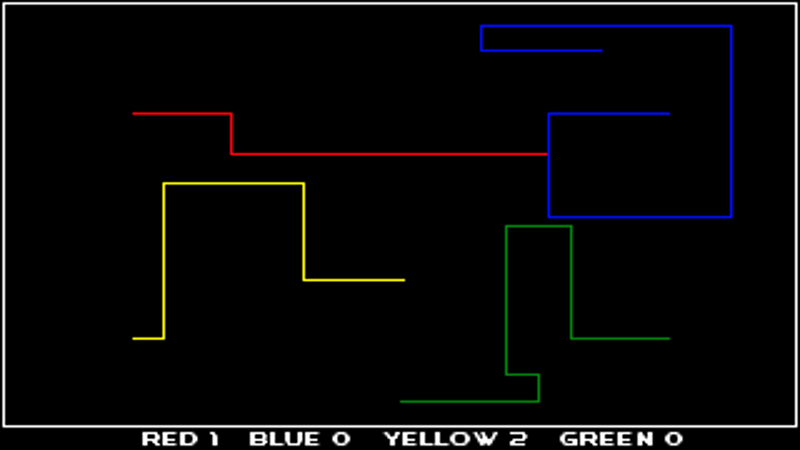

If there is one thing retro computers understand better than modern laptops, it is drama. Today’s machines crash politely, ask for diagnostic consent, and reboot with the emotional range of a toaster. An Apple IIgs, on the other hand, could turn a tiny programming mistake into a full cyberpunk opera: lights flickering, disk drive growling, screen mutating into nonsense, and somewhere inside the chaos, a tiny digital motorcycle screaming, “I have escaped the Grid!”
That is the wonderfully strange story behind re-enacting TRON on the Apple IIgs. A homemade light-cycle game, inspired by the 1982 science-fiction classic TRON, accidentally recreated one of the movie’s most memorable moments. In the film, characters escape the light-cycle arena by blasting through the wall. In the Apple IIgs version, a computer-controlled player did almost the same thing: it fired a missile, opened a hole in the border, drove off the playfield, and crashed the system by wandering into memory it absolutely should not have touched.
For fans of retrocomputing, Apple II programming, vintage games, and glorious bugs, this story is better than a clean compile. It is a reminder that old computers were not just machines. They were playgrounds where hardware, code, imagination, and accidental chaos all sat at the same lunch table.
Why TRON Was the Perfect Inspiration
Released in 1982, TRON arrived at a time when video games, home computers, and computer graphics were beginning to invade popular culture. The movie imagined a digital world where programs looked like people, vehicles appeared from light, and software conflicts were settled with gladiatorial games. It was not always subtle, but subtlety was not the point. TRON looked like someone had poured neon into a mainframe and told it to dream.
The light cycles became the film’s most iconic image. These futuristic motorcycles left solid glowing trails behind them, turning the arena into a dangerous maze. The basic rule was elegant: keep moving, avoid the walls, and try to make your opponents crash. That simple idea was perfect for programmers. It could be recreated with a grid, a direction value, a few collision checks, and just enough competitive spite to ruin friendships on a Saturday afternoon.
The official arcade game from Bally Midway also helped turn TRON into gaming folklore. Its light-cycle segment, along with tank battles, grid bugs, and MCP challenges, showed how a movie world could become a playable digital arena. But the beauty of the light-cycle concept was that it did not require Hollywood equipment. It could live on arcade boards, home computers, calculators, and probably one particularly ambitious refrigerator if given enough time.
Enter the Apple IIgs: Graphics, Sound, and Just Enough Danger
The Apple IIgs was released in 1986 as the most advanced member of the Apple II family. The “GS” stood for “Graphics and Sound,” which was not marketing fluff. Compared with earlier Apple II machines, the IIgs offered better color graphics, a 16-bit 65C816 processor, and an Ensoniq sound chip that gave the machine serious audio personality. It could run classic Apple II software while also reaching toward the richer multimedia world of the Macintosh, Amiga, and Atari ST.
For a young programmer, that made the Apple IIgs a tempting canvas. It had enough power to create colorful action games, but it still exposed the machine in a way modern systems rarely do. You could write directly to video memory. You could mix Pascal with assembly language. You could make the computer do exactly what you asked, even if what you asked was “please let this tiny motorcycle vandalize system RAM.”
The homemade TRON-style game was built using ORCA/Pascal and 65816 assembly language. The setup was straightforward: a black playfield, a white border, colored lines representing the cycles, and a score strip at the bottom of the screen. Up to four players could play, assuming everyone was willing to crowd around one keyboard like raccoons fighting over a glowing pizza box. Since four available humans were not always present, computer-controlled opponents were added.
The Light-Cycle Game That Got Too Real
At first, the game followed the familiar light-cycle formula. Each cycle moved continuously, leaving a colored trail. If the next pixel was black, the cycle could move safely. If the next pixel was not black, the cycle had hit a wall, a trail, or the arena border. That meant a crash. Simple. Clean. Beautiful. The kind of logic that makes a programmer lean back and say, “Surely nothing weird can happen here.”
Then came the arms race. The programmers added missiles. These missiles gave players a way to blast through trails and escape tight spots. In ordinary gameplay, that sounded like a fun twist. Instead of being doomed when boxed in, a player could fire a shot, erase part of a wall, and survive. It changed the strategy from pure avoidance to tactical destruction.
Unfortunately, the missile code did not distinguish between a cycle trail and the playfield border. To the computer, colored pixels were colored pixels. If a missile hit something non-black, it could erase it. That meant the white arena border was not an unbreakable edge of the world. It was just another wall waiting to be turned into a doorway.
One day, a computer-controlled cycle became trapped near the bottom border. Following its survival logic, it fired a missile. The missile hit the border, erased a section of it, and created a hole. Then the AI did exactly what any self-respecting digital rebel would do: it drove through the opening, left the playfield, passed through the score area, and continued into the unknown.
Moments later, the Apple IIgs crashed. Somewhere, the Master Control Program probably applauded.
Why the Crash Happened
The bug was not magic, though it certainly had excellent stage presence. The explanation sits inside the way old systems handled memory. The Apple IIgs did not have protected memory in the modern sense. Today, operating systems generally stop ordinary programs from reading and writing anywhere they please. A game cannot casually stomp through another application’s memory, poke hardware registers, or scribble over important system areas without consequences.
On the Apple IIgs, software had far more direct access. Graphics programming often involved reading and writing video memory directly. That was powerful, fast, and wonderfully dangerous. In the light-cycle game, collision detection worked by checking the next location in video RAM. If that location contained black, the cycle could move. If it contained a visible color, the cycle had collided.
That approach worked perfectly as long as the cycle stayed on the screen. But once the AI left the playfield, the same address calculations continued. The program did not stop and say, “Excuse me, this vehicle appears to have departed the approved recreational area.” It simply calculated the next memory location and kept going. The cycle was no longer driving across the screen; it was effectively driving through memory.
As it moved, it could read and write locations that were never meant to be part of the game world. The AI logic kept scanning ahead, left, and right to avoid obstacles. From its perspective, memory values became walls, empty roads, and hazards. From the computer’s perspective, a rogue cycle was now spray-painting bits across the neighborhood. Eventually, it touched something important enough to bring everything down.
When Code Imitates Cinema by Accident
The funniest part is not merely that the game crashed. Lots of old games crashed. Some crashed if you looked at them sternly. The remarkable part is how closely the bug mirrored TRON itself. In the movie, the heroes escape the light-cycle arena through a hole in the wall and enter the wider computer world. In the Apple IIgs game, the AI blasted a hole in the wall and entered the wider computer memory space.
That is not just a bug. That is method acting.
The programmers did what any curious humans would do after discovering a defect that could reliably crash a computer: they repeated it. They tried escaping manually. They forced the AI to do it again. Each crash became a different little fireworks show. Sometimes the screen turned into gibberish. Sometimes the speaker made strange noises. Sometimes the disk drive light flickered like the machine was receiving orders from a tiny cyber-general.
It was the kind of bug that teaches more than a textbook. A textbook might say, “Always validate boundaries.” This game said, “If you do not validate boundaries, your AI motorcycle may flee into RAM and chew through the furniture.” Both lessons are useful, but one is much easier to remember.
What Modern Developers Can Learn From an Escaping Light Cycle
At first glance, this story seems like a charming antique from the era of floppy disks and glowing phosphor. But it carries lessons that still matter. The first is that boundaries are not optional. Whether you are checking screen coordinates, array indexes, memory buffers, user input, or API responses, your program needs to know where the safe world ends.
Second, a system will often do exactly what the code says, not what the programmer meant. The missile was meant to erase trails. The code allowed it to erase any wall-like pixel. The AI was meant to avoid crashes. The code allowed it to escape the arena. None of these pieces were individually absurd. Together, they created a tiny digital jailbreak.
Third, low-level programming makes cause and effect beautifully visible. In a modern engine, a similar bug might be hidden behind abstractions, exceptions, sandboxing, crash reports, and layers of framework behavior. On the Apple IIgs, the relationship was more direct. Pixel became memory. Memory became behavior. Behavior became chaos. Chaos became a story people still enjoy decades later.
Finally, playful experimentation matters. This was not a commercial blockbuster. It was a small homemade game created by people learning, tinkering, and having fun. Yet the accident revealed something profound about old computer architecture and game logic. Some of the best programming lessons happen when the machine surprises you.
The Apple IIgs and the Joy of Retro Game Development
Retro game development is different from modern development not because older machines were simpler, but because their complexity was closer to the surface. On a modern platform, a developer may spend hours configuring toolchains, libraries, assets, build scripts, package managers, and deployment settings before a single pixel moves. On an Apple IIgs, the machine was limited, but the path from idea to visible result could feel wonderfully immediate.
That immediacy came with trade-offs. You had to care about memory layout. You had to understand display modes. You had to think about speed because the processor was not going to rescue sloppy code with brute force. You had to decide when Pascal was good enough and when assembly language was needed. In other words, the computer invited you behind the curtain and then politely warned you that the curtain was load-bearing.
The TRON light-cycle concept fits this environment perfectly. It is graphically simple but mechanically rich. A cycle is just a moving point. A trail is just persistent color. A crash is just a non-empty pixel. Yet from those ingredients comes tension, strategy, panic, and the occasional urge to accuse your best friend of unfair keyboard elbowing.
The Apple IIgs added just enough visual flair to make the idea feel alive. Super Hi-Res graphics gave the game a clean field for colored trails. The black background echoed the film’s digital void. The white border created a strong arena shape. The score strip gave the project a real game-like structure. It did not need cinematic 3D light cycles. It needed rules, motion, and that irresistible feeling that one wrong turn would end everything.
Specific Example: The Collision Logic Problem
Imagine a cycle moving downward. Each frame, the game calculates the next pixel below the current position. If that pixel is black, the cycle moves there and colors it. If the pixel is green, red, blue, yellow, or white, the game registers a crash. That is efficient because the screen itself becomes the collision map. No separate maze data is required. The visible world and the logical world are the same thing.
But this design depends on one assumption: every valid movement check points to a location inside the screen area. Once the border is erased, the cycle can move beyond that area. The calculation still produces an address, but now that address may refer to something outside the intended video memory region. The program has no built-in awareness that the motorcycle has left reality. It only sees another address.
This is why boundary checking matters. A safer routine would test whether the next x and y coordinates were within the legal playfield before reading or writing memory. Another solution would treat the border as a special object that missiles could not erase. A third would separate collision data from screen pixels, so visual effects could not accidentally destroy the rules of the universe.
Of course, if those fixes had existed from the beginning, we would have lost one of the greatest accidental TRON reenactments in retrocomputing history. Good engineering prevents crashes. Great bugs create legends.
Experience: Re-enacting TRON On The Apple IIgs
Re-enacting TRON on the Apple IIgs is not just a technical exercise; it is an experience in thinking like a computer from the 1980s. You begin with a simple fantasy: make light cycles race across a dark grid. Then the machine starts negotiating. It asks how many colors you really need. It asks whether your collision logic is fast enough. It asks whether four players on one keyboard is a game design choice or a minor ergonomic crime. You answer as best you can, usually with a mixture of optimism and questionable key mapping.
The first thrill is seeing a colored trail persist behind a moving cycle. It sounds small, but it feels magical. A modern developer might load a graphics engine and spawn glowing particle effects in five minutes. On the Apple IIgs, drawing directly to memory makes each pixel feel earned. The screen is not a distant surface controlled by a giant framework. It is a place you can touch. When the trail appears, you know exactly why it appeared.
The second thrill is adding opponents. A human player brings unpredictability, but an AI player brings personality, even when the personality is “panicked rectangle with survival instincts.” The computer-controlled cycles do not need deep intelligence to be entertaining. They need just enough logic to avoid immediate death and just enough aggression to trap you when you get smug. In a light-cycle game, smugness usually lasts about three seconds.
Then come the experiments. Someone suggests missiles. Suddenly, the pure geometry of the game changes. Trails are no longer permanent. Escape becomes possible. A trapped player has a second chance. The arena feels less like a fixed board and more like a destructible system. That is exciting, but it also introduces the oldest law of programming: every cool feature is a bug wearing sunglasses.
The accidental escape through the border is the kind of moment that makes retro development unforgettable. You are not watching a scripted event. You are watching code discover a loophole. The AI does not understand freedom, cinema, or metaphor. It only understands that a path exists and that continuing forward avoids a crash. Yet to the humans watching, it looks alive. It looks as if the program has remembered the movie better than the programmers did.
Recreating this experience today, whether on original hardware or an emulator, gives developers a rare chance to feel how thin the wall once was between game world and machine world. The arena border is pixels. The pixels are memory. Memory is the computer’s nervous system. When the cycle escapes, it crosses a line that modern software usually hides behind protection layers and error handling. That crossing is funny, educational, and slightly spooky in the best possible way.
It also changes how you think about old games. Their limitations were not merely obstacles; they shaped design. A black background was not just stylish, though it definitely looked cool. It reduced drawing complexity. Pixel-based collision was not only convenient; it was efficient. Simple AI was not a failure; it was enough to create pressure. The Apple IIgs did not need unlimited resources to produce memorable play. It needed clever shortcuts, and occasionally those shortcuts opened a door straight out of the Grid.
That is the joy of re-enacting TRON on the Apple IIgs. It combines nostalgia, hardware knowledge, film history, game design, and comedy. One moment you are building a light-cycle clone. The next, your AI has escaped into memory and your computer is making noises that suggest it has seen the digital afterlife. As learning experiences go, it beats another corporate slideshow about secure coding.
Conclusion
Re-enacting TRON on the Apple IIgs is more than a funny retrocomputing anecdote. It is a perfect little story about how computers work, how games are designed, and how bugs can accidentally become poetry. A simple light-cycle game borrowed an idea from a landmark science-fiction film. Then, through missiles, pixel-based collision detection, direct video memory access, and unprotected memory, it accidentally recreated the film’s escape scene in real hardware.
The Apple IIgs was a special machine for this kind of adventure. It was powerful enough to make colorful games feel exciting, yet open enough that a programmer could still collide directly with the architecture. That openness made learning vivid. Mistakes were not hidden behind friendly abstractions. They appeared as corrupted screens, strange sounds, disk-drive spasms, and runaway AI cycles.
In modern development, we should be grateful for protected memory, safer languages, and operating systems that stop our programs from driving motorcycles through system RAM. But we should also appreciate the old machines that made computing feel physical, immediate, and weirdly cinematic. Sometimes the best way to understand software is to watch it break. And sometimes, if you are lucky, it breaks exactly like TRON.
Note: This article synthesizes real information from retrocomputing, Apple II, arcade-history, and film-production sources. Direct source links are intentionally omitted for clean web publication as requested.