
Note: This article is an original, publish-ready synthesis based on current U.S. childcare pay norms, nanny job standards, household-employment rules, and common online job-posting patterns. The examples below are paraphrased and fictionalized to avoid copying individual posts while reflecting real recurring themes.
When “Looking for a Nanny” Becomes “Looking for a Miracle Worker With No Rent, No Sleep, and No Boundaries”
Hiring a nanny is not like ordering a side of fries. You do not get to say, “Can I add laundry, tutoring, dog grooming, overnight care, emotional support, organic meal prep, and maybe a quick bathroom renovation?” and expect the price to stay the same. Yet across parenting groups, neighborhood boards, job platforms, and social media, a very special genre of post keeps appearing: the entitled parent nanny ad.
You know the type. It starts politely enough: “We’re a loving family looking for someone flexible.” Then, three lines later, “flexible” means working 62 hours a week, caring for four children under seven, driving a 2008 minivan with questionable brakes, cooking gluten-free dinners, deep-cleaning the house, and accepting payment in “free Wi-Fi and good vibes.” Somewhere, Mary Poppins quietly deletes her LinkedIn profile.
The modern nanny market in the United States is expensive because child care is skilled labor, not a favor with snacks. Nannies are often responsible for children’s safety, routines, meals, transportation, learning activities, emotional regulation, and household communication. In many cases, they are also household employees, which means families may have legal responsibilities around wages, overtime, taxes, and written agreements. A nanny is not “basically family” when payday arrives, then “the help” when boundaries appear.
So let’s laugh, wince, and learn from the most delusional types of nanny posts floating around the internet. Some are funny. Some are alarming. All of them prove one thing: if your job description sounds like five careers wearing a baby carrier, the pay should not resemble lunch money.
Why Entitled Nanny Posts Go Viral
Entitled nanny posts spread because they combine three things people cannot resist: outrageous expectations, tiny budgets, and the confidence of someone who has never calculated overtime. They also reveal a real tension. Many American families are under pressure from high childcare costs, inflexible work schedules, and limited affordable options. But financial stress does not transform an impossible job into a fair one.
A reasonable nanny job posting usually includes the children’s ages, schedule, pay range, duties, location, required experience, transportation needs, benefits, and expectations. A delusional post skips the basics and goes straight to fantasy: “Must love children, dogs, cleaning, cooking, teaching Mandarin, and being paid every other leap year.”
The funniest part is often the language. “Light housekeeping” somehow means cleaning all bathrooms. “Occasional driving” means two school drop-offs, three activities, grocery runs, and an airport pickup. “Part-time” means every weekday plus weekends, but only when the parents feel like it. “Like family” means invited to the birthday party, but not paid for the hours spent setting it up.
30 Delusional Nanny Posts That Deserve Their Own Warning Label
1. The $5-an-Hour Full-Time Fantasy
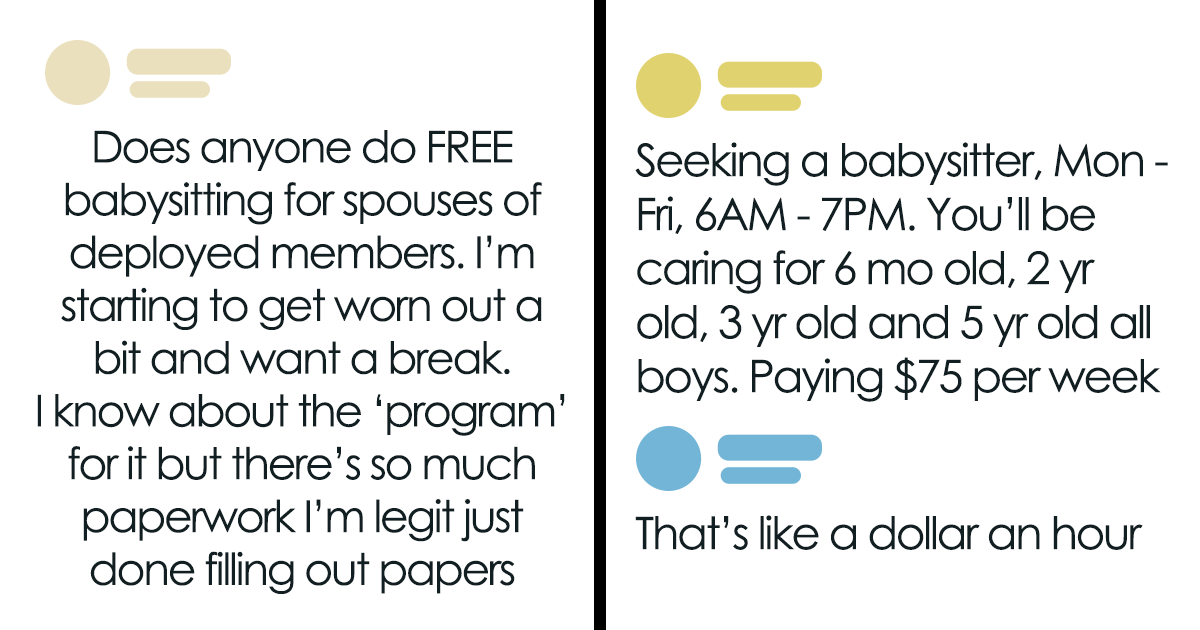
This classic post asks for full-time care at a rate that would make a lemonade stand file a complaint. The parent wants professional experience, CPR certification, reliable transportation, and “a passion for children,” but the budget is $200 a week for 40 hours. Passion is wonderful. Passion does not pay rent.
2. The “Pay Is Room and Board” Arrangement
Live-in nanny work can be legitimate, but “you may sleep in the laundry room and eat whatever the toddler rejects” is not compensation. A room is not a magic coupon that erases wages, boundaries, privacy, or time off.
3. The Five-Kid, One-Person Daycare
Some posts casually mention five children as if they are houseplants. “Ages 8 months, 2, 4, 6, and 9. Easy kids!” Easy? That is not a nanny job. That is a small civilization with snack demands.
4. The “Must Be Available 24/7” Parent
They want someone on call mornings, nights, weekends, holidays, and “some overnights if plans come up.” That is not flexibility. That is an unpaid hostage situation with crayons.
5. The Housekeeper-Nanny-Chef-Tutor Hybrid
The ad says “nanny,” but the duties include deep cleaning, laundry for six people, family dinner, homework tutoring, grocery shopping, and organizing closets. Congratulations, you are hiring an entire household staff and trying to fit it into one cardigan.
6. The “No Phone, No Sitting, No Eating” Rulebook
Professional expectations are fair. But banning basic human behavior during a 10-hour shift is absurd. A nanny is caring for children, not competing in a survival reality show called America’s Next Top Boundary Violation.
7. The “Must Bring Your Own Car and Gas” Bargain
Transportation duties should be clearly discussed and fairly compensated. Asking a nanny to drive children daily without mileage reimbursement or gas money is like asking the babysitter to sponsor your logistics department.
8. The “We Don’t Believe in Overtime” Post
This one usually says, “Salary only.” For many household employees, hourly pay and overtime rules matter. Calling it a salary does not magically turn 55 hours into 40. The law is not defeated by vibes.
9. The “My Kids Are Angels” Red Flag
Every parent loves their children. That does not mean the children never bite, scream, throw yogurt, or debate bedtime like tiny attorneys. Honest descriptions help everyone. “They are energetic and need structure” is useful. “They are perfect” is suspicious.
10. The Trial Shift That Lasts a Week
A paid trial is normal. An unpaid week of “seeing if you fit” is not. If someone is caring for your children, following your routines, and cleaning up applesauce from the ceiling, they are working.
11. The “College Student Preferred Because Cheap” Listing
Students can be excellent caregivers. But choosing them because you assume they deserve less pay is not a strategy; it is a budget wearing sunglasses and trying to sneak into professionalism.
12. The Overnight Newborn Job With Daytime Duties Too
Newborn care is demanding. Overnight care is demanding. Combining overnight feeding, daytime toddler care, laundry, meal prep, and no guaranteed sleep is not a job. It is a medical study on human collapse.
13. The “No Sick Days Because We Need Reliability” Parent
Reliability matters. So does being human. Paid sick time, clear backup plans, and respectful communication are not luxuries. They are how grown-ups run an employment relationship.
14. The “Must Have a Degree, But We Pay Like It’s 1997” Ad
Some parents request a bachelor’s degree in education, child development experience, multiple languages, and special-needs training, then offer less than entry-level retail pay. Credentials cost money. Experience has value. Children do not become “discount learners” because the post uses heart emojis.
15. The “Light Housekeeping” Trap
Child-related tidying is common: bottles, toys, kids’ dishes, children’s laundry. Scrubbing showers, cleaning parents’ bedrooms, washing dinner pans from last night, and detailing the garage are not light housekeeping. That is housekeeping-housekeeping.
16. The “Must Be Like a Grandmother” Request
This usually means warm, patient, endlessly available, and inexpensive. Grandmothers are wonderful. But hiring a professional nanny and expecting unpaid family energy is confusing the job market with Thanksgiving.
17. The “We Pay Cash Only” Wink
Some families think cash makes employment rules disappear. It does not. Household employment can involve tax responsibilities, wage records, and legal compliance. The IRS is famously not charmed by “but she felt like family.”
18. The “Must Never Discipline, But Kids Must Behave” Contradiction
Nannies need clear guidance on boundaries, routines, consequences, and communication. If a caregiver cannot redirect behavior but is blamed when chaos happens, the job comes with invisible handcuffs and visible juice spills.
19. The “Flexible Schedule” With No Guaranteed Hours
Guaranteed hours help nannies rely on predictable income. Without them, a family might cancel shifts whenever convenient, leaving the nanny with unpaid gaps. Flexibility should go both ways, not just toward the person holding the checkbook.
20. The “Must Travel With Us for Free Vacation” Post
Travel nannying is work. Airports, hotel rooms, disrupted naps, unfamiliar food, and children with vacation energy are not a vacation for the caregiver. If the nanny is responsible for children, the nanny is working.
21. The “No Outside Life” Requirement
Some listings want a nanny with no partner, no children, no school schedule, no second job, and no weekend commitments. Translation: “Please be a fully formed adult with no evidence of adulthood.”
22. The “Must Be a Native Speaker, But We Pay in Snacks” Deal
Bilingual care, language tutoring, and cultural learning are valuable skills. If a family wants immersive language support, that should be reflected in the pay and job description. Goldfish crackers are not a currency.
23. The “We Work From Home and Will Supervise You Constantly” Job
Work-from-home parents can successfully employ nannies, but only with clear boundaries. A nanny cannot build authority if a parent pops in every 11 minutes to renegotiate lunch, socks, and the emotional meaning of screen time.
24. The “Please Also Watch Our Aggressive Dog” Add-On
Pet care can be part of a job if discussed and paid. But adding an anxious 90-pound dog who “sometimes gets protective” changes the role. That is no longer light pet help. That is a side quest with teeth.
25. The “We Need Someone Tomorrow” Emergency
Last-minute childcare happens. Life is messy. But urgency usually costs more, not less. “Start tomorrow, background checked, available full-time, low rate” is not a hiring plan. It is panic with bullet points.
26. The “Must Follow Our 12-Page Parenting Philosophy” Listing
Clear parenting values are good. But if the instructions include five approved emotional tones, a snack color theory, and a ban on the word “okay,” the family may need a consultant before they need a nanny.
27. The “No Benefits, But Long-Term Commitment Required” Post
Parents often want stability, and children benefit from consistent caregivers. But long-term commitment is easier to earn with guaranteed hours, paid time off, fair wages, respectful communication, and a written agreement.
28. The “You Can Study While They Nap” Myth
Naps are not guaranteed. Even when they happen, nannies often use that time for bottles, laundry, dishes, planning activities, logging updates, and resetting the home. “You can do your own thing” quickly becomes “can you reorganize the pantry?”
29. The “We Want Montessori, Waldorf, STEM, and Military Discipline” Mix
Some posts collect educational buzzwords like fridge magnets. A nanny can support development, but no caregiver can run four philosophies at once while also folding towels and negotiating with a toddler wearing one boot.
30. The “We’re Easygoing” Post With 47 Rules
Nothing says easygoing like a job description that includes camera monitoring, no sitting, no leftovers, no music, no visitors, no personal calls, no opinions, and “must smile.” That is not easygoing. That is a haunted employee handbook.
What These Posts Get Wrong About Nanny Work
The biggest mistake is treating nanny work as casual help instead of skilled, intimate, high-responsibility labor. A nanny is trusted with the most important people in a household. That trust deserves more than vague promises, surprise duties, and a pay rate that sounds like it was found in a couch cushion.
Good nanny work requires judgment. A caregiver may need to handle choking hazards, fevers, tantrums, school pickups, food allergies, sibling conflict, nap transitions, separation anxiety, and emergency decisions. That is why experienced nannies charge professional rates. They are not “just playing.” They are keeping children safe, regulated, fed, engaged, and alive, which is generally considered a strong performance metric.
Another mistake is bundling multiple jobs together. A nanny is not automatically a housekeeper, personal assistant, tutor, chef, pet sitter, family therapist, and chauffeur. Some nannies offer extra services, but extra duties should come with extra pay, clear expectations, and enough time to do them without compromising child care.
Finally, entitled posts often ignore employment basics. Families should understand whether they are hiring a household employee, how overtime applies, what records to keep, and whether taxes are required. A written work agreement is not “too formal.” It protects everyone. It explains pay, schedule, duties, holidays, sick time, vacation, mileage, confidentiality, termination terms, and emergency procedures. In other words, it prevents the sentence nobody wants to hear: “But I thought you meant deep-clean the oven every Tuesday.”
What a Fair Nanny Post Actually Looks Like
A fair nanny post does not need to be fancy. It needs to be honest. Start with the children’s ages, the weekly schedule, and the real pay range. Mention whether the position is live-in or live-out, full-time or part-time, temporary or long-term. Include must-have qualifications such as infant experience, CPR certification, clean driving record, or comfort with pets.
Then separate child-related duties from household extras. For example: “Responsibilities include toddler meals, nap routine, stroller walks, playroom tidying, and child laundry.” If you also need family laundry, meal prep for adults, errands, or pet care, list those separately and pay accordingly.
Be clear about benefits. Paid time off, sick days, holidays, guaranteed hours, mileage reimbursement, and overtime policies can make a job more attractive. Even if your budget is limited, transparency builds trust. A nanny may accept a modest role if it is respectful, predictable, and realistic. What caregivers usually reject is the combination of low pay, endless duties, and a tone that suggests they should be grateful to enter your mudroom.
Why Parents Sometimes Become Entitled Without Realizing It
Not every bad nanny post comes from a bad person. Many parents are exhausted, financially squeezed, and overwhelmed by a childcare system that feels like it was designed during a group project where everyone forgot the deadline. They may compare nanny rates to their own take-home pay and panic. They may not understand household employment law. They may assume “light housekeeping” means whatever would make their life easier. They may genuinely think a live-in role costs little because the nanny “gets a room.”
But impact matters. When parents post unrealistic jobs, caregivers see disrespect. A nanny who reads “must be patient, loving, educated, experienced, available anytime, and willing to accept $8 an hour” does not think, “What a sweet family.” They think, “This job will eat my soul and then ask me to Venmo for snacks.”
The solution is not shame for struggling parents. The solution is education, honesty, and better planning. If a private nanny is too expensive, families can explore nanny shares, part-time care, daycare, family care centers, employer benefits, dependent care accounts, local subsidy programs, school-based care, or adjusted schedules. None of those options are perfect. But underpaying one worker to solve a national affordability problem is not fairness; it is outsourcing the crisis to the person changing diapers.
Experiences From the Nanny Search Trenches: What These Posts Teach Everyone
Anyone who has spent time reading nanny groups learns to spot trouble quickly. The red flags have a rhythm. First comes the compliment: “We are a fun, loving, laid-back family.” Then comes the schedule: Monday through Friday, 6:30 a.m. to 7 p.m., with occasional weekends. Then come the children: three kids, one infant, one toddler, one school-aged child who “needs firm guidance.” Then the extras arrive like clowns from a tiny car: meal prep, laundry, errands, homework, dog walking, house organization, grocery pickup, and “minor cleaning.” Finally, the pay appears: $250 a week.
The comments usually divide into two camps. Caregivers say, “That is not a fair wage.” Other parents say, “Child care is expensive; people are doing their best.” Both can be true. Child care is brutally expensive for families. Childcare work is also underpaid, undervalued, and physically demanding. The problem is that an impossible budget does not become ethical just because the family is stressed.
Experienced nannies often talk about emotional labor that never appears in the job post. They remember the toddler who needed thirty minutes of comfort after preschool. The baby who refused bottles for a week. The child who asked hard questions after a divorce. The parent who worked from home and accidentally disrupted every nap. The grandparent who stopped by and changed the rules. The nanny had to be calm, loving, consistent, professional, and adaptable. That kind of work is real, even when it looks quiet from the outside.
Parents also have experiences worth understanding. Many describe sticker shock when they first search for care. A professional nanny can cost more than rent in some cities. Families with multiple children may feel trapped between work obligations and childcare bills. Some parents write poor posts because they do not know the market yet. They are not trying to exploit anyone; they are discovering, in public and with unfortunate wording, that private in-home care is a premium service.
The best hiring experiences happen when both sides treat the relationship like employment and partnership at the same time. Parents who write clear posts, offer fair pay, respect boundaries, and communicate calmly tend to attract better candidates. Nannies who explain their rates, availability, and duties clearly help families understand the profession. A good match feels less like a transaction and more like a reliable system: children are cared for, parents can work, and the nanny can pay bills without doing financial gymnastics.
The worst experiences usually start with vagueness. “Flexible schedule” becomes last-minute changes. “Light cleaning” becomes adult laundry. “Occasional overtime” becomes every Friday night. “We’ll discuss pay later” becomes a rate nobody would have accepted if it had been stated upfront. Clear agreements are not awkward. They are kindness in written form.
One of the most useful lessons from delusional nanny posts is that tone matters. A parent can say, “Our budget is limited, but we want to be respectful. We need after-school care three days a week, child-related duties only, and we can offer a predictable schedule.” That post may not attract every candidate, but it sounds honest. Compare that with: “Must be energetic, loyal, flexible, and not money-motivated.” The second one sounds like the nanny will be paid in character development.
In the end, viral nanny posts are funny because they are extreme, but they are also educational. They remind families to research the market before posting. They remind caregivers to trust their instincts. And they remind everyone that care work is work. Loving children is part of the job, but love is not a payroll system.
Conclusion: The Real Lesson Behind Delusional Nanny Posts
The internet loves entitled parent nanny posts because they are outrageous, but the deeper issue is serious. Families need care. Caregivers need fair employment. Children need adults who are not burned out, underpaid, resentful, or expected to perform six jobs while singing “The Wheels on the Bus” with a smile.
A great nanny can change a family’s life. They can bring stability, warmth, structure, safety, and peace to chaotic days. But that kind of care deserves respect. If a job requires professional skill, emotional intelligence, physical stamina, household trust, and legal responsibility, the offer should reflect that.
So before posting a nanny ad, parents should ask one simple question: “Would I accept this job, at this pay, with these expectations?” If the answer is no, revise the post before the internet does it for you.