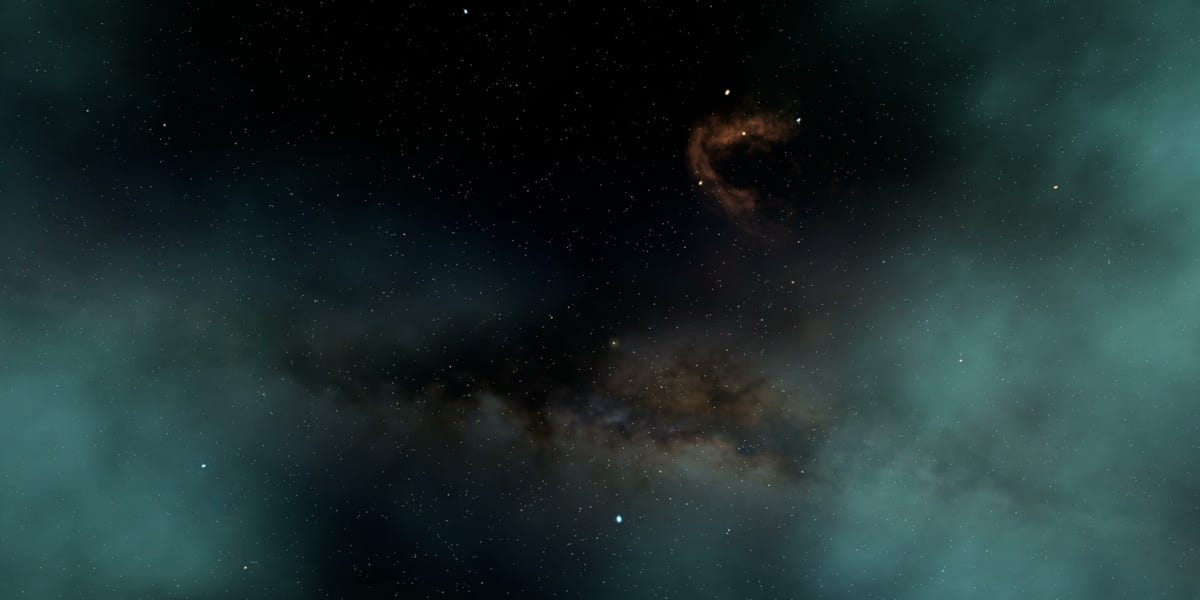

Look around your room. There is probably too much stuff: a cup you forgot to wash, a cable that belongs to a device you no longer own, and at least one mystery object that has been “temporarily” sitting there since 2021. Now look up at the universe, and suddenly your room seems outrageously crowded. On cosmic scales, the universe is not packed like a storage unit. It is more like an enormous sponge, with galaxies gathered along bright threads and walls while gigantic regions between them remain almost empty.
That emptiness has a name: the cosmic void. These voids are not science-fiction portals, supernatural holes, or places where physics went on vacation. They are vast low-density regions between galaxy clusters and filaments. They contain some matter, faint gas, dark matter, and perhaps lonely galaxies, but compared with the glittering cosmic web around them, they are stunningly underpopulated. Even more fascinating, these voids are growing as the universe expandsand on the largest scales, that expansion is accelerating.
The title may sound dramatic, but the core idea is real: most of the universe, by volume, is dominated by space that is extremely empty. The galaxies we admire are not spread evenly like sprinkles on a cupcake. They are arranged in a web-like pattern, leaving huge cosmic bubbles between them. As time passes, matter keeps gathering into denser regions while the emptier regions stretch, widen, and become more isolated. In other words, the universe is not simply getting bigger; its emptiest neighborhoods are becoming even emptier.
What Does “Void” Mean in Astronomy?
In everyday language, a void means nothing. In astronomy, it means “almost nothing,” which is a very important difference. A cosmic void is a huge region of space with far fewer galaxies than average. Some voids span tens, hundreds, or even more than a billion light-years. They are not perfectly empty boxes. They may contain thin gas, dark matter, radiation, and a few scattered galaxies, but compared with galaxy clusters, they look like the universe forgot to finish decorating.
A helpful way to picture it is to imagine soap bubbles in a sink. The shiny surfaces of the bubbles are where galaxies, groups, clusters, and superclusters tend to gather. The hollow interiors are the voids. Astronomers call the full pattern the cosmic web. It includes dense nodes, long filaments, broad walls, and empty spaces. The Milky Way, our home galaxy, is not floating in a random cosmic soup. It sits within this larger architecture, shaped by gravity over billions of years.
The Cosmic Web: Why Galaxies Form Threads Instead of Filling Space
The early universe was much smoother than it is today, but it was not perfectly smooth. Tiny differences in density existed from the beginning. Some regions had slightly more matter, while others had slightly less. Gravity amplified those differences. Matter in denser areas attracted more matter, gradually building galaxy clusters and long filaments. Meanwhile, lower-density areas lost matter to their denser surroundings and became the voids we observe today.
This is why the universe looks organized on the largest scales. It is not a random glitter explosion. It is a structure built by gravity, cosmic expansion, dark matter, and time. Dark matter, which does not emit light but exerts gravity, helped shape the scaffolding of the cosmic web. Ordinary matterthe stuff that makes stars, planets, coffee, and people who forget their passwordsfollowed that gravitational framework and formed galaxies.
When astronomers map millions of galaxies in three dimensions, they see this pattern clearly. Galaxies line up along vast filaments, bunch into clusters, and leave immense underdense regions between them. Those voids are not rare mistakes. They are a major feature of the universe’s design.
Most of the Universe Is Empty by Volume
One of the strangest facts in cosmology is that the bright, exciting objects we talk about moststars, planets, galaxies, nebulae, black holesoccupy only a tiny fraction of cosmic volume. They are visually spectacular but spatially modest. The universe is mostly space. Even atoms are mostly space, which means reality has a recurring theme: it enjoys emptiness with great enthusiasm.
Cosmic voids are the extreme version of this idea. They occupy much of the volume of the observable universe, while galaxies and clusters concentrate along the cosmic web. If you could shrink the universe into a walkable museum exhibit, the galaxies would not be evenly placed like lamps in a hallway. They would form tangled glowing strands around vast dark rooms. Most of your walking would be through the rooms, not along the strands.
This does not mean the universe is boring. Quite the opposite. Voids are scientifically valuable because they reveal how cosmic structure grows, how gravity behaves on immense scales, and how dark energy may influence the fate of everything. Emptiness, it turns out, is not empty of meaning.
Why Are Cosmic Voids Growing?
Cosmic voids grow for two main reasons: gravity pulls matter out of low-density regions, and the expansion of the universe stretches space itself. These two processes work together like a cosmic cleaning crew with an unlimited budget.
Gravity Moves Matter Toward Denser Regions
Gravity does not pull equally in every direction inside a void. Matter near the edges of a void is more strongly attracted toward the surrounding filaments, walls, and clusters. Over billions of years, galaxies and gas tend to flow away from emptier regions and toward denser structures. As a result, voids become less crowded, while the cosmic web becomes more defined.
This is not a sudden evacuation. No galaxy wakes up one morning and says, “I’m moving to a filament for better schools.” It is a slow gravitational drift across cosmic time. But given billions of years, even slow changes become monumental.
The Universe Itself Is Expanding
On top of gravitational structure formation, the universe is expanding. Distant galaxies are not generally flying through space like rockets from a central explosion. Instead, space between large-scale structures is stretching. The farther away a galaxy is, the more expansion affects the distance between us and it.
Voids are especially important in this picture because they contain less matter to resist expansion through gravity. Dense regions, such as galaxy clusters, can remain gravitationally bound. Voids, however, are underdense and can expand more freely. In a simple sense, dense regions hold together while empty regions do the stretching.
Dark Energy Accelerates the Expansion
The biggest reason the phrase “growing fast” belongs in this discussion is dark energy. Observations show that the expansion of the universe is accelerating. Scientists use the term dark energy for the mysterious influence associated with that acceleration. It appears to make up most of the universe’s total energy budget, while ordinary visible matter makes up only a small percentage.
Dark energy does not push galaxies around like wind. It is not a cosmic hair dryer. Its effect appears on the largest scales, changing how the expansion of space evolves over time. Because voids are the emptiest large regions, they are natural places to study how expansion behaves when matter’s gravitational grip is weakest.
How Fast Is the Void Growing?
The phrase “fast” needs careful handling. Cosmic voids do not expand like balloons inside a room. There is no outer wall of the universe pressing outward into a larger warehouse. Instead, distances between large-scale structures increase as space expands. Over billions of years, this makes voids larger and emptier in a relative sense.
For small, gravitationally bound systems like Earth, the solar system, or the Milky Way, cosmic expansion is not tearing things apart. Your desk is not expanding because of dark energy, although it may appear to be expanding if you keep adding notebooks. Gravity, electromagnetism, and other local forces easily dominate at small scales.
On the largest scales, however, expansion matters enormously. A void that spans hundreds of millions of light-years is not controlled by a single gravitationally bound object. Its size and evolution reflect the balance between matter, gravity, and dark energy. As the universe ages, many distant galaxies will become harder or impossible to observe because expansion carries them beyond our cosmic horizon. The night sky of the far future may look lonelier, even if the universe still contains countless galaxies.
The Boötes Void: A Famous Example of Cosmic Emptiness
One of the best-known cosmic voids is the Boötes Void, sometimes nicknamed the Great Nothing. It lies in the direction of the constellation Boötes and stretches across hundreds of millions of light-years. Only a small number of galaxies have been identified inside it compared with what astronomers would expect in a similarly sized region of average density.
The Boötes Void is not the largest possible void, and it is not a hole in space. Still, it is a powerful example of how unevenly matter is distributed across the cosmos. If the Milky Way were placed near the center of a large void, our view of the universe might have developed very differently. Early astronomers could have looked out and seen far fewer nearby galaxies, perhaps delaying the realization that the universe contains vast structures beyond our own galactic neighborhood.
That thought is humbling. Our cosmic address influences what we can easily discover. We are not just observers of the universe; we are observers from a particular neighborhood within it.
What Recent Universe Maps Are Teaching Us
Modern astronomy has entered the age of enormous sky surveys. Instruments such as the Dark Energy Spectroscopic Instrument, known as DESI, are mapping millions of galaxies and quasars in three dimensions. These maps are not just pretty cosmic pointillism. They help scientists measure how the universe expanded across billions of years.
One key method involves baryon acoustic oscillations, often described as ancient sound-wave patterns from the early universe. These patterns left a measurable imprint in the distribution of galaxies. By studying that imprint at different cosmic times, astronomers can track the expansion history of the universe and test whether dark energy behaves like a constant or changes over time.
Recent results have strengthened interest in the possibility that dark energy may not be perfectly constant. This does not mean the standard model of cosmology has collapsed. Science is not a movie villain’s bridge; it does not explode every time new data arrives. Instead, the data give researchers sharper questions. Is dark energy truly constant? Could it evolve? How does cosmic structure respond? What role do voids play in measuring expansion accurately?
Are Voids Truly Empty?
No. Cosmic voids are empty only compared with denser regions of the universe. They may contain isolated galaxies, diffuse gas, dark matter, neutrinos, radiation, and possibly other components we do not yet understand well. Calling them empty is useful, but only if we remember that astronomy grades on a cosmic curve.
A single galaxy inside a void may still contain hundreds of billions of stars. From a human perspective, that is not empty at all. From the perspective of large-scale cosmology, however, it is practically a lonely porch light in a desert the size of imagination.
This distinction matters because void galaxies can help scientists study galaxy evolution in unusual environments. A galaxy in a crowded cluster experiences frequent interactions, gravitational harassment, and gas stripping. A galaxy in a void may evolve more quietly. Comparing galaxies in voids with galaxies in dense regions helps astronomers understand how environment shapes cosmic history.
Does the Growing Void Mean the Universe Is Dying?
The growing emptiness of the universe points toward a long-term future that may feel emotionally chilly. If cosmic expansion continues accelerating, distant galaxies will slip farther away. Over extremely long timescales, future observers in our local group of galaxies may see a much darker and less populated sky. The cosmic web beyond our gravitational neighborhood could become unreachable and eventually unobservable.
But “dying” is a human word, and the universe does not seem worried about our vocabulary. The growth of voids is not an emergency. It is not a countdown clock for Earth. It is a large-scale feature of cosmic evolution. Stars will still form for a very long time. Galaxies will still merge. Black holes will still do black-hole things, which mostly involve being mysterious and having excellent public relations.
The deeper truth is not that the universe is dying tomorrow. It is that the universe changes. Its structure has evolved from a hot, dense early state into a vast cosmic web, and it will keep evolving. Voids are part of that story, not a glitch in the software.
Why Cosmic Voids Matter
Voids matter because they are clean laboratories for cosmology. In dense regions, gravity, gas physics, star formation, black holes, and galaxy interactions create a complicated mess. Voids are simpler. Their low density makes them useful for studying dark energy, cosmic expansion, gravity, and the overall geometry of the universe.
They also help scientists test whether the universe is homogeneous on the largest scales. The standard cosmological model assumes that, when viewed broadly enough, the universe looks statistically similar in all directions and locations. Voids and filaments are local texture within that larger pattern. Mapping them carefully helps researchers check whether that assumption holds and where new physics might be hiding.
In short, the emptiest places in the universe may answer some of the biggest questions in science. That is wonderfully ironic. Humanity built telescopes to study stars, then discovered that the spaces between the stars may be just as important.
Experiences Related to the Topic: Feeling the Void Without Leaving Earth
You do not need a spaceship to experience the emotional weight of cosmic emptiness. You only need a clear night, a dark sky, and a few quiet minutes away from the glow of streetlights. At first, the sky looks full. Stars appear everywhere, sprinkled across the blackness like sugar on velvet. But the longer you stare, the more you realize that what you are seeing is not fullness. It is contrast. The stars shine because the space around them is overwhelmingly dark.
That experience can change how you think about scale. When you look at the Milky Way from a truly dark location, it appears as a glowing river. It feels crowded, alive, and close enough to touch. Yet even inside our galaxy, stars are separated by enormous distances. The nearest star system to the Sun is more than four light-years away. That means light itself, the fastest messenger in the universe, takes years to cross what looks like a small gap on a sky chart. Now expand that idea from stars to galaxies, and then from galaxies to cosmic voids, and the mind starts making a polite grinding noise.
Another everyday experience that helps explain void growth is watching foam in a sink or bubbles in a glass. The material gathers along the edges, while the centers remain mostly empty. The cosmic web is not exactly soap foam, of course, because gravity and dark matter are doing the work instead of dish soap and air. Still, the visual metaphor works beautifully. Matter outlines the structure; emptiness fills the volume.
There is also a philosophical experience hidden in this topic. Humans often measure importance by brightness, noise, and activity. Cities seem important because they glow. Social media seems important because it never stops shouting. But the universe quietly argues for another view. The voids are silent, dim, and nearly empty, yet they shape the largest architecture we know. They influence how galaxies cluster, how expansion is measured, and how cosmologists imagine the future.
Thinking about cosmic voids can even make ordinary life feel sharper. A warm kitchen light, a conversation with a friend, a dog barking at absolutely nothingthese small events happen in a universe where most places are unimaginably empty. That does not make life insignificant. It makes it astonishingly specific. Every crowded dinner table, every classroom, every laugh in a hallway is a tiny rebellion against the cosmic default setting of emptiness.
The growing void also teaches patience. Cosmic change is slow beyond human instinct. A lifetime is barely a blink in the history of a galaxy. Yet the universe is moving, stretching, thinning, and rearranging itself. The empty spaces are growing, not with drama, but with persistence. It is a reminder that not all powerful changes are loud. Some are so vast that they appear still until we learn how to measure them.
Conclusion: The Universe Is a Web Wrapped Around Emptiness
Most of the universe is not filled with stars, planets, or galaxies. It is filled with spaceimmense, quiet, expanding space. Cosmic voids are the great low-density regions between the filaments of the cosmic web, and they are essential to understanding how the universe evolved and where it may be going.
The growth of the void is not a cosmic disaster movie. It is a natural result of gravity, structure formation, and accelerated expansion. Matter gathers where matter already exists, while underdense regions stretch and become more pronounced. Dark energy adds a profound mystery to this picture, pushing cosmologists to ask whether the universe’s acceleration is constant, changing, or something even stranger.
In the end, the universe is not best understood as a collection of objects. It is a relationship between objects and the spaces between them. Galaxies make the universe visible, but voids reveal its scale. The emptiness is not the absence of a story. It is one of the main characters.
SEO Tags