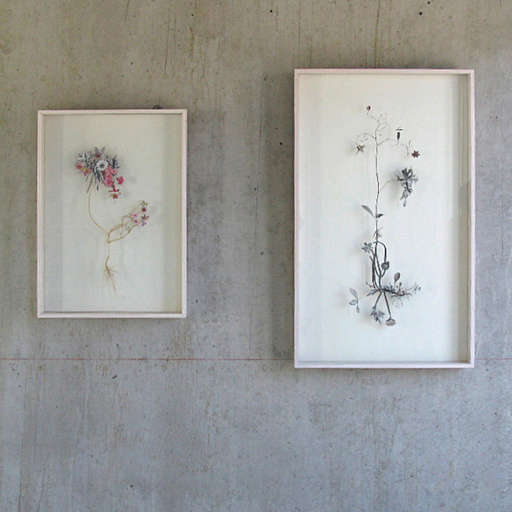

Some artists paint flowers. Some photograph them. Some arrange them in a vase and hope nobody’s cat stages a surprise attack before the photo is taken. Anne ten Donkelaar does something stranger, smarter, and far more memorable: she builds floral worlds that hover between botany, collage, sculpture, and dream. Her Flower Constructions are not simple pressed-flower crafts, and they are definitely not polite little arrangements that sit quietly in the corner. They are intricate, three-dimensional compositions made from real pressed plant material and cutout flower imagery, carefully elevated with pins so the whole piece seems to float.
That floating quality is the hook. At first glance, these works can look like fantastical bouquets caught in midair. Step closer, though, and the illusion opens up. You start seeing clipped petals from old books, wiry stems, fragile roots, dried leaves, and tiny shadows cast by the spacing of each element. The work moves from “pretty” to “how on earth did she make that?” in about three seconds flat. That shift matters, because Anne ten Donkelaar’s floral art is not just about beauty. It is about structure, fragility, memory, collecting, and the quiet drama of turning overlooked natural scraps into something almost cosmic.
In an age of mass-produced wall art and machine-made botanical prints, Flower Constructions feel wonderfully stubborn. They insist on handwork. They insist on slowness. They insist that roots matter as much as blossoms and that weeds deserve a promotion from background extra to leading role. The result is a body of work that feels both antique and modern, delicate and engineered, scientific and magical. If that sounds like a contradiction, good. Contradiction is part of the charm.
What Exactly Are Flower Constructions?
Anne ten Donkelaar’s Flower Constructions began in 2011, and the title suits them perfectly. These works are constructed, not merely composed. Each one is built from layers of pressed flowers, dried stems, roots, leaves, and clipped flower images, with every element mounted at a carefully chosen height. Instead of flattening nature into a tidy decorative panel, she gives it depth again. The flowers do not simply sit on a surface; they hover above it, creating tiny shadows and a subtle sense of movement.
That is why the series lands somewhere between collage and assemblage. A collage usually stays on one plane. An assemblage steps into space. Anne’s work borrows from both traditions, but it also feels connected to the world of herbaria, those carefully preserved collections of botanical specimens. The difference is that her version is not trying to catalog nature with scientific restraint. It is trying to reimagine it. The pieces often resemble impossible gardens, imagined ecosystems, or floral constellations that could only exist once the rules of ordinary horticulture have been gently ignored.
And that is where the series becomes so compelling. She is not documenting flowers as they are. She is building a second life for them. In her hands, a stem is not finished when it dries. A clipped image is not flat information. A root is not debris. Everything becomes a building block in a new visual language.
The Artist Behind the Work
Anne ten Donkelaar was born in 1979 and graduated in 2007 in 3D Product Design from the Utrecht School of the Arts. That training helps explain why her work feels so spatially intelligent. Even when she is using the lightest materials imaginable, she thinks like a builder. She understands how distance changes perception, how depth creates tension, and how structure can support delicacy instead of overpowering it.
Her artistic imagination also comes from collecting. She has described being drawn to damaged butterflies, odd weeds, broken twigs, and other fragile finds that many people would walk past without a second glance. That instinct runs straight through Flower Constructions. The work is full of respect for the overlooked. Nothing feels random, even when the compositions appear wild. You get the sense that she sees every scrap of natural material as a character with a backstory.
Studio details make the work even more fascinating. She presses long stems, organizes cutout images by color, and builds compositions with the patience of someone who knows rushing would ruin the spell. This is not “glue a daisy to cardstock and call it art” territory. This is precision work disguised as poetry.
Why the Work Feels Both Scientific and Surreal
The herbarium side
One of the most interesting things about Anne ten Donkelaar’s flower art is how it borrows the visual authority of botanical study. The pinned elements, the preserved specimens, the careful isolation of roots and stems, and the framing behind glass all hint at archival methods. That connection gives the work a sense of seriousness. It feels researched, observed, and collected. You are not just looking at decoration; you are looking at an invented specimen world.
That is part of why the phrase “imaginary herbarium” fits so well. Her pieces echo the logic of preservation while refusing to stay factual. They borrow the language of science and then wander off into fantasy with it. The result is wonderfully destabilizing in the best way. Your brain keeps trying to decide whether you are looking at evidence, memory, or dream material. The correct answer is probably: yes.
The dream side
Anne ten Donkelaar’s own concept for the series pushes it even further from straight botanical art. She has described the project in terms of seeds exploding into space and new flower planets evolving in unknown worlds. That cosmic frame changes how you read the work. Suddenly the empty space around each stem matters. The gaps stop looking like blank background and start feeling like atmosphere. The compositions become less like bouquets and more like suspended ecosystems, drifting just out of reach.
This is also why the pieces feel narrative. They do not just show flowers; they imply worlds. Each construction suggests a before and after. Something has bloomed, drifted, collided, survived, or transformed. The works invite storytelling without pinning viewers to a single interpretation. That openness is a huge part of their appeal. They are specific in material but expansive in meaning.
Materials, Technique, and the Quiet Drama of Pins
The more you look at Anne ten Donkelaar’s Flower Constructions, the more the technique starts to matter. Pins may sound humble, but here they are the secret engine of the whole series. They create depth, cast shadows, separate layers, and keep the work from collapsing into flatness. They also introduce a faint tension. Flowers are soft, fleeting, and vulnerable. Pins are sharp, exact, and structural. Bringing the two together creates a subtle push-pull between tenderness and control.
Her use of roots is especially telling. Many floral images focus on blossoms because blossoms are the extroverts of the plant world. Anne ten Donkelaar refuses that shortcut. She often includes the entire plant form, and that choice makes the work feel more complete, more honest, and oddly more human. A flower with roots has history. It has weight. It has a hidden life. Remove the roots, and the piece becomes decorative. Keep them, and the piece becomes alive with implication.
The paper cutouts matter just as much. They create moments of visual uncertainty, where the viewer cannot easily tell what is real and what is reproduced. That confusion is not a gimmick. It is central to the experience. It reminds us that representation and reality have always been intertwined in botanical art, from herbaria to illustrations to contemporary collage. Anne just makes that relationship visible, playful, and a little uncanny.
Why These Floral Collages Resonate Right Now
There is a reason Anne ten Donkelaar’s work travels so well between art audiences, garden lovers, design readers, and people who usually claim they are “not really into floral stuff.” Her work taps into several modern cravings at once. First, it offers tactility in a screen-heavy culture. You can almost feel the dryness of the stems, the crispness of the paper, and the tiny rise of each pinned layer. Second, it offers slowness. These pieces are built in a way that makes haste impossible, and viewers can sense that immediately.
Third, the work satisfies the current appetite for nature brought indoors, but it does so without becoming generic organic decor. Dried flowers and pressed botanicals have become popular again in interiors because they soften a space and preserve seasonal beauty. Anne ten Donkelaar’s work shares that appeal, but with far more imagination and rigor. Her pieces do not simply preserve flowers. They reinvent what floral art can be on a wall.
That may be why the work feels equally at home in galleries, design publications, and institutional collections. Two of her Flower Construction works are held in the UT Southwestern art collection, which says something useful about their presence. These pieces can be intricate without being noisy, delicate without being weak, and imaginative without losing formal control. They bring nature indoors, yes, but they also bring thoughtfulness indoors, which is much rarer and frankly much harder to dust.
Connections to Art History Without Feeling Stuffy About It
Anne ten Donkelaar’s work rewards comparison, but it does not need to lean on art history as a crutch. You can see echoes of cutout traditions in the way she builds form through selection and silhouette. You can see affinities with assemblage in her use of found materials and spatial layering. You can even sense a kinship with botanical illustration in the close attention to plant anatomy. Still, the work never feels borrowed. It feels translated.
That is an important distinction. Plenty of contemporary floral art stops at homage. Anne’s work goes further by combining visual traditions that do not always share the same room. She merges botanical order with surreal possibility, domestic craft associations with contemporary art scale, and scientific preservation with theatrical staging. The result is neither nostalgic nor aggressively avant-garde. It occupies a more interesting middle space: deeply made, visually inviting, and conceptually richer than it first appears.
And yes, there is a lesson here for anyone who still treats floral imagery as lightweight. Flowers are not fluff in Anne ten Donkelaar’s hands. They are structure, metaphor, memory, and material evidence of time passing. That is not soft art. That is stealthy art.
How to Really Look at Flower Constructions
If you are viewing one of these works, the best strategy is simple: do not rush. Start from a distance and let the overall composition register as a garden-like whole. Then move closer and watch the image break apart into components. Look for the point where a real stem meets a printed petal. Notice how shadows act like drawn lines. Follow the roots. Pay attention to the empty space. In Anne ten Donkelaar’s work, the air around the flowers is doing real labor.
That shift in looking is part of the pleasure. You begin with beauty and end with construction. You begin with image and end with object. You begin with “flowers” and end with a deeper awareness of how flowers are seen, preserved, collected, and imagined. The work teaches you how to look at it while you are looking at it. That is a neat trick, and not many artists pull it off without showing off.
What It Feels Like to Experience Anne ten Donkelaar’s Flower Constructions
Encountering Anne ten Donkelaar’s Flower Constructions is not the same as scrolling past an image of them online, even if the photographs are excellent. On a screen, you admire the composition. In person, you feel the tension between fragility and engineering. The works have a physical hush to them. They do not shout for attention, but they absolutely know how to keep it once they have it.
The first experience is usually surprise. From a few steps away, the pieces can read like fantastical pressed-botanical arrangements, almost polite in their beauty. Then you move closer and realize the flowers are not sitting flat. They hover. Stems rise off the backing. Tiny shadows flicker behind petals. Roots extend like fine handwriting. The whole work starts behaving less like a picture and more like a suspended habitat. That moment is delightful because your eyes have to renegotiate what they are seeing. It is like finding out a quiet person at dinner is actually the funniest one at the table.
The second experience is intimacy. These works ask for close looking, and they reward it generously. You notice the imperfect edge of a clipped paper bloom. You see where a dried stem curves in a way no illustrator would invent because real nature is always a little stranger than design. You become aware of how much patience went into every placement. There is no visual laziness here. Every component seems chosen, tested, and allowed into the composition for a reason. That kind of attention changes the way you stand in front of the work. You slow down. You breathe differently. You stop scanning and start studying.
There is also something emotional about the materials themselves. Pressed flowers already carry associations with memory, keepsakes, seasons, and the wish to preserve something that would otherwise disappear. Anne ten Donkelaar taps into that emotional history without getting sentimental. The pieces do not feel sugary or precious. They feel tender, which is harder to achieve and much more interesting. Even the damaged or dried elements are not presented as failures. They are part of the beauty. That can be unexpectedly moving. You come away feeling that the work understands something about survival, not in a loud heroic sense, but in a quiet, stubborn, stay-interesting-even-while-fragile sense.
And then there is the aftereffect. Long after you stop looking, the work tends to linger in your mind. You start noticing weeds on the sidewalk. Seed heads become sculptural. A torn petal on a flower no longer reads as ruined; it reads as specific. That may be one of Anne ten Donkelaar’s greatest strengths. Her art does not just transform flowers into objects. It transforms the viewer’s attention. It makes the overlooked feel charged again. It makes the ordinary plant world seem full of characters waiting for their cue. Not bad for a medium that some people still dismiss as “just floral.”
Conclusion
Anne ten Donkelaar’s Flower Constructions succeed because they are more than botanical collage, more than floral decor, and more than a clever mixed-media idea. They are acts of reassembly that turn fragile matter into lasting presence. By combining pressed flowers, roots, cut paper imagery, and precise spatial construction, she creates works that feel at once archival and alive. They speak to anyone interested in contemporary botanical art, floral collage, assemblage, or simply the pleasure of seeing nature handled with intelligence and wonder.
What makes the series memorable is not just its beauty, though beauty is certainly doing its job. It is the way Anne ten Donkelaar builds an entire philosophy out of small materials: collect carefully, look closely, honor fragility, and leave room for imagination. In a culture that often prefers speed, flatness, and instant readability, her work offers the opposite. It asks us to linger. It asks us to notice. And it proves that flowers, when placed in the right hands, can still surprise us.