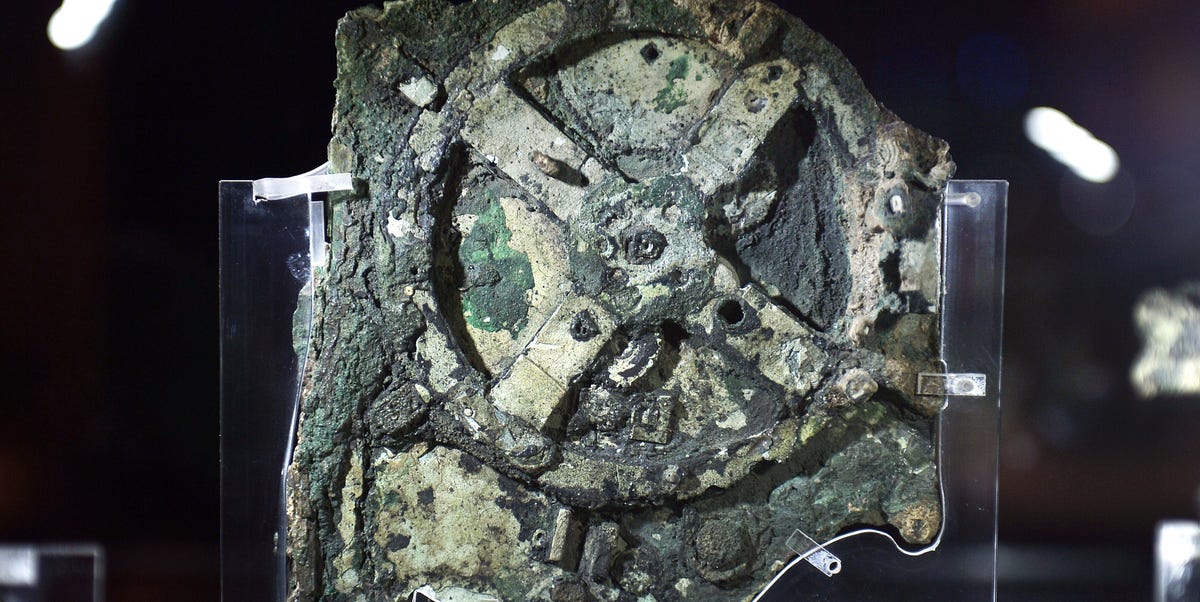

Editorial note: The famous device in this story is usually called the Antikythera mechanism. It was not truly “Roman-made” in the modern scholarly sense; it is widely understood as a Hellenistic Greek invention recovered from a Roman-era shipwreck. The title reflects the popular phrasing often used online, while the article explains the facts clearly.
The Ancient “Computer” That Should Not Have ExistedBut Did
Imagine opening a lump of sea-corroded bronze and discovering not a coin, not a sword, not a decorative trinket, but a miniature universe with gears. That is the basic shock of the Antikythera mechanism, often described as the world’s oldest known analog computer. Found in 1901 among the remains of a shipwreck near the Greek island of Antikythera, this mysterious machine has spent more than a century making scientists, historians, engineers, and curious readers lean forward and say, “Waitancient people built that?”
The short answer is yes. The longer answer is even better: the device was a hand-powered astronomical calculator that could model celestial cycles, predict eclipses, track calendar systems, and display the motions of the Sun, Moon, and possibly the five planets known in antiquity. In other words, while your modern laptop needs a charger, this ancient computer needed a handle and a brilliant understanding of the heavens.
Recent research has moved scientists closer to solving one of its biggest mysteries: what exactly the front calendar ring counted. A 2024 analysis by University of Glasgow researchers used Bayesian statistics and methods related to gravitational-wave data analysis to estimate the number of holes in the mechanism’s damaged calendar ring. Their conclusion strongly supports the idea that the ring most likely tracked a lunar calendar of about 354 or 355 days, not a 365-day Egyptian-style solar year.
That may sound like a tiny technical detail. But in the world of ancient technology, one missing hole can change the story. It tells us what the maker cared about, how the device was used, and how deeply ancient Greek engineers understood the rhythm of the sky.
What Was the Antikythera Mechanism?
The Antikythera mechanism was a complex geared device made of bronze and originally housed in a wooden case, roughly comparable in spirit to a mantel clock. It was discovered by sponge divers exploring a shipwreck loaded with statues, pottery, jewelry, coins, and luxury goods. The wreck is usually dated to the first century BCE, which is why the object is often connected in popular writing with the Roman world.
But the machine itself reflects the scientific culture of the Hellenistic Greek world. Its inscriptions were written in Greek, and its astronomy was rooted in Greek mathematical models influenced by earlier Babylonian observations. If Rome supplied the ship, Greece supplied the cosmic brain.
Today, the surviving fragments are kept at the National Archaeological Museum in Athens. The mechanism is not complete. It survives in dozens of corroded fragments, and only about a third of the original machine is believed to remain. Yet those fragments include enough gears, inscriptions, and structural clues to reveal something astonishing: the ancient world produced precision engineering far more advanced than scholars once imagined.
Why Scientists Call It the First Analog Computer
Calling the Antikythera mechanism a “computer” does not mean it had apps, Wi-Fi, or a screen that froze during an important meeting. It was an analog computer, meaning it used physical motion to calculate and display information. Instead of digital code, it relied on gear ratios. Instead of pixels, it used pointers, dials, and inscriptions.
Turn a handle, and the gears moved in carefully calculated relationships. Those movements represented astronomical cycles: lunar months, solar years, eclipse cycles, and possibly planetary positions. The machine converted human motion into celestial prediction. That is computing in a wonderfully mechanical form.
The genius of the device lies in its gearwork. The maker did not simply attach wheels randomly and hope Zeus approved. The gears embodied mathematical relationships. Certain wheels corresponded to known cycles such as the Metonic cycle of 235 lunar months over 19 years and the Saros cycle of 223 lunar months used to predict eclipses. This was not gadgetry for gadgetry’s sake. It was astronomy translated into bronze.
The Long Mystery: What Did the Calendar Ring Count?
For decades, researchers knew the mechanism included a calendar ring, but the ring was damaged. Only fragments survived. Beneath the ring were small, regularly spaced holes. The number of original holes mattered because it could show whether the ring represented a solar year, a lunar year, or another calendar scheme.
Earlier interpretations sometimes suggested a 365-day calendar. That would align with an Egyptian civil calendar, which was known in the ancient Mediterranean. Other researchers suspected a lunar calendar, closer to Greek calendrical practice, because Greek civic and religious life often depended on the Moon’s phases.
The trouble was simple: the evidence was broken. Imagine trying to count all the seats in a stadium after most of the stadium has fallen into the sea. You can measure what remains, estimate the curve, and compare patternsbut certainty is difficult.
How Modern Science Helped Solve the Ancient Puzzle
The 2024 Glasgow study approached the damaged calendar ring with statistical tools. Professor Graham Woan and Joseph Bayley analyzed measurements of the surviving holes and fragments to estimate how many holes the full ring originally contained. Their work suggested that a ring of 354 or 355 holes was far more likely than a 365-hole design.
That finding supports the view that the Antikythera mechanism’s calendar ring followed a lunar year. A lunar year of 12 lunar months is about 354 days, which fits ancient Greek calendar traditions more naturally than a 365-day solar calendar.
Here is the delightful twist: techniques developed for studying the modern universe helped decode a machine built to study the ancient universe. Researchers used methods related to gravitational-wave analysisthe kind of math used to interpret ripples in spacetimeto understand a bronze device that once helped people track the Moon. It is a scientific handshake across more than 2,000 years.
The UCL Breakthrough: Rebuilding the Mechanical Cosmos
The calendar ring was not the only puzzle. In 2021, a team at University College London proposed a detailed model for the front display of the Antikythera mechanism. Their research tackled one of the hardest questions: how could the device have shown the ancient Greek cosmos on its front face?
Only the back of the mechanism had been relatively well understood through earlier imaging work. The front remained more mysterious because so much of it was missing. Using inscriptions, surviving gear evidence, and known ancient astronomical cycles, the UCL team developed a model that could display the Sun, Moon, and the five planets known to the Greeks: Mercury, Venus, Mars, Jupiter, and Saturn.
This model does not mean every uncertainty has vanished. The Antikythera mechanism remains partly reconstructed through evidence-based interpretation. But the UCL work showed that the surviving clues can be arranged into a mechanically plausible system, one that fits the inscriptions and the astronomical knowledge of the time.
What the Machine Could Predict
Solar and Lunar Eclipses
One of the most impressive functions of the Antikythera mechanism was eclipse prediction. The device used the Saros cycle, a period of about 18 years, 11 days, and 8 hours, after which eclipses repeat in a similar pattern. On the mechanism’s back, a spiral dial helped track this cycle. Inscriptions likely indicated eclipse type, timing, and other details.
For ancient observers, eclipses were not casual sky events. They could be politically frightening, religiously significant, and scientifically fascinating. A machine that helped forecast them would have been a serious intellectual instrumentand probably a fantastic conversation starter at elite dinner parties.
The Moon’s Irregular Motion
The Moon does not move across the sky at a perfectly constant apparent speed. Ancient astronomers knew this, and the Antikythera mechanism appears to have modeled aspects of the Moon’s variable motion with remarkable ingenuity. Some reconstructions show a pin-and-slot system that could represent lunar anomaly, meaning the Moon’s changing speed in its orbit.
That is not “rough guess” engineering. That is subtle mathematical astronomy packed into a device small enough to sit in a wooden box.
Calendars and Games
The mechanism also seems to have tracked calendrical cycles, including the four-year cycle associated with Panhellenic games. That means it was not only a sky calculator but also a cultural calendar. It linked astronomy to civic time, religious life, and major public events.
In modern terms, it was part planetarium, part calendar app, part eclipse predictor, and part prestige object. Not bad for something built before electricity, batteries, or the phrase “software update.”
Why the Roman Empire Connection Is Complicated
The popular headline “first computer from the Roman Empire” is catchy, but it needs context. The shipwreck in which the device was found is often described as Roman-era, and the cargo may have been moving luxury goods through a Mediterranean trade network heavily shaped by Roman power. However, the scientific and linguistic evidence points strongly to a Greek origin for the mechanism itself.
The date of the device is still debated, with estimates often placing it between the second and first centuries BCE. That period overlaps with Rome’s expanding influence in the eastern Mediterranean, but the technology belongs to the Hellenistic world of Greek astronomy, mathematics, and mechanical craft.
So the fairest description is this: the Antikythera mechanism is an ancient Greek analog computer found in a Roman-era shipwreck. That phrasing may be less dramatic than “Roman computer,” but it is more accurateand honestly, the truth is dramatic enough without dressing it in a toga.
What the Discovery Reveals About Ancient Science
The Antikythera mechanism forces us to revise the lazy idea that ancient technology was simple. Yes, ancient people lacked modern electronics, but they did not lack intelligence, observation, mathematics, or craftsmanship. They studied the sky for generations. They recorded cycles. They built models. Then, in at least one extraordinary case, they turned that knowledge into a geared machine.
Before the mechanism was understood, many historians believed such complex gearing did not appear until much later medieval clockwork. The Antikythera mechanism upset that timeline. It suggests there may have been a lost tradition of advanced mechanical engineering in the ancient Mediterranean. The device looks less like a lonely miracle and more like the surviving tip of a vanished technological iceberg.
That is one of the most excitingand slightly heartbreakingparts of the story. If this one machine survived only because it sank into the sea, how many similar devices were melted down, broken, recycled, or lost? Bronze was valuable. A broken astronomical calculator could easily become raw material for something less interesting, such as a bowl. History is full of tragic downgrades.
How Scientists Studied a Corroded Lump of Bronze
The Antikythera mechanism did not reveal its secrets politely. When first recovered, it looked like corroded material rather than a scientific masterpiece. Over time, researchers used radiography, X-ray imaging, computed tomography, surface scanning, and digital modeling to see inside the fragments without destroying them.
These imaging methods uncovered hidden gears and inscriptions. Some inscriptions function almost like labels or an instruction manual, describing cycles and displays. The text helped researchers connect physical gearwork to astronomical meaning.
This combination of archaeology and physics is what makes the story so powerful. A classic archaeologist can read the cultural setting. A historian of science can explain the astronomy. An engineer can evaluate the gear trains. A statistician can estimate the missing holes. A physicist can adapt modern data tools. The mechanism is not solved by one genius in a dusty room; it is solved by teams across disciplines, each adding another flashlight beam to the same dark cave.
Why the Lunar Calendar Finding Matters
The 354/355-hole conclusion matters because it changes how we understand the device’s priorities. A lunar calendar would have been especially useful in Greek religious and civic life, where months often began with the new Moon. It also fits the mechanism’s broader obsession with lunar cycles, including eclipse prediction.
If the calendar ring was lunar, the mechanism was not simply a general-purpose date tracker. It was deeply tuned to the Moon’s role in ancient timekeeping. The Moon was not background decoration. It was a central clock.
The finding also highlights the maker’s precision. Creating hundreds of evenly spaced holes on a small bronze ring required extraordinary skill. Even if we avoid exaggeration, the craftsmanship is jaw-dropping. The device was not only conceptually advanced; it was physically difficult to manufacture.
Was the Mystery Really “Solved”?
Yes and no. Scientists have solved important parts of the Antikythera mechanism mystery, especially regarding its lunar calendar ring and possible front display. But the entire device is not completely known. Missing pieces still leave questions about exact gear arrangements, full planetary displays, original appearance, and workshop origin.
That is not a weakness of the research. It is honest science. The mechanism is more than 2,000 years old, incomplete, corroded, and mechanically complex. Any claim that every question is settled should be treated carefully. The better conclusion is that scientists have solved major pieces of the puzzleand the remaining gaps are now much narrower than before.
Specific Examples of Ancient Genius Inside the Device
Example 1: The Saros Eclipse Dial
The Saros dial shows how ancient astronomers used long-term patterns to predict eclipses. By embedding that cycle into a spiral display, the mechanism turned abstract astronomy into a readable interface. It was like giving the cosmos a dashboard.
Example 2: The Metonic Cycle
The Metonic cycle links 235 lunar months with 19 solar years. This helped reconcile lunar months with the solar year, a major challenge for ancient calendars. The mechanism’s use of this cycle shows mathematical sophistication and practical calendrical awareness.
Example 3: Mechanical Modeling of Lunar Motion
The Moon’s irregular movement was difficult to represent mechanically. The mechanism’s gear systems suggest its makers were not satisfied with a simple average. They wanted a model that reflected real celestial behavior. That ambition makes the device feel unexpectedly modern.
Experiences Related to the Topic: What It Feels Like to Encounter the World’s First Computer
There is a special kind of wonder that happens when history stops behaving like a flat timeline. Most of us are taught, quietly and repeatedly, that technology moves in a straight line: ancient people had simple tools, medieval people had better tools, modern people got electricity, and then everyone started arguing about passwords. The Antikythera mechanism ruins that tidy picture in the best possible way.
Seeing photographs of the fragmentsor better yet, standing before reconstructions of the devicefeels like looking at a message in a bottle from a civilization that was much smarter, stranger, and more technically daring than we often imagine. The corroded bronze does not look flashy. It does not glow. It does not announce itself with a startup sound. Yet once you understand what those gears were doing, the object becomes almost electric.
One meaningful experience connected to the Antikythera mechanism is the shift from seeing ancient artifacts as “old things” to seeing them as “working ideas.” A statue can tell us about beauty. A coin can tell us about power. But a machine tells us about thought in motion. It shows not only what people valued, but how they reasoned. The mechanism reveals a world where astronomy was not merely mythic storytelling; it was measurable, modelable, and mechanical.
Another powerful experience is realizing how much patience scientific discovery requires. The mechanism was pulled from the sea in 1901, but it took generations to understand it. Early observers noticed gears. Later researchers used X-rays. Modern teams applied computed tomography, digital modeling, and statistical inference. The mystery was not solved in a dramatic movie moment with one person shouting, “I’ve got it!” It was solved slowly, through careful measurement, correction, debate, and collaboration.
That slow process is worth appreciating. In an age of instant search results, the Antikythera mechanism reminds us that some truths need time. Some answers hide under corrosion. Some discoveries require a physicist, an archaeologist, an engineer, a classicist, and maybe even a patient hobbyist measuring tiny holes for a reconstruction project.
For readers, the most personal takeaway may be this: intelligence is not limited to our century. The people who built the Antikythera mechanism looked at the same Moon we see today and asked how to understand its motion. They did not have satellites, computers, or high-resolution screens. They had observation, mathematics, metal, tools, and imagination. Somehow, that was enough to build a pocket-sized cosmos.
There is also a humbling lesson for modern innovators. We often assume the newest tool is automatically the greatest tool. But the Antikythera mechanism shows that elegance can matter as much as power. This device did not process billions of calculations per second. It did something more poetic: it made the sky turn in your hand. That experienceof compressing the heavens into gearsis still breathtaking.
Anyone writing, teaching, or thinking about this topic can use it as a reminder that the past is not dead storage. It is a workshop full of unfinished conversations. The Antikythera mechanism invites us to ask better questions: What knowledge have we lost? What technologies disappeared because no one preserved them? Which modern assumptions will future archaeologists laugh at politely?
In that sense, the ancient computer is not only an artifact. It is an experience of intellectual time travel. Not the Hollywood kind with portals and dramatic music, but the quieter kind where a damaged object changes how you see human creativity. The mystery is partly solved, but the wonder remains fully operational.
Conclusion: A Bronze Machine That Rewrote the History of Technology
The Antikythera mechanism is one of the most extraordinary scientific artifacts ever found. Recovered from a Roman-era shipwreck but rooted in Hellenistic Greek science, it demonstrates that ancient engineers could build complex mechanical models of the cosmos more than 2,000 years ago.
Modern research has solved major parts of the mystery. The 2021 UCL model offered a plausible reconstruction of the front display, while the 2024 Glasgow analysis strengthened the case that the calendar ring tracked a lunar year of about 354 or 355 days. Together, these discoveries show that the mechanism was not a simple clock or decorative curiosity. It was a sophisticated astronomical calculator, a mechanical bridge between mathematics, craftsmanship, and the sky.
The best part? The Antikythera mechanism still has secrets. And perhaps that is why it remains so fascinating. It is solved enough to amaze us, but mysterious enough to keep us looking.