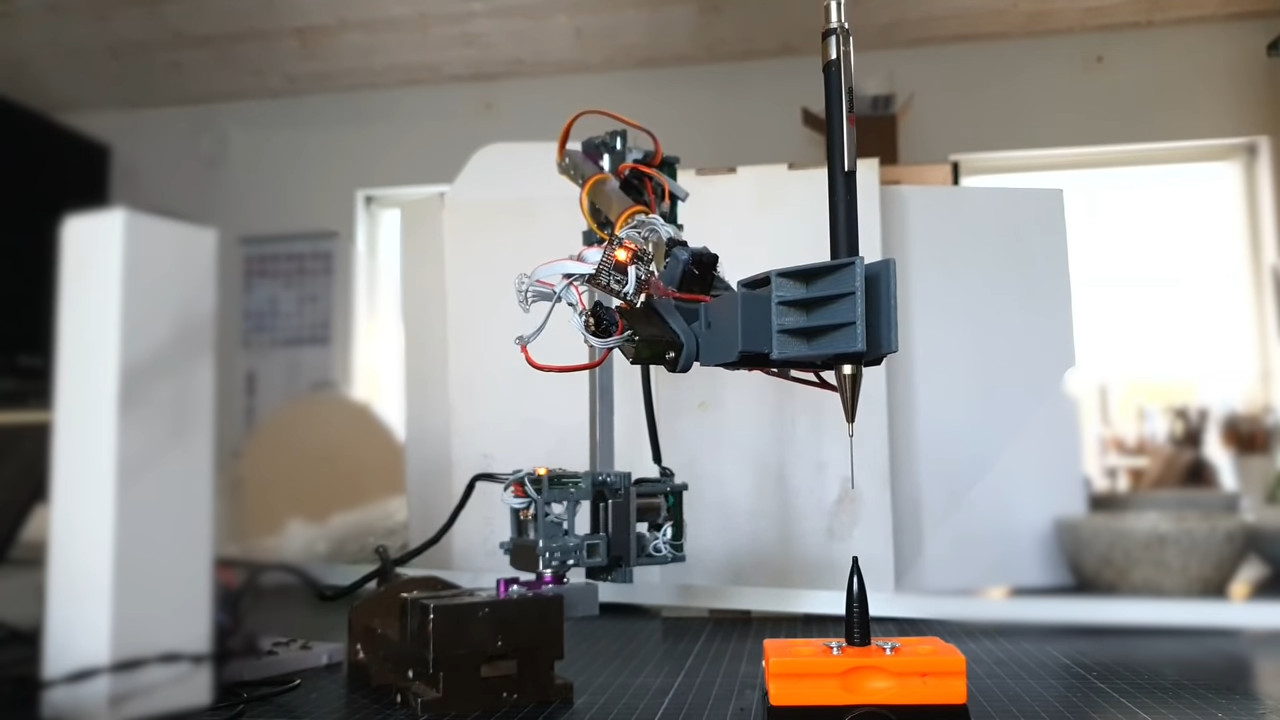

At first glance, a robot arm built with ordinary servos sounds like the engineering equivalent of making a race car out of shopping cart wheels. It might move. It might wave. It might even pick up a marshmallow on a good day. But “amazing accuracy”? That usually sounds like marketing spilled into the workshop.
And yet, that is exactly why this story is so compelling. A clever low-cost robot arm project proved that hobby-grade servos do not have to remain sloppy, jittery little drama queens. With the right feedback, careful calibration, and smarter control software, a servo-driven arm can move with startling smoothness and precision. That does not magically turn it into a six-figure industrial manipulator, but it does show something far more interesting: accuracy is not only about buying expensive hardware. It is also about understanding where error comes from and refusing to let it stay comfortable.
That is the real takeaway behind the phrase Robot Arm Achieves Amazing Accuracy With Just Servos. The word “just” is a bit cheeky. The project may rely on servos as its actuators, but the precision comes from everything wrapped around them: sensing, control loops, compensation, tuning, and calibration. In other words, the servos are the muscles, but the brains finally showed up for work.
Why This Robot Arm Matters
Low-cost robot arms often follow a familiar recipe: 3D-printed parts, off-the-shelf RC servos, simple motion commands, and a lot of hope. Hope, unfortunately, is not a motion-control strategy. Cheap servos can struggle to hold angle, gears can introduce backlash, and small errors at one joint multiply dramatically by the time the tool reaches the end of the arm.
This is what makes the project stand out. Instead of throwing the whole design into the “well, it was a fun prototype” pile, the builder pushed the system in the opposite direction. The arm was upgraded to use additional position sensing and more advanced control logic, allowing it to move far more smoothly than a typical hobby setup. The end result looked less like a toy waving at a science fair and more like a budget robot that suddenly discovered self-respect.
The most memorable demonstration is simple and brilliant: the arm carefully guides a thin pencil lead through the tip of a mechanical pencil without snapping it. That sort of demo is perfect because it reveals precision in a way numbers sometimes fail to do. Anyone can understand how easy it is to break a tiny graphite rod. If a servo arm can thread that needle, it is doing something very right.
The Real Secret: Closed-Loop Control
The phrase “with just servos” can be misleading unless you understand what a servo really is. A servo is already a closed-loop device in a basic sense. It tries to reach a target position and hold it. But many hobby servos do this with limited internal sensing, modest control electronics, and gear trains that introduce mechanical slop. That is fine for steering a model car or opening a Halloween prop coffin lid. It is less fine when you want a robot arm to place a tool exactly where you intended.
The breakthrough comes when you improve the feedback and the controller. In this project, the arm’s servos were enhanced with extra sensing so the system had a better picture of what the motor and the output shaft were actually doing. That distinction matters. If the motor thinks it moved correctly but the gears flexed or lagged, the robot’s end effector does not care about the motor’s feelings. It only cares where the joint actually ended up.
Why Extra Encoders Change Everything
Additional encoders give the controller better truth. A sensor on the output side helps measure the joint angle that really reaches the arm. A sensor closer to the motor reveals fast internal motion and helps the controller respond quickly. Together, these measurements make it possible to estimate and compensate for behavior that cheap servos normally hide behind plastic gears and wishful thinking.
That is a big deal because motion control is a constant argument between command and reality. The software says, “Go here.” The mechanism says, “I tried, but there was backlash, a little overshoot, some friction, and also gravity is rude.” Better sensing lets the controller stop guessing and start correcting.
Backlash: The Tiny Villain With Expensive Consequences
If there is a supervillain in low-cost robot arms, it is backlash. This is the small amount of free play between mechanical parts, especially inside geared systems. When direction changes, the motor may move before the output fully follows. On a single joint, that might seem minor. Across several joints in a multi-axis arm, it becomes a geometric prank with real consequences.
Backlash is especially nasty because it does not just create error. It creates unpredictable error. And unpredictable error is what makes a robot arm look hesitant, twitchy, or suspiciously drunk. Once the controller can detect and compensate for that slack, the whole machine begins to look calmer and more deliberate.
Velocity, Torque, and Settling Time
High-accuracy motion is not only about position. It is also about how a joint approaches the target, how much it overshoots, and how quickly it settles. This is where control tuning matters. A robot arm can technically hit a point and still look terrible doing it if it oscillates, rings, or arrives with the grace of a folding chair thrown down a staircase.
Good servo tuning balances responsiveness and stability. Too aggressive, and the arm overshoots and jitters. Too timid, and it feels mushy and slow. The best motion is boring in the best possible way: the joint moves, settles, and stays where it belongs. In robotics, boring is often a compliment.
Why Accuracy Is Harder Than Repeatability
One of the most important distinctions in robotics is the difference between repeatability and accuracy. Repeatability means the robot can return to the same place again and again. Accuracy means that place is actually the correct one in the real world.
A hobby arm can be reasonably repeatable and still miss the true target because its kinematic model is off, its zero positions drift, or its frame is not calibrated well. That is why serious robot work depends on calibration. If the robot’s internal map of itself is wrong, it can be consistently wrong with tremendous confidence. Which, to be fair, is also how many humans navigate group projects.
Calibration matters at multiple levels. You calibrate sensors. You calibrate joint offsets. You calibrate the relationship between the arm and the world around it. You may even calibrate the relationship between the arm and a camera if vision is involved. A precise arm without calibration is like a talented violinist playing with one string tuned by a haunted thermostat.
How a Servo Arm Gets Surprisingly Precise
So how does a low-cost servo arm claw its way toward impressive precision? Not with one miracle part. With a stack of disciplined improvements.
1. Better Feedback
When the controller can measure output position more directly, it no longer depends on the servo’s internal guesswork alone. That opens the door to tighter control, better fault detection, and more meaningful compensation.
2. Compensation for Mechanical Slop
Every low-cost robot has quirks. Good software learns those quirks and counteracts them. This includes backlash compensation, gravity effects, and the little nonlinear behaviors that show up when real mechanisms leave the whiteboard and enter the physical world.
3. Tighter Motion Tuning
Overshoot, oscillation, and sluggish response can all make a robot inaccurate in practice. Tuning the control loop improves settling time and makes movements look intentional instead of apologetic.
4. Thoughtful Mechanical Design
Even the smartest control algorithm cannot completely rescue a floppy structure. Rigid links, well-supported shafts, clean assembly, and minimized flex all help the software succeed. Precision is a team sport.
5. Calibration, Calibration, Calibration
This deserves repeating because it is the unglamorous hero of robotic accuracy. When a builder takes the time to calibrate joints, offsets, and coordinate relationships, the robot stops living in fantasy land and starts dealing with measurable reality.
Why This Is Such an Exciting Development for Makers
The beauty of this kind of project is not only the result. It is the message. For makers, students, and small labs, industrial-grade robot hardware is often out of reach. But this project suggests that a lot of performance can be unlocked with knowledge instead of only money.
That is huge. It lowers the barrier to experimentation. It gives hobby robotics a path out of the “close enough” swamp. It invites builders to think like motion-control engineers rather than just parts collectors. And it proves that even humble servo hardware can become the foundation for serious learning in sensing, control theory, kinematics, and system integration.
In other words, this is not just a cool robot arm. It is a roadmap for leveling up.
Where a Servo-Driven Precision Arm Could Be Useful
A budget-friendly arm with strong precision and smooth motion could be useful in more places than people assume:
- Desktop pick-and-place experiments for electronics assembly
- Camera or sensor positioning rigs
- Light lab automation tasks
- Educational robotics and control-system demos
- Small-part sorting, probing, and inspection projects
- Research prototypes where fast iteration matters more than industrial certification
No, it is not going to replace a full industrial cell on Monday morning. But it can absolutely close the gap between “maker project” and “real robotic tool” in a way that feels surprisingly practical.
The Limits Still Matter
Let us not pretend physics clocked out for lunch. A servo-based arm still faces real limitations. Gear wear, thermal drift, structural flex, power noise, load variation, communication latency, and long-term durability all matter. A robot that looks glorious in a short demo may still struggle under continuous duty or changing payloads.
That is why the most honest way to interpret this project is not “cheap servos beat industrial robotics.” They do not. The better headline is this: smart control can extract startling performance from modest hardware. That is a far more useful lesson anyway, because it is true, repeatable, and worth applying across all kinds of machines.
Final Thoughts
Robot Arm Achieves Amazing Accuracy With Just Servos is one of those stories that sticks because it hits the sweet spot between ingenuity and practical engineering. It is satisfying on the surface because the demo is impressive. But it is even more satisfying underneath because the result makes sense once you study the ingredients.
Precision did not appear by magic. It came from better sensing, better control, backlash compensation, careful tuning, and a refusal to accept that low-cost hardware had to remain mediocre. That is a lesson worth remembering in robotics and beyond. Sometimes the biggest upgrade is not swapping the whole machine. Sometimes it is finally listening to what the machine has been trying to tell you all along.
And in this case, what it was saying was pretty clear: “I could have been accurate this whole time. You just never asked properly.”
Extra Section: Real-World Experiences and Lessons From Servo Precision Builds
Anyone who has spent time around hobby robot arms knows the emotional arc. Day one is optimism. Day two is assembly. Day three is wondering why the elbow joint seems to have developed a personality disorder. The first real experience most builders have is discovering that motion errors are sneaky. A servo may look accurate when moving one joint by itself, but once multiple joints move together, tiny mistakes stack up. The base is off by a little, the shoulder adds its own opinion, the wrist contributes some flair, and suddenly the end effector is nowhere near the screw, switch, or tiny part you wanted to touch.
That is why one of the most useful experiences in projects like this is learning to stop blaming only the servo. Yes, hobby servos can be inconsistent. But a surprising amount of “bad servo behavior” is really system behavior. Power rails sag. Printed brackets flex. Horns are mounted one tooth off. Cables tug on moving joints. Control updates arrive late. The arm is not inaccurate because of one dramatic failure. It is inaccurate because a dozen small compromises are holding a team meeting inside the mechanism.
Builders who improve accuracy usually report the same turning point: they start measuring instead of guessing. They watch encoder feedback. They compare commanded angles with actual output. They test the same move from different directions to expose backlash. They repeat trajectories until patterns appear. This is the moment a fun gadget becomes an engineering project. Suddenly the robot is not “being weird.” It is giving data.
Another common experience is discovering how much smoothness affects perceived intelligence. A jerky arm looks cheap, even if it lands close to the target. A smooth arm looks capable, even before you measure it with tools. That is why tuning matters so much. When a servo arm glides into position and settles without wobbling, people assume the machine is more advanced than it may actually be. In a way, they are right. Smooth control is a form of competence.
There is also a practical lesson in patience. Precision builds reward boring habits: squaring parts carefully, checking fasteners, calibrating offsets, routing wires cleanly, and testing one change at a time. None of this makes for thrilling montage footage. Nobody gasps when you re-run a homing test twenty times. But those boring steps are exactly where accuracy is earned. The flashy demo at the end is just the public trailer for a very long calibration documentary.
Perhaps the best experience people take from projects like this is confidence. Once you have seen a low-cost servo arm perform delicate, repeatable motion, your view of robotics changes. Expensive hardware still matters, of course, but it no longer feels like the only path to quality. You start to realize that precision is a system property. Good mechanics help. Good sensors help. Good code helps. Good calibration helps. Stack enough of those together, and even modest servos stop acting like disposable hobby parts and start acting like serious components in a thoughtful machine.
That is what makes this topic so compelling. It is not just about one impressive robot arm. It is about the experience of discovering that better engineering can unlock better behavior from hardware you already thought you understood. And that is the kind of lesson that follows builders into every future project they touch.