
Traditional Catan already has a clever trick up its cardboard sleeve: the island changes whenever its hexagonal terrain tiles are rearranged. A fan-made electronic Catan game board pushes that idea much further. Instead of printed cardboard, it uses individual hexagonal modules equipped with round LCD screens, custom circuit boards, magnetic connectors, and their own microcontrollers.
Snap several modules together and they do more than form a colorful island. They exchange data, detect neighboring tiles, help a controller understand the board’s shape, and display assigned resources and production numbers. It is Catan after wandering into an electronics workshop and emerging with a suspicious number of blinking components.
What Is the Modular Electronic Catan Board?
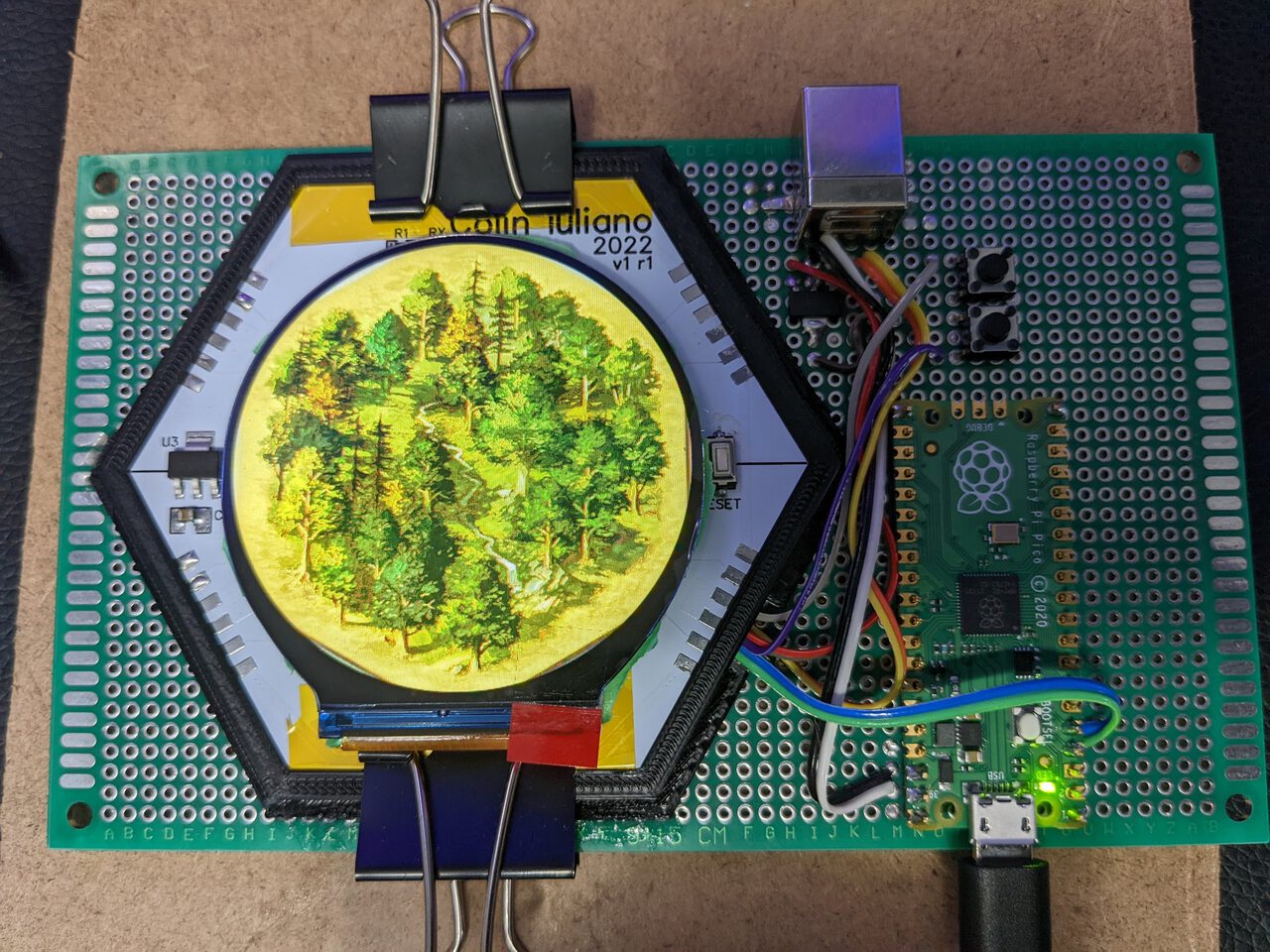
The project was created by hardware tinkerer Colin Iuliano as an experimental collection of electronic hexagonal tiles. Each tile contains a 2.1-inch circular LCD, an RP2040 microcontroller, a custom hexagonal printed circuit board, and six edge connectors. Magnets pull neighboring tiles into alignment, while spring-loaded contacts carry power and data between them.
The result is not a single rigid board with electronics hidden underneath. It is a collection of self-contained modules that can be arranged into different sizes and shapes. The familiar Catan island can be assembled from 19 land hexes, but the same concept could theoretically support larger maps, narrow islands, scattered archipelagos, or entirely different hex-based games.
That distinction is important. Many electronic board-game projects add lights or sensors to one permanent playing surface. This design makes the playing surface itself programmable. Every hex is simultaneously a screen, a network node, a structural component, and a tiny computer.
Why Modularity Matters for Catan
Catan’s replay value depends heavily on its variable map. Terrain tiles and number tokens can be rearranged so that access to brick, lumber, grain, wool, and ore changes from game to game. Players are forced to rethink their opening settlements instead of memorizing one perfect route to victory. Official rules even provide both a beginner layout and a variable setup method.
Loose cardboard hexes have one practical weakness: they can drift apart, rotate, or perform a tiny tectonic event when someone bumps the table. Commercial frames and third-party accessories have long tried to keep modular Catan maps from sliding around. Magnetic electronic tiles address that problem while also making each position digitally reconfigurable.
Each Hex Is an Independent Module
There is no permanent “forest tile” or “mountain tile.” A module becomes whatever image the host controller tells it to display. The same physical hex could show pasture in one game, desert in the next, and an animated ocean during an experimental scenario.
This approach also improves repairability. A conventional electronic board may become unusable when one central display or controller fails. A modular system can potentially continue operating after one damaged tile is removed or replaced. That is one of the strongest engineering arguments for modular design: individual units can be tested, serviced, upgraded, or swapped without rebuilding the entire object.
Magnets Make Assembly Fast
The modules connect through custom magnetic pogo-pin assemblies. Pogo pins are spring-loaded electrical contacts commonly used where components must be connected and disconnected repeatedly. The magnets provide alignment and holding force, while the pins maintain contact for power, ground, and data. Modern pogo-pin systems are valued for compact size and reliable repeated mating, although precise mechanical alignment remains essential.
The creator could not simply purchase one inexpensive connector that met every requirement. A full Catan board needs many connections: six edges per tile and at least 19 tiles for a standard island. The connectors also had to work in either orientation because there is no permanent male side, female side, master tile, or subordinate tile. The solution uses symmetrical contact groups so any compatible edge can meet another.
Inside an Electronic Catan Tile
The RP2040 Does the Heavy Lifting
Every tile contains an RP2040, the dual-core microcontroller introduced with the Raspberry Pi Pico. The chip provides two Arm Cortex-M0+ cores, 264 KB of on-chip SRAM, programmable I/O hardware, and support for external flash storage. Those features made it an unusually capable low-cost choice for a module that had to drive a display while simultaneously managing six communication interfaces.
The project was developed during the 2021–2022 semiconductor shortage, when many familiar microcontrollers were difficult or expensive to obtain. According to the creator, the RP2040 was one of the few affordable options fast enough to drive the selected RGB display. Sometimes engineering brilliance begins with a grand vision; sometimes it begins with “this is the chip that is actually in stock.”
A Round LCD Fits the Hexagonal Design
Each module uses a 2.1-inch, 480-by-480-pixel, 16-bit color LCD. A round screen leaves room around the six corners of the hexagonal enclosure while still providing a large central image. Similar displays offer high pixel density and wide viewing angles, qualities that help terrain art remain readable when players are seated around different sides of the table.
The display is not a simple low-bandwidth SPI panel with its own large framebuffer. It expects a continuous RGB pixel stream. Meanwhile, the RP2040 does not have enough internal memory to store an entire full-color 480-by-480 frame. The firmware therefore streams scanlines from flash and generates the image as the panel is refreshed.
One processor core is largely devoted to producing those scanlines. Background artwork is drawn first, followed by the central production marker and the number displayed above it. RP2040 video projects often dedicate substantial processing and programmable I/O resources to maintaining a steady display signal, so this division of labor is a practical use of the chip’s dual-core architecture.
Custom PCB and Resin Enclosure
The electronics sit on a custom hexagonal PCB designed specifically for the project. Around it is a resin-printed enclosure that positions the display and edge connectors. Custom geometry is unavoidable here: ordinary rectangular development boards would waste space, interfere with neighboring modules, and make the finished island resemble a pile of remote controls.
Digital fabrication has become especially useful for tabletop projects because enclosures, inserts, terrain, and modular tiles can be prototyped without industrial tooling. The electronic Catan board applies the same maker philosophy to a much more demanding object, where every printed piece must align mechanically and electrically.
How the Tiles Discover the Board Layout
Displaying attractive terrain is only half the challenge. The system must determine where each tile sits relative to every other tile. A basic shared bus might reveal that 19 devices are connected, but it would not automatically explain which tile is northwest of the desert or which two modules touch the same edge.
To solve that problem, all six sides of every hex are individually addressable. Each edge forms a direct connection with the neighboring edge it touches. The project calls the resulting structure a position-aware partial mesh or pseudo-mesh network because information can travel through the board while each tile still knows which physical side received it.
A Modified One-Wire Link Connects Neighbors
Communication between adjacent tiles uses a modified One-Wire-style protocol. One-Wire communication normally provides half-duplex, bidirectional data transfer over a single data conductor plus ground. Its small contact requirement makes the general idea attractive when the same connection must be repeated around six compact edges.
In this project, each tile-to-tile connection is half-duplex. The firmware deliberately slows communication enough for the RP2040’s internal pull-up resistors to return a line to its idle state. It is not a textbook implementation copied from a temperature-sensor circuit; it is a project-specific adaptation shaped by limited pins, limited space, and the desire to avoid extra components.
The Host Maps the Island
A separate host device supplies power and initiates configuration. When triggered, it asks its first connected tile for an identifier. It then instructs that tile to check each edge for neighbors. Every discovered tile reports both its identity and the side on which it was found. The host repeats this process until it can reconstruct the connected arrangement in memory.
Messages propagate through a flooding-style broadcast mechanism. A tile checks whether a broadcast is addressed to it; when it is not, the tile relays the message through other interfaces. Managed flooding is also used in established mesh-network designs because it can move messages through multiple possible paths without requiring every node to maintain an elaborate route table. Its drawbacks include duplicated traffic and the risk of broadcast congestion.
Once the host recognizes the full layout, it assigns a terrain type and production number to each module. The creator experimented with an ESP32 host, which could eventually provide Wi-Fi or Bluetooth configuration through a phone, computer, or dedicated control panel.
Why Automatic Board Generation Is Harder Than It Looks
Randomly assigning pictures is easy. Generating a balanced and rules-compliant Catan map is not. The game’s number distribution reflects the probabilities of rolling two dice, with 6 and 8 among the most frequently produced results. In a fully randomized official setup, the red-number tokens must not be placed on adjacent hexes.
A useful electronic generator would therefore need to understand more than colors. It should track terrain quantities, production-number quantities, adjacency, the desert, harbor placement, expansion rules, and optional balancing preferences. A casual family setup might simply avoid neighboring 6 and 8 tiles. A tournament-oriented generator could also evaluate how evenly strong intersections are distributed around the island.
The prototype does not yet perform that complete validation. Its host assigns resources and numbers randomly, so the generated display should be treated as a technical demonstration rather than an automatically legal competitive setup. The creator identified proper board generation as one of the main improvements for a possible second version.
What an Advanced Version Could Add
A refined modular electronic Catan board could do considerably more without replacing the social, physical game. Animated water could move around the coast. Forests could sway subtly. A tile selected by the robber could darken, while a producing resource could briefly glow after a dice roll. Visual cues might improve accessibility by combining terrain art with patterns, icons, and high-contrast number displays.
Software profiles could support Seafarers-style islands, gold fields, custom fan scenarios, educational probability demonstrations, or unrelated hex-grid games. Because the board is assembled from independent displays, expansion would involve adding modules rather than purchasing one entirely new electronic surface.
The host could also save favorite layouts or generate maps according to selected criteria. Players might request a beginner-friendly board, a low-ore challenge, a symmetrical teaching setup, or a deliberately chaotic map for friends who believe peace was never an option.
However, the existing prototype does not track roads, settlements, cities, cards, trades, dice, or victory points. The physical pieces and human players still handle the actual game. That limitation may be healthy. Catan’s negotiations, alliances, suspiciously temporary friendships, and debates over whether three sheep are really worth one brick should remain human activities.
Current Limitations of the Electronic Board
The project’s most obvious challenge is cost. Every tile needs a display, microcontroller, flash storage, circuit board, connector hardware, enclosure, and assembly time. Multiply that by 19 or more modules and the island becomes significantly more expensive than cardboard.
Power distribution is another concern. One screen may not draw an alarming amount of current, but a table filled with bright LCDs can create voltage-drop, connector-resistance, and heat-management problems. Future designs would need careful brightness control, sufficient conductor capacity, protection against reversed or misaligned connections, and a power supply with sensible headroom.
The network also needs more polish. The creator reported that communication was generally reliable, but broadcasts could interfere with interfaces already receiving data. A production-ready version would need stronger collision handling, error detection, timeouts, firmware updates, and graceful recovery when players add or remove tiles during operation.
Finally, electronic modules will never be as spill-resistant, inexpensive, or casually replaceable as printed cardboard. One enthusiastic elbow near a glass of soda could turn game night into an accelerated course in corrosion. Modularity helps because a damaged tile may be replaced individually, but it does not grant immunity from sticky beverages.
Game-Night Experience: What Using a Modular Electronic Catan Board Would Feel Like
The most striking part of the experience would happen before anyone places a settlement. Instead of sorting terrain tiles, rotating harbor frames, and checking number tokens, the host would place a stack of identical electronic hexes on the table. Players could begin snapping them together in the familiar three-four-five-four-three arrangement. Each connection would have a small magnetic click, making setup feel halfway between assembling a puzzle and docking tiny spacecraft.
At first, the displays might remain blank or show a neutral waiting pattern. When the host’s configuration button is pressed, the board would begin discovering itself. Tiles could illuminate in sequence as their identifiers are found, giving players a visible sense that the island is waking up. A few seconds later, forests, hills, fields, mountains, pastures, and the desert would appear across the modules. The transformation would create a genuine “showtime” moment that ordinary setup cannot match.
Reading the board should be comfortable because the round screens present both terrain art and number markers directly beneath the players’ pieces. A production number could be drawn larger than a cardboard token, helping players seated farther away. During resource production, matching tiles could pulse briefly. That small effect would reduce missed payouts without turning the board into an arcade cabinet that shouts every time someone receives wool.
The modular format would also invite experimentation. After a standard game, the group could pull the island apart and build a long coastal map. A second cluster of tiles could become an unexplored island. Empty spaces might represent dangerous channels. Although those scenarios require additional rules and software beyond the prototype, the physical experience naturally encourages players to ask, “What happens if we connect it this way?” That question is the heart of good modular design.
There would also be practical annoyances. The board would need a power connection, and someone would inevitably route the cable through the exact location where the snack bowl belongs. Fingerprints might collect on the displays. A stubborn connector could make one tile flicker. Firmware configuration would introduce a new pregame ritual alongside the traditional search for missing dice.
Even so, the best version of this experience would not automate players out of the game. Roads would still be placed by hand. Resource cards would still be traded face to face. The robber would still inspire dramatic accusations. Electronics would enhance setup, atmosphere, readability, and experimentation while preserving the tactile decisions that make tabletop games social.
That balance is what makes the project more interesting than simply running a digital Catan app on a large monitor. Players remain gathered around physical objects, reading expressions and negotiating deals. The technology stays in the table rather than pulling everyone toward separate screens. It adds spectacle without replacing the people who provide the actual entertainment.
A Valuable Blueprint for Future Smart Board Games
The modular electronic Catan board demonstrates a broader design idea: smart tabletop games do not need to be built as giant touchscreens. Smaller intelligent pieces can cooperate to create a larger surface. That structure is flexible, locally repairable, and adaptable to games that require maps to change shape.
It also provides a compact lesson in embedded engineering. The project combines PCB design, display timing, real-time rendering, custom connectors, mechanical fabrication, power distribution, networking, graph discovery, and user-interface design. A cardboard hex looks simple. Replacing it electronically reveals how many jobs that little piece of cardboard was quietly doing for free.
The prototype remains unfinished in important ways, but that does not diminish its achievement. It proves that a group of inexpensive microcontrollers and circular displays can discover their physical arrangement and cooperate as one programmable game board. Future versions could become smoother, cheaper, more robust, and easier to configure. The central concept already worksand, fittingly for Catan, it creates an impressive result one connected resource at a time.