
Mossy cobblestone is what happens when ordinary cobblestone stops looking freshly mined and starts looking like it has survived three kingdoms, two dragon attacks, and one extremely damp basement. This green-flecked block is perfect for ruined castles, overgrown paths, medieval wells, jungle shrines, forgotten graveyards, and any build that needs instant history without waiting 400 in-game years.
The recipe is pleasantly simple. In vanilla Minecraft, combine one cobblestone block with either one vine or one moss block to produce one mossy cobblestone. The recipe works in modern Java Edition and Bedrock Edition, and you do not need rare tools, enchantments, or a suspiciously expensive villager trade.
Below, you will learn how to make mossy cobblestone in three quick steps, where to collect the ingredients efficiently, and how to use the finished block without turning your entire base into a green-gray blob.
Mossy Cobblestone Recipe at a Glance
| Ingredient 1 | Ingredient 2 | Result |
|---|---|---|
| 1 Cobblestone | 1 Vine | 1 Mossy Cobblestone |
| 1 Cobblestone | 1 Moss Block | 1 Mossy Cobblestone |
Both recipes create the same block. Vines are convenient when you live near a jungle or swamp, while moss blocks are excellent for large projects because a small supply of moss can be expanded with bone meal. Choose whichever ingredient is easiest to renew in your world.
How to Make Mossy Cobblestone in 3 Quick Steps
Step 1: Mine at Least One Cobblestone Block
Start by mining stone with a pickaxe. Normal stone drops cobblestone unless you use a pickaxe enchanted with Silk Touch. Any basic pickaxe will do, so this is one of the easiest ingredients to obtain during the first few minutes of a survival world.
For a small garden wall, a stack may be enough. For a castle ruin, abandoned village, or enormous fantasy sewer that nobody requested but everyone secretly respects, gather several stacks. The conversion is one-to-one: every mossy cobblestone block requires one ordinary cobblestone block.
Plan your material totals before crafting. Otherwise, you may discover halfway through construction that your “ancient fortress” has one ancient corner and three suspiciously modern walls.
Step 2: Collect Vines or Moss Blocks
You have two ingredient options, and each has advantages.
Vines: Vines commonly appear on trees and other surfaces in humid environments such as jungles and swamps. Use shears to collect them as items. Breaking vines with your bare hand is quick, but it usually rewards you with the emotional satisfaction of destroying a vine and little else.
Once collected, vines can be placed on suitable block faces near your base. Allow them to grow downward, harvest the lower sections with shears, and leave the upper sections intact. This creates a simple renewable vine farm for future crafting projects.
Moss blocks: Moss blocks naturally generate in lush caves. These caves are recognizable by their plant-filled interiors, moss-covered surfaces, glow berries, cave vines, azalea growth, and other greenery. Finding an azalea tree on the surface may indicate that a lush cave lies below.
Moss blocks are particularly useful for bulk crafting because bone meal can spread moss across compatible nearby blocks. Bring one moss block home, establish a controlled growing area, and expand your supply instead of repeatedly traveling to a distant cave.
A hoe breaks moss blocks quickly. Always preserve at least one starter block so you do not accidentally craft your entire renewable supply into building material.
Step 3: Combine the Ingredients
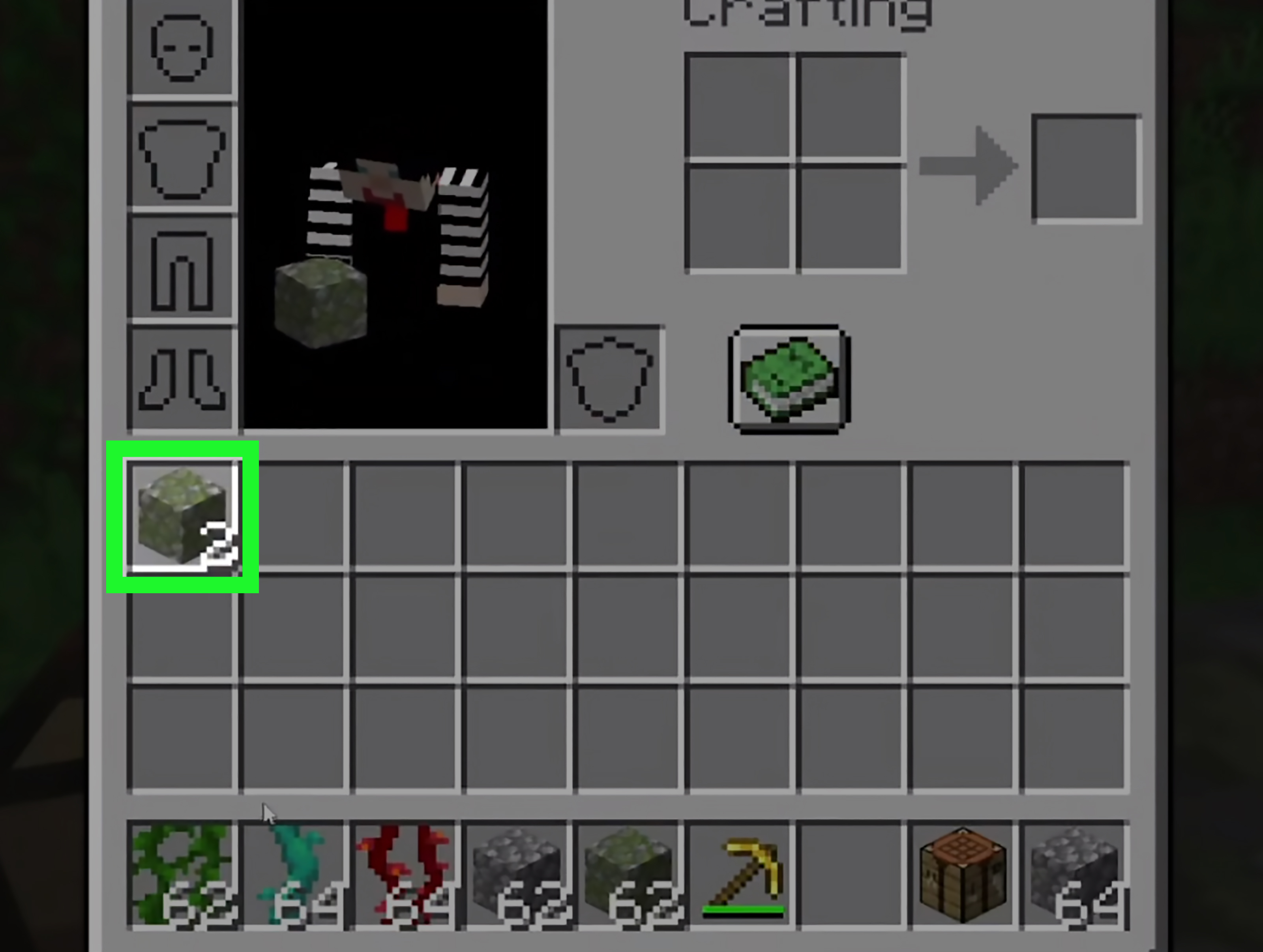
Open your crafting interface and place one cobblestone with either one vine or one full moss block. The output slot will show one mossy cobblestone. Move it into your inventory and repeat the process until you have the quantity you need.
A crafting table is convenient when processing large batches, although the recipe requires only two ingredients. The important rule is that cobblestone must be paired with a vine or a full moss block. Moss carpet is decorative, but it is not the standard vanilla substitute in this recipe.
That is the entire process. No furnace. No smelting. No stonecutter. No waiting for rain. Minecraft does not require you to place cobblestone outdoors and whisper encouraging words to it until moss appears.
Where Can You Find Mossy Cobblestone Naturally?
Crafting is the most predictable method, but mossy cobblestone also generates naturally in several Overworld locations. Depending on your seed and edition, you may encounter it in dungeons, jungle temples, pillager outposts, underwater ruins, certain village structures, and rocky formations in old growth taiga biomes.
Natural generation is useful when you need a small quantity and happen to find a nearby structure. However, dismantling half the Overworld because you need 900 blocks for a retaining wall is not especially efficient. Renewable vines or a moss-growing setup will usually serve large building projects better.
Mine naturally generated mossy cobblestone with a pickaxe so the block drops itself. Breaking it without the proper tool may leave you with nothing, which is a memorable way to convert ancient architecture into regret.
How to Gather the Ingredients Faster
Build a Simple Vine Farm
Create a tall wall or row of pillars, attach vines near the top, and allow them to grow downward. Harvest the lower growth with shears while leaving the original upper vines in place.
A wide farm produces more vines at once, but even a compact setup behind your storage room can support occasional building projects. Keep spare iron available for replacement shears and store the collected vines close to your cobblestone supply.
Use Moss and Bone Meal for Large Projects
For a major ruin, castle, or landscape project, moss blocks are usually the more scalable option. Place moss in an area containing compatible blocks, apply bone meal, and collect the newly spread moss with a hoe.
Repeat the cycle while preserving a starter block. A skeleton farm, composter setup, or steady collection of bones will make bone meal easier to obtain.
Organize the work into separate areas: one zone for moss propagation, one chest for cobblestone, and one crafting station for finished blocks. Good logistics will not make your castle more magical, but they will stop you from running between six chests like a confused medieval accountant.
Create a Renewable Cobblestone Source
Cobblestone is abundant underground, but a cobblestone generator can provide a renewable source beside your base. When flowing water meets flowing lava under the correct conditions, a new cobblestone block forms and can be mined repeatedly.
Use a safe generator design so the lava does not consume your drops, tools, or dignity. For very large projects, combine a renewable generator with an efficient pickaxe and organized storage.
What Can You Make With Mossy Cobblestone?
Mossy cobblestone can be used as a full building block or converted into matching slabs, stairs, and walls. These shaped variants let you create roofs, arches, fences, foundations, broken edges, and detailed ruins while maintaining the same weathered texture.
The block also has a specialized use in duplicating the Wild Armor Trim smithing template. This process is considerably more expensive than decorating a wall because template duplication also requires diamonds, but it gives mossy cobblestone a practical purpose beyond architecture.
How to Build With Mossy Cobblestone
Mix It With Regular Cobblestone
Treat mossy cobblestone as an accent rather than the only block in your palette. Start with ordinary cobblestone and replace selected blocks with mossy variants.
A ratio of approximately one mossy block for every four to eight regular blocks often creates convincing weathering. Wetter, older, or more abandoned structures can use a higher concentration.
Place moss near foundations, water channels, shaded corners, roof runoff, broken walls, and vegetation. These locations make visual sense because moisture and neglect naturally collect there. Intentional clusters generally look more believable than perfectly even spacing.
Combine It With Other Aged Materials
Mossy cobblestone pairs well with regular cobblestone, stone bricks, mossy stone bricks, cracked stone bricks, gravel, coarse dirt, rooted dirt, mud, spruce wood, dark oak, vines, leaves, and moss carpet.
Use stairs and slabs to break up straight edges. For a ruined wall, remove a few full blocks, insert stairs facing irregular directions, add moss near the foundation, and scatter coarse dirt around the base.
For an old pathway, blend cobblestone, mossy cobblestone, gravel, and occasional stone bricks. The goal is controlled disorder. It should look naturally worn, not like a creeper redesigned the property while you were eating lunch.
Use Mossy Blocks to Tell a Story
Strong Minecraft builds communicate history. A mossy bridge over a forest river feels immediately believable. A moss-covered desert tower may need an oasis, hidden spring, or magical explanation.
Mossy stones can mark a forgotten trail, indicate a dungeon entrance, surround an ancient portal, or identify the oldest district of a growing settlement. Small environmental details become visual clues, allowing one decorative block to perform a surprising amount of unpaid narrative work.
Common Mossy Cobblestone Mistakes
Using Moss Carpet Instead of a Moss Block
Moss carpet and moss blocks are separate items. The standard crafting recipe uses a full moss block or a vine. When the output does not appear, make sure you are not holding moss carpet.
Breaking Vines Without Shears
Bring shears when collecting vines. Otherwise, you may destroy the vines without obtaining the items needed for crafting. This mistake is particularly painful after a long trip to a jungle.
Confusing It With Mossy Stone Bricks
Mossy cobblestone has the rough texture of cobblestone. Mossy stone bricks have a structured brick pattern. Both blocks create an aged appearance, but they use different base materials.
Expecting Moss to Convert Placed Cobblestone Automatically
Bone meal can help moss spread across compatible terrain, but do not assume it will automatically age every cobblestone block in your wall. The dependable method is crafting cobblestone with a vine or moss block.
Java Edition vs. Bedrock Edition
The basic mossy cobblestone recipe is available in modern Java and Bedrock editions. The controls and crafting interfaces differ between computers, consoles, and mobile devices, but the ingredient combination remains the same.
Mods, add-ons, behavior packs, custom data packs, and multiplayer server plugins can alter recipes. When the normal combination does not work, confirm that you are playing vanilla Minecraft and that your server has not replaced or disabled the recipe.
Frequently Asked Questions
Can You Make Mossy Cobblestone Without Vines?
Yes. Combine one cobblestone block with one moss block. This is useful for players who have discovered a lush cave or created a renewable moss supply.
Can You Turn Mossy Cobblestone Back Into Cobblestone?
Vanilla Minecraft does not provide a standard crafting recipe that removes the moss and returns ordinary cobblestone. Store the two block types separately when a project requires both.
Does Mossy Cobblestone Spread?
No. Placed mossy cobblestone does not spread moss to neighboring cobblestone. It remains a stable building block until a player breaks or moves it.
Is Mossy Cobblestone Flammable?
No. Like regular cobblestone, it is a stone-based material and does not burn. This makes it useful around fireplaces, lava details, and structures where wooden blocks would be risky.
What Pickaxe Do You Need?
A basic wooden pickaxe is sufficient to collect mossy cobblestone, although stronger pickaxes will mine it faster.
Practical Building Experience: What Usually Works Best
A typical survival-building experience with mossy cobblestone begins with underestimating how much you need. A player crafts 32 blocks, confidently begins an abandoned watchtower, and discovers that 32 blocks decorate approximately one dramatic corner.
The first practical lesson is to build a sample section before gathering all your materials. Make a five-block-wide wall, test the balance between mossy and ordinary stone, and multiply the material cost by the planned size. This small calculation can prevent several mining and crafting trips later.
The second lesson is that clustered weathering looks better than uniform weathering. When mossy blocks appear at mathematically perfect intervals, a castle wall can resemble patterned wallpaper. When they appear in uneven groups near the foundation, beside a leaking roof, or around vegetation, the result feels organic.
A reliable technique is to finish the structure with regular cobblestone first. Step back, identify areas that should appear damp or neglected, and replace selected blocks in irregular clusters. Add mossy stairs, slabs, or walls so the weathering continues across the building’s shape instead of appearing only on flat surfaces.
Another common experience is discovering that vines and moss support different production styles. Vines are ideal for gradual, low-maintenance crafting. Plant them on a tall surface, let them grow, and harvest them whenever you need more blocks.
Moss is better for a focused construction session because bone meal can expand the supply quickly. Players building a cottage may prefer a small vine wall. Players constructing an entire ruined city will appreciate a dedicated moss-growing area, organized storage, and enough bone meal to frighten every skeleton in the county.
Material storage also affects the experience. Keeping cobblestone, vines, moss blocks, shaped variants, and finished mossy cobblestone in separate labeled containers prevents accidental shortages. It is surprisingly easy to convert every moss block and then realize you no longer have a starter block for future propagation.
Reserve one clearly marked stack of moss or protect a starter block in your growing area. This simple habit prevents a renewable resource from becoming a one-time resource because of an enthusiastic crafting session.
Moss placement should also reflect the environment. On a bridge, concentrate it around the waterline and beneath shaded arches. On a cottage, place it near the foundation, beneath windows, and beside leaf blocks. On a mountain ruin, use smaller patches on exposed walls and heavier growth in sheltered corners.
Finally, mossy cobblestone works best as part of a broader palette. A wall made entirely from one block can become visually heavy. Mixing it with ordinary cobblestone, cracked stone bricks, gravel, spruce beams, leaves, and uneven dirt paths creates depth and suggests gradual aging.
The strongest builds rarely scream, “Look, moss!” Instead, they quietly suggest that rain has fallen, roots have spread, and nobody has repaired the western wall since a creeper incident that officials continue to describe as “under investigation.”
The practical takeaway is straightforward: gather more material than your first estimate, preserve renewable starter blocks, apply moss in believable clusters, and mix several block shapes. Those habits make the crafting process more efficient and the finished structure considerably more convincing.
Conclusion
To make mossy cobblestone in Minecraft, mine cobblestone, collect either vines or moss blocks, and combine one of each in the crafting interface. The recipe produces one mossy cobblestone and provides a simple, renewable source of weathered building material.
Use vines for a passive farm, moss blocks for faster bulk production, and a mixed material palette for ruins, paths, bridges, castles, and overgrown landscapes that look naturally aged rather than aggressively green.
Note: This guide describes the standard vanilla recipe for modern Minecraft Java and Bedrock editions. Mods, add-ons, custom servers, data packs, and future updates may change crafting behavior.