
Strength training does not have to involve clanking iron, complicated machines, or a gym membership that quietly charges your credit card while you stay home. For many older adults, a small set of resistance bands can provide a practical, joint-friendly way to strengthen the legs, arms, back, shoulders, and core.
The best resistance bands for seniors are easy to grip, available in genuinely light resistance levels, simple to adjust, and durable enough to inspire confidence. They should also match the user’s goals. A band that works beautifully for seated physical therapy exercises may be less convenient for standing rows, while a short loop designed for the hips will not be ideal for an overhead press.
This guide compares four standout options for different needs, including rehabilitation, hand comfort, full-body exercise, and affordable lower-body training. Product specifications, independent testing, exercise guidance, and senior-friendly usability were considered when selecting the recommendations.
Exercise guidance synthesized from NIA, CDC, ACSM, and Arthritis Foundation resources.
Quick Comparison of the Best Resistance Bands for Seniors
| Resistance band | Best for | Band style | Important feature |
|---|---|---|---|
| THERABAND CLX | Rehabilitation and controlled exercise | Long band with consecutive loops | Multiple built-in hand and foot positions |
| Rogue Tube Bands | Older adults who prefer handles | Tube bands with fixed handles | Textured grips and clearly separated resistance options |
| Bodylastics Basic Series | Versatile full-body home workouts | Stackable tube system | Internal cord designed to reduce snapping risks |
| Fit Simplify Resistance Loop Bands | Budget-friendly leg and hip exercises | Short flat loops | Five progressive resistance levels |
Why Resistance Bands Work Well for Older Adults
Resistance bands create tension as they stretch. Unlike a dumbbell, which weighs the same throughout a movement, a band generally becomes more challenging as it lengthens. This allows users to control the exercise by shortening the range of motion, changing their hand position, or switching to a lighter band.
The National Institute on Aging includes resistance bands among the tools older adults can use for muscle-strengthening exercise. Current federal guidance also recommends that older adults perform activities that strengthen all major muscle groups on at least two days each week, alongside aerobic and balance activities.
For everyday life, stronger muscles can make getting out of a chair, carrying groceries, climbing stairs, and maintaining posture feel more manageable. Bands are also inexpensive, portable, and usable from a seated position. They fit in a drawer instead of requiring a dedicated room that suddenly smells like a high school locker room.
Resistance bands are not automatically risk-free, however. Worn bands can tear, unsecured anchors can slip, and excessive resistance can irritate joints. Choosing a suitable product and using controlled technique remain essential.
1. THERABAND CLX: Best Overall for Rehabilitation and Beginners
THERABAND has a long history in physical therapy and rehabilitation settings, and its CLX design is especially useful for older adults who want a controlled, adaptable band. Instead of being one uninterrupted strip, the band contains consecutive loops running along its length.
Users can place a hand, foot, or forearm inside a loop rather than tying knots or wrapping a slippery strip several times around the palm. The loops also make the band’s working length easier to adjust. Moving to a closer loop increases tension, while choosing a more distant loop creates a gentler starting position.
Why It Is Senior-Friendly
The CLX is well suited to seated rows, leg presses, shoulder rotations, biceps curls, lateral steps, and therapist-prescribed mobility exercises. Progressive color-coded resistance levels make it possible to begin gently and advance without replacing the entire exercise system.
Non-latex versions are available, which is important for users with latex sensitivity. The flat construction is also lightweight and easy to pack for travel or store beside a chair used for home exercise.
Possible Drawbacks
Although the loops are more convenient than an ordinary flat strip, users with significant finger or wrist arthritis may still prefer a thick foam handle. The band is also commonly sold by individual resistance level, so creating a complete progression can cost more than buying one bundled set.
Best choice for: Beginners, physical therapy patients, travelers, and seniors who value precise hand and foot placement.
THERABAND features and progression verified through current manufacturer information and rehabilitation-focused product reviews.
2. Rogue Tube Bands: Best Resistance Bands With Handles
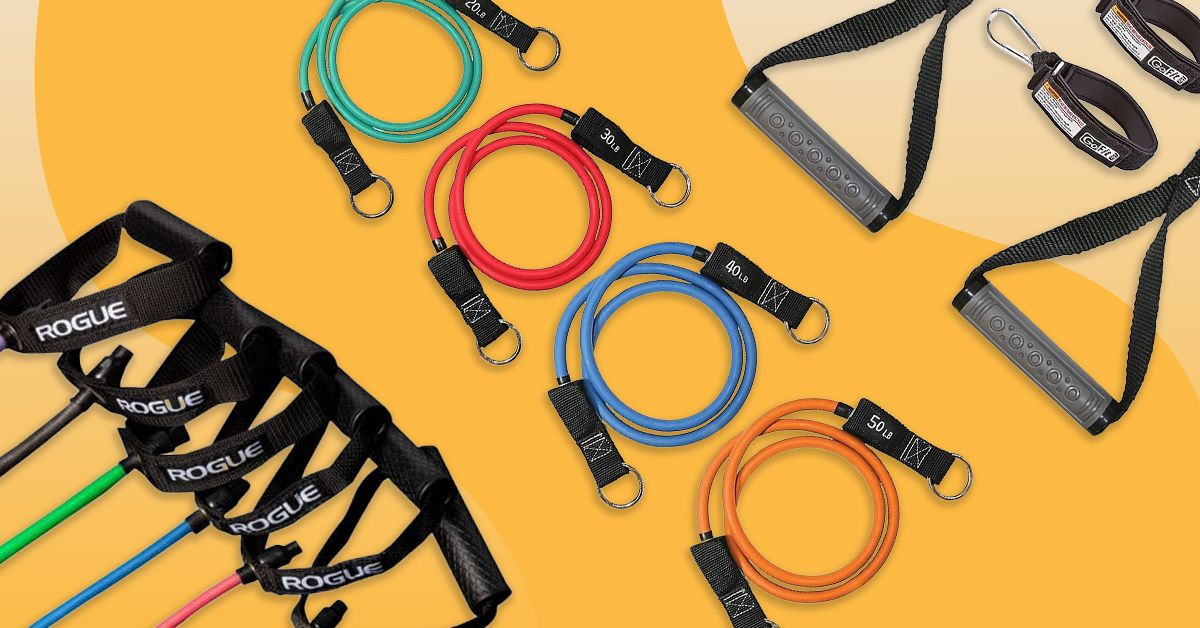
For an older adult who dislikes gripping flat rubber, Rogue Tube Bands offer a straightforward alternative. Each tube has permanently attached textured handles, eliminating the clips and carabiners found on many stackable systems.
The tubes are available in six resistance options, beginning at approximately 10 pounds and progressing to 60 pounds when stretched according to the manufacturer’s measurement standard. Seniors should generally begin with the very light or light option unless a physical therapist or qualified trainer recommends otherwise.
Why the Handles Matter
Hand comfort is not a minor detail. The Arthritis Foundation notes that tube-style bands with handles can be easier to grip and position than flat bands, particularly for people with hand or wrist limitations. Rogue’s handles are textured and permanently connected, so there is less setup before each exercise.
The light tubes work well for curls, seated rows, chest presses, triceps extensions, and gentle shoulder work. Because every resistance level is a separate handled tube, switching intensity is simple: put one down and pick up another.
Possible Drawbacks
The resistance amount is not prominently printed on every tube, so users must remember the color system. These bands are also shorter than some competing tube systems and cannot be stacked together. Buying a full package may be unnecessary for a beginner who only needs the two lightest levels.
Best choice for: Seniors with mild hand stiffness, users who want minimal setup, and anyone who prefers traditional exercise handles.
Rogue dimensions, handle construction, resistance range, and tester observations verified through manufacturer and independent review information.
3. Bodylastics Basic Series: Best Safety-Focused Full-Body Set
Bodylastics is a strong choice for seniors who want one expandable system for a broad range of exercises. Its Basic Series typically includes several tubes, handles, a door anchor, ankle straps, and a carrying bag. Individual tubes can be connected to the handles alone or combined to create more resistance.
The most notable feature is an internal inelastic cord designed to limit overstretching and reduce how far the tube can recoil if its elastic material fails. This does not make the product indestructible or eliminate the need for inspection, but it adds a useful safety layer.
Why It Is So Versatile
With the door anchor and interchangeable accessories, users can perform rows, presses, pulldowns, leg extensions, hamstring curls, and standing hip exercises. The stackable design allows resistance to increase in smaller stages than systems that jump directly from one heavy band to another.
For seniors, the lighter Basic Series configuration is usually more practical than a high-resistance athletic package. A massive resistance total looks impressive on the box, but most beginners benefit more from smooth movement and dependable form than from equipment capable of challenging a professional linebacker.
Possible Drawbacks
This system requires more setup than a fixed-handle tube. Clips must be attached correctly, and the door anchor must be positioned on a sturdy door that closes securely. Users with reduced vision, hand dexterity, or memory may prefer assistance during the first few sessions.
Best choice for: Seniors who want a complete home exercise kit, gradual resistance progression, and a tube system with an added recoil-reduction feature.
Bodylastics design and internal safety-cord information verified through current manufacturer documentation.
4. Fit Simplify Resistance Loop Bands: Best Budget Option
Fit Simplify Resistance Loop Bands are compact, affordable, and particularly useful for strengthening the hips, thighs, and glutes. The set contains five short loops ranging from extra light to extra heavy, along with a small carrying bag and exercise guidance.
The extra-light and light bands are appropriate starting points for exercises such as seated hip abductions, standing side steps, glute bridges, and gentle leg raises. Strengthening the muscles surrounding the hips can support walking, stair climbing, and stability during daily movement.
Where Short Loops Perform Best
Short loops require almost no setup. Place one above the knees or around the ankles, position the feet safely, and begin. They are especially convenient for short exercise sessions beside a sturdy chair or kitchen counter.
The full set weighs very little and fits easily into luggage, a purse, or a bedside drawer. Fit Simplify also provides online exercise demonstrations covering both lower- and upper-body movements.
Possible Drawbacks
Latex loops can roll, pinch skin, or pull leg hair, particularly when placed directly against the body. A flat loop also offers no built-in handle, making it less comfortable for users with hand arthritis. These bands are best treated as a lower-body supplement rather than the only resistance equipment in the home.
Best choice for: Budget-conscious seniors, travelers, and older adults focusing on hip, thigh, and balance-supporting muscles.
Fit Simplify levels, exercises, accessories, and use cases synthesized from manufacturer and medical product-review information.
How to Choose Resistance Bands for a Senior
Start With Light Resistance
The right band should allow approximately 10 to 15 controlled repetitions without forcing the user to hold their breath, twist the body, or shorten the movement dramatically. The final few repetitions may feel challenging, but they should not cause sharp pain.
Resistance colors are not standardized across brands. A red band from one company may feel entirely different from a red band made by another, so read the printed resistance description rather than shopping by color alone.
Consider Grip Strength and Arthritis
Foam or textured handles are often easier to hold than thin flat rubber. Consecutive-loop bands can also reduce the need to tie knots. For severe hand limitations, a physical therapist may suggest cuffs or straps that transfer some load away from the fingers.
Check the Material
Many resistance bands contain natural latex. Anyone with a known latex allergy should choose a clearly labeled non-latex product made from synthetic rubber or another alternative material.
Match the Band to the Exercise
Long bands and handled tubes are the most versatile for total-body exercise. Short loops are excellent for the legs and hips. Therapy strips are inexpensive and adjustable, while stackable systems offer the broadest resistance range but require more setup.
A Simple Resistance Band Routine for Seniors
The following beginner routine can be performed while seated or while holding a sturdy chair for support. Begin with one set of 8 to 12 repetitions per exercise. Rest for at least one day before training the same muscles again.
- Seated row: Loop a long band around the feet and gently pull the elbows backward.
- Seated leg press: Place the middle of the band around one foot and slowly extend the knee.
- Biceps curl: Secure the band beneath both feet and bend the elbows without swinging.
- Seated hip abduction: Place a short loop above the knees and gently press the knees apart.
- Supported side step: Hold a countertop and take small sideways steps against a light loop.
Move slowly in both directions. Returning to the starting position is part of the exercise, not the moment to let the band snap back like an angry rubber noodle.
Resistance Band Safety Tips
- Inspect every band for cracks, cuts, discoloration, thinning, or damaged attachment points before use.
- Replace worn bands instead of attempting to repair them with tape.
- Keep the band away from the face and never release it while it is stretched.
- Use only sturdy anchor points, and test a door anchor with gentle pressure before exercising.
- Wear supportive shoes and keep a stable chair or counter nearby during standing movements.
- Exhale during the harder part of the movement instead of holding your breath.
- Stop exercising if you experience chest pressure, dizziness, unusual shortness of breath, or sharp joint pain.
- Store bands away from direct sunlight, extreme heat, pets, and sharp objects.
The CDC recommends muscle-strengthening exercise on at least two days per week for older adults, but more is not automatically better. Recovery days give muscles and connective tissues time to adapt.
Band inspection, anchoring, grip, and resistance-selection guidance supported by Arthritis Foundation and federal activity recommendations.
Which Resistance Band Is Best for Most Seniors?
The THERABAND CLX is the strongest overall recommendation for beginners and rehabilitation-focused users because its built-in loops simplify positioning and resistance adjustment. Seniors who strongly prefer conventional grips may find the Rogue Tube Bands more comfortable.
The Bodylastics Basic Series is better for someone who wants a complete, expandable home gym, while the Fit Simplify loop set is the most affordable choice for hip and leg exercises.
The best product is not necessarily the one offering the most resistance or accessories. It is the band a person can set up safely, hold comfortably, and use consistently. A light band used twice a week beats a deluxe kit that spends six months living behind the couch.
Experience Notes: What Seniors Commonly Notice in Real-World Use
The following observations summarize recurring experiences reported by older exercisers, physical therapy patients, trainers, and independent product testers. They are not presented as one person’s medical case, but they illustrate what day-to-day resistance band use often feels like outside a product photograph.
The First Challenge Is Usually Setup, Not Strength
During the first few sessions, many beginners spend more energy figuring out where to place the band than actually exercising. A flat strip may slide off the feet, a short loop may twist, and a door anchor can look suspiciously complicated until someone demonstrates it. This is one reason simple products frequently work best. The CLX loops give users obvious placement points, while Rogue’s fixed handles eliminate clip selection. After two or three sessions, setup usually becomes routine and the workout feels less like assembling patio furniture.
Hand Comfort Can Determine Whether the Band Gets Used
Older adults with stiff fingers often discover that a band marketed as “easy” still requires considerable grip strength. Wrapping a flat strip around the hands may create uncomfortable pressure across the knuckles. Foam or textured handles tend to distribute that pressure more comfortably. Some users also place their forearms through a CLX loop rather than gripping tightly. The practical lesson is simple: resistance level matters, but so does the interface between the equipment and the body.
Progress Often Appears in Daily Activities First
Resistance band progress is not always dramatic or visible in a mirror. An older exerciser may first notice that rising from a dining chair requires less effort, carrying a laundry basket feels steadier, or climbing the final few stairs no longer produces the same leg fatigue. These modest improvements are meaningful because they relate directly to independence. Increasing from a yellow band to a red one is satisfying, but being able to get out of the car more confidently is usually the better victory.
Light Bands Are More Useful Than Many People Expect
Beginners sometimes assume that the lightest band is merely a warm-up toy. In practice, it can be challenging during shoulder rotations, lateral arm raises, or slow leg extensions. A light band also makes it easier to learn alignment without compensating by leaning, jerking, or holding the breath. Stronger older adults may quickly progress to medium resistance for rows and leg work while continuing to use the light band for smaller shoulder muscles.
Short Sessions Are Easier to Maintain
A common successful routine lasts only 10 to 20 minutes. The band is kept near a sturdy chair, and the user performs four or five exercises while listening to music or watching television. This approach removes the need for special clothing, transportation, and an elaborate workout plan. Consistency grows because the exercise feels like a normal part of the day rather than a major appointment.
Equipment Inspection Becomes a Valuable Habit
With repeated use, people learn to check the area near handles, clips, and anchor points before starting. Tiny surface cracks or whitening rubber may signal that replacement is due. Users also learn not to store bands in a hot car or sunny window, where elastic material can deteriorate more quickly. This 20-second inspection may not be exciting, but neither is being surprised by a snapping tube halfway through a chest press.
The Best Band Is the One That Matches the User
Real-world experience repeatedly shows that no single design works for everyone. A person completing therapist-prescribed rehabilitation may love the precise loops of the THERABAND CLX. Someone with hand stiffness may prefer Rogue’s handles. A more active senior may appreciate the expandable Bodylastics system, while a traveler may use Fit Simplify loops because they disappear into a suitcase pocket. Comfort, confidence, and simplicity usually matter more than the number of accessories printed on the package.