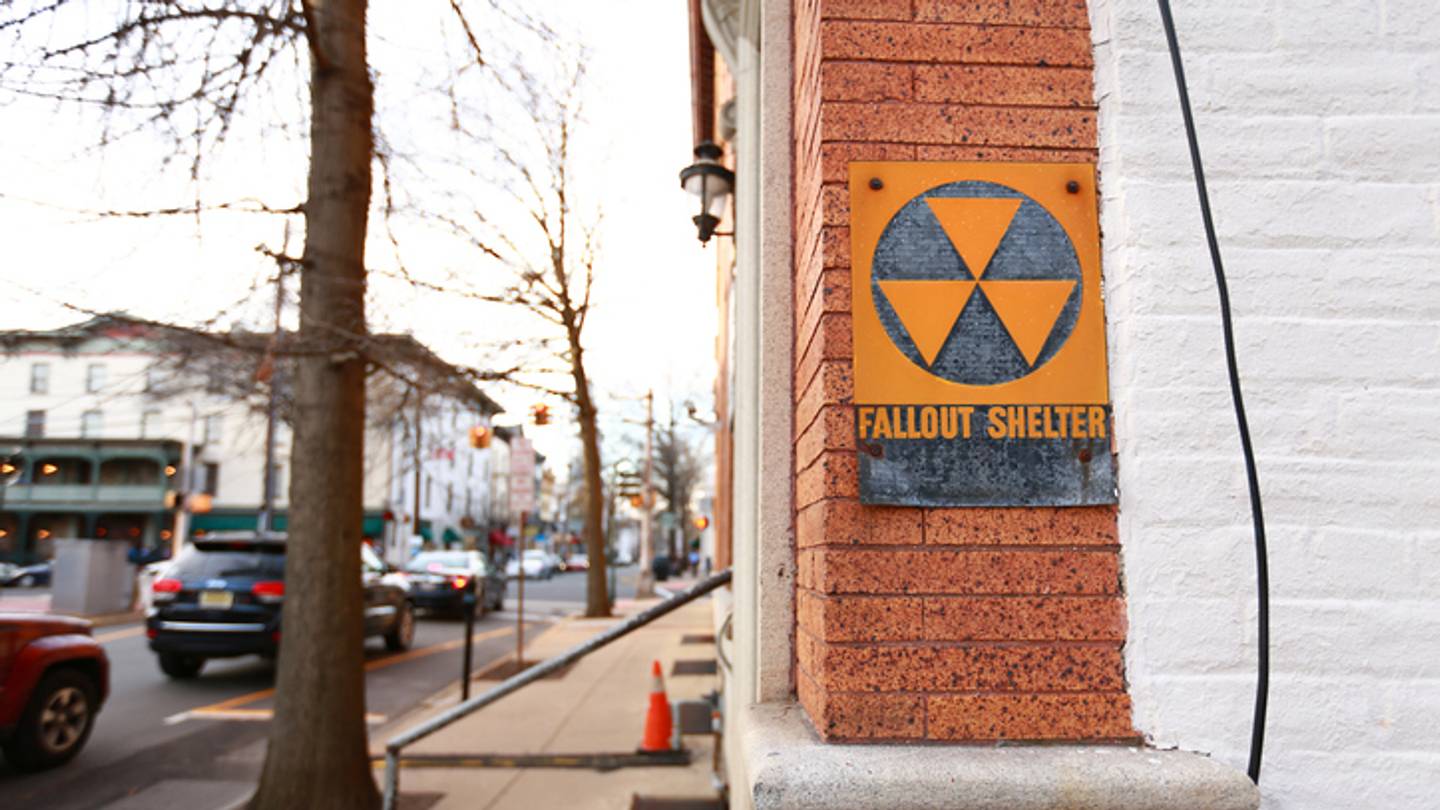

Walk through an older school, post office, courthouse, apartment building, or city hall in the United States, and you may spot a strange little time traveler bolted near an entrance: a black-and-yellow fallout shelter sign. It looks official. It looks serious. It looks like it might know something you do not. And, if we are being honest, it also looks like the building is hiding either canned crackers from 1963 or the opening scene of a very dramatic movie.
So why do we still see fallout shelter signs decades after the Cold War? Are these buildings still safe shelters? Did someone simply forget to take the signs down? Are they protected historic artifacts? Or are they just incredibly stubborn pieces of metal with better job security than most humans?
The answer is a mix of history, bureaucracy, nostalgia, neglect, public safety confusion, and the surprisingly long life of galvanized steel. Fallout shelter signs remain visible because they were part of a massive civil defense effort during the Cold War, and once that program faded, many signs were never removed. Today, they survive as relics of nuclear anxiety, reminders of government preparedness campaigns, and accidental street-level museum exhibits.
What Were Fallout Shelter Signs Originally For?
Fallout shelter signs were not decorative. They were not vintage wall art, although try telling that to the internet. They were created to mark buildings that had been surveyed, approved, and sometimes stocked as public shelters during the Cold War.
After World War II, the United States entered a long period of tension with the Soviet Union. Nuclear weapons changed the way Americans thought about war, cities, schools, basements, and even family dinner conversations. The danger was not only the blast itself but also radioactive falloutdust and debris made radioactive after a nuclear explosion, which could drift with the wind and expose people to dangerous radiation.
A fallout shelter was meant to reduce that exposure. In simple terms, thick walls, underground space, concrete, brick, earth, and distance from outside air could help protect people from fallout radiation. The government searched for buildings that already had basements or interior areas with enough shielding. Instead of building every shelter from scratch, officials looked at what already existed: schools, municipal buildings, libraries, office towers, churches, and post offices.
The Cold War Program Behind the Signs
The familiar fallout shelter sign became widely associated with the early 1960s, especially the Kennedy administration’s civil defense push. In 1961, the federal government launched major efforts to identify and mark public fallout shelters across the country. This effort included the National Fallout Shelter Survey, which assessed existing buildings for potential shelter space.
The idea was ambitious: find places where civilians could go quickly after a nuclear warning or attack, label them clearly, and stock them with basic supplies. Civil defense planners were thinking in practical terms. In a crisis, people would not have time to search a directory, call three agencies, compare Yelp reviews, and ask whether the basement had decent lighting. They needed a symbol they could recognize fast.
That is where the black-and-yellow sign came in. The design usually featured three yellow triangles inside a black circle, with the words “Fallout Shelter” in bold lettering. The symbol was made to be visible, memorable, and distinct from the radiation hazard symbol. The government did not want people confusing “danger: radiation” with “come here to reduce danger from radiation.” That would be the kind of branding mistake that gets discussed in emergency-management meetings for the next century.
Why Are the Signs Black and Yellow?
The fallout shelter sign’s color scheme was not random. Black and yellow are high-contrast colors that are easy to notice from a distance. Road signs, warning labels, and industrial safety markings often rely on similar contrast for quick recognition. The fallout shelter sign needed to stand out on brick walls, concrete facades, school corridors, and busy downtown streets.
The three-triangle symbol also gave the sign an official identity. It did not look like a restaurant sign, a restroom marker, or a cheerful announcement that the PTA bake sale had moved downstairs. It looked like civil defense: urgent, standardized, and slightly intimidating.
In many places, the signs were made from durable metal, often aluminum or galvanized steel. That durability is one reason they still survive. The government accidentally created one of the longest-lasting public communication campaigns in American history. A sign meant to guide people during a nuclear emergency ended up outliving movie theaters, shopping malls, pay phones, and several generations of office carpeting.
Were Fallout Shelters Actually Stocked?
Many public fallout shelters were stocked with basic emergency supplies. These could include water containers, sanitation kits, medical supplies, radiation-detection instruments, and food rations such as survival biscuits or crackers. The plan was not luxury living. Nobody was promising throw pillows, artisanal coffee, or reliable Wi-Fi. The goal was survival for a short period while radiation levels outside dropped.
Some shelters were designed around the assumption that occupants might need to remain inside for days or even up to two weeks, depending on conditions and official instructions. The supplies reflected that grim practicality. Large water barrels, toilet supplies, medical kits, and calorie-dense food were more important than comfort.
Of course, stocking a shelter was one thing. Maintaining it for decades was another. Over time, supplies expired, disappeared, were discarded, or were forgotten in basements behind broken chairs and holiday decorations. Many buildings changed owners or uses. A shelter area might become storage, a mechanical room, a gym equipment closet, or the mysterious locked space every school custodian knows about but refuses to discuss.
So Why Do We Still See Fallout Shelter Signs Today?
The simplest reason is also the most human: removing old signs was rarely anyone’s top priority. After the Cold War cooled down, many civil defense programs changed, merged, or faded into broader emergency management systems. Local governments had new concerns: hurricanes, floods, wildfires, terrorism, cyberattacks, pandemics, power outages, and the eternal mystery of why public printers never work when needed.
Fallout shelter signs stayed behind because they were physically attached to buildings and administratively attached to nobody’s urgent to-do list. A metal sign on a wall does not demand maintenance meetings. It does not send emails. It does not file complaints. It simply hangs there, aging quietly while the world moves on.
1. Many Signs Were Never Officially Removed
In thousands of buildings, the signs remained after the shelters were no longer inspected, stocked, or recognized as active public shelters. Unless a city, agency, landlord, or preservation group made a deliberate decision, the easiest option was to leave the sign alone.
2. Building Owners May Not Know What They Mean
A modern building manager may inherit a property with a fallout shelter sign and no documentation. Is it historic? Is it legally required? Is it safe to remove? Does it belong to the city? The federal government? The ghost of civil defense past? Uncertainty often leads to inaction.
3. They Became Historic Curiosities
Many communities now view fallout shelter signs as artifacts of the Cold War. They are small but powerful reminders of a period when nuclear anxiety shaped school drills, public policy, architecture, and popular culture. In some cities, residents and historians argue that the signs should be preserved because they tell a story.
4. Removing Them Can Cost Money
Taking down a sign sounds easy until someone has to pay for labor, equipment, wall repair, disposal, documentation, and approvals. If the sign is high on a building facade or mounted on older masonry, removal may be more trouble than expected. Suddenly, “just unscrew it” becomes a small facilities project, and everyone quietly decides the sign can enjoy another decade.
5. Some People Like Them
Fallout shelter signs have become part of urban texture. Photographers notice them. History buffs document them. Collectors hunt for them. Tour guides point them out. They are eerie, memorable, and oddly stylish in a midcentury-doomsday kind of way.
Do Old Fallout Shelter Signs Still Mark Real Shelters?
This is the most important question, and the answer is: do not assume they do. An old fallout shelter sign does not necessarily mean the building is currently maintained, stocked, approved, or open as a public shelter.
Many signs are outdated. The original shelter supplies may be gone. The designated shelter area may no longer exist in usable form. The building may have been renovated, sold, repurposed, or structurally changed. A basement that made sense in 1962 may now contain HVAC equipment, private storage, or a locked door with a very unhelpful sign that says “Authorized Personnel Only.”
Some cities have removed signs precisely because they could mislead people during an emergency. New York City, for example, began removing old fallout shelter signs from some buildings because officials considered them outdated relics that no longer indicated functional public shelters. That move highlighted a larger issue: historic signage can be fascinating, but emergency instructions must be accurate.
What Should You Do in a Modern Nuclear Emergency?
Modern emergency guidance focuses less on finding a Cold War-era public shelter sign and more on getting inside quickly, staying inside, and following official instructions. In a nuclear explosion or radiological emergency, the general advice from emergency agencies is to seek the nearest substantial building, move to the basement or middle of the structure, stay away from windows and exterior walls, and remain tuned to official updates.
That means the “best shelter” may not be the one with a rusty sign outside. It may be the nearest sturdy building with thick walls and an interior or underground space. In other words, the old sign might be historically interesting, but your emergency plan should rely on current public safety guidancenot a piece of metal that may have been installed when people were still arguing about color television.
Fallout Shelter Signs as Cold War Memory
Fallout shelter signs survive because they are more than signs. They are public memory in metal form. They remind us of a time when nuclear war was not an abstract topic for documentaries, video games, or political speeches. It was part of everyday life. Children practiced duck-and-cover drills. Families discussed home shelters. Cities mapped basements. Public buildings stored emergency crackers. The future felt both technologically dazzling and terrifyingly fragile.
The signs also reveal something about American optimism. Strange as it sounds, the fallout shelter program was based on the belief that planning could make survival possible. The signs said, in effect: “This way. We have thought about the unthinkable.” Whether the program was adequate is still debated, but the impulse behind it was clear. Government officials wanted civilians to believe there was a practical response to nuclear danger.
Today, seeing one of these signs can feel surreal. We may pass it while holding a smartphone more powerful than the computers that once filled entire rooms. We may photograph it, post it online, and then continue walking to a coffee shop that charges six dollars for iced foam. The sign belongs to another era, yet its message still cuts through the noise: disaster planning matters, even when the disaster feels impossible.
Why They Still Matter
Fallout shelter signs matter because they connect architecture, public policy, fear, design, and memory. They show how deeply the Cold War entered ordinary spaces. A school basement was not just a basement. A post office was not just a post office. A courthouse wall could become part of a national survival map.
They also raise useful questions about preparedness today. What public warnings do we trust? Are our emergency plans current? Do people know where to go during disasters? Are old signs helping, confusing, or educating us? A faded fallout shelter marker may no longer point to a ready shelter, but it still points to a conversation worth having.
In a country facing hurricanes, fires, floods, extreme heat, infrastructure failures, and new security threats, preparedness is not a Cold War antique. The tools have changed, but the principle remains: people need clear information before panic arrives.
Specific Examples of Where You Might Still See Them
Fallout shelter signs are often found on older public and institutional buildings. You might notice them on city halls, libraries, schools, churches, college buildings, courthouses, apartment towers, or post offices constructed or surveyed before the late 1960s. Dense cities with older building stock tend to have more surviving examples because they had many large masonry and concrete structures suitable for survey during the Cold War.
Washington, D.C., New York City, Boston, Chicago, Philadelphia, and many smaller towns still have visible examples, though the number declines as buildings are renovated or demolished. Some signs remain indoors near stairwells and basement entrances. Others are outside, faded by rain and sun, still performing their one job with ghostly determination: pointing downward.
Should Fallout Shelter Signs Be Preserved?
There is no single answer. Preservationists argue that fallout shelter signs are valuable historic artifacts. Removing them erases a visible reminder of Cold War life. They are accessible, public, and emotionally powerful. You do not need a museum ticket to understand them. You only need to look up from the sidewalk.
Public safety officials may see the issue differently. If a sign suggests that a building is an active shelter when it is not, it can create dangerous confusion. In an emergency, people need current instructions, not vintage guesses. A compromise may be to preserve selected signs with interpretive labels or move them into museums, archives, schools, and local history displays.
That approach respects both history and safety. Keep the story, but do not let a rusty sign become an emergency plan.
Experiences Related to Fallout Shelter Signs
One of the strangest things about fallout shelter signs is how quietly they reveal themselves. You can pass the same building for years and never notice one. Then one day, while waiting for a bus, looking for an address, or trying to avoid awkward eye contact with a pigeon, there it is: “Fallout Shelter.” Suddenly the wall has a backstory.
Many people describe the experience as a tiny historical jump scare. The sign feels out of place in modern life. It sits next to security cameras, delivery lockers, bike racks, and touchless entry systems, yet it speaks in the language of sirens, basements, and civil defense pamphlets. It is not loud, but it changes the mood. A normal building becomes a Cold War artifact.
Students often encounter fallout shelter signs in old schools and universities. A sign near a basement staircase can turn an ordinary hallway into a history lesson more effective than a textbook paragraph. You begin to imagine what it meant for children to grow up with nuclear drills, for teachers to explain shelter procedures, and for administrators to treat the basement as part classroom-adjacent storage area, part survival infrastructure. Nothing says “please line up quietly” like the possibility of radioactive dust.
Older adults sometimes remember the signs differently. For them, they are not quirky vintage objects. They are reminders of a real emotional atmosphere. The Cold War was not only a geopolitical contest; it shaped childhood routines, neighborhood conversations, and household purchases. Some families considered backyard shelters. Some stocked canned goods. Some watched public service films that tried to make nuclear survival sound orderly, manageable, and only mildly inconvenient.
Urban explorers and photographers often see fallout shelter signs as visual treasures. A faded sign on brick has texture, contrast, and mystery. It tells a story in seconds. Unlike a plaque that politely explains history, a fallout shelter sign still feels operational, even when it is not. It has command energy. It does not say, “Once upon a time.” It says, “Go here.” That directness is part of its power.
For building staff, however, the experience may be less romantic. A facilities manager may see the sign as one more inherited oddity: old pipes, mystery keys, outdated floor plans, and a basement room everyone calls “the shelter” even though it now contains paint cans and a broken folding table. The sign may trigger questions from visitors, but there may be no official answer beyond, “It was here when we got here.” That phrase is responsible for preserving half of America’s weirdest building features.
There is also a modern preparedness lesson hiding in these experiences. Seeing a fallout shelter sign can make people ask practical questions: Where would I go in an emergency? Do I know local alerts? Does my family have a plan? What supplies would actually help? The sign may be outdated, but the impulse to prepare is not. A good emergency plan today is less about Cold War crackers and more about communication, water, medications, power backups, official alerts, and knowing how to shelter in place when needed.
In that sense, fallout shelter signs still do something useful. They interrupt daily life just enough to remind us that safety is not automatic. They are not reliable directions to a stocked bunker, and they should not be treated as current emergency guidance. But as historical prompts, they are remarkably effective. They make the past visible, the present feel fragile, and the future worth planning for.
So the next time you see one, take a moment. Notice the design. Think about the people who installed it, the people who trusted it, and the generations who walked past it without knowing whether it was still true. Then maybe check your emergency supplies when you get home. Not because the sign is telling you where to go, but because it is reminding you that preparedness should not be left in the basement with the expired crackers.
Conclusion
We still see fallout shelter signs because history is stubborn, metal is durable, and bureaucracy has a long memory when nobody is assigned to clean it out. These signs were born from Cold War civil defense planning, when the United States tried to mark public spaces that could protect people from radioactive fallout. Over time, the shelters aged, supplies vanished, programs changed, and many signs simply stayed put.
Today, fallout shelter signs are best understood as historic artifacts, not modern safety guarantees. They remind us of nuclear anxiety, government planning, public design, and the complicated relationship between fear and preparedness. Some should be preserved. Some should be removed if they mislead the public. All of them deserve to be understood.
A fallout shelter sign may no longer point to a ready bunker, but it still points to an important lesson: emergency planning only works when information is current, clear, and trusted. The past left us signs. The present gives us better guidance. The smart move is to learn from both.
Note: This article synthesizes information from reputable U.S. government, museum, archive, emergency-management, and historical sources, including civil defense records, public preparedness guidance, museum collections, library archives, and reporting on the removal of outdated fallout shelter signs.