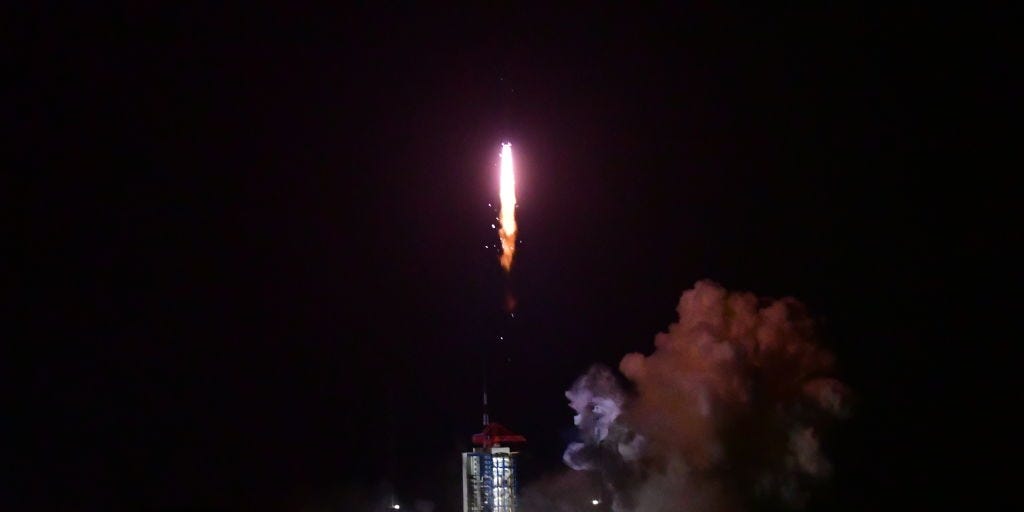

In 2021, reports that China had launched a nuclear-capable hypersonic weapon around the planet sounded like the opening scene of a particularly expensive disaster movie. The alarming vocabulary was all there: nuclear, space, orbital, hypersonic and China. Add dramatic music, and the headline practically writes itself.
The reality is serious, but more complicated. China appears to have tested an experimental long-range delivery system combining a fractional orbital flight path with a maneuverable hypersonic glide vehicle. The system could potentially carry a nuclear warhead. However, there is no public evidence that the tested vehicle actually carried a nuclear warhead, produced a nuclear explosion or remained permanently stationed in orbit.
So, did China test a nuclear space weapon? The most accurate answer is: China tested technology that could become part of a nuclear-capable orbital strike system, but it did not publicly demonstrate an armed nuclear weapon in space.
The Direct Answer: What Was Tested?
The U.S. Department of Defense says China conducted an ICBM-range hypersonic glide vehicle test on July 27, 2021. The vehicle reportedly traveled about 40,000 kilometersnearly the circumference of Earthand remained in flight for more than 100 minutes. Pentagon reports describe it as China’s first fractional orbital launch involving an intercontinental-range missile and a hypersonic glide vehicle.
The Pentagon’s 2024 assessment said the test likely demonstrated China’s technical ability to field a fractional orbital bombardment system, commonly shortened to FOBS. That report also stated that China did not appear to have repeated a FOBS test in 2022 or 2023.
| Popular Claim | What Public Evidence Supports | Verdict |
|---|---|---|
| China tested a nuclear bomb in space | No nuclear explosion or confirmed nuclear warhead was reported | False or highly misleading |
| China tested a nuclear-capable delivery system | U.S. assessments describe an intercontinental-range orbital and hypersonic system | Supported |
| The vehicle traveled through orbital space | U.S. officials say it followed a fractional orbital profile around Earth | Supported, although technical details remain classified |
| China permanently placed a weapon in orbit | The vehicle returned to Earth during the test | Not supported |
What Happened During the 2021 Chinese Hypersonic Test?
The story first became public in October 2021, when reporting based on U.S. intelligence assessments described a Chinese launch conducted during the summer. Initial accounts placed the event in August, but subsequent reporting identified July 27 as the important test date. Some reports also described a second test on August 13.
According to the early accounts, a rocket placed a vehicle on a low orbital path. The system traveled around the globe before releasing or transitioning into a hypersonic glide phase. It then reentered the atmosphere and headed toward a target inside China. Early reporting said it missed that target by roughly two dozen miles, although later Pentagon language said the vehicle came close to its intended impact area.
China disputed the characterization. A Chinese Foreign Ministry spokesperson said the event involved a reusable space vehicle rather than a missile and described it as a routine technology test intended to make travel to and from space more economical.
The dates matter. China publicly discussed a reusable spacecraft test conducted on July 16, while the U.S. government later identified the suspected FOBS-style test as occurring on July 27. That leaves open the possibility that officials and reporters were initially talking about separate launchesa peaceful spaceplane experiment and a military-related hypersonic test.
What Does “Nuclear-Capable” Actually Mean?
This is the most important distinction in the entire debate. A nuclear-capable system is a vehicle that could be configured to carry a nuclear warhead. It does not mean that every test uses one.
Many modern missiles are dual-capable. Depending on their design and mission, they may carry conventional explosives, nuclear warheads, test instruments or inert payloads. During development, engineers frequently launch systems with telemetry equipment instead of operational warheads. Nobody tests a new delivery vehicle by casually attaching a live nuclear device and hoping the paperwork sorts itself out.
No publicly available evidence shows that China’s 2021 vehicle contained nuclear material. No nuclear detonation was detected, announced or alleged. Calling the event a “nuclear test” therefore confuses the testing of a possible delivery system with the testing of a nuclear explosive.
What Is a Fractional Orbital Bombardment System?
A traditional intercontinental ballistic missile rises rapidly, follows a high ballistic arc and releases its warhead toward a predetermined target. Its route may be extremely fast, but once the missile enters its unpowered ballistic phase, its likely destination can be calculated.
A fractional orbital bombardment system takes a different route. A rocket sends its payload toward low Earth orbit, but the payload deorbits before completing a normal, continuing orbital mission. The word fractional refers to the fact that the vehicle may travel only part of an orbitor use an orbital trajectory temporarilybefore descending toward its target.
The concept is not new. The Soviet Union developed and deployed a FOBS capability during the Cold War. What made China’s experiment notable was the apparent combination of an orbital trajectory with a maneuverable hypersonic glide vehicle. It was old strategic mischief wearing newer aerodynamic shoes.
Why Use an Orbital Route?
Most U.S. early-warning architecture was historically designed around expected missile routes, particularly trajectories approaching from northern regions. A fractional orbital system could theoretically fly from another direction, including over the Southern Hemisphere, before approaching North America.
That does not make the weapon invisible. Launches produce heat signatures, orbital objects can be tracked and a 100-minute journey offers plenty of time for sensors to notice that something unusual has joined the itinerary. The advantage is less about disappearing and more about complicating tracking, target prediction and interception.
What Makes the Hypersonic Glide Vehicle Important?
Hypersonic generally means traveling faster than five times the speed of sound. The word sounds futuristic, although ballistic missile warheads have traveled at hypersonic speeds for decades. Speed alone is not the technological surprise.
A hypersonic glide vehicle is boosted to great altitude by a rocket and then glides through the upper atmosphere. Unlike a conventional ballistic reentry vehicle, it can maneuver laterally and adjust its route. Defenders may know it is coming without knowing precisely where it intends to go.
This combination creates several defensive problems:
- The vehicle may fly below the altitude covered most effectively by some traditional early-warning radars.
- Its maneuvers can make the projected impact point change during flight.
- It can approach from less familiar geographic directions.
- Its conventional or nuclear payload may not be identifiable immediately.
- Decision-makers may have less confidence in their tracking data during a crisis.
The United States has been developing space-based tracking sensors and a Glide Phase Interceptor partly because existing defenses were not optimized for maneuvering hypersonic targets. Government Accountability Office reviews have also warned that these defensive programs face significant technical, coordination and acquisition risks.
Was It Really a “Space Weapon”?
That depends on how broadly the term is defined.
If a space weapon means any military system that travels through outer space, the Chinese vehicle fits reasonably well. Long-range ballistic missiles also pass through space, however, and they are usually classified as strategic missiles rather than space weapons.
If a space weapon means a device permanently based in orbit, the description becomes misleading. The tested vehicle returned to Earth instead of waiting overhead like an extremely hostile satellite.
If the term refers to a counterspace weapon designed to attack satellites, the available evidence does not support it. A CSIS Space Threat Assessment concluded that the reported test did not demonstrate a counterspace weapon and did not show that the vehicle could target satellites. The system was apparently intended to deliver a payload toward Earth, not to chase communications satellites around orbit.
“Orbital strike system” is therefore more precise than “space weapon,” while “nuclear-capable orbital delivery system” is more accurate than “nuclear weapon in space.” Precision is less exciting than panic, but it is considerably more useful.
Would a Nuclear-Armed FOBS Violate Space Law?
The 1967 Outer Space Treaty prohibits states from placing nuclear weapons or other weapons of mass destruction in orbit around Earth. China, the United States and Russia are parties to that treaty. It also prohibits stationing such weapons in outer space by other means.
The 2021 test did not publicly establish a treaty violation because there is no evidence that the payload contained a nuclear warhead. The event was a flight test of a delivery architecture, not the confirmed deployment of an orbital nuclear weapon.
A genuinely nuclear-armed fractional orbital system would create difficult legal questions. The answer could depend on whether the payload was technically placed in orbit, how long it remained there and whether it completed a full revolution. More importantly, legal word games would offer little comfort during an actual nuclear crisis. A government watching an unidentified object descend toward its territory would not pause to conduct a seminar on orbital definitions.
Why Might China Want This Capability?
Preserving a Retaliatory Strike
One likely motivation is ensuring that China could retaliate after an enemy attack. Beijing has long worried that increasingly capable U.S. intelligence, conventional strike systems and missile defenses might threaten China’s nuclear deterrent.
A weapon that can approach from an unexpected direction and maneuver during descent could improve the chance that at least some retaliatory forces survive defenses. Pentagon assessments explicitly connect China’s interest in hypersonic and fractional orbital systems to concerns about U.S. missile defense. RAND and Brookings analyses similarly place the technology within China’s effort to develop a more survivable second-strike capability.
Creating Strategic Uncertainty
A dual-capable vehicle forces an opponent to ask unpleasant questions. Is it carrying a conventional payload? Is it nuclear? Is it targeting a military facility, a city or an early-warning radar? Is the launch an attack, a demonstration or a technical failure?
Ambiguity can deter an enemy, but it can also increase the chance of catastrophic misunderstanding. A conventional strike system that resembles a nuclear delivery vehicle may cause leaders to assume the worst while the clock is moving fastest.
Demonstrating Technological Status
The test also showed that China could integrate advanced launch, orbital, reentry, guidance and high-temperature flight technologies. Even without immediate deployment, demonstrating those abilities sends a strategic message to military planners, political leaders and domestic audiences.
Is the Weapon Unstoppable?
No. “Difficult to intercept” is not the same as “magically unstoppable.” Every military technology arrives with trade-offs, engineering problems and a marketing department determined to ignore both.
An orbital route may provide geographic flexibility, but it can take much longer than a direct ballistic trajectory. The roughly 100-minute Chinese flight was far slower than a conventional ICBM attack, which might reach its target in about half an hour. More flight time gives defenders additional opportunities to detect, classify and track the object.
Accuracy is another concern. Missing by two dozen miles would be unacceptable for many conventional missions, although it could be less significant for a high-yield nuclear weapon. Maneuvering through the atmosphere at extreme speed also produces enormous heat, communication difficulties and guidance challenges.
Finally, orbital launch facilities, command systems and supporting infrastructure can be monitored. A FOBS capability would complicate defense planning, but it would not repeal physics.
Why the 2021 Test Still Matters
The test matters because strategic stability depends heavily on warning, predictability and communication. China’s vehicle challenged all three.
A less predictable route can weaken confidence in early-warning systems. A maneuverable payload makes interception harder. A dual conventional-nuclear capability creates uncertainty about the attacker’s intentions. Combined, these features can pressure leaders to make faster decisions with worse information.
Academic research on U.S.-China strategic competition warns that nuclear weapons, missile defenses, conventional precision weapons, cyber operations and space systems are increasingly entangled. An attack on one system might be interpreted as preparation for a much larger strike. That is how a technical innovation becomes a political risk rather than merely an impressive engineering project.
Conclusion: Did China Test a Nuclear Space Weapon?
China did not publicly test a nuclear explosive in space, and there is no confirmed evidence that its 2021 vehicle carried a nuclear warhead. Describing the event simply as a “nuclear space weapon test” therefore goes beyond the available facts.
China did, however, test an extraordinary long-range system that reportedly used a fractional orbital trajectory and a hypersonic glide vehicle. U.S. assessments consider the architecture potentially suitable for nuclear delivery, and the experiment demonstrated capabilities that could complicate missile warning and defense.
The fairest verdict is that China tested a potential nuclear delivery platform that used orbital space, not a confirmed nuclear weapon deployed in space. That answer is less dramatic than the headline, but it is serious enough without assistance from science-fiction vocabulary.
Extended Experience Section: How to Read the Next “Nuclear Space Weapon” Headline
Experience 1: The First Headline Is Usually the Least Precise
Anyone who followed the Chinese test story in real time experienced a familiar national-security pattern. The first report was dramatic, the second report changed the date, later accounts added technical details and official documents eventually confirmed only part of the original narrative.
This does not mean the early reporting was useless. Intelligence stories often emerge in fragments because governments protect sensors, sources and analytical methods. It does mean readers should treat the first headline as an alert rather than a completed technical assessment. “China launched something unusual” was solid. “China has placed an operational nuclear superweapon in orbit” was not.
Experience 2: One Adjective Can Change the Entire Story
The difference between nuclear, nuclear-armed and nuclear-capable is enormous. A nuclear-armed missile carries a nuclear warhead. A nuclear-capable missile may be able to carry one. A nuclear test ordinarily refers to the detonation or testing of a nuclear explosive device.
The 2021 event belongs primarily in the second category. When a headline deletes “capable,” it turns a delivery-system test into something resembling an orbital nuclear detonation. That missing adjective does more damage to accuracy than several pages of technical jargon can repair.
Experience 3: Conflicting Statements May Refer to Different Events
China said it had tested a reusable spacecraft. American reporting described a hypersonic orbital weapon. At first glance, one side appeared to be lying. The later timeline suggested a more complicated possibility: the reusable spacecraft flew on July 16, while the suspected military system flew on July 27.
The practical lesson is to compare dates, launch sites, flight durations and official wording before treating two statements as direct contradictions. Governments certainly use ambiguity when convenient, but calendar confusion is not classified technology. Sometimes two countries are arguing about different rockets.
Experience 4: “Hypersonic” Should Begin the Analysis, Not End It
Hypersonic has become a shortcut for unstoppable, invisible and revolutionary. Yet ballistic missile warheads have exceeded Mach 5 since long before smartphones, streaming television and people arguing with refrigerators.
The useful questions concern maneuverability, altitude, range, sensors, accuracy and mission. Can the vehicle change direction? Can existing radars maintain a track? How precisely can it strike? Does its route shorten warning time or merely approach from an unexpected direction? In China’s case, the combination of orbital routing and atmospheric maneuvering mattered more than the speed label alone.
Experience 5: Capability Is Not the Same as Deployment
A successful technology demonstration does not automatically produce an operational military force. After a prototype flies, engineers still face reliability testing, manufacturing, crew training, command integration, maintenance, targeting procedures and warhead certification. Military history contains many spectacular demonstrations that became expensive museum pieces.
The Pentagon concluded that China’s test demonstrated the technical ability to field a FOBS capability. That wording is deliberate. It indicates meaningful progress without claiming that large numbers of operational weapons are already waiting in silos.
Experience 6: Uncertainty Is Part of the Strategic Effect
The public may never receive every technical detail of the 2021 flight. U.S. officials have reasons to conceal what their sensors detected, while China has reasons to obscure the system’s purpose and performance.
That uncertainty is not merely an inconvenience for journalists. It may be part of the weapon’s value. A system that causes opponents to question its route, payload and target can influence planning before it is ever used. Unfortunately, the same ambiguity can encourage worst-case assumptions during a confrontation.
The best reading experience therefore combines skepticism with seriousness. Avoid turning incomplete evidence into a blockbuster plot, but do not dismiss the underlying capability because some headlines were exaggerated. China’s test was neither an orbital nuclear apocalypse nor a harmless science experiment. It was a strategically important demonstration whose most dangerous feature may be the number of questions it leaves unanswered.