
Publishing note: This article explains publicly known Apache aircrew survival gear at a high level. It does not reveal sensitive procedures, current classified packing lists, or weapon-use guidance.
The AH-64 Apache is famous for its shark-like silhouette, tandem cockpit, helmet displays, sensors, and battlefield reputation. But behind the drama of a combat helicopter is a quieter question: if an Apache crew has to leave the aircraft, what helps them survive until recovery? The answer is not one magical backpack full of movie props. In real Army aviation, survival equipment is usually part of a layered system: what the pilot wears, what is attached to the vest, what the aircraft carries, and what the crew has been trained to do under stress.
So, what is in an Apache helicopter survival kit? Public information points to a mix of aviation life support equipment, protective clothing, communications, signaling tools, basic medical support, water-related survival items, and mission-tailored gear. In plain English: the kit is designed to help a downed crew member stay alive, stay locatable, and stay functional long enough to be recovered. It is less “action hero toolbox” and more “extremely serious emergency insurance policy with pockets.”
Apache Survival Gear Starts With the Aircraft and Crew
The Apache is a two-seat attack helicopter operated by a pilot and a co-pilot/gunner. Boeing’s public AH-64E specifications describe a standard crew of two, and U.S. Army materials describe the Apache as a multi-mission aircraft with advanced performance, survivability, and digital capabilities. That matters because the crew’s survival kit is not separate from the aircraft’s mission. Apache crews operate in demanding conditions, often at low altitude, at night, and in weather or terrain that does not politely cooperate.
When people hear “survival kit,” they often imagine a tin full of fishing line, matches, and heroic optimism. Military aviation is more structured. Army aircrew survival gear falls under the broader world of Aviation Life Support Equipment, often shortened to ALSE. An ALSE shop inspects, maintains, and tracks personal equipment used by flight crew members. That includes items meant to protect the body during flight, support emergency egress, and improve survival odds after an aviation emergency.
What “Survival Kit” Really Means in an Apache
For Apache crews, survival equipment is best understood as a system. Some items are worn directly on the body. Some are integrated into a vest. Some are attached to protective gear. Some may vary depending on climate, water crossings, operating area, and mission planning. Public Army sources also show that aircrew protection has evolved over time, from older survival vest systems to Air Warrior, Air Soldier concepts, and newer Aircrew Combat Equipment.
That evolution exists for a simple reason: pilots cannot fly well if they are wrapped like overstuffed burritos. Survival gear must be reachable, secure, flame-resistant where required, compatible with aircraft controls, and light enough that the crew can still move. In a cramped Apache cockpit, bulk is not a fashion crime; it is a performance problem.
Core Categories Inside an Apache Aircrew Survival Setup
1. Protective Flight Clothing
The first layer of survival is what the crew wears. Aviation clothing is built around protection from fire, weather, abrasion, and cockpit hazards. A typical military aircrew setup may include a flight suit, gloves, boots, and layers adjusted for temperature. The point is not comfort in the luxury sense. It is comfort in the “can still think clearly while the environment is trying to ruin your day” sense.
Layered clothing also helps crews handle changing conditions. A mission may begin in heat, continue at altitude, and end in a cold landing zone. Gear must support movement, cockpit safety, and emergency survival after landing or forced exit.
2. Helmet, Eye Protection, and Communications Interface
The helmet is more than head protection. In Apache operations, helmet systems are tied to flight information, visual awareness, communications, and crew coordination. Public Apache information emphasizes the aircraft’s advanced sensors and cockpit systems. While the exact configuration can vary by model and update, the helmet remains one of the most important survival-related pieces because it protects the head and helps the crew communicate.
In an emergency, communication becomes oxygen for decision-making. A pilot who can coordinate with the other crew member and recovery forces has a much better chance of turning chaos into a plan.
3. Survival Vest or Aircrew Combat Equipment Vest
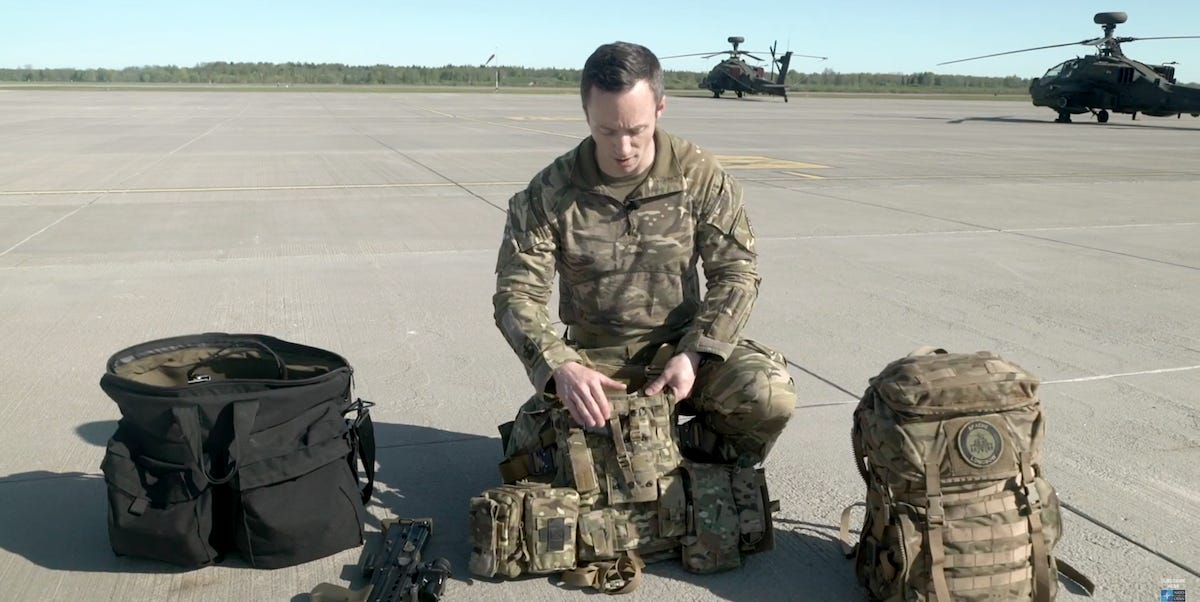
The survival vest is the pocketed heart of the system. Older public Army technical information for aircrew survival armor recovery equipment describes a vest-based setup carrying survival, signal, and communication components. Public descriptions include items such as a compass, mirror, distress signal equipment, medical and basic survival components, and a radio pocket. Modern systems have continued the same basic idea: keep essential equipment on the person, not somewhere unreachable.
Newer Army reporting on the Aircrew Combat Equipment vest shows a push toward improved protection, modularity, and reduced burden for rotary-wing crews. That is important for Apache crews because a vest has to do many jobs at once. It must carry emergency equipment, integrate with body armor or flotation where needed, and avoid interfering with restraints, controls, or cockpit movement.
4. Communications and Location Aids
If an Apache crew is down, being found is a priority. Publicly discussed survival gear commonly includes communications and signaling equipment. The broad purpose is simple: help friendly recovery forces identify, locate, and communicate with the crew. Depending on era and system, this category may include survival radios, emergency beacons, and visual signaling aids.
This is where training matters as much as hardware. A device is only useful if the crew knows how to manage it under stress, in bad weather, possibly injured, and possibly separated from the aircraft. The gear is small; the discipline behind it is enormous.
5. Visual Signaling Tools
Public Army survival vest descriptions have included visual signaling equipment. At a high level, this can mean reflective signaling, lights, markers, or other location aids approved for military use. The purpose is not to “look cool,” although some gear does have a dramatic Hollywood glow. The purpose is to help rescue teams distinguish a friendly survivor from rocks, brush, shadows, or every other annoying thing that looks human-shaped from the air.
Visual signals are especially important when radios are limited, damaged, or affected by terrain. In aviation recovery, redundancy is king. If one method fails, another may still work.
6. Basic Medical Support
Survival gear often includes medical components intended for immediate emergency needs. Apache crews train for demanding missions, but even the best aircraft and best crew can face hard landings, burns, cuts, dehydration, shock, or exposure. Basic medical supplies help stabilize the situation until recovery.
The key word is “basic.” The survival kit does not turn a pilot into a flying hospital. It buys time. In survival planning, buying time is often the whole ballgame.
7. Water and Environmental Survival Items
Environment drives survival planning. Desert, mountain, jungle, cold weather, and over-water operations create very different needs. Public Army discussions of aviation life support equipment and SERE training repeatedly emphasize environmental stress, hydration, and survival under harsh conditions.
An Apache crew operating in hot terrain may need water-related survival support and heat management. A crew flying over water may require flotation or emergency breathing-related equipment depending on mission and aircraft setup. A crew in cold weather needs protection against exposure. The kit is not one-size-fits-all; it is mission-tailored.
8. Food, Shelter, and Sustainment Basics
Public Army materials on aircrew equipment have referenced survival items intended to support crews for a limited emergency window. In practical terms, sustainment basics may include compact items for hydration, energy, warmth, and temporary protection from the environment. These are not camping luxuries. Nobody is packing a cast-iron skillet and marshmallows in an Apache cockpit.
The point is to keep the survivor functioning. A cold, exhausted, dehydrated person makes worse decisions. A basic sustainment kit helps protect the mind as much as the body.
How Apache Survival Gear Has Evolved
The Army has spent years improving aircrew gear because old problems do not vanish just because aircraft get smarter. Public reporting on Air Soldier and Air Warrior efforts highlights goals such as reducing weight and bulk, improving situational awareness, and keeping essential survival capabilities. Army reporting on the Aircrew Combat Equipment vest describes one of the most significant upgrades to rotary-wing aircrew protection in more than two decades.
That trend tells us something important: survival gear is not static. It changes with aircraft, threats, materials, climate needs, and lessons from training and operations. A vest that made sense years ago may be too bulky for today’s cockpit integration. Armor that protects well but limits reach can create problems. A kit that works in one environment may be incomplete in another.
Survival Gear Is Also About the Apache’s Built-In Protection
When discussing Apache survival, it is easy to focus only on what the crew carries. But the aircraft itself is part of the survival equation. Public Army and Boeing information emphasizes survivability, improved performance, and modernization. Army reporting has also discussed aircraft survivability equipment, such as missile warning and infrared countermeasure systems, designed to improve protection for rotary-wing aircraft.
These aircraft systems aim to prevent the emergency from happening in the first place. The personal survival kit is what matters if prevention fails. In aviation safety, that layered mindset is normal: avoid the threat, survive the impact, exit the aircraft, communicate, signal, stabilize, and recover.
Why the Kit Must Be Compact and Wearable
An Apache cockpit is not a walk-in closet. The crew sits in tandem, surrounded by controls, displays, restraints, and mission equipment. Survival gear must be placed where it can be carried without blocking movement or creating snag hazards. Public research into rotary-wing aviator performance has examined how life support and protective ensembles affect crew performance in AH-64 simulator settings. That is a polite scientific way of saying: gear can save you, but too much gear in the wrong place can also make flying harder.
This is why modern aircrew systems chase a difficult balance: protection without clumsiness, capability without clutter, and enough emergency gear without turning the pilot into a tactical Christmas tree.
Training: The Invisible Part of the Survival Kit
The most important survival item is not always an object. It is training. U.S. Army aviation career information has referenced Survival, Evasion, Resistance, and Escape training requirements for Army aviators. Public Army articles also show personnel recovery training where aircrews practice with assigned survival equipment components.
Training turns gear into capability. A mirror, radio, medical item, or location aid is only useful if the crew can identify it, reach it, and use it appropriately while tired, scared, injured, wet, cold, overheated, or all of the above. Survival training also teaches priorities: protect life, manage exposure, communicate, conserve energy, and support recovery.
What Is Not Publicly “Revealed”
It is worth being honest: no responsible article should pretend to publish a current, complete, mission-specific Apache survival kit inventory. Exact configurations may vary by unit, mission, theater, aircraft model, threat level, and current Army guidance. Some details are not appropriate for public discussion. That is not secrecy for drama; it is common sense.
What can be said safely is this: Apache survival gear is built around protection, communication, signaling, medical basics, water and environmental survival, modular load carriage, and recovery support. It is a professional system maintained by trained personnel, not a random pouch of gadgets bought five minutes before takeoff.
500-Word Experience Section: What Apache Survival Gear Teaches About Real Preparedness
One of the most useful ways to understand an Apache helicopter survival kit is to stop thinking about it as a collection of objects and start thinking about it as a culture. In Army aviation, equipment is checked, inspected, fitted, trained with, complained about, improved, and checked again. That cycle may sound boring, but boring is beautiful when the alternative is discovering a missing item after an emergency.
Accounts from aviation life support environments show that ALSE personnel are the quiet professionals behind crew survival. They are not the ones in the recruiting poster, but they are the people making sure flight gear is serviceable, properly configured, and ready. A pilot may be the star of the cockpit, but the ALSE shop is part of the safety net. Think of it as the backstage crew for a very loud, very expensive, very serious theater production.
The first practical lesson is that survival gear has to be familiar before it is needed. In a calm classroom, almost anyone can point to a pocket and say what belongs there. In a real emergency, fine motor skills fade, attention narrows, and simple tasks become harder. That is why repetition matters. Crews train with equipment so they can find and manage essential items under pressure. The best kit is not the biggest kit; it is the kit the crew can actually reach, recognize, and rely on.
The second lesson is that weight matters. People often imagine more gear equals more safety. Aviation proves that this is only half true. Gear that is too heavy, too hot, or too bulky can reduce mobility and endurance. In an Apache, where cockpit space is tight and crew coordination is constant, a survival vest must earn every inch. This explains why newer systems focus on modularity and reduced bulk. The goal is not to carry everything imaginable. The goal is to carry what matters, in a layout that supports the mission.
The third lesson is that environment always gets a vote. A survival setup for desert heat is not the same as one for cold weather or over-water operations. Hydration, exposure protection, flotation, visibility, and emergency communication needs change with the mission area. That is why responsible survival planning avoids universal “one perfect kit” claims. The perfect kit for one mission could be incomplete for another.
The fourth lesson is humility. Apache crews train hard, fly advanced aircraft, and use sophisticated systems, but survival planning begins with the assumption that things can still go wrong. That mindset is not pessimistic. It is professional. The survival kit is a reminder that technology, training, and preparation work best when they overlap.
Finally, Apache aircrew survival gear shows that preparedness is not about panic. It is about calm preparation before the bad day arrives. The gear is inspected before takeoff. The crew trains before deployment. Recovery plans exist before they are needed. That is the real “combat gear revealed”: not just radios, vests, protective clothing, and survival items, but a disciplined system designed to keep human beings alive when the aircraft can no longer do it for them.
Conclusion
An Apache helicopter survival kit is not a single mysterious bag hidden under the seat. It is a layered survival ecosystem that includes protective clothing, helmet systems, a survival or combat equipment vest, communication and signaling aids, basic medical support, environmental survival items, and mission-specific additions. Just as important, it includes the training and maintenance culture that makes the gear useful under pressure.
The Apache may get attention for power, speed, sensors, and battlefield presence, but crew survival depends on smaller, quieter details: a properly fitted vest, a working communication device, a visible signal, a checked medical component, a trained response, and a recovery plan. In the end, the most impressive survival gear is not the flashiest item. It is the item that works when the crew needs it most.