
Most chairs quietly accept their destiny: support a human, collect a sweater, repeat. Marni’s colorful woven chairs refused that job description. Introduced during Milan Design Week in 2012, the limited-edition furniture combined the Italian fashion house’s offbeat color sense with Colombian craft traditions, social reintegration, portrait photography, and charitable fundraising. These seats had more going on than some entire living rooms.
The project became widely known as 100 Chairs and was connected to L’Arte del Ritratto, or “The Art of Portraiture,” a visual collaboration with photographer and filmmaker Francesco Jodice. The furniture was made in Colombia through a rehabilitation-oriented workshop involving former prisoners and craftspeople. Sales benefited ICAM in Milan, an initiative helping children of incarcerated mothers grow up in a more family-like environment. The result was not merely fashionable furniture with a donation attached. It was a layered story about labor, dignity, family, color, and the power of a chair to carry more than body weight.
Historical project details synthesized from contemporary design coverage.
How Marni Moved From the Runway to the Living Room
Marni built its fashion reputation through unexpected prints, unusual proportions, fearless color combinations, and cultivated eccentricity. Its clothes often appear sophisticated and playful at once, as though a museum curator and an art-school rebel agreed to share a closet. Translating that aesthetic into furniture made surprising sense.
For the 2012 Salone del Mobile, the brand presented a limited family of chairs, lounge seats, rocking chairs, deck chairs, and small tables. Period reports do not always use identical counts for each type, but the collection was consistently promoted around the idea of one hundred handmade pieces. The forms referenced traditional Colombian seating, while Marni developed fresh woven patterns and color combinations.
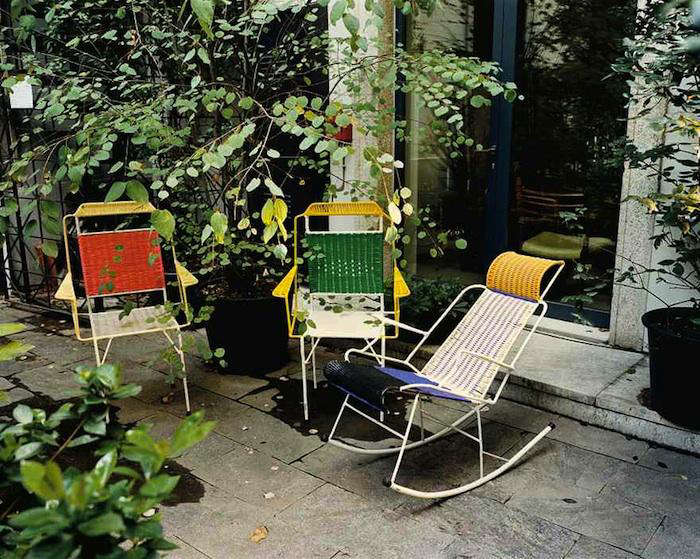
This was not a logo stamped on a generic chair. Marni’s hand was visible in the rhythm of the weaving, the use of asymmetry, and combinations that should have argued but somehow became friends. Pink met orange without requesting permission. Green sat beside blue with total confidence. Black and white added graphic structure, turning the frames into three-dimensional drawings.
Materials That Made the Chairs Memorable
Metal Frames With a Second Life
The pieces used slim metal structures, often described in contemporary coverage as salvaged or reclaimed frames. The material created a sturdy skeleton without making the furniture visually heavy. It also supported the project’s interest in reuse: an existing frame could become the foundation for a highly distinctive new object.
Handwoven PVC Cord
Multicolored PVC cord was woven around seats, backs, and arms. On a specification sheet, PVC sounds about as romantic as a plumbing invoice. In the chairs, however, it behaved like textile: stretched, crossed, layered, and repeated until the surface gained texture and depth.
The handmade process kept the pieces from feeling mechanically identical. Small variations revealed the maker’s touch. Color was not simply applied after the form was finished; it helped define width, movement, curves, and visual balance. From across a room the chairs looked graphic. Up close, the weave rewarded slow inspection.
Construction, materials, and Colombian design references.
The Cause Behind the Color
The project’s social purpose operated on two connected levels. First, production in Colombia was tied to a workshop model supporting the professional and social reintegration of people with prison experience. Such work can offer income, skills, routine, and renewed participation in community life. The respectful way to understand that story is to recognize the makers as craftspeople, not to reduce their lives to dramatic marketing material.
Second, proceeds went to ICAM in Milan. The organization was described as helping children of incarcerated mothers spend their early years in a family-oriented setting rather than a conventional prison environment. That created a meaningful link between production and beneficiary: both parts of the project addressed consequences of incarceration through work, care, and domestic space.
A chair is an appropriate object for that message. Chairs suggest belonging. They create a place at the table, a position in a room, and a small claim to comfort. By turning seating into a vehicle for reintegration and family support, Marni gave the ordinary act of sitting a social dimension.
Charitable purpose and rehabilitation context.
L’Arte del Ritratto: Furniture as a Stage for People
The furniture appeared alongside L’Arte del Ritratto, a photography and video project by Francesco Jodice. Marni employees, technicians, artisans, and collaborators were photographed with the chairs, bringing people behind the fashion house into view.
Luxury campaigns usually place the finished object in the spotlight while the larger workforce remains invisible. Jodice’s portraits shifted the emphasis. The chair became a stage, the employee became the subject, and Marni appeared less like a mysterious label floating above Milan and more like a community of humans who design, stitch, plan, solve problems, and probably wonder who finished the office coffee.
The portrait exhibition later traveled to Marni boutiques, where additional local teams could be photographed and added. The project therefore expanded rather than remaining frozen at its Milan debut.
L’Arte del Ritratto exhibition and touring format.
From Milan Design Week to Art Basel Miami
The chairs attracted attention during Milan’s 2012 design festivities, where fashion brands were increasingly using Salone del Mobile to experiment beyond clothing. Marni’s presentation stood out because it was colorful, handmade, socially engaged, and immediately understandable. Visitors did not need a twelve-page curatorial essay to recognize that the pieces were joyful; the deeper story rewarded those who asked questions.
Later in 2012, the chairs appeared in Miami during Art Basel and Design Miami, bringing the project to a broader American audience. Contemporary coverage reported that examples were available through the Marni store, with some priced around $300. For limited furniture linked to a luxury fashion house, that was unusually approachablealthough “approachable” remains a risky word for any chair that costs more than a weekend road trip.
Miami helped the collection enter a wider conversation involving art, fashion, interiors, philanthropy, and collecting. The chairs were no longer just a furniture-fair launch. They became cultural objects that showed what a fashion brand could make and what the sale of those objects could support.
Milan and Miami presentation details.
Why Marni’s Woven Chairs Still Feel Current
They Blurred Fashion and Furniture Naturally
Today, fashion labels regularly release furniture, tableware, hotel interiors, and café concepts. Marni’s project remains convincing because the chairs did not feel like an unrelated side business. Their fearless colors, awkward charm, and unexpected proportions belonged unmistakably to the brand.
They Connected Craft With Social Value
The collection anticipated growing interest in the human story behind design. Buyers increasingly ask who made an object, how it was produced, and whether the process created value beyond a retail transaction. Marni offered a clear narrative, though modern audiences would reasonably request even more transparency about wages, long-term employment, material sourcing, and direct maker credit.
They Made Serious Ideas Visually Inviting
Socially engaged design can occasionally look as cheerful as a tax form. Marni took another route. The chairs were exuberant first and explanatory second. Their beauty invited attention; the cause deepened it. They worked because people wanted them as furniture, not only as moral receipts.
Marni continued exploring the relationship between fashion, Colombian craftsmanship, interiors, and charitable support in later design-week collections. That continuity helped turn the original chairs from an isolated experiment into an early chapter of a broader creative language.
Later Marni furniture and charitable design initiatives.
How to Style a Marni Chair
A Marni woven chair is not interested in disappearing inside a beige room. In a restrained interior, place one beside a white wall, pale oak table, or neutral sofa. The pattern becomes a focal point without turning the space into a carnival tent.
In a colorful room, repeat only one or two shades from the chair: perhaps a cobalt vase, rust pillow, or green artwork. Avoid matching everything exactly. Marni’s appeal depends on tension and surprise, not on making a room look as if it was purchased in one nervous afternoon.
The chairs also suit covered patios, sunrooms, courtyards, and breakfast corners. Protection from prolonged moisture and intense sunlight remains sensible, especially for collectible examples. Metal can corrode, cord can loosen, and color can fade. Fashionable furniture, like fashionable people, occasionally needs shade.
Collecting, Authenticity, and Care
Original pieces from the 2012 project are limited design objects, so provenance matters. Useful evidence may include receipts, original tags, boutique correspondence, exhibition records, or auction documentation. Color alone is not proof: woven metal chairs inspired by Latin American traditions exist in many forms.
Inspect the cord where it wraps around the frame, beneath the seat, and near arm joints. Look for rust, cracked PVC, loose weaving, distorted legs, repainting, or repairs made with mismatched material. Routine care should be gentle: use a soft brush, a low-suction vacuum attachment, or a slightly damp cloth, and avoid aggressive solvents.
Before placing a collectible chair outside, determine whether it has already been restored or whether protective coatings have aged. A covered terrace is generally kinder than an exposed pool deck. The chair may look ready for permanent vacation, but rain, ultraviolet light, and chlorine are terrible travel companions.
The Ethical Lesson: A Cause Should Be More Than a Caption
Marni’s chairs offer a practical standard for judging later fashion-for-good campaigns. A credible initiative should connect the product, making process, and beneficiary clearly. It should respect the people whose histories give the project emotional power, explain where money goes, and create an object worth owning even without the charitable message.
The project did not solve incarceration, inequality, or employment barriers. No chair is that talented. It did, however, direct attention and money toward difficult issues while celebrating skilled work. Its makers, materials, sales, beneficiary, and portrait exhibition formed one coherent narrative rather than a cause pasted onto a product at the last minute.
There is also a broader lesson for luxury brands. Social impact works best when it is embedded in production and distribution rather than confined to an advertising slogan. A colorful product can attract an audience, but transparency, fair treatment, and durable partnerships determine whether the underlying initiative has lasting value.
A 500-Word Experience Guide: What It Feels Like to Live With a Marni Chair
Living with a Marni chairor simply spending time with one in a showroom, gallery, or collector’s homeis different from seeing it online. In photographs, the first impression is color. In person, the first impression is energy. The woven lines create visual vibration, especially where several shades cross within a narrow backrest. As you move around the chair, patterns overlap and separate. It behaves almost like kinetic art, despite having the athletic mobility of, well, a chair.
The next experience is tactile. The cord has tension and texture, and the seat responds differently from upholstery. It supports without swallowing the sitter. You remain aware of the frame and woven construction, which makes sitting feel slightly more active. This is not necessarily the throne for an eight-hour movie marathon with a popcorn bowl the size of a satellite dish. It is better suited to conversation, reading, coffee, or a slow afternoon outside.
Then comes the social effect. Guests notice it. A Marni chair rarely waits politely for someone to ask; it begins the conversation on arrival. People want to know whether it is vintage, handmade, Italian, Colombian, indoor, outdoor, art, or furniture. The most accurate response is “yes, more or less,” followed by the project’s story. That storytelling function is part of ownership. One chair connects a Milanese fashion house, Colombian workshops, former prisoners, an Italian family-support initiative, and international design events.
Placement changes the mood dramatically. In a minimalist room, the chair acts like punctuationan exclamation point after several calm sentences. In a bohemian interior, it joins a conversation among textiles, ceramics, plants, and collected objects. Outdoors, it can appear almost native beside dense greenery. The best location gives the silhouette breathing room.
Daily use also teaches respect for handmade variation. One section of weaving may sit differently from another. Color shifts with daylight. Small marks gradually become part of the object’s history, although collectors may experience every scratch as a personal betrayal. Care becomes a balance between preservation and purpose. Locking the chair away protects it but weakens its identity as seating. Treating it like disposable patio furniture ignores its rarity. Thoughtful, regular use offers the sensible middle path.
Comfort is also more nuanced than it appears in photographs. The flexible weave can feel pleasantly supportive, but individual models differ in seat depth, back angle, and arm height. A low lounge chair encourages relaxed sitting, while a straighter dining-style chair creates a more upright posture. Trying the chair before buying is ideal, especially when the intended user is tall, petite, or hoping to spend long periods reading.
Most importantly, the chair changes how value is understood. Its significance does not come only from the Marni name, limited production, or possible resale price. Value also resides in labor, context, and connection. The object encourages its owner to notice the hands that made it and the family-focused cause its sale supported. That does not turn every cup of coffee enjoyed in the chair into a heroic act. It simply makes the furniture harder to regard as anonymous.
After time with a Marni chair, ordinary seating can seem strangely silent. The Marni piece has a biography. It carries fashion history, design-week excitement, cultural exchange, charitable ambition, and the irregular beauty of human making. You may sit down because your feet are tired, but you stand up remembering that useful objects can participate in larger stories.
Conclusion: Style, Substance, and a Seat at the Table
Fashionable Chairs for a Cause from Marni remains a memorable example of fashion moving into furniture without losing its identity. The project translated Marni’s bold visual language into woven PVC and metal, referenced Colombian craft, involved people rebuilding working lives after incarceration, and generated support for children of imprisoned mothers through ICAM.
Its lasting appeal comes from balance. The chairs are serious without looking solemn, collectible without feeling cold, and charitable without sacrificing design quality. Sometimes a chair is simply a place to sit. Sometimes it arrives dressed for Milan, raises money for families, starts three conversations, and makes the beige sofa across the room question its life choices.
Editorial note: Contemporary reports sometimes describe the exact mix of chairs, loungers, and tables differently, but consistently identify the project as a limited collection centered on approximately one hundred handmade pieces.