
Nature has no shortage of dramatic survival tools: claws, venom, armor, speed, and teeth that would make a dentist quietly leave the room. Yet some animals survive by doing something far less theatrical. They simply disappear.
Animal camouflage can involve matching a background, breaking up the body’s outline, resembling an unrelated object, changing color, or attaching pieces of the environment to the body. Predators use these adaptations to approach prey, while prey animals use them to avoid becoming lunch. In either case, camouflage turns the natural world into an enormous game of hide-and-seek in which losing may have serious consequences.
How Does Animal Camouflage Work?
Camouflage is not one single trick. It is a collection of visual and behavioral strategies that reduce the chance of detection. The most familiar form is background matching, in which an animal’s colors resemble its surroundings. Other species use disruptive patterns that make their outlines difficult to recognize.
Then there is masquerade: an animal may look like a leaf, twig, rock, flower, or patch of coral. Some creatures add movement to the performance by swaying like vegetation or freezing in a branch-like pose. A smaller group can alter its appearance dynamically, changing its color, pattern, texture, or posture as conditions shift.
The following masters of disguise demonstrate just how inventive evolution can become when being noticed is bad for business.
1. Cuttlefish: The Living High-Definition Display
Color, pattern, and texture on demand
A cuttlefish does not merely wear camouflage. It operates an entire visual-effects department beneath its skin. Specialized structures allow it to produce rapidly changing patches, bands, spots, and waves of color. Pigmented cells called chromatophores contribute dark and warm tones, while reflective cells help create additional optical effects.
The deception does not stop with color. Muscular structures called papillae can alter the skin’s texture, helping a cuttlefish resemble sand, pebbles, algae, or rough coral. One moment it looks smooth and pale; the next it appears mottled and bumpy, as though the seafloor has developed eyes and decided to leave.
Cuttlefish use these displays to hide from enemies, stalk prey, communicate, compete, and court potential mates. Researchers have also observed cuttlefish producing specialized patterns while approaching crabs, showing that camouflage can become an active hunting strategy rather than a simple invisibility setting.
2. Mimic Octopus: The Underwater Impersonator
A disguise with acting included
Many octopuses can alter their color and body texture, but the mimic octopus takes deception into theatrical territory. It changes not only its appearance but also its posture and behavior, creating impressions of other marine animals.
By arranging its flexible arms in different ways, it may resemble creatures such as a lionfish, sea snake, jellyfish, shrimp, or crab. The performance can include changes in movement. A convincing disguise is more useful when the “sea snake” moves like a sea snake instead of an eight-armed balloon trying to hail a taxi.
This behavioral mimicry may discourage predators by suggesting that the octopus is venomous, dangerous, or simply not worth investigating. It can also help the octopus move across exposed seafloor habitats where a plain, undisguised body would attract unwanted attention.
3. Phantastic Leaf-Tailed Gecko: The Dead Leaf That Blinks
Ragged edges complete the illusion
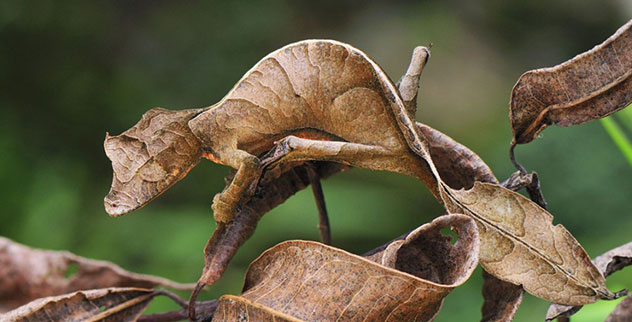
Madagascar’s leaf-tailed geckos look as though someone swept together a pile of forest debris and accidentally gave it toes. Their flattened bodies, mottled colors, irregular outlines, and leaf-shaped tails allow them to disappear against bark, branches, and dead foliage.
The phantastic leaf-tailed gecko is especially convincing. Its markings can resemble leaf veins and patches of lichen, while notches along the tail imitate damage commonly seen on decaying leaves. Instead of presenting predators with the familiar outline of a lizard, the gecko offers what appears to be one more unremarkable piece of forest litter.
Remaining still during daylight makes the disguise even more effective. Other leaf-tailed geckos use skin flaps and flattened bodies to reduce shadows around their edges, preventing their silhouettes from giving away the game.
4. Pygmy Seahorse: Coral with a Curly Tail
Tiny enough to overlook, detailed enough to amaze
Pygmy seahorses are among the smallest and most difficult marine animals to spot. Bargibant’s pygmy seahorse grows to roughly two centimeters long and lives among the branches of gorgonian coral. Its body color and rounded bumps closely match the coral polyps around it.
The result is a disguise so precise that the animal can be difficult to recognize even when someone points directly at it. It does not merely share the coral’s general color; its body recreates the coral’s texture and repeated surface pattern.
For a tiny fish that is not built for high-speed escape, remaining unnoticed is a sensible strategy. The seahorse grips its host with a curled tail and becomes part of the scenery. Somewhere nearby, a frustrated photographer is probably insisting that the empty-looking coral branch definitely contains a fish.
5. Walking Stick Insect: The Twig with Travel Plans
Shape and behavior working together
Walking sticks, also called stick insects, use long, narrow bodies and branch-like legs to imitate twigs. Their brown, green, or mottled coloration strengthens the illusion, but physical appearance is only part of the trick.
Many stick insects hold their bodies at branch-like angles and move slowly. Some sway gently, resembling vegetation shifting in a breeze. That behavioral detail matters because a perfectly twig-shaped insect that sprints across a leaf would raise questions.
Stick and leaf insects represent an ancient and highly successful form of masquerade. Their disguises help them avoid birds, reptiles, and other visual predators while they feed on vegetation. The best camouflage, apparently, sometimes involves spending the afternoon pretending to be furniture.
6. Leaf-Mimic Katydid: Even the “Leaf Damage” Looks Real
Veins, edges, spots, and perfect posture
A leaf-mimic katydid does not settle for being vaguely green. Depending on the species, its wings may resemble healthy foliage, dried leaves, torn vegetation, or leaves marked by fungus and decay. Vein-like lines run across the wings, while irregular edges and spots strengthen the deception.
During the day, many katydids remain still in positions that help their bodies merge with surrounding plants. This reduces the likelihood of being detected by birds, frogs, monkeys, snakes, and other predators. When night arrives, the supposedly ordinary leaf may unfold its legs and begin walking away, which seems rude after everyone trusted it.
Leaf mimicry demonstrates that effective camouflage often depends on tiny details. A plain green body may be helpful, but a body that resembles a specific leafincluding its imperfectionsis considerably harder to identify.
7. Screech-Owl: Bark with Bright Yellow Eyes
Mottled feathers erase the bird’s outline
Screech-owls spend much of the day resting in cavities or against tree trunks. Their mottled gray, brown, or reddish plumage closely resembles bark, especially when the birds remain motionless in shadow.
Feather patterns break up the shape of the head and body, while small ear tufts further disrupt the familiar round outline of a bird. When pressed against a trunk, a screech-owl can appear to be part of the tree until it opens its eyes. Then the tree seems strangely judgmental.
This concealment provides protection while the nocturnal owl sleeps. It also demonstrates why behavior and habitat selection are essential parts of camouflage: bark-colored feathers work best when the bird chooses bark as its background rather than, for example, a shiny red mailbox.
8. Arctic Fox: A Disguise for Every Season
White in winter, earthy in summer
The Arctic fox uses seasonal camouflage to remain inconspicuous in a landscape that transforms dramatically throughout the year. During winter, many Arctic foxes grow thick white coats that blend with snow and ice. When summer exposes rocks, soil, and tundra vegetation, the coat changes to brown or gray.
This seasonal wardrobe assists both hunting and predator avoidance. A white fox crossing a snowfield can be remarkably difficult to follow, particularly when blowing snow softens its outline. The same white coat would be considerably less useful after the tundra turns brown, so molting provides a new background-matching pattern.
The strategy is elegant, although it requires excellent timing. Nature does not provide changing rooms, garment bags, or a customer-service desk for foxes unhappy with the spring collection.
9. Stonefish: The Rock You Should Not Step On
Camouflage combined with a powerful defense
Stonefish are bottom-dwelling ambush predators with mottled coloration, rough skin, irregular shapes, and lumpy surfaces that help them disappear among rocks, coral, sand, and reef debris. Algae may even grow on their bodies, making the illusion more convincing.
Remaining still allows a stonefish to wait for smaller animals to approach. It can then capture prey with a sudden strike. Its camouflage also creates a serious hazard for people because stonefish possess venomous dorsal spines. Accidental contact may occur when someone fails to recognize that a rock-shaped object is, in fact, a fish with strong opinions about personal space.
Stonefish camouflage therefore serves two functions: it hides a predator from prey and reduces the need to chase food. The venomous spines provide a separate defense if the disguise fails or the animal is stepped on.
10. Decorator Crab: Camouflage You Can Put On
A portable garden attached with natural hooks
Decorator crabs take a wonderfully practical approach to concealment: they collect materials from their habitat and attach them to their shells. Pieces of algae, sponges, anemones, and other small organisms can be fastened to hooked bristles called setae on the crab’s carapace.
Instead of evolving one permanent pattern, the crab assembles a disguise from whatever is locally available. In a kelp habitat, it can wear algae. Elsewhere, sponges and anemones may make more suitable accessories. As long as the crab stays near the environment represented by its outfit, it becomes difficult for predators to recognize.
This form of self-decoration is camouflage with a do-it-yourself spirit. The crab does not merely blend into its neighborhood; it picks up pieces of the neighborhood and carries them around. Interior decorators may call this “bringing the outdoors in.” The crab calls it Tuesday.
Why These Animal Camouflages Are So Effective
The most successful disguises combine several techniques rather than relying on color alone. The leaf-tailed gecko matches color, texture, shape, and shadow. The walking stick adds careful movement to its twig-like body. The decorator crab adjusts its disguise to the local habitat, while the cuttlefish changes its entire visual display in seconds.
Camouflage also depends on the observer. Some predators detect colors, polarized light, movement, or fine patterns differently from humans. An animal that looks obvious in a brightly lit photograph may be much harder to detect beneath water, inside forest shade, or through the visual system of its natural enemy.
Most importantly, camouflage does not need to create perfect invisibility. It only needs to delay recognition. A few extra seconds may give prey time to escape or allow a predator to move close enough to strike.
Experiencing the Hidden World: Learning to See Camouflaged Animals
An illustrative naturalist-style field experience
Imagine joining a wildlife guide on a forest walk just after sunrise. At first, the landscape appears calm and uncomplicated: wet bark, hanging vines, brown leaves, and patches of moss. The guide stops beside a tree and asks the group to find the gecko. Everyone examines the trunk. Nothing moves. A few people confidently point at knots in the bark. Someone identifies a promising clump of lichen, which turns out to be exactly thata clump of lichen.
Then the guide traces the air beside a faint outline. A tail appears first, shaped like a damaged leaf. Gradually, legs, eyes, and a flattened body emerge from the visual confusion. The surprising part is not that the gecko was small. It is that the animal was visible the entire time. The human brain simply classified its details as bark and ignored them.
That experience changes how a person looks at nature. Instead of searching only for complete animal shapes, the observer begins looking for inconsistencies: a leaf vein that bends unnaturally, a patch of bark that seems too symmetrical, or a twig with tiny joints. Movement becomes important, but so does unusual stillness. A bird that refuses to shift position may be hiding. A rock that appears to breathe deserves another lookpreferably from a safe distance.
An aquarium offers a similar lesson. A cuttlefish may be obvious while swimming through open water, but once it settles near a textured surface, its skin transforms. Colors break into patches, the body darkens, and the surface becomes uneven. Watching this change in real time makes static photographs feel incomplete. Camouflage is not always a costume; sometimes it is a continuous response to light, texture, danger, and opportunity.
Finding a pygmy seahorse can be even more humbling. An observer may stare directly at a coral fan while a guide repeatedly indicates the correct branch. The seahorse remains invisible until one tiny eye moves. Once detected, it becomes difficult to understand how it was ever missed. That sudden shiftfrom “nothing is there” to “how could I not see it?”is one of the great pleasures of wildlife observation.
These encounters also encourage patience. Wild animals do not perform on command, and searching carelessly can damage the habitat that makes their camouflage possible. Turning over rocks, touching coral, shaking branches, or approaching a resting owl may expose or stress the animal. Ethical observation means slowing down, watching from an appropriate distance, and allowing the disguise to remain useful.
Over time, the experience becomes less about collecting sightings and more about improving attention. A forest, reef, or tundra is not empty merely because its residents are hard to see. It may be crowded with creatures whose survival depends on persuading the eye that there is nothing worth noticing.
Conclusion: Nature’s Masters of Disappearance
The world’s most amazing animal camouflages reveal that survival often depends on deception, timing, and extraordinary attention to detail. Cuttlefish transform their skin like living screens. Mimic octopuses combine visual disguise with performance. Geckos, katydids, and walking sticks impersonate leaves and branches, while screech-owls vanish against bark.
Other animals take entirely different approaches. Arctic foxes change coats with the seasons, stonefish become dangerous pieces of reef, and decorator crabs build portable disguises from their surroundings. Each strategy solves the same basic problem: how to see without being seen.
The next time a forest, shoreline, or coral reef appears quiet, look again. The most remarkable animal in the scene may already be in front of you, patiently waiting for your eyes to catch up.
SEO Metadata