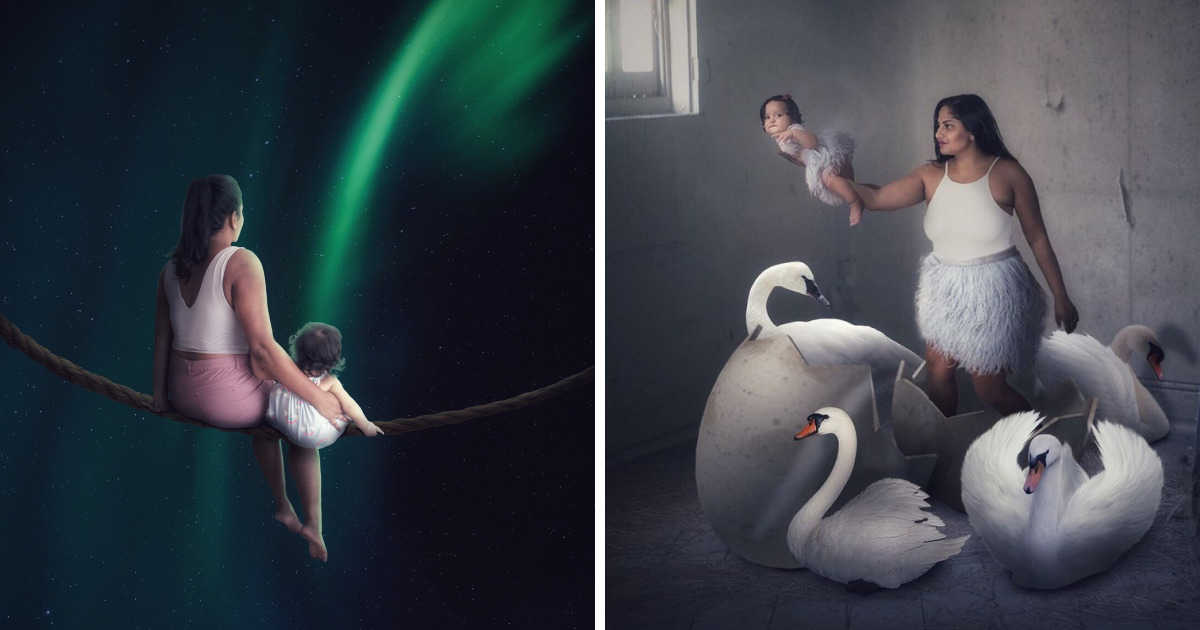

Most family albums contain birthday cakes, sleepy smiles, and at least one photograph in which somebody has blinked at exactly the wrong moment. Lyann Kearin’s collection of surreal mother-and-daughter photography takes a dramatically different route. In her visual universe, a living room becomes a star-filled sky, a backyard turns into an enchanted woodland, and an ordinary bath can apparently migrate to a rooftop.
Kearin began the project as a first-time mother photographing her baby daughter, Ava. After experimenting with a mobile bokeh application and Photoshop Mix, she taught herself more advanced photo manipulation techniques. The original portraits were captured close to homein the living room, garden, and near the family shedbefore digital editing transported mother and daughter into elaborate fantasy worlds.
The result is more than a collection of cute baby pictures with sparkles sprinkled on top. These creative family portraits explore imagination, cultural identity, motherhood, humor, anxiety, and the small emotional adventures hidden inside domestic life. Below, we examine the ten surreal scenes, what makes each composition memorable, and why creating fantasy photography at home can produce surprisingly powerful visual storytelling.
How an Ordinary House Became a Surreal Photography Studio
Surreal photography works by presenting something recognizable and then quietlyor spectacularlybreaking the rules. A familiar face may float in space. A household object may become enormous. A normal room may open into a landscape that could not physically exist. Museums and photography archives describe surrealist photography as a medium capable of turning dreams, fears, fantasies, and unconscious ideas into apparently believable images.
Kearin uses that tradition in a warm, personal way. Instead of constructing disturbing dreamscapes, she combines motherhood with fairy-tale imagery. Her home supplies the practical ingredients: simple backgrounds, natural light, familiar costumes, a baby bath, books, a dog, and a traditional swing. Digital compositing supplies the moonlight, forests, giant mushrooms, magical skies, and occasional airborne broom.
That combination is important. The photographs feel fantastical, but they remain anchored by the genuine connection between mother and daughter. Viewers may not believe that Ava is actually drifting through the night sky, but they believe the affection in the scene.
1. Watching the Northern Lights
In the first scene, mother and daughter appear to sit together beneath a glowing night sky. The composition transforms a quiet domestic pose into a private encounter with the aurora borealis. There is no crowded observation deck, no suitcase, and no frozen toesarguably the most luxurious possible way to view the northern lights.
The image succeeds because the emotional action is simple. A mother holds her baby while both figures face something vast and beautiful. The sky provides spectacle, but the body language creates meaning. It suggests a parent introducing a child to wonder long before the child can understand how large the world really is.
Technically, this type of composite depends on compatible lighting. If the figures are photographed under warm, flat indoor light but placed beneath a cool, luminous sky, the illusion quickly falls apart. Adjusting color temperature, contrast, edge detail, and reflected light helps separate a convincing dreamscape from a family portrait pasted onto a desktop wallpaper.
2. When You Cannot Find the Sunshine, Be the Sunshine
This optimistic scene began as a different concept involving a swan-princess-style reflection. When the first idea failed to cooperate, Kearin changed direction and produced a brighter visual message. That creative pivot is one of the project’s most relatable details. Sometimes art arrives through careful planning; sometimes the original plan falls over and the backup idea walks away wearing the crown.
The finished image treats light as both a physical and emotional symbol. Mother and daughter do not merely stand in sunshinethey become part of its warmth. The scene can be read as encouragement, especially within the unpredictable early months of parenthood. When circumstances feel gray, connection becomes its own source of brightness.
Surreal family photography is particularly effective when its visual metaphor is easy to understand. The audience does not need an instruction manual. Light means hope, warmth, energy, and safety. By placing Ava at the center of that symbolism, the image turns a familiar motivational phrase into an intimate family portrait.
3. “Life of Us,” Inspired by Life of Pi
One of the collection’s most cinematic compositions draws inspiration from Life of Pi. The image echoes the film’s dreamlike ocean imagery while replacing its lonely survival story with a mother-and-child adventure.
The inspiration carries personal significance for Kearin because of her South Indian background and her connection to the story’s Indian protagonist. That cultural thread gives the image more substance than a simple movie tribute. It becomes a playful act of identification: an internationally recognized fantasy is reimagined through her own family.
Water is a useful element in surreal photography because it creates reflections, visual depth, and a sense of uncertainty. A calm surface can look peaceful one moment and infinite the next. In a composite portrait, an ocean can represent risk, discovery, isolation, or freedom. Here, it feels like a shared voyage. Ava is not merely being carried through the scene; she is presented as her mother’s tiny travel companion.
4. Royal Swing
The “Royal Swing” scene combines family history, cultural familiarity, and fantasy styling. Kearin wore the featured outfit during her maternity photographs and later reused it in a portrait with Ava. The swing also carries cultural meaning because suspended indoor swings are found in many South Indian homes.
Reusing the maternity outfit creates a quiet before-and-after narrative. In the earlier photographs, Ava was present but unseen. In the new image, she becomes an active participant. The clothing therefore works like a bridge between pregnancy and motherhood.
The regal styling could easily become overly formal, but the presence of a baby keeps the mood playful. Parenthood has a remarkable ability to turn royal costumes into burp-cloth-adjacent workwear. The image balances elegance with intimacy, showing how a meaningful household object can become the centerpiece of a fantasy portrait without losing its personal history.
5. A Bath on the Roof With Randolph the Dog
This wonderfully absurd scene imagines mother, daughter, and dog enjoying a bath on a rooftop. The setting is impossible enough to attract attention immediately, yet the family interaction keeps it from feeling random.
Randolph, an Australian cattle dog, was photographed separately because his excitement around Ava could have caused an accidental injury. The practical decision demonstrates an essential principle of creative child photography: the final image may look adventurous, but the real shoot should remain controlled and safe.
Separate photography also gives the editor more control. The dog can be positioned at the best angle without requiring a baby, an animal, a camera, and a bathtub to cooperate simultaneouslya level of coordination normally available only to professional circus directors.
The scene’s humor comes from contrast. Bathing is among the most ordinary family routines, while bathing on a roof is an excellent way to alarm the neighbors. By placing a familiar activity in an impossible location, Kearin turns domestic chaos into visual comedy.
6. Children See Light Among the Darkness
The collection becomes more emotionally complex in a photograph dedicated to mental health. Kearin has discussed her experiences with depression and anxiety, themes she sometimes represents through her images. In this scene, darkness surrounds the subjects while the child remains connected to light.
The concept reflects the difference between an adult’s internal landscape and a child’s immediate perception. A parent may be carrying fears, exhaustion, or sadness that a young child cannot name. Yet the child may still respond to affection, play, color, and security.
The photograph avoids pretending that motherhood automatically erases mental health struggles. Instead, it presents love and difficulty in the same frame. That honesty gives the fantasy image emotional weight. The darkness is not defeated with a dramatic explosion. It remains present, but so does the light.
Surreal photography is well suited to subjects that are difficult to describe literally. Shadows, fog, enclosed spaces, and bright focal points can visualize emotional states without reducing them to a clinical diagram. The scene asks viewers to feel the contrast before analyzing it.
7. A New Mode of Transportation
When local traffic threatened to become particularly unpleasant during the Commonwealth Games, Kearin imagined a faster alternative: traveling by broom. The idea converts a routine transportation problem into a miniature magical adventure.
Flying portraits are a classic form of photo manipulation because they produce an immediate break from reality. The challenge lies in posing. Clothing, hair, shadows, and posture must suggest movement even though the subject is safely supported on the ground or another stable surface.
The best part of this image is its everyday motivation. There is no epic prophecy and no villain to defeat. Mother and daughter take to the sky because traffic is annoying. It is fantasy used for practical problem-solving, which may be the most parent-like kind of magic imaginable.
The composition also illustrates how creative ideas often begin with irritation. A delayed trip, rainy afternoon, messy room, or broken household object can become the prompt for a visual story. Instead of waiting for perfect inspiration, photographers can ask a more useful question: “What would make this ordinary problem completely ridiculous?”
8. A Magical Milk Bath in the Woodlands
For this portrait, a backyard milk bath is transformed into a woodland scene. The practical setup remains close to home, while editing creates the atmosphere of an enchanted forest.
The visual appeal comes from texture. Soft bathwater, flowers, leaves, skin tones, and forest greenery produce a gentle, storybook palette. Unlike the dramatic ocean scene or flying broom, this composition feels quiet and enclosed. It resembles a hidden location that exists only for mother and daughter.
Home photography often benefits from working backward. Rather than searching for an entire fantasy location, a photographer can identify the small physical elements that must be captured accurately: the subjects, the container, nearby flowers, and the direction of the light. The larger environment can then be constructed around them.
Photography guides frequently recommend using windows, simple backdrops, household lamps, and ordinary objects as the foundations of indoor creative work. Composite editing can expand those limited spaces into scenes that would otherwise require travel, complicated sets, or a suspiciously cooperative forest.
9. Addressing the Elephant in the Room
The phrase “elephant in the room” refers to an obvious issue that everyone notices but nobody wants to discuss. Kearin turns that expression into a literal visual joke by introducing an elephant into the domestic scene.
The concept was inspired by a situation that resonated with her personally. Rather than explaining the private details, she translated the emotional experience into a widely recognizable metaphor. That decision allows viewers to connect the picture with their own unspoken conflicts.
Literalizing an idiom is an excellent technique for conceptual photography. A “storm in a teacup” can become an actual thunderstorm inside a cup. Someone “carrying the world” can hold a miniature planet. A “mountain of laundry” can become tall enough to require climbing equipment.
The humor invites viewers into the image, while the unresolved tension gives them something to consider afterward. That balance is difficult to achieve. Too much explanation kills the mystery; too little structure produces a random elephant standing around without a job.
10. Reading Beneath a Magic Mushroom
The final scene shows mother and daughter reading together under an oversized mushroom. Kearin created it as a relatively quick edit while she was sick and unable to organize a more demanding shoot.
Its simplicity is part of its charm. Reading is already an act of transportation. A parent and child can remain in one room while visiting castles, oceans, distant planets, or forests populated by animals with suspiciously advanced conversational skills.
The mushroom makes that imaginative process visible. It frames the pair within a fairy-tale environment, but the emotional center remains the shared book. The scene therefore summarizes the entire project: staying home does not have to mean staying inside ordinary reality.
It also proves that a successful surreal portrait does not always need dozens of dramatic elements. One oversized object, a clear silhouette, and a recognizable interaction may be enough. Strong concepts usually survive simple execution; weak concepts merely acquire additional layers.
Why These Surreal Mother-and-Daughter Portraits Work
The Images Begin With a Relationship, Not an Effect
Digital editing may attract the first glance, but the bond between Kearin and Ava holds the series together. Each fantasy grows from recognizable aspects of family life: bathing, reading, traveling, comforting, playing, and sharing quiet moments.
Every Scene Contains a Clear Visual Story
The photographs are not merely demonstrations of Photoshop tools. Each one presents a situation with a mood, a setting, and an implied narrative. Composite-photography artists often emphasize that successful editing begins with storytelling; software should serve the concept rather than become the concept.
The Home Becomes Part of the Creative Method
Working close to home reduces travel, allows flexible scheduling, and makes it easier to respond to a baby’s needs. It also encourages resourcefulness. A blank wall can become a sky. A garden corner can become a forest. A bathtub can apparently end up anywhere it pleases.
The Editing Supports Emotional Themes
Surrealism is most effective when impossible imagery expresses something real. Darkness represents anxiety. Sunshine becomes resilience. The ocean suggests adventure. The giant mushroom embodies the world opened by storytelling. The images look playful, but many contain carefully chosen emotional symbols.
Experiences and Lessons From Creating Surreal Family Photos at Home
Attempting this kind of project at home quickly teaches a useful lesson: the glamorous final image and the actual photo session are distant relatives who exchange holiday cards but rarely meet. The finished portrait may show a serene mother floating through a galaxy. Behind the scenes, the photographer may be moving a laundry basket, searching for a missing sock, adjusting a curtain, and making increasingly optimistic noises toward a baby who has decided that the camera strap is the true artistic subject.
The most productive experience begins with a small idea rather than a complete cinematic universe. Choose one action the child already enjoys, such as reading, splashing in water, reaching for bubbles, hiding behind a blanket, or sitting in a parent’s lap. Then build a fantasy around that behavior. A blanket can become a flying carpet. Soap bubbles can become tiny planets. A cardboard box can become a submarine. Starting with a comfortable activity reduces pressure and often produces more natural expressions.
Preparation matters, but flexibility matters more. Babies and young children do not recognize production schedules. They may become tired, hungry, distracted, or deeply offended by a hat that looked delightful on the planning board. A successful session may last only a few minutes. Set the camera, background, props, and lighting before bringing the child into the scene. Photograph adult subjects, pets, and background elements separately whenever doing so improves safety or reduces stress.
One of the most common early mistakes is trying to repair everything during editing. Photoshop can combine locations and create impossible scale, but it cannot easily rescue poor lighting, heavy motion blur, or a pose that does not match the imagined environment. If the final character will appear to fly toward the right, the original pose must suggest movement in that direction. If moonlight will come from above, the source photograph should not contain a strong orange lamp shining from below.
Simple household tools can produce surprisingly polished results. A large sheet can serve as a clean background. A window can provide soft directional light. A stool can support a safe seated pose and later be removed digitally. A spray bottle can add atmosphere to plants. A fan can create movement in fabric or hair, although it should remain gentle around children. The goal is not to reproduce a professional studio but to capture usable pieces for the final composite.
Editing these photographs also creates an unusual record of family life. Traditional snapshots preserve what a moment looked like; surreal portraits can preserve what a period felt like. Exhaustion may become a storm cloud. A child’s curiosity may become a glowing doorway. A favorite bedtime story may turn the bedroom into an enchanted forest. Years later, the fantasy elements may reveal emotional details that an ordinary photograph would never show.
However, publishing photographs of children requires thoughtful boundaries. Parents should consider who can view the images, whether identifying details are visible, how the child may feel about the material later, and whether the post reveals locations or routines. Pediatric media guidance encourages parents to think carefully before sharing a child’s image and to respect privacy as the child becomes old enough to participate in the decision.
The most rewarding part of a home fantasy project is not achieving flawless realism. It is discovering how many stories already exist inside ordinary rooms. Limited space can encourage stronger ideas because the artist must transform what is available. The couch becomes a boat, the hallway becomes a tunnel through time, and the family dog becomes a supporting actor who still expects payment in snacks.
Conclusion
Lyann Kearin’s surreal scenes with Ava demonstrate that imaginative family photography does not depend on exotic travel, expensive sets, or years of formal training. A home, a camera, a few familiar objects, and a willingness to learn can become the foundation of an entire fantasy world.
Each of the ten images begins with something personal: cultural memory, mental health, a favorite film, an everyday frustration, a meaningful outfit, or a quiet activity shared with a child. Digital manipulation expands those experiences without replacing them. Beneath the northern lights, on a flying broom, or beside an elephant nobody wishes to discuss, the emotional subject remains the samea mother discovering the world again through her daughter.
Perhaps that is why the collection feels so inviting. It reminds viewers that imagination is not an escape reserved for distant destinations. Sometimes the shortest route to another world begins in the living room.