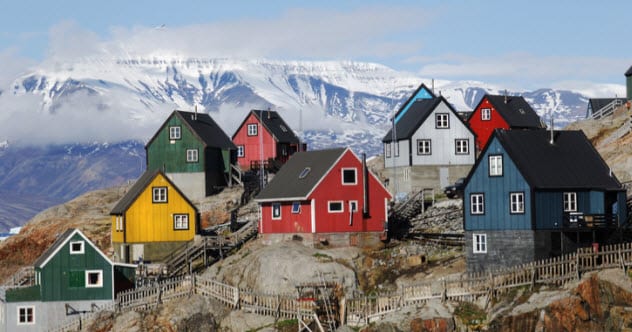

Greenland tends to enter the imagination as one enormous block of white floating near the top of a classroom map. That picture is not entirely wrong, but it leaves out nearly everything that makes the island fascinating. Greenland has colorful coastal towns, an Indigenous language rich in meaning, sheep farms, ancient Norse ruins, modern art, dramatic political ambitions, and transportation habits that make an ordinary road trip completely impossible.
It is geographically part of North America, politically connected to Europe, and culturally shaped above all by its Inuit population. Its ice influences oceans thousands of miles away, while its coastal communities have developed ways of living that are distinctly Greenlandic. These surprising Greenland facts reveal a place that is far more complicated than a giant freezer with excellent scenery.
1. Greenland Is the World’s Largest Island
Greenland covers approximately 836,000 square miles, or about 2.16 million square kilometers. That makes it the largest island on Earth that is not classified as a continent. Australia is larger, but geographers place it in the continent category, allowing Greenland to keep the island championship belt.
The island is roughly three times the size of Texas and stretches more than 1,600 miles from north to south. Despite that enormous area, Greenland has a population of only around 57,000 people. A single crowded American football stadium could theoretically hold almost every Greenlander, although the concession lines would be catastrophic.
Greenland is therefore one of the least densely populated places in the world. Its population is smaller than that of many suburban communities, yet its territory is larger than Mexico.
2. The Ice-Free Part of Greenland Is Still Huge
Approximately 80 percent of Greenland is covered by the Greenland Ice Sheet. In many locations, the ice is more than a mile thick. That statistic can make the remaining land sound like a narrow strip of exposed rock, but the ice-free portion covers roughly 158,000 square miles. In other words, the part of Greenland without an ice sheet is larger than many entire countries.
Most exposed land lies along the coast, where mountains, tundra, valleys, fjords, and small patches of vegetation appear during summer. South Greenland can become surprisingly green, with grasses, wildflowers, shrubs, and agricultural areas supporting sheep farms.
There are no natural forests comparable to those in Canada or Scandinavia, but Greenland is not permanently colorless. During the brief Arctic summer, brown tundra turns green, flowers appear, and coastal hillsides look much less like the surface of a snowball.
3. “Greenland” May Be One of History’s Best Marketing Names
The familiar story says Erik the Red named the island Greenland around the end of the 10th century because an appealing name would encourage other Norse settlers to follow him. He had been exiled from Iceland after violent disputes, so attracting neighbors to a remote Arctic settlement required more than a cheerful brochure and complimentary breakfast.
The name was not entirely dishonest. Southern Greenland contains sheltered fjords and valleys that become green during summer. Norse settlers established farms there, raising sheep, goats, and cattle while hunting marine animals and trading products such as walrus ivory.
Norse communities survived in Greenland for several centuries before disappearing during the late Middle Ages. Researchers continue to debate the reasons. Cooling temperatures, changing trade networks, economic difficulties, environmental pressures, and social choices may all have contributed. There probably was no single dramatic moment when everyone packed a longship and left a note on the door.
4. Greenland Is in North America but Is Part of the Kingdom of Denmark
Geographically, Greenland belongs to the North American continent. Its western coast faces the Canadian Arctic, and the island’s closest cultural relatives include Inuit communities across northern Canada and Alaska. Politically, however, Greenland is a self-governing territory within the Kingdom of Denmark.
Greenland received home rule in 1979 and expanded self-government in 2009. Its elected parliament and government control many domestic areas, including education, health services, fisheries, natural resources, and environmental policy. Denmark retains responsibilities in fields such as defense and parts of foreign affairs, although Greenlandic representatives increasingly participate in decisions affecting the island.
The possibility of full independence remains an important subject in Greenlandic politics. Under the self-government framework, Greenlanders have the right to pursue independence through a democratic process. The discussion is not simply about flags and ceremonies; it also involves economic sustainability, trade, public services, resource development, and Greenland’s relationship with Denmark.
5. Greenlandic Is a Remarkably Descriptive Language
Kalaallisut, commonly called Greenlandic, is Greenland’s official language and the primary language of most residents. It belongs to the Inuit language family and is related to languages spoken across the Arctic regions of Canada and Alaska.
Greenlandic is polysynthetic, meaning speakers can combine several meaningful elements into one long word. A single word may communicate an idea that requires an entire English sentence. This feature has given Greenlandic an intimidating reputation among language learners, especially those who become nervous when a word begins on one side of the page and appears to end somewhere near the margin.
The language also carries generations of knowledge about weather, sea ice, animals, family relationships, and the landscape. Danish remains widely used, particularly in administration and higher education, while English is increasingly common in tourism and international business.
Greenlandic identity is expressed not only through language but also through music, visual art, storytelling, film, clothing, food, and contemporary political debate. Greenland is not a museum display of Arctic tradition. It is a modern society in which old knowledge and new technology regularly share the same boat.
6. There Are Almost No Roads Between Towns
Greenland has roads within towns, but nearly none connect one community to another. Settlements are separated by mountains, glaciers, fjords, open water, and vast stretches of uninhabited land. Building a conventional national highway network would be extraordinarily expensive and, in many areas, physically impractical.
Travel between communities therefore happens by airplane, helicopter, passenger ship, private boat, snowmobile, or dogsled, depending on the location and season. Greenland’s airport network functions much like a highway system in other countries. A helicopter is not merely a sightseeing luxury; for some settlements, it is the scheduled bus with significantly better views.
This transportation system affects everyday life. Weather can delay flights, sea ice can alter sailing plans, and reaching a neighboring town may require more organization than crossing several states in the continental United States. Travelers quickly learn that Greenlandic distance is measured not only in miles but also in wind, waves, visibility, and available aircraft.
7. Nearly Everyone Lives Along the Coast
The interior of Greenland is dominated by the ice sheet and has no permanent towns. Almost every community sits along the ice-free coastline, with most of the population concentrated on the more accessible western side of the island.
Nuuk, the capital, is Greenland’s largest city and its political, educational, and cultural center. It includes apartment buildings, museums, restaurants, a university, a shopping center, and a busy harbor surrounded by mountains. It is a modern Arctic capital rather than a tiny collection of cabins waiting for a polar bear to wander through.
Other communities have distinct identities. Ilulissat is famous for enormous icebergs drifting from a nearby glacier. Sisimiut combines fishing, industry, education, and outdoor recreation. Tasiilaq serves as an important center in East Greenland, while towns in the south sit near old Norse sites and modern sheep farms.
The sea remains essential to Greenlandic life. Fishing is central to the economy, and boats connect families, hunting areas, workplaces, and neighboring settlements. The coastline is not Greenland’s edge; in many ways, it is the country’s main street.
8. Greenland Contains the World’s Largest National Park
Northeast Greenland National Park covers approximately 375,000 square miles, making it the largest national park on Earth. It is bigger than many countries and occupies a vast section of Greenland’s remote northeast.
The park contains mountains, glaciers, tundra, fjords, and enormous areas with almost no permanent human presence. Wildlife includes musk oxen, Arctic foxes, walruses, seals, polar bears, and numerous bird species. Access is strictly controlled because of the region’s isolation, environmental sensitivity, and dangerous conditions.
Unlike a typical American national park, visitors cannot drive to an entrance booth, purchase a souvenir mug, and ask where the nearest burger is hiding. Expeditions require permits, careful planning, specialized equipment, and substantial Arctic experience.
The park also hosts scientific and military stations. Researchers study ecosystems, geology, climate, wildlife, and atmospheric conditions in an environment that remains among the least disturbed large landscapes on the planet.
9. Greenland’s Ice Affects the Entire World
The Greenland Ice Sheet is the second-largest body of land ice on Earth after Antarctica. If it melted completely, it contains enough water to raise global average sea level by roughly 24 feet. Such a total loss would not happen overnight or within a single ordinary planning cycle, but the figure demonstrates the ice sheet’s global importance.
Satellite measurements show that Greenland has been losing hundreds of billions of tons of ice during an average recent year. The losses occur through surface melting, runoff, and the movement of glaciers into the ocean, where they break apart and release icebergs.
A Climate Archive Beneath Your Boots
Greenland’s ice is also an extraordinary record of the past. Snow accumulated over thousands of years, compressing older layers into ice and trapping tiny samples of ancient atmosphere. Scientists drill ice cores and analyze dust, gases, chemicals, and volcanic material preserved inside them.
These frozen archives help researchers reconstruct past temperatures, atmospheric composition, volcanic eruptions, and abrupt climate changes. A cylinder of Greenland ice may look like an oversized freezer pop, but scientifically it functions more like a library written in snow.
Radar surveys have even revealed mountains, valleys, and a canyon system hidden beneath the ice. Greenland therefore has an unseen landscape buried under its visible one.
10. Greenland Sharks May Live for Around 400 Years
The deep, cold waters of the Arctic and North Atlantic are home to the Greenland shark, one of the strangest long-term residents associated with the island. These slow-moving sharks can grow more than 20 feet long, although they rarely appear near busy beaches or pose the sort of cinematic threat that requires dramatic background music.
Scientists estimate that some Greenland sharks may live for approximately 400 years, making them the longest-living known vertebrates. An old individual alive today might have begun swimming before the United States existed.
The sharks grow extremely slowly and may not reach sexual maturity until they are well over a century old. Their longevity makes them fascinating to scientists studying aging, metabolism, genetics, and adaptation to cold environments.
They also demonstrate how much remains unknown about Arctic ecosystems. Greenland may appear empty on a map, but its seas contain complex food webs, deep-water habitats, and creatures operating on timelines that make human history look hurried.
Why Greenland Is More Than a Land of Ice
The most important thing to understand about Greenland is that it is a homeland, not an empty Arctic backdrop. Its landscapes are spectacular, but they exist alongside communities with their own languages, ambitions, humor, music, political debates, and daily routines.
Greenland combines enormous scale with small populations, modern government with ancient cultural knowledge, and geographic isolation with global influence. Its melting ice affects distant coastlines. Its strategic location shapes international discussions. Its people continue to negotiate how development, independence, tourism, fishing, mining, and environmental protection should fit together.
The island may be famous for icebergs, yet the real surprise is how much life, history, and complexity exists around them.
Experiencing Greenland: What a Journey Really Feels Like
Arrival Immediately Changes Your Sense of Scale
A journey through Greenland rarely begins with a smooth highway transfer. Visitors typically arrive by air and then continue through a network of smaller aircraft, helicopters, and boats. Looking down from a plane reveals why: mountains rise directly from fjords, glaciers spill through valleys, and settlements appear as tiny clusters of brightly painted buildings.
The landscape makes familiar measurements feel unreliable. A mountain that seems close may be several miles away. An iceberg that looks modest from shore may tower above a tour boat. With few trees, roads, or buildings available for comparison, the eye loses its usual measuring tools.
Transportation Becomes Part of the Experience
In many destinations, transportation is merely the part travelers tolerate between attractions. In Greenland, transportation often becomes the main event. A boat ride may pass waterfalls, seals, seabirds, and icebergs shaped like arches or castles. A short flight can provide sweeping views of the ice sheet and coastal mountains.
Schedules remain vulnerable to Arctic weather. Fog, wind, sea ice, and rough water can rearrange plans quickly. Successful travelers leave room in their itinerary and resist treating every delay as a personal attack by the atmosphere. Flexibility is not simply pleasant; it is part of the required equipment.
Silence Is One of Greenland’s Most Memorable Attractions
Outside the towns, visitors often encounter an unfamiliar level of quiet. There may be no traffic, machinery, or background hum. The silence is interrupted by wind, water, birds, sled dogs, or the sudden crack of shifting ice.
Near an active iceberg field, that crack can be followed by a deep splash as ice breaks or rolls. The spectacle is beautiful but should be watched from a safe distance because calving ice can generate dangerous waves. Nature in Greenland does not install railings merely because someone has a good camera.
Summer and Winter Offer Completely Different Journeys
Summer brings long daylight hours, hiking, sailing, whale watching, kayaking, and easier access to coastal areas. North of the Arctic Circle, the midnight sun allows outdoor activities late into what the clock insists is nighttime. Sleeping may require blackout curtains and a firm conversation with one’s internal body clock.
Winter offers snow-covered landscapes, dogsled travel in suitable regions, northern lights, and a closer look at how communities function during darkness and extreme cold. Winter travel also demands serious clothing, cautious planning, and respect for local guidance.
Greenlandic Food Reflects the Environment
Meals may feature Greenland halibut, Arctic char, shrimp, lamb from South Greenland, reindeer, musk ox, or locally gathered plants. Traditional foods involving seal or whale remain culturally important in some communities, although availability and attitudes vary.
Visitors should approach local food with curiosity rather than turning dinner into a performance of exaggerated bravery. Asking respectful questions about preparation, seasonality, and cultural meaning usually creates a more valuable experience than announcing that every unfamiliar ingredient tastes like chicken.
The Best Experiences Include Local Voices
Icebergs may provide the first reason to visit, but conversations, guided walks, museums, art workshops, music, and community-based tours often provide the lasting memories. Local guides can explain how weather, wildlife, language, history, and family life connect to places that otherwise appear to be simple wilderness.
Responsible travel means respecting private property, following wildlife rules, reducing waste, using qualified guides, and remembering that small communities are homes rather than themed attractions. Greenland rewards patience and attention. Travelers who slow down discover that the island’s most powerful quality is not merely its size, but the intimate relationship between people, sea, weather, and land.
Note: Weather, transportation schedules, access rules, and local conditions in Greenland can change rapidly. Travelers should confirm current information with transportation providers, local guides, and Greenlandic authorities before departure.