
Some comics politely escort you toide the punchline behind a curtain, switch off the lights, and let it leap at you wearing a fake mustache.
Created by Southern California artist Daniel Murrell, Danby Draws is a colorful webcomic series built around everyday life, family, gaming, movies, superheroes, science fiction, and whatever other subjects happen to wander into the artist’s imagination. The stories are generally short, accessible, and cheerful, but their endings rarely behave themselves.
Artist background and publishing history: >That unpredictability is the main attraction of these 30 comical comics with unexpected endings. A familiar situation appears in the opening panel. The reader confidently predicts what will happen next. Then the final panel calmly removes the floor.
Meet Daniel Murrell, the Artist Behind Danby Draws
Murrell has enjoyed comics since childhood and spent years drawing and sharing his work with friends. During the pandemic, he began introducing his comics to a broader online audience. The official Danby Draws website launched in 2020 and now contains hundreds of gag-driven strips covering life, family, nerd culture, and delightfully random situations.
The artist’s stated goal is refreshingly uncomplicated: make attractive comics that make people happy. That does not mean every joke is sugary or predictable. Some punchlines are mischievous, mildly dark, or wonderfully ridiculous. Even so, the humor generally remains approachable enough to share without first consulting a lawyer, a therapist, and the family group-chat administrator.
Murrell has also described an evolving visual process. He has experimented with brighter colors, looser rendering, and less concern about making every object look perfectly realistic. That freedom suits his comedy. A world containing Satan, Pokémon, spaceships, talking animals, superheroes, and suspicious bed bugs should not look as though it was designed by an accounting firm.
Creative process and visual-style comments: 2>Why Unexpected Comic Endings Are So Funny
The setup quietly writes a prediction
Every short comic makes a tiny agreement with the reader. The first panel establishes a situation, and the next panel encourages a reasonable expectation. A shooting star should inspire a wish. A detective should uncover romantic betrayal. A superhero should save the day. A horoscope should offer vague guidance that somehow applies to every person who has ever misplaced a sock.
Danby Draws uses those assumptions as construction material. The comic builds a perfectly ordinary path and then installs a trapdoor immediately before the destination.
The punchline replaces one story with another
Humor researchers frequently connect comedy with incongruity: the sudden collision of ideas that do not seem to belong together. A successful joke does not merely become random. The surprise must make a strange kind of sense after it arrives. Readers should think, “I never expected that,” followed closely by, “Unfortunately, that logic checks out.”
Humor theory and incongruity research: >Sequential art is especially effective at creating this response. Panels control what readers see, when they see it, and how much empty space separates one moment from another. A final image can function like a comedian’s perfectly timed pause. The reader moves from one panel to the next and discovers that the entire premise has changed.
Sequential-art structure: 3>Recognizable references make the twist faster
Many Danby Draws comics borrow familiar ingredients from popular culture. James Bond, Darth Vader, Garfield, Pokémon, Zelda, superheroes, space captains, demons, and archaeological adventures arrive with built-in expectations. Readers already understand these worlds, so Murrell does not need three pages of exposition and a downloadable map.
Instead, he can immediately begin rearranging the furniture. Bond faces an unexpectedly adorable form of torture. A video-game reference becomes evidence in a private investigation. A famous villain receives a suspicious physical upgrade. Pop culture supplies the setup; playful misinterpretation supplies the explosion.
A Tour Through 30 Comics and Their Comic Machinery
-
1. The Flat-Earth Opportunity
A ridiculous belief becomes a possible ticket to space. The joke works by treating nonsense not as a problem, but as an oddly practical travel strategy.
-
2. Game Night With Satan
A supernatural encounter turns into a strangely ordinary decision about what to play. Eternal damnation is apparently less frightening when someone brings snacks and explains the rules.
-
3. The Tomb Designed for Archaeologists
An ancient ruler plans elaborate traps with the energy of a screenwriter preparing an adventure sequel. History becomes funnier when the dead are already anticipating Indiana Jones.
-
4. A Horoscope That Gets Too Specific
Astrology is funniest when its famously broad predictions suddenly become uncomfortably personal. The stars are no longer guiding you; they appear to be reading your browser history.
-
5. Bond’s Most Diabolical Torture
A classic spy-movie threat is interrupted by feline behavior. The contrast between theatrical villainy and ordinary cat chaos makes the scene land beautifully.
-
6. The Unqualified Space Captain
Lying on a résumé is risky in any profession. Doing it aboard a spacecraft adds several additional consequences, including the possibility that no one knows which button means “avoid disaster.”
-
7. When Shooting Stars Shoot Back
A romantic celestial image is interpreted more literally than expected. The comic turns a peaceful wish-making tradition into a reminder that language can be alarmingly precise.
-
8. The Heroic Plan That Misunderstands Heroism
One character approaches a noble task with confidence but applies completely backward logic. The result demonstrates that enthusiasm and competence remain distant relatives.
-
9. The Aging Pop-Culture Fan
A familiar song or cultural reference triggers the sudden realization that several decades have escaped. Nothing attacks the knees quite like learning how old a favorite hit has become.
-
10. Cat Logic Wins Again
The cat-centered comic succeeds because cats already behave like tiny landlords who have misplaced the lease. The final panel merely confirms who actually controls the household.
-
11. Another Very Questionable Captain
Leadership in science fiction usually looks brave and decisive. Danby Draws asks what happens when the person in charge has confidence, a uniform, and absolutely no useful memory.
-
12. The Butterfly Dream With a Moth Ending
A hopeful transformation story takes a more humble biological route. It is funny, slightly sweet, and unexpectedly supportive of moths, nature’s fuzzy porch-light enthusiasts.
-
13. Dinosaurs Meet an Unhelpful Explanation
A prehistoric scenario reframes extinction through modern absurdity. The joke becomes funnier because the dinosaurs cannot file a complaint about historical accuracy.
-
14. Darth Vader’s Leg Extension
A dramatic science-fiction figure receives a physical modification that creates more questions than fear. Evil may rule the galaxy, but apparently it still worries about proportions.
-
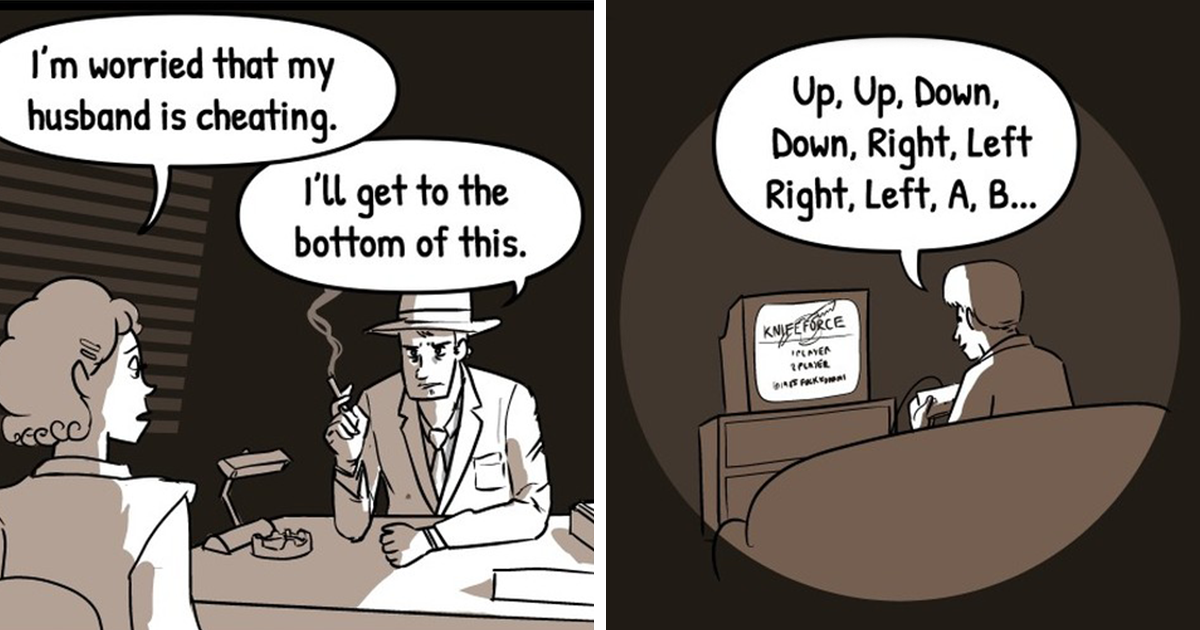
15. The Detective Finds a Different Kind of Cheating
A private investigator uncovers suspicious behavior, but the betrayal belongs to gaming rather than romance. The vocabulary remains accurate while the emotional stakes become hilariously smaller.
-
16. Bed Bugs With Branding Ambitions
A familiar household nuisance receives a literal or linguistic reinterpretation. The result proves that even pests can participate in wordplay without paying rent.
-
17. The Mermaid’s Poorly Worded Wish
Wish-based stories always depend on precise language. Here, the desire for legs receives the sort of technically correct fulfillment normally associated with malicious customer support.
-
18. Summoning a Demon at Lunch
Occult imagery collides with an ordinary sandwich. The humor comes from treating a terrifying ritual as though someone merely selected an adventurous condiment.
-
19. Garfield Faces a Lasagna Emergency
A well-known cartoon obsession becomes the setup for a fresh reversal. Familiarity does most of the work, while the final panel delivers the carbohydrate-based tragedy.
-
20. Color Guard Becomes Dangerously Literal
A harmless phrase is interpreted as an action-packed profession. Flags stop being performance equipment and begin looking like weapons with excellent choreography.
-
21. Space Travel Meets Résumé Fraud Again
The collection returns to professional incompetence because it is a dependable source of comedy. Few situations are more efficient than placing an unprepared person beside expensive machinery.
-
22. A Famous Blue Dog Gets Reinterpreted
A recognizable childhood character or idea receives an adult dose of literal thinking. Nostalgia enters the panel confidently and leaves checking whether it misunderstood its own name.
-
23. The Invention of the First Earworm
A prehistoric musician discovers that catchy tunes can become permanent mental tenants. Civilization advances, but now everyone has the same chorus stuck in their heads.
-
24. Pokémon Logic Meets Another Universe
Gaming conventions are transferred into a situation where they should not work. Naturally, they almost do, because fictional rules become wonderfully flexible when a joke needs transportation.
-
25. Social Media Gets the Treatment
Online platforms and their famous owners provide easy targets for satire. The joke compresses complicated internet frustration into a simple interaction with a very sharp final beat.
-
26. Zelda Anatomy Raises Questions
A beloved video-game character is examined with unnecessary practical attention. Fantasy survives dragons and magic, but it struggles when someone starts asking how the equipment actually works.
-
27. The Oppenheimer Audience Takes a Detour
A major historical drama collides with contemporary moviegoing culture. The resulting mashup reflects how internet audiences can transform serious cinema into a shared joke before leaving the theater.
-
28. Not Giving a Rat’s Behind
An idiom becomes visual information. This familiar cartoon technique works because the phrase seems harmless until an artist insists on showing exactly what it would mean.
-
29. Invincible Armor Meets an Obvious Weakness
A superhero’s impressive ability contains a flaw that should have appeared during planning. The costume may be unstoppable, but the person wearing it remains vulnerable to comic timing.
-
30. Ash and Pokémon Training Logic
The final selection plays with a franchise in which children travel alone, animals battle professionally, and adults rarely ask follow-up questions. There is plenty of room for one more absurdity.
What Makes the Danby Draws Style Recognizable?
The artwork is detailed enough to establish each scene immediately but not so crowded that readers miss the joke. Characters have readable expressions, colors help separate the action, and backgrounds provide context without demanding their own documentary series.
That clarity is essential. A twist-ending comic must guide the eye with precision. When a reader reaches the final panel, every important detail should become understandable within seconds. Confusion can be funny when it belongs to a character. It is less charming when readers need to organize a committee to interpret the punchline.
Murrell also uses a flexible range of subjects. One comic may involve mythology, the next may reference a video game, and another may begin with a completely ordinary conversation. This variety prevents the series from becoming trapped inside one formula. The structure may often involve setup and reversal, but the road toward that reversal keeps changing.
Light Humor, Dark Edges, and Broad Appeal
Danby Draws occupies a useful space between wholesome comics and aggressively dark comedy. The strips can contain demons, death, villains, dangerous inventions, or extinction-level problems, yet the overall effect is playful rather than punishing.
The darker ingredients are generally treated as cartoon objects instead of realistic suffering. Satan can participate in game night. A villain can become part of a visual pun. A terrible event can be reframed through pop-culture logic. The audience receives enough danger to create tension, but the punchline releases that tension before anyone needs to contact emergency services.
This balance makes the comics easy to browse and share. Readers can enjoy the artwork casually, while comedy fans can study the mechanics hiding beneath the surface. The strips reward both the person who laughs immediately and the person who spends ten seconds admiring how carefully the joke was constructed.
Why a Short Comic Can Improve a Long Day
A webcomic asks for very little. It does not require a two-hour commitment, a subscription to six interconnected streaming services, or a family tree explaining which dragon belongs to whom. A few panels can create curiosity, surprise, and laughter in less time than it takes an office printer to announce another paper jam.
Research on humor and laughter suggests that positive humor can support mood, social connection, and stress management. A funny comic is not medical treatment, and it cannot repair every difficult situation. It can, however, interrupt a repetitive thought pattern and give the mind a brief change of direction.
Humor, laughter, stress, and well-being research: >That interruption resembles the comic’s own structure. The reader begins on one mental path, encounters a surprise, and ends somewhere lighter. For a few seconds, the day no longer follows its expected script.
The Reader Experience: Living With Comics That Refuse to Behave
Reading a large collection of twist-ending comics creates a peculiar kind of friendly suspicion. After the first few strips, you stop trusting anything. A sweet conversation between two characters? Clearly dangerous. A peaceful evening beneath the stars? Something is preparing to fall from the sky. A heroic figure explaining an impressive ability? That power almost certainly has a warranty-voiding defect.
The entertaining part is that awareness does not necessarily help. You know a reversal is coming, but you do not know which assumption the artist plans to attack. You may correctly predict that a wish will go wrong, yet completely misunderstand how it will go wrong. The punchline slips through the narrow space between being surprising and being fair.
There is also a satisfying rhythm to reading the comics in a group. Each strip acts like a tiny puzzle. The opening panels provide clues, the mind proposes an answer, and the final panel reveals that the puzzle was secretly about something else. Occasionally, you understand the joke immediately. At other times, recognition arrives half a second later, producing the classic delayed laughthe sound of the brain finally catching the bus.
Pop-culture references add another layer to the experience. Recognizing a character or franchise creates an instant sense of participation. You know the original rules, so you can appreciate how the comic breaks them. A Pokémon joke feels different when you remember the games. A Bond parody lands faster when you recognize the theatrical villain setup. The reader’s own memories become unpaid supporting actors.
The comics can also inspire creative observation away from the screen. Ordinary phrases begin to look suspiciously visual. “Shooting star,” “bed bug,” “color guard,” and “cheating” all contain alternate meanings waiting to be illustrated. Once you notice that possibility, daily language starts generating imaginary panels. A grocery-store sign can become a premise. A strange conversation can become dialogue. A badly designed product can become a superhero’s tragic invention.
For aspiring cartoonists, that is perhaps the most useful experience these comics offer. Strong ideas do not always require enormous fictional worlds. They can begin with a common expression, a cultural reference, or a simple question: What is the least expected interpretation of this situation that still makes sense?
The creative process is not effortless, of course. Murrell has acknowledged that some ideas remain unfinished for months until the right wording or structure appears. He has also spoken about the anxiety of posting work publicly, even after doing so many times. That honesty matters because polished comics can make creativity look instantaneous. Behind a four-panel joke may be hours of drawing, rejected concepts, revised dialogue, and at least one moment of wondering whether the entire idea should be launched into the sun.
Artist comments about unfinished ideas, posting anxiety, and creative persistence: >As a reading experience, the complete collection feels cheerful without becoming bland and clever without constantly pointing at its own cleverness. The comics are small reminders that surprise remains available in familiar places. A cat, a sandwich, a résumé, a horoscope, or an old video game can still produce an ending nobody saw coming.
That is ultimately why these 30 comical comics work. They encourage readers to make assumptions and then reward them for being wrong. In everyday life, being wrong can be inconvenient. In a Danby Draws comic, it is usually the best part.
Conclusion
Daniel Murrell’s Danby Draws series demonstrates how much storytelling can fit inside a few carefully arranged panels. Bright visuals establish the scene, familiar references invite quick understanding, and unexpected endings transform ordinary setups into miniature comic traps.
Whether the subject is a demon, a dinosaur, an incompetent spaceship captain, a confused superhero, or a cat doing what cats do bestignoring everyonethe humor depends on disciplined misdirection. The final panel is surprising, but it rarely feels disconnected from what came before. It simply reveals that the comic has been following a different set of rules all along.
These strips are quick to read, easy to revisit, and difficult to predict. Just remember: when a Danby Draws character says everything is under control, begin looking for the nearest emergency exit.