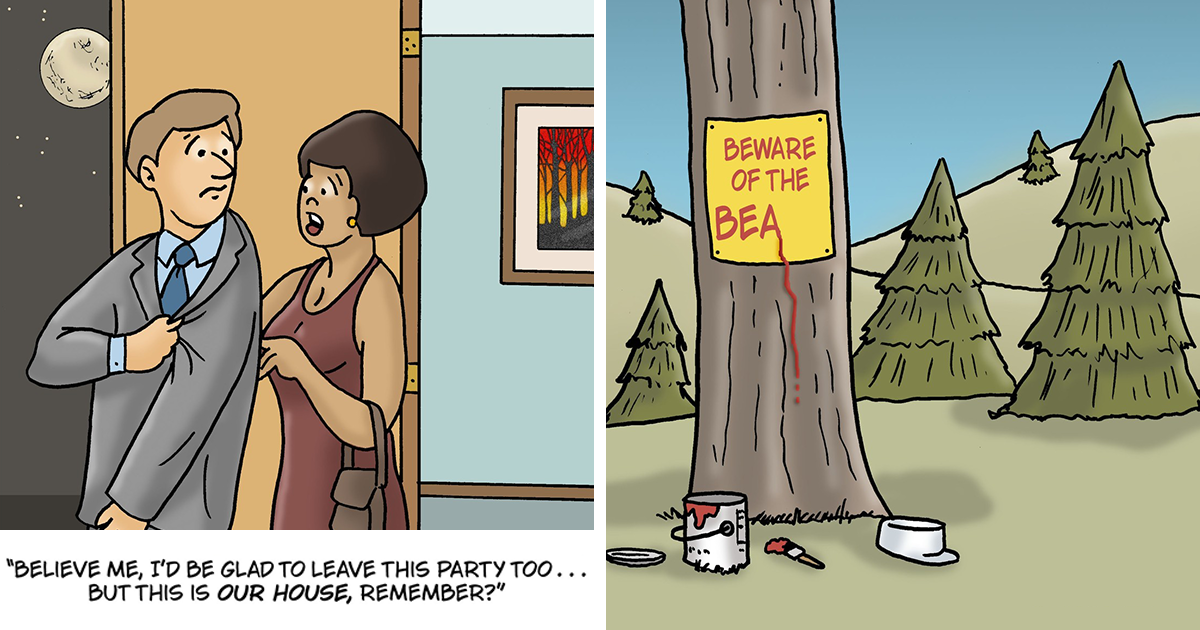

A good one-panel comic performs a minor miracle: it introduces a situation, creates an expectation, and knocks that expectation sideways before your coffee gets cold. Doug Hill, the cartoonist behind Laughing Hippo Studio, has become particularly skilled at this compact form of comedy. His hand-drawn cartoons turn marriage, family life, technology, animals, aging, work, and ordinary misunderstandings into delightfully silly visual punchlines. This collection of 30 witty one-panel comics proves that a joke does not need an elaborate plot, twelve recurring characters, or a cinematic universe with mandatory homework. Sometimes one drawing, one caption, and one wonderfully bad decision are more than enough.
A Small Cartoon With a Surprisingly Large Job
One-panel comics look simple because the hard work has already been hidden. There is no second frame in which a character can explain what happened. There is no dramatic close-up, flashback, or helpful narrator saying, “Meanwhile, the joke approaches from the left.” Everything must arrive at once: setting, characters, conflict, timing, and punchline.
That compact structure is exactly what makes the work of Laughing Hippo Studio so satisfying. Doug Hill creates scenes that readers can understand almost immediately. A living room looks like a living room. A doctor looks reassuringlyor suspiciouslylike a doctor. A married couple can communicate twenty years of mutual exasperation with one raised eyebrow. Once the familiar situation is established, Hill inserts one unexpected detail that changes its meaning.
The result feels connected to the long American tradition of newspaper cartoons. Comic strips and panel cartoons have documented domestic life, employment, social customs, popular entertainment, and changing attitudes since their rise in American newspapers during the late nineteenth century. Hill’s work carries that approachable tradition into the social-media era, where a cartoon can travel from a sketchbook to thousands of screens without ever being folded beside the sports section.
Meet Doug Hill, the Artist Behind Laughing Hippo Studio
Doug Hill is the cartoonist behind Laughing Hippo Studio and several bodies of work associated with the name, including Potpourri Cartoons, Bartoons, and Off the Wall comics. His cartoons are recognizable for their clean single-panel layouts, conversational captions, expressive characters, puns, mild innuendo, and endings that frequently take a sensible situation somewhere gloriously unreasonable.
Hill has explained that much of his material grows out of everyday life. Family conversations, things overheard in public, television, current events, and popular trends can all become starting points. He has three children, five grandchildren, and seven great-grandchildren, so when he writes about family dynamics, he is not exactly conducting research from a distant laboratory. He has been surrounded by generations of potential material.
His long teaching career also appears to have strengthened one of the qualities that makes his cartoons accessible: the ability to make an idea understandable without flattening it. Hill has said that teaching involved breaking complicated concepts into digestible and entertaining pieces. That same instinct fits one-panel cartooning beautifully, where confusion is expensive and every extra line must pay rent.
Traditional Drawing in a Digital World
Although Laughing Hippo Studio has built an audience online, Hill’s process remains largely traditional. He prefers pencil and paper, using digital tools mainly for elements such as color and lettering. That hand-drawn foundation gives the comics a personal warmth. The lines are polished enough to communicate clearly but loose enough to feel alive.
This balance matters. Highly detailed art can be beautiful, but excessive visual information may slow down a gag that needs to land instantly. Hill understands that the drawing serves the joke, not the other way around. In his own assessment of the craft, a strong illustration cannot rescue a weak idea, while a genuinely funny gag can carry a simple drawing. That principle may be the unofficial constitution of successful single-panel comedy.
Why These 30 Witty One-Panel Comics Work
1. Familiar Situations Create Immediate Recognition
Many Laughing Hippo Studio comics begin in places readers already know: kitchens, bedrooms, offices, stores, restaurants, classrooms, doctors’ offices, and family gatherings. These recognizable environments reduce the amount of explanation needed. The reader understands the social rules before reading the caption.
Then Hill breaks one of those rules. Someone answers a routine question too literally. A spouse reveals an alarming interpretation of a harmless statement. An animal behaves as though it has studied human bureaucracy. A supernatural character discovers that modern life is more exhausting than the underworld.
The joke succeeds because the audience first recognizes reality and then watches it develop a small, unexpected leak.
2. The Caption and Picture Share the Work
A strong one-panel cartoon is neither an illustrated joke nor a funny picture with decorative text. The words and image must cooperate. Remove either half and the joke should lose something important.
Research into cartoon comprehension often focuses on incongruity: the mental jolt created when an expected interpretation collides with a surprising one. Eye-tracking observations discussed by longtime cartoon editor Bob Mankoff suggest that readers may move between the caption and the visual punchline until the two pieces “click.” Individual reactions differ, but that moment of recognition is central to the pleasure of understanding a cartoon.
Hill’s funniest panels exploit this relationship efficiently. The caption might sound normal until the reader notices an object in the background. In another cartoon, the artwork establishes a ridiculous premise while the dialogue treats it as completely ordinary. That contrast is comedy’s favorite office chair.
3. Everyday Language Becomes a Trapdoor
Puns can be painful when forced, but they remain perfectly suited to one-panel comics. A familiar phrase can carry two meanings, allowing the cartoonist to construct the scene around the less obvious interpretation.
Hill frequently mines idioms, misunderstood expressions, names, signs, clichés, and accidental double meanings. The character inside the cartoon may hear a phrase one way while the reader understands both versions. The audience receives a tiny reward for solving the linguistic puzzleand a slightly larger reward for realizing that someone in the drawing has made a terrible mistake.
Misheard conversations also provide rich material. Hill has described catching phrases on television or hearing something incorrectly in a store, only to discover that the mistaken version contains the seed of a cartoon. It is a useful reminder that creative inspiration occasionally arrives disguised as bad hearing.
4. Family Humor Comes With Built-In History
Marriage and family relationships appear regularly in Laughing Hippo Studio comics because they offer instant context. A husband and wife do not need elaborate introductions. Readers bring their own knowledge of shared chores, selective listening, forgotten anniversaries, money discussions, conflicting television preferences, and the mysterious migration of household objects.
Hill’s approach generally exaggerates recognizable friction without turning the characters into villains. The humor comes from stubbornness, awkward honesty, or two people understanding the same conversation in completely different ways. It is less “the family is collapsing” and more “the family is fine, but nobody knows where the remote went.”
Because Hill draws from several generations of family experience, younger and older readers may recognize different layers. One person sees a joke about technology. Another sees a joke about aging. A third sees Uncle Frank, right down to the suspicious cardigan.
5. Animals Behave Like Peopleand People Barely Notice
Animals are ideal residents of one-panel cartoons. They can speak, hold jobs, visit therapists, complain about relationships, and develop elaborate opinions about humans. The reader accepts this immediately because cartoon logic has generous zoning laws.
Laughing Hippo Studio often uses animals to expose human habits. Dogs may interpret loyalty too professionally. Cats can turn household ownership into a hostile takeover. Farm animals may discuss their circumstances with unsettling awareness. Wild creatures can behave like suburban neighbors who have already contacted the homeowners association.
Anthropomorphism also lets Hill approach familiar topics from a fresh angle. A human complaint may sound ordinary, but the same complaint delivered by a bear, fish, or bird becomes ridiculousand occasionally more accurate.
6. Death and the Supernatural Lose Their Dignity
Ghosts, witches, monsters, angels, devils, and the Grim Reaper appear naturally in Hill’s comic world. These figures arrive carrying centuries of dramatic symbolism, only to encounter scheduling problems, relationship issues, customer service, or workplace frustration.
The contrast between supernatural power and ordinary inconvenience creates an immediate comic mismatch. Death may be inevitable, but apparently it can still have a deadline. A monster may terrify an entire village yet remain incapable of understanding a basic social cue. The supernatural becomes funny when it discovers paperwork.
This playful treatment keeps the humor mischievous rather than grim. The subject may involve mortality, but the tone usually says, “Yes, life is short, and somehow the printer is still jammed.”
7. Technology Is Helpful Until Humans Touch It
Modern devices provide endless opportunities for single-panel comedy. Phones, social networks, artificial intelligence, online shopping, video games, and digital notifications promise convenience while creating new varieties of confusion.
Hill’s style works especially well with technology because he approaches new trends through familiar human weaknesses. The machine may be advanced, but the user remains distracted, impatient, overconfident, or unable to remember a password created eleven seconds earlier.
Rather than constructing complicated technical satire, the comics usually focus on recognizable consequences: partners ignoring each other, people misunderstanding automated systems, or digital tools solving the wrong problem with breathtaking efficiency.
The Art of the Unexpected Ending
A one-panel comic technically has no “ending” because the entire event is visible at once. Nevertheless, the reader experiences it in stages. First comes the scene. Next comes the caption. Finally, one overlooked detail rearranges the meaning of everything.
Hill’s personal favorite offers an excellent example. It depicts a couple looking toward a desert scene presented as an unfinished paint-by-numbers picture. The colored characters stand against the incomplete landscape and conclude that they must be in an “unpainted desert.” The gag combines a visual inconsistency, a familiar phrase, and a literal interpretation in one compact idea.
Nothing requires explanation once the pieces connect. The reader recognizes “unpainted” as a visual condition and a playful substitution for “uninhabited.” The cartoon does not chase the audience down the street shouting, “Did you understand the wordplay?” It trusts the joke and leaves before parking becomes expensive.
Old-School Newspaper Humor Meets Social Media
Laughing Hippo Studio’s work evokes the newspaper comics many readers once encountered over breakfast. The layouts are direct, the characters are easy to read, and the jokes rarely require extensive background knowledge. Yet the distribution is thoroughly modern.
On social media, a single-panel cartoon has several advantages. It fits naturally on a phone screen. It can be understood quickly. It is easy to share, revisit, or send to a friend with the message, “This is absolutely you,” thereby beginning a small but manageable family dispute.
Hill’s online presence has expanded significantly over time, demonstrating that traditional gag cartooning can remain relevant without abandoning its identity. The medium may shift from newsprint to Instagram, but readers still appreciate the same essential ingredients: a clear premise, expressive characters, and a surprise worth sharing.
The durability of the format should not be surprising. American cartoon history includes thousands of newspaper features, humorous panels, editorial drawings, and comic strips covering everything from domestic life to political change. Institutions such as the Library of Congress preserve vast collections because cartoons are not merely disposable jokes; they are compact records of how people worked, argued, worried, celebrated, and laughed.
What Aspiring Cartoonists Can Learn From Laughing Hippo Studio
Begin With the Idea, Not the Decoration
Hill’s belief that the gag is the heart of a cartoon is useful advice for any creator. A beautifully rendered scene may attract attention, but the central idea determines whether readers remember it. Before polishing shadows on a sofa for three hours, make sure the sofa is participating in an actual joke.
Build Around a Clear Situation
The Center for Cartoon Studies describes characters, environment, plot, and the gag as essential components of single-panel work. Hill’s cartoons usually establish these elements with impressive economy. The reader knows who is speaking, where the action is happening, and what kind of social interaction is underway. Only then does the joke introduce chaos.
Listen for Accidental Comedy
Cartoon ideas do not always emerge from formal brainstorming sessions. They may begin with a misheard sentence, an oddly worded advertisement, an uncomfortable family conversation, or a sign that accidentally promises something terrifying.
Keeping notes is essential because funny observations are fragile. A brilliant idea that feels unforgettable at lunch can become “something about a dentist and maybe a penguin” by dinner.
Let Characters Take the Absurd Seriously
One of the most reliable comic techniques is to place something ridiculous in a scene and have the characters treat it as normal. The audience recognizes the absurdity while the people inside the panel remain professionally committed to it.
This technique appears throughout Hill’s work. The stranger the premise becomes, the more calmly the dialogue may proceed. Deadpan delivery creates space for the reader to supply the laughter.
Draw From Life Without Copying It
Real experiences provide emotional recognition, but cartooning requires transformation. A minor disagreement can become a battle between species. A medical appointment can become a negotiation with fate. A casual phrase can produce an entire imaginary profession.
Hill’s cartoons do not merely repeat daily life. They tilt it until all the loose change falls out.
The Experience of Reading 30 Laughing Hippo Studio Comics
Reading a collection of 30 witty one-panel comics is different from following a long graphic story. There is no central plot demanding concentration and no cliffhanger insisting that the reader purchase Volume 14 to discover whether Steve finally opens the mysterious refrigerator. Each panel is a fresh beginning.
That makes the collection easy to enter at any point. One reader may start with the first cartoon and proceed carefully. Another may scroll until an expressive dog appears. A third may stop immediately at a marriage joke because the facial expression looks uncomfortably familiar.
The best experience comes from allowing each panel a moment to work. A quick glance reveals the setting, but a second look often uncovers the detail that completes the punchline. A sign in the background, an unusual object, or the identity of a silent character may contain half the joke. Racing through one-panel comics is like swallowing popcorn without chewing: technically possible, but suspiciously joyless.
Another pleasure is predicting the gag before reading the caption. Sometimes the scene appears so familiar that the brain begins preparing a conventional explanation. Hill then replaces it with a stranger but logically connected interpretation. Getting fooled is part of the entertainment. The reader loses a tiny argument with a drawing and enjoys the defeat.
Sharing the cartoons adds another layer. Family humor works particularly well because readers immediately assign roles. A joke about forgetfulness belongs to Dad. A cartoon about online shopping is clearly for one particular cousin. A panel involving a stubborn pet is forwarded to every person currently paying veterinary bills for an animal that refuses to acknowledge them in public.
The comments surrounding online comics can become a second comedy performance. Readers contribute alternate captions, personal stories, groan-worthy puns, and explanations for people who missed the reference. Occasionally, someone improves the joke. Occasionally, someone explains it with such seriousness that the explanation becomes funnier than the cartoon.
The collection also offers a useful emotional pause. The humor is generally brief, familiar, and low-pressure. Readers do not need to study fictional lore or understand a week of breaking news. Most jokes concern recognizable human behavior: people avoid chores, misunderstand instructions, worry about aging, misuse technology, irritate their partners, and attempt to preserve dignity while doing something profoundly undignified.
There is also nostalgia in the visual rhythm. For readers who grew up with newspaper funnies, the clean drawings and caption-driven punchlines recall a slower form of entertainment. For younger audiences, the same format feels unusually efficientalmost like a meme drawn by hand and given better posture.
After 30 panels, the lasting impression is not that every joke targets the same audience. Humor remains personal, and one cartoon may produce a loud laugh while another earns only an approving exhale through the nose. The strength of Laughing Hippo Studio lies in variety. Family scenes sit beside animal jokes, supernatural misunderstandings, workplace absurdities, and playful language.
The experience resembles listening to a skilled relative tell short jokes at a gathering: some are clever, some are proudly corny, and several arrive with just enough mischief to make everyone check whether the children heard them. Most importantly, the cartoons understand their purpose. They are here to create a quick moment of recognition, surprise, and reliefand then make room for the next ridiculous situation.
Conclusion: One Panel Is Plenty
The 30 witty one-panel comics by Laughing Hippo Studio demonstrate how much comedy can fit inside a small frame. Doug Hill does not rely on elaborate narratives or visual spectacle. He begins with ordinary life, removes one screw, and waits for reality to wobble.
His family experience, teaching background, traditional drawing process, and affection for classic cartoon humor all contribute to a style that feels familiar without becoming frozen in the past. The subjects may include smartphones, online trends, and modern anxieties, but the mechanics remain timeless: recognition, misdirection, incongruity, and a clean punchline.
Some readers will laugh at the wordplay. Others will recognize their spouse, coworker, pet, parent, or mildly chaotic self. A few may simply admire the efficiency required to tell a complete joke before the thumb can scroll away.
That is the charm of Laughing Hippo Studio. The cartoons do not ask for much time, but the strongest ones linger. They remind us that daily life is already full of comedy. A cartoonist simply notices it, draws a border around it, and gives the confused person in the corner something funny to say.
Editorial note: This original article was developed from publicly available artist interviews, creator profiles, cartoon-history archives, and research on visual humor. It analyzes the collection without reproducing the original comic artwork or captions.