
Note: This article is written for editorial and educational purposes, using real, widely recognized advertising campaigns as inspiration and analysis. Brand names and campaign titles belong to their respective owners.
Some advertisements sell sneakers. Some sell soap. And then there are the rare ones that quietly sneak into your brain, rearrange the furniture, and leave you staring at a billboard like it just asked you to reconsider your entire life before lunch. Those are the powerful advertisements that make us stop and think.
The best ads are not always the loudest, the funniest, or the ones with the biggest celebrity budget. Often, they are the simplest: a child running “like a girl,” a bear reminding humans not to burn down forests, a pair of crash-test dummies begging drivers to buckle up, or a single sentence that makes buying less feel like doing more. Great advertising does not merely interrupt attention; it earns it.
In a world where people scroll faster than a caffeinated squirrel, meaningful advertising has to work harder. It must be visually striking, emotionally honest, culturally aware, and clear enough to land in seconds. The campaigns below show how creativity can turn marketing into memory, public service into action, and brand messaging into conversations that outlive the media buy.
Why Powerful Advertisements Stay With Us
Powerful advertisements usually share three ingredients: a strong human truth, a memorable creative device, and a clear emotional payoff. They do not simply say, “Buy this.” They say, “Look closer.” They invite people to feel something before asking them to do something.
That is why campaigns about road safety, body image, climate change, equality, smoking prevention, and technology can become cultural landmarks. They take ordinary behavior and make it visible. They reveal the hidden cost of a habit, the beauty in an overlooked person, or the absurdity of a social norm we accepted without reading the fine print. Advertising, at its best, is not a megaphone. It is a mirror with better lighting.
40 Powerful Advertisements That’ll Make You Stop And Think
1. Apple “1984”
Apple’s legendary Macintosh commercial turned a product launch into a rebellion against conformity. With dystopian imagery and cinematic drama, it told viewers that technology could be personal, creative, and liberating. It barely showed the product, which is brave advertising behavior bordering on wizardry.
2. Apple “Think Different”
Instead of listing features, Apple celebrated rebels, artists, scientists, and visionaries. The campaign positioned the brand as a home for people who challenge the status quo. It worked because it sold identity before it sold hardware.
3. Nike “Just Do It”
Three words became a global motivational speech. “Just Do It” is powerful because it speaks to athletes and non-athletes alike. It says the first step is not glamorous, but it counts. Also, it is much cheaper than hiring a personal coach to yell encouragement at your sneakers.
4. Nike “Dream Crazy”
This campaign leaned into courage, controversy, sacrifice, and belief. Its message was not just about athletic performance but about standing for something. Whether viewers agreed or disagreed, they had to think about what conviction costs.
5. Dove “Campaign for Real Beauty”
Dove challenged the polished perfection of beauty advertising by featuring real women with real bodies. The campaign helped change how brands talk about beauty, self-esteem, and representation. It reminded audiences that confidence should not require a Photoshop subscription.
6. Dove “Real Beauty Sketches”
This emotional film compared how women described themselves with how strangers described them. The result was a moving lesson in self-perception. It made people ask, “Am I seeing myself fairly?” That question is stronger than any product claim.
7. Always “#LikeAGirl”
Always transformed an insult into a statement of power. By asking people to act out what it means to run or throw “like a girl,” the campaign exposed how language can shrink confidence. Then it flipped the phrase into pride.
8. Truth Initiative Anti-Smoking Campaigns
The truth campaign used facts, attitude, and youth culture to fight tobacco marketing. Instead of lecturing teens, it exposed manipulation. That shift made the message feel less like homework and more like a rebellion.
9. CDC “Tips From Former Smokers”
This campaign featured real people living with the consequences of smoking-related illness. Its power came from honesty. No abstract warnings, no cartoon lungs, no polite whispering. Just human stories that made the risk impossible to ignore.
10. Smokey Bear “Only You Can Prevent Wildfires”
Smokey Bear is one of the most enduring public service icons in American advertising. The message is simple, personal, and memorable. Also, when a bear wearing jeans tells you to be careful with fire, you listen.
11. Ad Council “Love Has No Labels”
This campaign used skeleton imagery to show that beneath visible differences, people share the same humanity. It tackled bias with warmth rather than accusation. The result was inclusive, emotional, and instantly understandable.
12. Vince and Larry Crash Test Dummies
The seat belt campaign used humor to make safety memorable. Vince and Larry turned a serious message into slapstick education. The line “You could learn a lot from a dummy” made buckling up feel obvious, not optional.
13. NHTSA “Click It or Ticket”
This campaign is powerful because it combines education with consequence. Instead of relying only on fear, it makes the rule clear: wear a seat belt or face a ticket. Direct? Yes. Subtle? Not even a little. Effective messaging does not always wear velvet gloves.
14. “Buzzed Driving Is Drunk Driving”
This road safety message attacks a dangerous loophole people create for themselves. By naming “buzzed” driving as drunk driving, the campaign removes ambiguity. It turns a casual excuse into a serious decision.
15. Sandy Hook Promise “Evan”
At first, the ad appears to be a teen romance story. Then it reveals missed warning signs of potential violence in the background. The twist forces viewers to reconsider what they notice, and what they overlook.
16. Sandy Hook Promise “Back-to-School Essentials”
This chilling PSA begins like a cheerful school shopping commercial, then reveals students using supplies to survive a shooting. The contrast is devastating. It uses familiar advertising language to expose an unacceptable reality.
17. Patagonia “Don’t Buy This Jacket”
Patagonia’s famous anti-consumption ad asked customers to think before buying. It was bold because most brands prefer customers not to think too long near the checkout button. The campaign made restraint part of the brand’s identity.
18. REI “#OptOutside”
REI closed stores on Black Friday and encouraged people to spend time outdoors instead of shopping. The message worked because the company acted on its values. Saying “nature matters” is nice; locking the cash register proves it.
19. Burger King “Moldy Whopper”
Showing a burger decomposing was risky, weird, and strangely unforgettable. The message promoted the removal of artificial preservatives. It proved that beauty in advertising can sometimes look like a science experiment in the back of the fridge.
20. Volkswagen “Think Small”
In an era of big American cars, Volkswagen embraced smallness. The campaign’s minimalist design and self-aware copy made honesty feel stylish. It showed that advertising can win by refusing to pretend.
21. Volkswagen “Lemon”
This print ad called one of its own cars a “lemon” because inspectors found a tiny flaw. The message was quality control. The genius was admitting imperfection to prove standards.
22. De Beers “A Diamond Is Forever”
This campaign changed how generations associated diamonds with commitment. It is one of advertising’s clearest examples of turning a product into a cultural ritual. Whether romantic or strategic, it was undeniably powerful.
23. Got Milk?
The “Got Milk?” campaign made absence the star. Instead of praising milk directly, it showed the panic of needing it and not having it. The question became part of everyday language, which is the advertising equivalent of moving into culture rent-free.
24. Coca-Cola “Mean Joe Greene”
This classic ad showed a tough football player softened by a child’s kindness. It worked because it linked a product to generosity and connection, not just refreshment. The bottle became a bridge between strangers.
25. Google “Parisian Love”
Google told an entire love story through search queries. No actors, no sweeping speeches, just typed words and human intention. It showed that technology is powerful when it quietly helps life happen.
26. P&G “Thank You, Mom”
This Olympic campaign celebrated mothers behind elite athletes. By focusing on support rather than medals, P&G tapped into gratitude. It made household brands feel connected to the emotional labor of family life.
27. State Street Global Advisors “Fearless Girl”
The statue facing Wall Street’s Charging Bull became a symbol of gender diversity in leadership. It was not just an ad; it was a public installation that people photographed, debated, and remembered.
28. The New York Times “The Truth Is Hard”
This campaign used stark typography and urgent language to defend journalism in a divided era. It reminded readers that facts require reporting, verification, and courage. Truth, apparently, does not assemble itself like a flat-pack bookshelf.
29. Airbnb “We Accept”
Airbnb’s inclusion campaign positioned hospitality as more than booking a room. The message connected travel with belonging and acceptance. It worked because it linked the brand promise to a larger social value.
30. Heineken “Worlds Apart”
This campaign brought people with opposing views together to build something and then talk. Its strength was not pretending disagreement disappears. Instead, it showed conversation as a human possibility.
31. UN Women “Autocomplete Truth”
The campaign used real search autocomplete results to reveal sexist attitudes. By placing search bars over women’s mouths, it visualized how bias silences people. Simple design, enormous impact.
32. Amnesty International “It’s Not Happening Here, But It’s Happening Now”
This outdoor campaign placed images of human rights abuses into ordinary city environments. It collapsed distance. The viewer could no longer treat suffering as something happening “somewhere else.”
33. WWF “Before It’s Too Late”
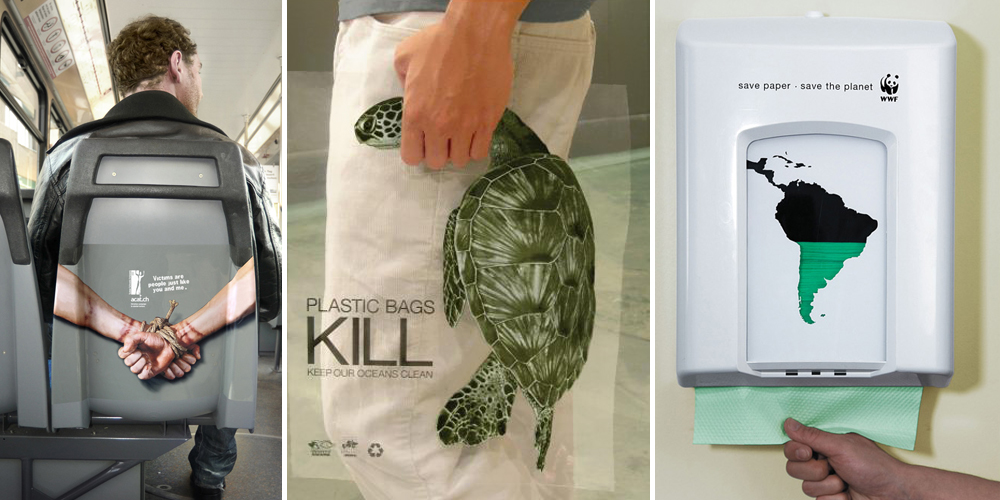
WWF’s environmental ads often use visual metaphor, such as forests shaped like lungs or animals disappearing into white space. These images work because they make ecological damage feel immediate and personal.
34. Greenpeace Ocean Plastic Campaigns
Greenpeace has used striking visuals to connect everyday plastic use with marine harm. The strongest versions make waste feel intimate, not abstract. Suddenly, a straw is not just a straw; it is a tiny villain with excellent distribution.
35. Metro Trains “Dumb Ways to Die”
This rail safety campaign wrapped a serious message in a ridiculously catchy song. Cute characters died in absurd ways before the ad connected the joke to train safety. It proved that humor can carry heavy messages when handled carefully.
36. Old Spice “The Man Your Man Could Smell Like”
Old Spice revived its image with surreal humor and rapid-fire confidence. While not a social issue campaign, it made people rethink how personality can transform a brand. It was strange, fast, and impossible to forget.
37. Budweiser “Wassup?”
The campaign captured casual friendship with one silly greeting. Its power came from cultural spread. People repeated it because it felt like a joke they were invited to join.
38. Snickers “You’re Not You When You’re Hungry”
This campaign made hunger a personality crisis. The idea was simple, flexible, and funny across countless executions. It turned a product benefit into a universal human truth: hunger makes us weird.
39. Mastercard “Priceless”
Mastercard’s campaign separated cost from value. It listed prices, then landed on a priceless emotional moment. The structure was so strong it became instantly recognizable and endlessly adaptable.
40. ALS Ice Bucket Challenge
Although it spread as a social media movement, the ALS Ice Bucket Challenge functioned like a massive awareness campaign. It combined participation, spectacle, peer pressure, and philanthropy. It made people laugh, donate, and learnoccasionally while screaming in a driveway.
What These Powerful Advertisements Teach Marketers
They Start With a Human Truth
The strongest campaigns are built on something people already feel but may not have expressed. Girls notice when confidence gets mocked. Drivers make excuses. Consumers feel guilty about waste. Parents sacrifice quietly. Great advertising gives language and imagery to those truths.
They Respect the Audience’s Intelligence
Powerful advertising does not explain every detail like a nervous tour guide. It leaves room for discovery. Apple’s “1984,” Google’s “Parisian Love,” and UN Women’s “Autocomplete Truth” work because viewers connect the dots themselves. That tiny mental click is where memory forms.
They Use Emotion With Purpose
Emotion alone is not strategy. A sad violin over a slow-motion sandwich will not save weak messaging. The emotion must serve the point. Fear can prevent danger. Humor can lower resistance. Pride can build identity. Gratitude can deepen loyalty. The best ads know exactly which feeling they are trying to earn.
They Make the Message Easy to Repeat
“Just Do It.” “Got Milk?” “Think Different.” “Click It or Ticket.” These phrases are short enough to remember and strong enough to travel. A great campaign gives people a portable idea they can carry into conversation.
Experiences and Reflections: Why These Ads Hit So Hard
Anyone who has ever paused mid-scroll because of an ad knows the feeling. You were not planning to be moved. You were probably looking for a recipe, checking the weather, or pretending that “just five minutes online” was a legally binding agreement. Then an image, a line of copy, or a short film interrupts the autopilot.
That is the real magic of powerful advertisements: they break routine. Most advertising is wallpaper. It surrounds us, but we do not really see it. A powerful ad becomes a window. It changes the room. Suddenly, a public service message about texting while driving is not “traffic safety content.” It is a picture of a person who might not make it home. A beauty campaign is not “soap marketing.” It is a reminder of how harshly people judge themselves in mirrors, photos, and fitting rooms with lighting designed by villains.
From a writer’s perspective, these campaigns are fascinating because they prove that restraint often beats noise. Many of the most memorable ads do not shout. They trust one strong idea. A skeleton screen reveals hidden bias. A search box reveals sexism. A jacket ad asks people not to buy the jacket. A tiny Volkswagen sits in a sea of white space and proudly says, “Think small.” These ideas are brave because they resist the urge to explain themselves to death.
From a consumer’s perspective, powerful advertisements can feel almost personal. A campaign like “#LikeAGirl” may remind someone of a childhood insult they laughed off at the time. A smoking prevention ad may remind a family of someone they lost. A climate campaign may make a person reconsider the plastic bottle in their hand. The ad does not change behavior by force; it creates a moment of self-recognition. That moment can be uncomfortable, but it is also where change begins.
For brands, the lesson is clear: people remember meaning. They remember how an ad made them feel, what it made them question, and whether the brand had the courage to say something real. But there is also a warning. Purpose-driven advertising cannot be costume jewelry. If a company borrows a cause without living the values behind it, audiences will notice. The internet has many talents, and one of them is detecting hypocrisy at Olympic speed.
The most powerful advertisements earn trust because the message, medium, and action align. REI encouraged people to go outside and actually closed its stores. Patagonia questioned consumption while building a brand around repair and durability. Public service campaigns asked for specific behaviors: buckle up, do not text and drive, prevent wildfires, quit smoking, notice warning signs. The best ads do not leave people floating in emotion; they give them a next step.
In everyday life, these campaigns also remind us that creativity is not decoration. It is problem-solving with better shoes. A good ad can make a law feel relevant, a health risk feel real, a social issue feel visible, or a product feel connected to identity. The strongest advertisements do not merely compete for attention. They respect it. They say something worth the seconds they take from us.
So the next time an advertisement makes you pause, do not dismiss it too quickly. Ask why it worked. Was it the image? The twist? The honesty? The joke? The discomfort? Somewhere inside that pause is the secret of great communication: the right idea, delivered simply, can travel farther than a giant budget with nothing to say.
Conclusion
Powerful advertisements do more than promote products or causes. They shape conversations, challenge assumptions, and sometimes change behavior. From Apple’s cinematic rebellion to Dove’s body-confidence movement, from Smokey Bear’s wildfire warning to Sandy Hook Promise’s unsettling PSAs, these campaigns show that advertising can be more than interruption. It can be insight.
The best ads make us laugh, ache, question, and remember. They know that people are not walking wallets; they are emotional, distracted, complicated humans trying to make sense of the world. When advertising respects that reality, it becomes more than marketing. It becomes a message worth keeping.