
SEO and product teams are a bit like peanut butter and jelly. Separately, each one can do a respectable job. Together, they can create something people actively search for, happily click, and actually use without muttering, “Who designed this maze?”
For years, SEO was often treated as a final checklist item: add keywords, fix title tags, submit the sitemap, sprinkle some structured data, and hope the traffic gods smile. Product teams, meanwhile, focused on features, usability, release dates, customer feedback, and the daily reality of shipping things that do not break before lunch. The problem? Search performance is deeply connected to product decisions. URL structures, navigation, page templates, internal linking, JavaScript rendering, onboarding flows, content architecture, page speed, and conversion paths are all product choices with SEO consequences.
That is why modern organic growth works best when SEO and product teams collaborate from the beginning, not after the launch party confetti has already been vacuumed. A strong SEO strategy helps product teams understand market demand, user language, competitive gaps, and search intent. A strong product team helps SEO professionals turn that demand into fast, useful, trustworthy experiences that people can discover, understand, and enjoy.
This guide explores seven practical ways SEO and product teams can collaborate to ensure success, inspired by the kind of product-minded SEO thinking often discussed across the Moz community and the broader search industry. The goal is simple: build products that are searchable, usable, measurable, and valuable enough that users come back without being chased by a retargeting ad wearing a trench coat.
Why SEO and Product Collaboration Matters
Search engines want to surface pages that help users. Product teams want to build experiences that help users. SEO teams want to make those experiences discoverable. In theory, everyone is aiming at the same target. In practice, teams often work in separate rooms, separate tools, separate roadmaps, and occasionally separate planets.
When SEO is brought in late, the team may discover that a beautiful new product experience has crawl problems, thin landing pages, missing internal links, duplicate templates, slow loading components, or URLs that look like a robot sneezed into a database. Fixing those issues after launch is usually more expensive than preventing them during planning.
Collaboration changes the game. SEO insights can help product managers prioritize features based on real search demand. Product analytics can help SEOs understand what visitors do after they land. UX research can reveal whether the page satisfies the intent behind the query. Engineering can make technical SEO scalable. Content can connect user education with product adoption. Suddenly, organic growth is not just “more blog posts.” It becomes a product system.
1. Build SEO Into the Product Roadmap Early
The first and most important collaboration habit is simple: invite SEO to the roadmap conversation before decisions are locked. SEO should not be the person standing at the end of the assembly line holding a clipboard and sighing dramatically. Organic visibility is influenced by architecture, naming, templates, navigation, content requirements, performance goals, and release sequencing. Those belong in planning.
For example, imagine a SaaS company is building a new “team workload dashboard.” The product team may describe it internally as “resource allocation intelligence.” That sounds fancy, like something written on a conference badge. But customers may search for “team workload management,” “capacity planning tool,” or “how to see who has too much work.” If SEO joins early, the team can name the feature, design the landing page, structure help content, and create use-case pages around the language users actually use.
How to make roadmap collaboration work
Start by adding SEO review to roadmap discovery, not just launch QA. Give the SEO team visibility into upcoming features, page types, migrations, experiments, and deprecations. In return, SEO should provide concise opportunity briefs: search demand, audience intent, competitor examples, content gaps, technical risks, and potential business impact.
The best format is not a 90-slide deck titled “Organic Growth Opportunity Framework v17 Final FINAL.” A one-page brief often works better. Product managers are busy. Give them the search opportunity, the user problem, the recommended product action, and the expected measurement plan.
2. Use Search Data to Understand Customer Problems
Keyword research is not just an SEO task. It is customer research wearing comfortable shoes. Every query reveals something about what people want, fear, compare, misunderstand, or urgently need. Product teams can use search data to identify demand patterns long before those patterns appear in support tickets or sales calls.
For instance, if thousands of people search for “best CRM for freelancers,” that is not only a content opportunity. It may reveal a product positioning opportunity. Freelancers might need lighter onboarding, simpler pricing, fewer enterprise features, and templates built for solo workflows. If people search for “project management tool with client portal,” that query may indicate a feature expectation that belongs in product discovery.
SEO teams can bring product teams a richer picture of the market by grouping queries by intent. Informational searches show education needs. Comparison searches show competitive pressure. Feature searches show product expectations. Problem-based searches show pain points. Transactional searches show demand close to conversion.
Turn keyword research into product intelligence
A useful collaboration exercise is to build a shared “search intent map.” Each cluster should include the query theme, user problem, funnel stage, current page coverage, product feature connection, and conversion opportunity. This turns SEO data into a practical product asset.
For example, a payroll software company may find search clusters around “payroll for restaurants,” “tip pooling payroll,” and “overtime rules for hourly workers.” Instead of writing generic blog posts forever, the product team could build restaurant-specific onboarding flows, payroll calculators, compliance explainers, and template pages. The SEO team gets better content. The product team gets better activation. The user gets help without needing a magnifying glass and three cups of coffee.
3. Design Search-Friendly Product Pages and Templates
Product pages are often where SEO and product collaboration becomes very real. A page template can either support scalable organic growth or quietly sabotage it while looking gorgeous in the design review. Search-friendly templates need more than pretty visuals. They need indexable content, clear headings, unique copy, helpful media, structured data where appropriate, internal links, fast loading, and a layout that answers user questions quickly.
This matters for SaaS feature pages, ecommerce product pages, marketplace listings, comparison pages, location pages, help center articles, templates, tools, and programmatic SEO pages. If many pages use the same template, one small SEO decision can affect thousands of URLs. That is exciting in the same way that holding a tray of soup while roller-skating is exciting: powerful, but risky.
What SEO should review in product templates
SEO teams should collaborate with product designers, developers, and content strategists on title structures, H1 rules, canonical logic, crawlable navigation, schema opportunities, image optimization, pagination, faceted navigation, indexation rules, and internal linking modules. Product teams should explain which page elements are dynamic, which are user-generated, which are required for conversion, and which can be adjusted without hurting the user experience.
A strong template balances discoverability and usefulness. For example, an ecommerce product page should not simply repeat the manufacturer description that appears on 300 other websites. It should include unique product details, comparison guidance, FAQs, reviews, specs, shipping information, and helpful internal links to related categories. A SaaS feature page should explain the user problem, show the product in context, include proof, answer objections, and guide visitors toward a next step.
4. Align on Technical SEO Before Launches and Migrations
Technical SEO is where collaboration can save everyone from a very awkward Monday morning. Site migrations, redesigns, platform changes, JavaScript updates, navigation redesigns, and URL restructuring can affect crawling, indexing, rankings, and user experience. When SEO is not involved early, teams may accidentally remove high-performing pages, break redirects, block important sections, or launch a site that looks great but cannot be properly understood by search engines.
The solution is to make technical SEO part of the launch process. Product and engineering teams already use QA checklists. SEO requirements should be included in those workflows, especially for high-impact releases.
Create a shared launch checklist
A collaborative SEO launch checklist might include crawlability checks, robots.txt review, XML sitemap updates, canonical tag validation, redirect mapping, internal link testing, metadata rules, structured data validation, mobile usability, page speed targets, analytics tracking, and Search Console or Bing Webmaster monitoring after launch.
For migrations, the SEO team should map old URLs to new URLs, identify priority pages, benchmark traffic and rankings, test redirects in staging, and monitor errors after release. Product managers should make sure SEO tasks are visible in the sprint, not hidden in someone’s personal notes under “please remember before disaster.”
Technical collaboration is not about slowing the product team down. It is about preventing rework. A clean migration protects organic traffic, improves user trust, and lets the team focus on growth instead of emergency patching.
5. Connect SEO Metrics With Product Metrics
SEO teams often report impressions, rankings, clicks, organic sessions, and backlinks. Product teams often report activation, retention, feature adoption, conversion rate, churn, engagement, and revenue. Both sets of metrics are useful, but the magic happens when they are connected.
Organic traffic alone is not success if visitors bounce, fail to understand the product, or never reach value. Product activation alone may be limited if the right users never discover the product in the first place. SEO and product teams should build shared dashboards that follow the full journey from query to landing page to product action.
Measure the whole organic journey
A practical shared dashboard might include target query visibility, landing page clicks, click-through rate, engagement rate, signup rate, trial activation, feature usage, assisted conversions, and revenue influenced by organic sessions. For content-led product pages, the team can also track scroll depth, CTA clicks, demo requests, template downloads, or in-product events.
For example, suppose an SEO page ranks well for “free invoice template,” but very few visitors create an account. The SEO team may think the page is working because traffic is up. The product team may think the page is weak because activation is low. Together, they can test a better template preview, clearer CTA, shorter signup flow, or a “download now, customize later” experience. The result is not just more traffic. It is more useful traffic.
This shared measurement also improves prioritization. If a keyword cluster attracts visitors who retain well, product teams may choose to build deeper workflows for that audience. If a page gets traffic but poor engagement, SEO and product can investigate whether the intent is mismatched, the page is confusing, or the product offer is not strong enough.
6. Collaborate on UX, Content, and Search Intent
Search intent and user experience belong in the same conversation. A page can rank and still disappoint users. A product flow can be elegant and still fail to answer the questions people had before clicking. SEO and product teams should work with UX researchers and content designers to make sure the experience matches the user’s real goal.
Consider the query “how to manage remote team schedules.” A user may want a guide, a template, a tool, examples, or a comparison of methods. If the landing page immediately screams “BOOK A DEMO” before explaining anything, it may feel like walking into a store and being tackled by a salesperson near the entrance. Helpful content builds trust first, then offers a logical next step.
Use research to improve search experiences
SEO can provide query data and competitor SERP analysis. UX can provide interviews, usability tests, and behavior patterns. Product can provide feature knowledge, user segments, and adoption data. Content can turn all of that into pages, guides, labels, microcopy, and onboarding messages that make sense.
The team should ask questions such as: What problem brought this user here? What does the SERP suggest they expect? What objections must the page answer? What product action should happen next? What information is missing? Where do users hesitate? Which words do customers use that the company does not?
When teams answer those questions together, SEO content becomes more than a traffic magnet. It becomes a product experience. The page helps users learn, compare, decide, and act.
7. Create a Repeatable Collaboration Rhythm
Collaboration cannot depend on random hallway conversations, especially when half the team is remote and the hallway is now a Slack channel full of cat GIFs. SEO and product teams need a repeatable rhythm.
This does not mean adding meetings until calendars look like abstract art. It means creating lightweight systems for communication, prioritization, and feedback. A monthly SEO-product review can cover upcoming roadmap items, organic performance, technical issues, search opportunities, and experiments. A shared backlog can track SEO recommendations alongside product tasks. A simple intake process can help product managers request SEO input early.
Build habits, not one-time projects
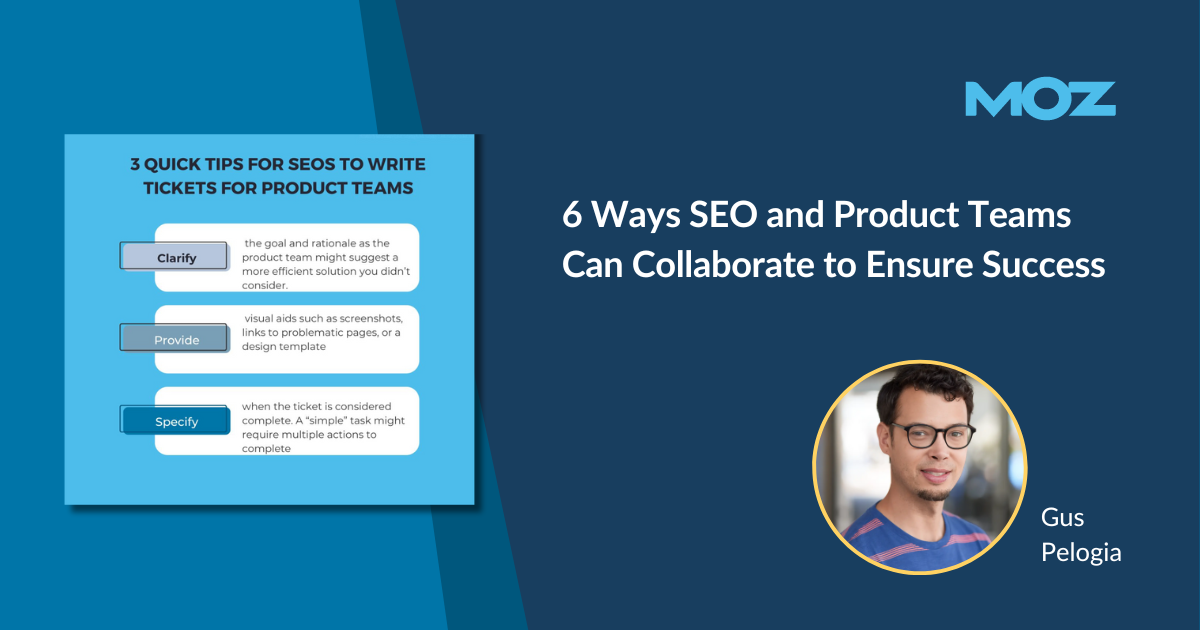
The most successful teams treat SEO as an ongoing product capability. They document SEO requirements for new templates. They review search data during discovery. They include SEO acceptance criteria in tickets. They track post-launch performance. They revisit old pages when the product changes. They celebrate wins together, because nothing says team bonding like watching a landing page climb from page three to page one while conversion rate also improves.
Regular communication also reduces tension. SEO teams learn product constraints. Product teams learn search risks and opportunities. Engineering learns which technical fixes matter most. Leadership sees organic growth as a system, not a mysterious channel powered by keywords and moonlight.
Common Mistakes That Hurt SEO and Product Collaboration
Even smart teams stumble. One common mistake is treating SEO as a marketing-only function. When SEO has no influence on product architecture or release planning, organic growth becomes reactive. Another mistake is chasing search volume without considering product fit. High-volume keywords may look exciting, but if they attract the wrong audience, the traffic will be about as useful as a chocolate teapot.
Teams also struggle when they use different definitions of success. SEO may celebrate traffic while product worries about activation. Product may celebrate feature adoption while SEO worries about crawl depth or duplicate content. Shared metrics solve this problem by connecting discovery, experience, and business outcomes.
Finally, many teams forget to maintain SEO after launch. Products evolve. Features change. Screenshots become outdated. URLs get retired. Competitors improve. Search intent shifts. A page that performed well last year may need new examples, better internal links, updated schema, stronger product positioning, or a faster template. SEO collaboration should continue throughout the product lifecycle.
Practical Experience: What Collaboration Looks Like in Real Teams
In real-world projects, the best SEO and product collaboration usually starts with a small moment of shared curiosity. Someone asks, “Why are users searching for this?” or “Why does this page get traffic but no signups?” That question opens the door to better strategy.
One common experience happens during feature launches. A product team prepares a powerful new capability, but the initial launch plan includes only a press release, an in-app announcement, and maybe a blog post. The SEO team reviews search data and discovers that users are already looking for several related problems. Instead of launching one generic announcement, the teams create a feature landing page, a comparison page, a tutorial, a help article, and two use-case pages. The product team provides screenshots and workflow details. SEO shapes the information architecture. Content writes in the language customers use. Engineering ensures the pages load quickly and are easy to crawl. The launch now has a long-term organic foundation, not just a one-week traffic spike.
Another experience appears during product-led SEO projects. A company may have valuable product data, templates, calculators, listings, or user-generated resources that can become useful search pages. But without product involvement, SEO may create pages that are technically possible yet not genuinely helpful. Product teams understand what data is reliable, what users need, and what actions matter after landing. SEO teams understand how to structure those pages for search discovery. Together, they can build scalable pages that solve real problems instead of thin programmatic pages that search engines and users both side-eye suspiciously.
Collaboration also matters when results are disappointing. Suppose a new template library attracts organic visitors but few users save a template. The SEO team may suggest rewriting metadata or adding more keywords. The product team may notice that the save button appears too late, the preview is unclear, or the signup wall arrives too soon. UX research may reveal that visitors want to test the template before creating an account. The winning solution may be a product change, not another paragraph of copy. That is the point: SEO success often depends on product experience.
In larger organizations, the biggest challenge is usually ownership. SEO recommendations can float around without a home. Product teams may agree that SEO matters but have no sprint capacity. Engineering may need clearer requirements. Leadership may ask for traffic growth while prioritizing only paid campaigns. The teams that break through this problem make SEO work visible. They assign owners, estimate impact, add tasks to the roadmap, and report outcomes in business language.
A useful habit is the “SEO office hour” for product managers. Once or twice a month, PMs bring upcoming features, page changes, or experiments. SEO brings search opportunities, risks, and quick recommendations. These sessions prevent surprises and build trust over time. They also help SEO professionals understand product trade-offs. Not every SEO idea deserves immediate engineering time. Not every product release needs a full organic strategy. Collaboration helps teams choose the right level of effort.
The best experience of all is when SEO becomes part of the product culture. Product managers start asking, “How will users find this?” Designers ask, “Does this page answer the search intent?” Engineers ask, “Should this be crawlable?” Content teams ask, “What product action should this guide support?” At that point, SEO is no longer a last-minute checklist. It is a shared growth mindset.
Conclusion
SEO and product teams can collaborate to ensure success by working together early, sharing customer insights, designing search-friendly templates, protecting technical SEO, connecting metrics, improving UX around search intent, and building a steady communication rhythm. This partnership turns SEO from a traffic channel into a product growth engine.
The companies that win organic search are not always the ones that publish the most content. They are often the ones that build the clearest, fastest, most useful experiences around real user needs. When SEO and product teams collaborate well, they create pages people can find, understand, trust, and act on. That is good for rankings, good for users, and good for the business. Also, it makes launch week slightly less terrifying, which deserves its own trophy.
SEO Tags