
Phones make terrible alarm clocks. They’re bright, distracting, and one “quick scroll” turns into accidentally learning the entire life story of someone’s pet hedgehog at 2:07 a.m. A dedicated alarm clock is the underrated hero of better sleep hygiene: it sits there quietly, does one job, and (mostly) doesn’t tempt you with notifications, group chats, and doomscrolling.
The best alarm clocks of 2024 aren’t all the same, either. Some wake you gently with sunrise light. Some wake you aggressively with sirens and a bed shaker (no judgment). Some are minimalist cubes that look like modern art. And some are smart displays that can run routines while you’re still negotiating with your pillow.
Quick Picks at a Glance
- Best overall sleep upgrade: Hatch Restore 2
- Best sunrise light without an app: Philips SmartSleep Wake-Up Light (HF3520/series)
- Best screen-free smart alarm: Loftie Clock
- Best smart display for routines: Google Nest Hub (2nd Gen)
- Best for heavy sleepers: Sonic Alert Sonic Bomb (SBB500SS)
- Best travel-friendly: Lexon Flip+
- Best minimalist design: Braun BC09
- Best classic analog bell: Peakeep Twin Bell Alarm Clock
- Best budget digital “just wake me up”: JALL Wooden Digital Alarm Clock
How These Were Chosen (Without Pretending One Clock Fits Everyone)
This list reflects the overlap among what major U.S. product editors and sleep-focused reviewers highlighted (think: reliability, usability in the dark, display dimming, alarm effectiveness, and real-world bedside sanity). It also filters for what was broadly available and relevant throughout 2024because the “best” alarm clock is the one you can actually buy, set up in five minutes, and trust on a Monday.
How to Choose an Alarm Clock You Won’t Hate
1) Decide how you want to wake up: gentle, normal, or “emergency broadcast”
If you wake up anxious or groggy, a sunrise alarm can feel like your bedroom is politely turning the lights on instead of yelling at you. If you sleep like a rock, you may need volume, vibration, flashing lights, or multiple alarms. The point isn’t sufferingit’s consistency.
2) Check the display: readable at 6 a.m., not a mini-sun at 2 a.m.
A great clock has a dimmer that goes truly dim. “Six brightness levels” sounds fancy until the lowest level still lights up your ceiling like a low-budget UFO. Look for a full-range dimmer, an automatic dim option, or a display-off mode.
3) Power-outage reality: battery backup is about your settings, not your electricity
Many clocks have a battery backup that saves your time and alarmsbut the display and alarm still rely on wall power. Translation: you won’t have to reprogram everything after a flicker, but you should still keep a secondary plan if outages are common.
4) Button design matters more than you think
Big snooze button? Bless. Tiny flush buttons that require a NASA-grade fingertip maneuver at 5:58 a.m.? Less bless. If you’ve ever accidentally changed the time while trying to snooze, you already know why this matters.
The 9 Best Alarm Clocks of 2024
1) Hatch Restore 2 Best Overall for Better Mornings (and Better Bedtimes)
If you want one device that can replace your alarm, wind-down routine, and “I need calming sounds right now” button, the Hatch Restore 2 is the all-in-one pick. It pairs a sunrise-style light with audio (nature sounds, white noise, guided content options) and lets you build routines in an app.
Why it stands out: The light-and-sound wake-up feels more like easing into the day than being catapulted into consciousness. It’s also genuinely helpful for people who struggle with consistency: the routine structure makes “going to bed” feel like a sequence you can repeat instead of a vague life goal.
Good for: Light sleepers, anxious wakers, anyone trying to stop using their phone at bedtime.
Watch-outs: Some content libraries may require a subscription; it’s an investment compared to basic clocks.
2) Philips SmartSleep Wake-Up Light Best Sunrise Alarm Without the App Ecosystem
Philips has been doing wake-up lights for years, and the SmartSleep line remains a favorite for people who want sunrise simulation without turning bedtime into another phone-based project. Expect gradual brightening, adjustable intensity, and classic bedside-friendly controls.
Why it stands out: It’s straightforward: set it, use it, wake up. For many sleepers, that simplicity is the feature. It also doubles as a bedside lamp, which is convenient if you want one less thing on your nightstand.
Good for: Dark winter mornings, light therapy fans (in a gentle, not-medical-device way), anyone who hates subscriptions.
Watch-outs: It takes up more space than a basic clock, and you’ll pay more than you would for a simple digital display.
3) Loftie Clock Best Screen-Free Smart Alarm (That Still Feels Modern)
Loftie’s whole vibe is “please stop sleeping next to a glowing rectangle.” It’s designed to be a dedicated bedside companion: calming sounds, a gentle alarm approach, and a display that doesn’t scream for attention. Many people love it specifically because it’s not trying to be a phone.
Why it stands out: It aims for habit-building: bedtime sounds, wake-up tones that aren’t rage-inducing, and an aesthetic that looks like it belongs on a nightstand instead of a dorm-room cinderblock shelf (though it can do that too).
Good for: People who want a “smart” alarm clock but not a smart life in the bedroom.
Watch-outs: Premium price; if you only need a basic beep, you can spend far less.
4) Google Nest Hub (2nd Gen) Best Smart Display as an Alarm Clock
If you like waking up to routineslights on, weather report, calendar reminders, maybe musicsmart displays can do a lot. The Nest Hub (2nd Gen) is commonly recommended for the bedside because it supports gradual “sunrise alarm” behavior and can integrate with smart-home setups.
Why it stands out: It’s a true “morning dashboard.” Set an alarm, trigger a routine, and let the device handle the basics while you handle the extremely difficult task of becoming a person.
Good for: Smart-home users, routine lovers, anyone who wants voice control bedside.
Watch-outs: It’s still a screenso if your goal is less tech in the bedroom, choose a dedicated clock instead.
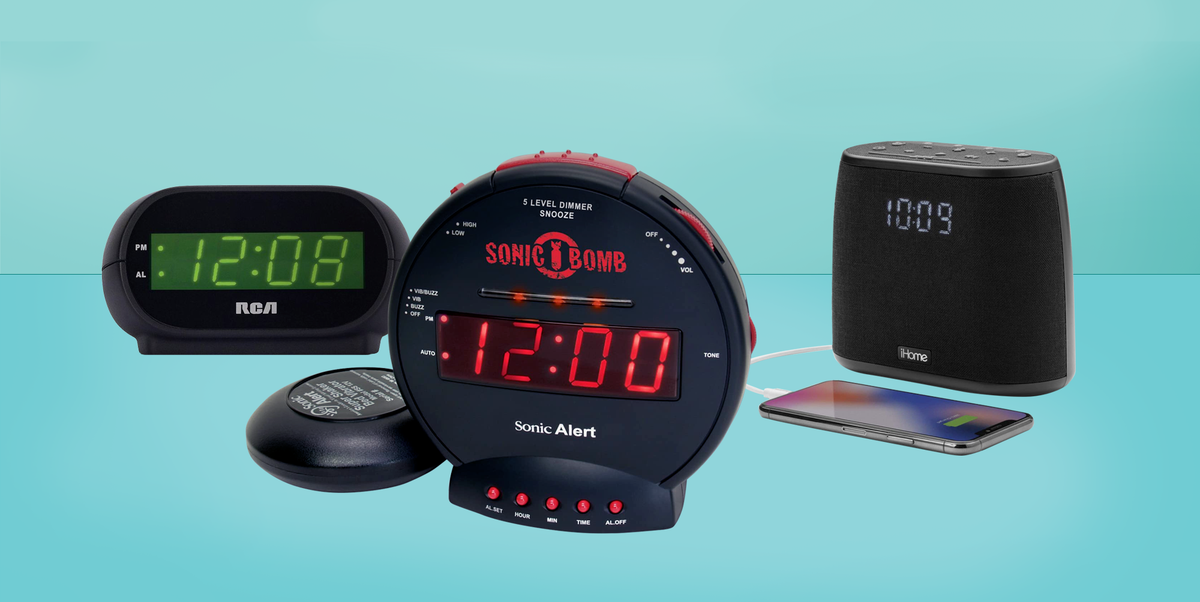
5) Sonic Alert Sonic Bomb (SBB500SS) Best for Heavy Sleepers (and “I Will Not Oversleep” Energy)
This is the nuclear optionin a good way, if you’ve slept through normal alarms. The Sonic Bomb is known for a very loud alarm, bed shaker, and flashing lights. It’s commonly recommended for heavy sleepers and also for people who are hard of hearing.
Why it stands out: It covers multiple senses. If sound alone doesn’t work, the vibration often does. And if you’re still negotiating with sleep, the strobe light is the final boss.
Good for: Heavy sleepers, shift workers, students with early classes, hearing accessibility needs.
Watch-outs: Not subtle. If you share a room, this can become a relationship test.
6) Lexon Flip+ Best Travel-Friendly Alarm Clock (Simple and Weirdly Satisfying)
The Flip+ is famous for one delightfully low-tech idea: you literally flip the clock to turn the alarm on or off. It’s compact, easy to pack, and less prone to “Wait… did I actually set it?” anxiety.
Why it stands out: Travel mornings are chaotic, and the Flip+ reduces mistakes. It also works well for small nightstands, guest rooms, and minimalist setups.
Good for: Travelers, dorms, guest rooms, minimalists who still want a real alarm.
Watch-outs: If you need “extra loud,” this isn’t the bed-shaker category.
7) Braun BC09 Best Minimalist Design (That’s Also Actually Useful)
Braun clocks are beloved for clean design and practical function. The BC09 keeps it simple with a clear digital display, snooze, backlight, and a crescendo alarm (starts softer, ramps up). It’s the kind of clock you buy because you want your bedroom to feel calmernot like an electronics aisle.
Why it stands out: You get design cred and day-to-day usability. Crescendo alarms are underrated: less panic, more “oh right, it’s morning.”
Good for: Aesthetic bedrooms, people who hate clutter, anyone who wants a “normal” alarm with better design.
Watch-outs: It’s not the cheapest option for a basic digital clock.
8) Peakeep Twin Bell Alarm Clock Best Classic Analog Bell (Old-School, in a Good Way)
Sometimes you want a clock that does not need Wi-Fi, software updates, or an account. The Peakeep twin bell style is the throwback pick: simple analog face, loud ringing, and the kind of “get up” energy that feels like a cartoon alarmminus the cartoon.
Why it stands out: Reliability. It’s also a great “phone detox” tool because it’s literally just a clock.
Good for: People who want simplicity, kids/teens learning time, vintage décor lovers.
Watch-outs: No gentle wake-up herethis is a bell doing bell things.
9) JALL Wooden Digital Alarm Clock Best Budget Digital “Just Wake Me Up” Option
JALL’s wooden-style digital clocks became popular because they look nicer than typical plastic budget clocks while still staying affordable. Most versions are easy to read, straightforward to set, and offer basic extras like adjustable brightness and alarm settings.
Why it stands out: If you want something simple, decent-looking, and not expensive, this category nails it. It’s also a common choice for desks, kitchens, or anywhere you want time visibility without a big tech footprint.
Good for: Budget shoppers, dorm rooms, offices, guest rooms.
Watch-outs: Budget clocks vary by exact modelcheck that your chosen version has the dimming behavior you want.
FAQs
Is a sunrise alarm clock actually worth it?
If you hate being jolted awake, yesmany people find gradual light plus a softer sound makes mornings less miserable. It won’t magically fix sleep deprivation, but it can make waking up feel less like a personal attack.
What’s better: a smart display or a dedicated alarm clock?
Dedicated clocks win for fewer distractions and easier “set it and forget it” reliability. Smart displays win if you love routines and voice control. If your bedtime goal is less screen time, pick a dedicated clock.
How loud is “loud enough” for heavy sleepers?
For truly deep sleepers, volume alone can failvibration and flashing alerts help. That’s why bed shakers are popular: they add a physical cue that’s hard to ignore.
Conclusion
The best alarm clock of 2024 isn’t “the fanciest”it’s the one that matches how you actually wake up. If you want a whole sleep routine, go with Hatch Restore 2. If you want gentle light without the app ecosystem, Philips is a strong bet. If you need the nuclear option, Sonic Bomb exists for a reason. And if you just want a reliable time display with a beep, a good budget clock is still a life upgrade over your phone.
Pick the style that fits your mornings, set it up once, and enjoy the strangely luxurious feeling of waking up without immediately checking notifications. Your future self (and your eyeballs) will thank you.
Experiences: What It’s Like Living With These Alarm Clocks (The Real-World Stuff)
The most surprising “experience” people report after switching from a phone to a real alarm clock is how much calmer bedtime feels. There’s a weird little relief in putting your phone across the room (or outside the bedroom) and knowing you won’t miss your alarm. That separation doesn’t just reduce late-night scrolling; it changes the vibe of the room. The nightstand becomes a place for a lamp, a book, maybe a glass of waterrather than a portal to the entire internet.
Sunrise alarms also tend to create a specific kind of morning: less panic, more momentum. With a standard buzzer, it’s common to jolt awake, slap snooze, repeat, and feel behind before you’ve even stood up. With a wake-up light, the “experience” is often that you’re already half-awake by the time the sound starts. People describe it like waking up on a camping tripeyes open gradually, brain catches up a little more smoothly, and the first minute of consciousness isn’t spent negotiating with a blaring alarm.
That said, sunrise clocks can be a learning curve. The first few mornings, some users set the light too bright too fast (hello, artificial sunrise at full intensity), or they choose alarm sounds that are “relaxing” in theory but weirdly annoying in practice. The sweet spot tends to be a longer ramp-up (30–45 minutes) with a softer sound at the endenough to finalize the wake-up, not startle you. Over time, many people end up customizing a “weekday routine” versus a “weekend routine,” which is where devices like Hatch and Loftie shine: they’re built for consistency, not just noise.
Heavy sleepers have a totally different experience. For them, the issue isn’t stressit’s penetration. A normal alarm is just background music to their dreams. That’s why bed shakers get almost emotional reviews: the first week with a shaker can feel like discovering an off switch for oversleeping. The flip side is that roommates and partners experience the same upgrade as a mild jump scare. If you share a bed, it’s worth experimenting with placement (under the mattress near your side) and using vibration first, then escalating to sound only if needed.
Minimalist clocks like the Braun BC09 tend to win on everyday ease. People often underestimate how much they’ll appreciate a backlight that’s easy to press, a display that’s readable without squinting, and an alarm that ramps up instead of detonating. It’s not glamorous, but it’s the kind of “experience” that makes mornings feel less chaotic: you wake up, you know what time it is, and you move on.
Travel clocks bring their own mini-drama. In hotels, it’s common to forget time zones, get confused by unfamiliar bedside controls, or wake up wondering if you set the alarm correctly. The Lexon Flip+ works well in real life because it removes doubtflip it to “on,” flip it to “off.” That physical action is reassuring, especially when you’re exhausted, jet-lagged, or trying to wake up quietly without waking everyone else.
Finally, smart displays create a “morning ritual” experience. For routine lovers, it’s genuinely satisfying to say “Good morning” and have lights turn on, weather and calendar pop up, and music start. But screens can also be a temptation. Some people love the dashboard feeling; others notice they start reading headlines before they’ve even brushed their teeth. If you’re the second type, a dedicated clock can feel like a small but powerful boundaryone that makes the first 30 minutes of your day feel more like yours.