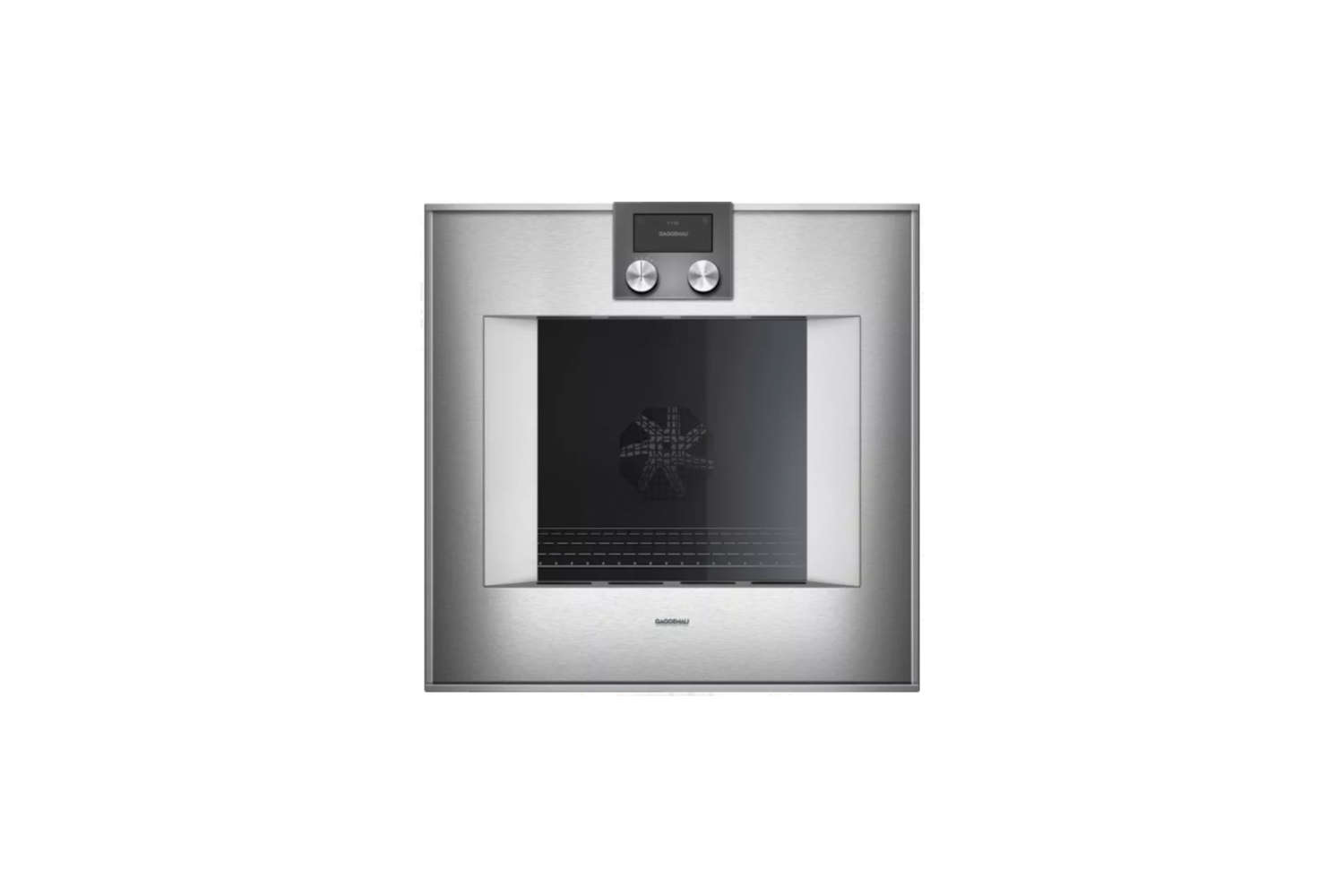

The Gaggenau 400 Series 24-inch single electric wall oven is not designed to disappear quietly into the kitchen. With its stainless steel-backed glass front, handleless automatic door, side-opening design, touchscreen controls, and specialized cooking modes, it looks less like a conventional appliance and more like something borrowed from a professional culinary studio.
Model BO450612 is the right-hinged version of this premium built-in oven. It combines a 3.2-cubic-foot cavity with convection cooking, automatic programs, a three-point temperature probe, optional baking-stone operation, pyrolytic self-cleaning, and Home Connect functionality. Gaggenau’s U.S. website now classifies this specific model as no longer available, so shoppers are most likely to encounter remaining dealer inventory, showroom units, open-box appliances, or preowned examples.
That availability warning matters, but it does not make the oven irrelevant. It remains an interesting choice for luxury kitchen renovations, replacement projects, and buyers comparing established 400 Series models with newer Gaggenau alternatives.
Gaggenau BO450612 Specifications at a Glance
| Feature | Specification |
|---|---|
| Product type | Built-in single electric wall oven |
| Series | Gaggenau 400 Series |
| Nominal width | 24 inches |
| Usable capacity | 3.2 cubic feet, or 76 liters |
| Door configuration | Right-side hinge with automatic opening |
| Temperature range | 85°F to 550°F |
| Heating modes | 13 |
| Controls | Rotary knobs and TFT touch display |
| Connectivity | Home Connect through Wi-Fi or LAN |
| Cleaning system | Pyrolytic self-cleaning |
| Electrical supply | 208–240 volts, 60 Hz, hardwired |
| Electrical rating | Approximately 4.0 kW and 17 amps |
A Design That Rejects the Ordinary Oven Door
Handleless automatic opening
The most distinctive feature of the Gaggenau 400 Series 24-inch wall oven is its handleless front. Instead of grabbing a bar and pulling the door downward, the user activates an electronic control that releases the door automatically.
This design creates a remarkably clean appearance. There is no bulky handle interrupting the glass and stainless steel surface, which helps the oven coordinate with minimalist cabinetry, integrated refrigerators, and contemporary appliance walls.
It is also the sort of feature that makes visitors pause and ask, “How do you open this thing?” That may or may not be the reason you buy a luxury oven, but it is an entertaining bonus.
A side-opening door
The BO450612 uses a right-side hinge, and the door can open as far as 180 degrees when surrounding cabinetry permits. Unlike a traditional drop-down door, it does not create a horizontal barrier between the cook and the oven cavity.
This can make it easier to approach a heavy roasting pan, insert the temperature probe, baste meat, or inspect a tray of pastries. It is especially useful when the oven is installed at a comfortable working height rather than beneath a countertop.
The hinge is not reversible. Buyers who need a left-hinged version should look for the corresponding BO451612 configuration instead. Cabinet layout must therefore be considered before ordering, not after the delivery team arrives and begins making concerned facial expressions.
Professional-looking materials
The stainless steel-backed full-glass door gives the oven a strong architectural presence. Controls are positioned across the top, while the dark viewing window keeps the facade visually restrained.
Inside, two halogen lights illuminate the cavity from the top and side. This dual-light arrangement provides a clearer view of browning and rising than a single dim bulb tucked into a corner like it owes someone money.
Thirteen Cooking Modes for More Precise Results
The Gaggenau BO450612 offers 13 heating modes rather than forcing every recipe through the same generic bake setting. The available functions include:
- Convection
- Economy convection
- Top and bottom heat
- Top heat
- Bottom heat
- Convection with bottom heat
- Convection broiling
- Broiling
- Economy broiling
- Baking-stone operation
- Roaster operation
- Dough proofing
- Defrosting
These modes allow the cook to choose how heat reaches the food. Conventional top-and-bottom heat is useful for familiar baking tasks, while convection circulates hot air for more even cooking. Bottom heat can help firm the base of a tart or casserole, and convection with bottom heat is particularly appealing for pizza, flatbread, and other foods that need both strong base heat and circulating air.
The oven’s electronic temperature control operates from 85°F to 550°F. Low settings support proofing and gentle warming, while the upper end provides the heat required for roasting, broiling, and baking-stone recipes.
Convection for everyday cooking
Convection is likely to become the everyday setting for many owners. Moving air helps reduce hot and cool zones, which is useful when roasting vegetables, baking cookies, or cooking foods on more than one level.
Economy convection is intended for more energy-conscious cooking when maximum speed is unnecessary. It may take some experimentation to determine which family recipes respond best, but it gives experienced cooks another way to manage heat rather than simply adjusting the timer and hoping for personal growth.
Baking-stone operation
Baking-stone mode is one of the oven’s most enthusiast-oriented features. With the compatible stone and heating element, sold as optional accessories, the oven can create stronger heat beneath pizza, bread, and rustic pastries.
A stone stores thermal energy and transfers it rapidly into the base of the dough. The result can be a crisper crust and stronger oven spring than a lightweight sheet pan typically provides. The oven is not transformed into a wood-fired pizzeria, but it becomes considerably more capable than the average compact wall oven.
Dough proofing
Dough proofing maintains a controlled low-temperature environment for yeast dough. This is valuable in a cold kitchen where bread otherwise behaves as though it has entered hibernation.
Consistent proofing temperatures make baking schedules more predictable. Home bakers can spend less time moving bowls between sunny windows, warm laundry rooms, and the top of the refrigerator.
Three-Point Core Temperature Probe
The included plug-in temperature probe measures food internally rather than relying solely on cooking time. Its three sensing points help the oven evaluate the temperature within a roast, poultry item, or other thick food.
The system can estimate remaining cooking time and shut the oven off when the target internal temperature is reached. This is particularly helpful for expensive cuts of meat, where a small difference in doneness can separate a memorable dinner from a very costly lesson in chewing.
A probe also adapts better than a fixed timer to variations in food size, starting temperature, shape, and composition. Two roasts of the same weight may not finish simultaneously, but their internal temperatures provide a much more reliable measure of doneness.
TFT Touch Display and Recipe Memory
The control system combines physical rotary knobs with a TFT touch display. This hybrid approach offers the precision of digital menus without requiring every adjustment to be made by repeatedly tapping a flat glass panel.
The interface displays operating information, temperature, cooking modes, and program guidance in clear text. Users can personalize automatic programs and save as many as 50 individual recipes, including settings that use the temperature probe.
Recipe memory is useful for dishes prepared regularly. Once the preferred mode, temperature, duration, and probe target have been established, they can be stored rather than reconstructed from memory while flour is drifting across the counter.
An actual-temperature display also shows what is happening inside the cavity rather than displaying only the selected target. Fast heating helps reduce preheating time when the cook would prefer dinner during the current calendar day.
Home Connect and Remote Monitoring
The BO450612 supports Home Connect through Wi-Fi or a wired LAN connection. Home Connect can provide appliance monitoring, program controls, timers, and status notifications through a compatible mobile device, although exact functions may depend on the appliance, software version, account, network, and regional service availability.
Remote notifications can be more useful than they initially sound. A cook can move around the house while checking whether a timer has finished instead of standing near the kitchen and pretending not to watch the clock.
Smart connectivity should still be treated as a convenience rather than the oven’s primary reason for existing. The real value lies in its heating system, probe, physical design, and cooking flexibility. An oven must remain good at roasting potatoes even when the Wi-Fi router is having an emotional crisis.
Pyrolytic Self-Cleaning
The pyrolytic cleaning cycle heats the cavity to an extremely high temperature, reaching approximately 905°F during the cleaning process. Food residue is reduced to ash that can be wiped away after the oven cools.
Gaggenau Clean-Enamel and a heated-air cleaning catalyst further support maintenance. This system is especially welcome after roasting fatty foods or preparing meals that bubble enthusiastically over the edge of the dish.
Accessories that are not approved for pyrolysis must be removed before starting the cleaning cycle. The temperature probe, baking stone, wire rack, roaster, and other sensitive accessories should never be left inside unless the documentation specifically identifies them as pyrolysis-safe. The oven may be clever, but it cannot protect a forgotten probe from volcanic decision-making.
Included and Optional Accessories
Original BO450612 packages were specified with an enamel baking tray, grill shelf, grill tub with grid, and plug-in meat probe. Because the model is discontinued, buyers considering a floor sample or preowned oven should confirm which accessories remain with the appliance.
Optional equipment was offered for more specialized cooking, including a pull-out rack system, baking stone, separate stone heating element, enameled broil pan, pizza peels, additional trays, wire racks, and a cast-aluminum roaster.
Accessory completeness can materially affect value. A discounted oven becomes less of a bargain when several model-specific parts must be located individually, especially if the missing item is the probe or hardware required for a desired cooking mode.
Capacity and Real-World Cooking Space
At 3.2 cubic feet, the Gaggenau 24-inch oven is smaller than many 27-inch and 30-inch American wall ovens. That is an unavoidable consequence of its compact width, not evidence that the cavity has been hiding space behind the control panel.
The capacity is appropriate for many everyday casseroles, roasting pans, cakes, breads, and family meals. However, households that frequently cook oversized turkeys, use extra-wide sheet pans, or prepare several large dishes simultaneously should verify the usable interior measurements with their own cookware.
The oven provides four tray levels. Convection improves flexibility when more than one rack is used, but loading patterns still matter. Air must be able to circulate, and densely packed trays can limit browning regardless of how distinguished the logo on the door may be.
Installation Requirements and Cabinet Planning
The required cabinet cutout is approximately 23 1/4 inches high, 22 1/16 inches wide, and 21 11/16 inches deep. The appliance weighs roughly 126 pounds before packaging, so installation is not a casual one-person afternoon project.
The oven requires a fixed electrical connection and is rated for 208–240 volts at approximately 17 amps, with a total connected load of about 4.0 kW. Electrical work should be completed according to the installation instructions and applicable local codes.
The front extends about 1 7/8 inches beyond the cabinet face. Nearby drawers, cabinet handles, walls, and countertops must be checked for interference. A corner installation requires additional attention because the side-opening door needs enough clearance to swing and provide comfortable access.
The electrical connection should be planned outside the oven cutout where specified. Buyers using wired Home Connect should also account for the LAN connection before the appliance is pushed into place. Discovering that the network cable is still in the packaging after installation is an excellent way to test the patience of everyone involved.
Advantages of the Gaggenau 400 Series 24-Inch Oven
- Elegant handleless design with automatic door opening
- Ergonomic side-opening door
- Thirteen versatile heating modes
- Accurate three-point core temperature probe
- Useful dough-proofing and baking-stone functions
- Pyrolytic self-cleaning system
- Recipe memory for frequently prepared dishes
- Wi-Fi and LAN connectivity through Home Connect
- Compact width for premium kitchens with limited wall space
Potential Drawbacks
- The BO450612 has been discontinued in the U.S.
- Its 3.2-cubic-foot cavity is smaller than many full-size ovens
- The right-side hinge cannot be reversed
- Specialized accessories may be expensive or difficult to locate
- Professional installation and hardwired electrical service are required
- Repairs may cost more than service for mainstream appliances
- The controls and numerous modes require an initial learning period
Who Is This Wall Oven Best For?
The Gaggenau BO450612 is best suited to cooks who value precision, design, and specialized functions more than maximum cavity size. It makes particular sense in an appliance wall, luxury condominium, compact designer kitchen, or cooking space built around European-width appliances.
It is also attractive to bread bakers, pizza enthusiasts, and cooks who regularly roast meat with a temperature probe. Someone who uses an oven mainly to reheat frozen snacks may enjoy the design, but much of the appliance’s engineering would spend its life waiting for a more ambitious assignment.
Because the model is no longer part of Gaggenau’s active U.S. catalog, a potential buyer should investigate the serial number, production history, warranty status, local service coverage, accessory completeness, and condition of the automatic door mechanism before purchasing.
Extended Ownership Experience: What Living With This Oven May Feel Like
The first noticeable change in daily use is the side-opening door. With a conventional oven, the lowered door creates a hot platform that the cook must lean across. With the Gaggenau, the space directly in front of the cavity remains open. Sliding in a casserole or checking a roast feels more like working with a professional cabinet oven than wrestling with a household range.
That convenience becomes more apparent when handling heavy cookware. A cast-iron roaster can be brought closer to the cavity before being transferred to the rack. When the oven is installed near chest or waist height, the movement feels controlled and natural. The main limitation is architectural: if the hinge side is too close to a wall or tall cabinet, the same door that should improve access can become an obstacle.
The controls may feel unfamiliar during the first several meals. There are more choices than “bake,” “broil,” and “good luck.” Owners must learn when to use convection, conventional heat, bottom heat, or one of the combination settings. After that learning period, the choices begin to feel purposeful rather than excessive.
Consider homemade pizza as an example. A basic oven might be set to its highest temperature with a stone placed on a rack. The Gaggenau adds a dedicated baking-stone operation when the compatible accessories are installed. The cook can preheat the stone, use strong lower heat, and build a repeatable routine. The first pizza may still emerge shaped like a country with disputed borders, but the base has a better chance of becoming crisp.
For roasting, the temperature probe changes the experience more dramatically than the smart-home functions. Instead of repeatedly opening the door and losing heat, the cook inserts the probe, selects a target temperature, and monitors progress through the oven. The estimated completion time becomes increasingly useful as the food cooks. Planning side dishes is easier when the roast provides something more informative than silence.
Bread bakers may appreciate proofing mode even more than the high-temperature settings. A stable warm cavity removes one of the least predictable variables in yeast baking. Dough can rise consistently during winter, summer, or an aggressive air-conditioning season. When the dough is ready, convection or baking-stone operation can take over for the bake.
Cleaning is another area where the ownership experience feels appropriately premium. Most spills can be wiped before they harden, but the pyrolytic cycle handles accumulated residue without requiring prolonged scrubbing. It is still necessary to remove unsuitable accessories and clear heavy debris beforehand. Self-cleaning means less manual labor, not permission to leave an entire lasagna on the oven floor.
Home Connect is most useful as a supporting feature. Timer alerts and operating updates can prevent forgotten dishes, especially in a larger home. Remote functions are convenient, but they do not replace the need to prepare food safely and confirm that the cavity is ready for operation.
The oven’s smaller size also influences ownership. It heats a compact cavity and fits a 24-inch opening, but cookware selection becomes more intentional. Owners may need to retire oversized sheet pans or measure roasting dishes before holiday cooking. For a household that normally prepares one main dish and one smaller tray, this is unlikely to be troublesome. For someone who cooks Thanksgiving dinner for twenty people, a second oven would be more than decorative.
Long-term satisfaction ultimately depends on using the features that justify the appliance. A cook who experiments with bread, pizza, roasts, pastries, and stored programs can make the Gaggenau feel like a genuine culinary tool. A cook who never moves beyond one conventional setting may be left with a beautiful, costly box that makes excellent frozen fries.
Final Verdict
The Gaggenau 400 Series 24-inch single electric wall oven is a sophisticated compact appliance built around precision cooking and distinctive industrial design. Its side-opening automatic door, broad selection of heating modes, three-point temperature probe, baking-stone capability, recipe memory, and pyrolytic cleaning place it well above the typical 24-inch wall oven.
Its discontinued status, limited capacity, fixed hinge direction, installation requirements, and potential service costs must be considered carefully. For the right kitchen and the right cook, however, the BO450612 remains an impressive example of how a compact wall oven can deliver serious culinary flexibility without looking remotely ordinary.
Note: Gaggenau currently identifies BO450612 as no longer available on its U.S. website. Before purchasing remaining inventory, a showroom unit, or a preowned appliance, confirm its condition, warranty eligibility, included accessories, installation compatibility, and access to authorized local service.