
Every founder has a money personality. Some founders treat every dollar like it was hand-carved from rare marble and personally blessed by their first customer. Others see cash as rocket fuel: raise it, spend it, hire fast, advertise harder, and hope the engine does not detach mid-flight. Neither instinct is automatically wrong. In fact, both can build excellent companies. The trouble begins when a founder’s natural money style becomes a religion.
Startup finance is rarely a clean choice between “be frugal” and “go big.” The real question is sharper: What spending actually moves the company toward durable growth? A saver can protect runway, reduce dilution, and keep the company alive during ugly markets. A spender can capture market share, hire talent before competitors do, and accelerate learning. But a saver taken too far becomes a bottleneck. A spender taken too far becomes a bonfire wearing a Patagonia vest.
This article explores founder spending habits, startup burn rate, runway management, capital efficiency, and the difficult middle path between penny-pinching and reckless expansion. The goal is not to crown savers or spenders as “better.” The goal is to help founders recognize their default setting, challenge it, and build a company that can survive both good times and bad ones.
The Two Founder Money Personalities
Most founders lean toward one of two financial instincts: saving or spending. These habits usually form long before a company has a board, a CFO, or a monthly investor update. They come from personal history, previous business scars, family attitudes about money, and the type of company the founder wants to build.
The Saver Founder
The saver founder loves efficiency. They negotiate software contracts, use secondhand office furniture, review every subscription, and can smell unnecessary headcount from three Zoom calls away. They know the runway number. They know last month’s net burn. They know who expensed the $38 airport salad, and they have questions.
This mindset can be powerful. Many great companies were built with disciplined spending. A low-burn startup can survive fundraising droughts, avoid desperate down rounds, and make decisions from a position of strength. When capital markets tighten, saver founders often look unusually wise. Their companies may not have the loudest launch parties, but they still have payroll.
However, the saver mindset has a shadow side. Some founders underinvest in sales, marketing, product quality, customer success, or senior leadership because every expense feels like a threat. They delay hiring a strong VP because the salary seems painful. They avoid paid acquisition even when the unit economics are working. They keep doing everything themselves because “we’re staying lean,” when the honest translation is, “I have become the company’s most exhausted department.”
The Spender Founder
The spender founder sees money as acceleration. They believe that if the company has a shot at a big market, it should move fast. Hire the best people. Build the brand. Open the new channel. Run the experiment. Buy the tools. Upgrade the team. In the right situation, this instinct can be exactly what a startup needs.
Some markets reward speed. If a company has product-market fit, strong retention, healthy gross margins, and a repeatable customer acquisition motion, spending more can be rational. Growth often requires investment before the returns show up neatly in a spreadsheet. Sales teams need ramp time. Marketing campaigns need testing. Product teams need enough talent to ship at the pace customers expect.
But spender founders can confuse motion with progress. They may hire before defining the job, increase marketing before understanding conversion, or spend heavily to “signal momentum” when the underlying business is slowing. The office looks better. The team looks bigger. The burn rate looks like it ate a second burn rate. Unfortunately, vanity growth is not the same as company health.
Why Both Instincts Get Worse Under Pressure
The most dangerous moment for founder spending habits is not when everything is calm. It is when growth slows, fundraising gets harder, competitors get louder, or the board starts asking questions that begin with “help me understand.” Pressure makes founders double down on their natural instinct.
Spenders often respond to slowing growth by spending more. The logic sounds reasonable at first: if growth is slowing, maybe the company needs more salespeople, more marketing, more product investment, or a bigger push. Sometimes that is true. But if the slowdown is caused by weak positioning, poor retention, bad unit economics, or a product that no longer feels urgent to customers, additional spending can simply make the problem more expensive.
Savers often respond to slowing growth by cutting more. That also sounds reasonable. If revenue is not growing fast enough, protect cash. Reduce marketing. Freeze hiring. Delay sales expansion. Cancel tools. Serve instant coffee that tastes like a printer cartridge. The problem is that cutting the very activities that create pipeline, product improvement, and customer success can slow growth even further. A company can save itself into irrelevance.
In other words, spenders can pour fuel on a fire that is not connected to an engine. Savers can remove the fuel from an engine that was finally starting to work.
Burn Rate Is Not the Enemy. Unexamined Burn Is.
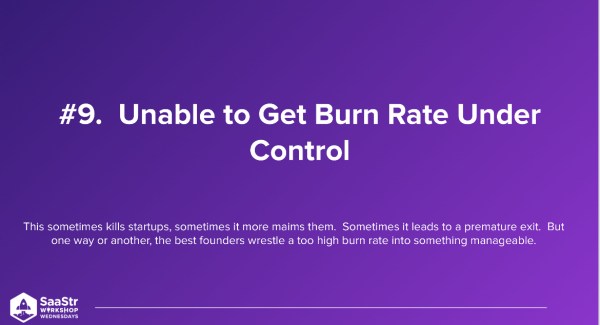
Burn rate is the amount of cash a startup spends beyond what it brings in. Founders often discuss it as if lower is always better, but that is too simplistic. A startup with zero burn may also have zero ambition, zero growth, and zero chance of winning a fast-moving market. Meanwhile, a startup with a high burn rate may be making smart investments that produce durable revenue.
The key is not whether the company is spending money. The key is whether the spending is tied to a credible growth engine. Founders should separate expenses into categories: necessary operating costs, growth investments, learning experiments, and waste. The first three may be justified. The fourth deserves immediate judgment, preferably without a twelve-person committee.
Good Burn vs. Bad Burn
Good burn buys learning, revenue, retention, or strategic advantage. Examples include hiring a sales leader after proving the sales motion, investing in onboarding because churn is too high, funding product reliability because enterprise customers demand it, or testing paid acquisition when customer lifetime value clearly supports it.
Bad burn buys comfort, ego, confusion, or delay. Examples include hiring a large team before knowing what the team should do, spending on brand campaigns without a measurable goal, keeping underperforming projects alive because they were expensive to start, or copying a competitor’s spending pattern without copying their economics.
A simple founder question helps: If this expense works, what number will improve? If nobody can answer, the expense may be a costume party for strategy.
The Saver Trap: Protecting Cash While Starving Growth
Saver founders are often praised because discipline is easy to admire. It feels mature. It photographs well in investor updates. But extreme frugality can quietly limit a startup’s ceiling.
Consider a SaaS company that reaches early product-market fit. Customers are renewing. Expansion revenue is promising. Sales calls are converting. The founder, worried about dilution and burn, refuses to hire experienced salespeople or invest in marketing. For a while, the company looks efficient. Then competitors with similar products build stronger distribution. They become the default choice in the category while the saver founder is still personally approving LinkedIn ad tests for $300.
This is the saver trap: the company survives but does not compound. It has enough cash to keep going, but not enough investment to become truly important. Eventually, employees lose energy, customers see less innovation, and the market moves on. The founder did not run out of money. They ran out of momentum.
Signs a Founder Is Saving Too Much
A founder may be over-saving when every hire is delayed until the team is already burned out, when marketing is cut even though the payback period is healthy, when customer support is understaffed despite rising churn risk, or when the founder keeps low-value tasks because hiring feels emotionally expensive. Frugality should create freedom. If it creates paralysis, it has gone too far.
The Spender Trap: Buying Growth Without Understanding It
Spender founders can be inspiring. They are bold, optimistic, and allergic to tiny thinking. But when spending outruns understanding, the startup becomes fragile. It may look successful from the outside because headcount is rising and announcements sound impressive. Internally, the company may be carrying a cost structure that only works if everything goes perfectly. Spoiler: startups are not famous for everything going perfectly.
Imagine a founder who raises a large seed round and immediately hires across engineering, sales, marketing, operations, finance, and “strategic vibes.” The team is talented, but the company has not yet proven the product, the customer segment, the pricing, or the sales cycle. Six months later, the burn rate is massive, the product roadmap is bloated, and the company needs another round before it has earned one. That is not ambition. That is a countdown clock with snacks.
Signs a Founder Is Spending Too Much
A founder may be over-spending when headcount grows faster than clarity, when sales hires are added before a repeatable sales process exists, when paid marketing scales before retention is proven, when expensive executives are brought in to solve problems the founder has not defined, or when the company depends on a future fundraise to survive. Hope is not a financing strategy. Neither is “the market will understand once we explain the vision in a better deck.”
The Middle Path: Spend Like a Scientist, Not a Tourist
The healthiest founders do not simply save or spend. They allocate. They treat money as a tool for testing assumptions and building leverage. They are willing to invest, but they demand evidence. They are willing to cut, but they avoid cutting the muscle that creates growth.
One useful approach is to divide spending decisions into three buckets: proven engines, promising experiments, and unsupported habits.
1. Proven Engines
A proven engine is an area where the company understands the relationship between spending and outcomes. For example, if adding account executives reliably increases qualified pipeline and closes revenue within a known payback period, sales hiring may be a smart investment. If customer success reduces churn and drives expansion, underfunding it may be foolish. Proven engines deserve fuel, especially when competitors are hesitating.
2. Promising Experiments
Promising experiments are not proven yet, but they are worth testing. A new marketing channel, a new customer segment, a product-led growth motion, or an AI-powered support workflow might fit here. The key is to cap the downside. Define the budget, timeline, success metric, and decision rule before spending. Otherwise, experiments become hobbies with invoices.
3. Unsupported Habits
Unsupported habits are expenses that continue because nobody wants to challenge them. This might include unused software, low-performing events, vague consultants, legacy projects, or team structures that made sense two years ago but no longer match the business. These are the easiest cuts because they reduce burn without damaging the company’s growth engine.
How Founders Can Check Their Own Bias
The hardest part of startup spending is that founders are rarely neutral. Savers can always find a reason to wait. Spenders can always find a reason to accelerate. That is why founders need systems that challenge instinct.
Ask: What Would the Opposite Founder Do?
If you are a saver, ask what a smart spender would fund right now. Would they hire a senior sales leader? Increase customer success coverage? Run a serious demand generation test? Improve onboarding? If the answer is obvious and you still resist, your frugality may be fear in a tasteful sweater.
If you are a spender, ask what a smart saver would cut right now. Would they pause a weak channel? Delay a hire? Renegotiate software? Require clearer deliverables before expanding a team? If the answer makes you uncomfortable, congratulations. You may have found the adult supervision your budget needed.
Use Milestone-Based Budgeting
Instead of asking, “Can we afford this?” ask, “What milestone does this help us reach?” A startup budget should connect cash to progress: revenue targets, retention improvements, product launches, enterprise readiness, margin improvement, or fundraising milestones. This turns spending from an emotional argument into an operating plan.
Review Burn Monthly, Not Randomly
Founders should understand monthly gross burn, net burn, runway, revenue growth, cash collection, and upcoming obligations. Reviewing these numbers monthly creates discipline without turning the company into a spreadsheet monastery. When leaders know the numbers, they make fewer dramatic decisions and more useful ones.
Specific Examples of Balanced Founder Spending
A balanced founder does not always choose the cheapest option. They choose the option with the best risk-adjusted return. For example, hiring a strong finance lead may feel expensive at 40 employees, but it can prevent cash surprises, improve forecasting, and make fundraising smoother. That is not overhead for the sake of overhead. It is infrastructure for better decisions.
Similarly, cutting all marketing during a slowdown may look responsible, but if marketing is the source of qualified pipeline, the cut may create a larger revenue problem three months later. A better approach is to cut weak campaigns, keep high-performing channels, and test messaging that reflects current buyer pain.
On the other hand, a founder should be cautious about hiring a large sales team before the founder or early sellers can close deals consistently. Salespeople do not magically create product-market fit. They amplify what already works. Hiring ten reps into an unclear market is like buying ten microphones for a song nobody has written.
The Founder’s Real Job: Create Optionality
Great cash management gives founders options. It allows them to raise when terms are attractive, not when panic is sweating through the all-hands meeting. It allows them to invest when competitors pull back. It allows them to survive customer delays, market shifts, and product mistakes.
Optionality does not come from saving every dollar. It also does not come from spending every dollar. It comes from knowing which dollars create leverage and which dollars merely create activity.
The best founders build a culture where money is respected but not worshiped. Teams should understand that spending is allowed when it is tied to learning, growth, customer value, or speed. They should also understand that waste is not a personality trait. It is a fixable management issue.
Extra Founder Experiences and Practical Lessons
One of the most common founder experiences is the emotional whiplash after raising capital. Before the round, every cost feels dangerous. After the round, the bank balance suddenly looks heroic. The temptation is to behave like a “real company” overnight: bigger team, better tools, polished brand, maybe even an office plant that costs more than the first landing page. But the best founders remember that fundraising is not revenue. It is borrowed confidence with expectations attached.
A practical lesson from early-stage companies is to make the founder do a job manually before hiring for it. If the company needs outbound sales, the founder should try outbound first. If customer onboarding is messy, the founder should sit in onboarding calls. If support tickets are painful, the founder should read them. This does not mean founders should do everything forever. It means they should understand what excellence looks like before creating a role. Hiring without understanding the work often leads to expensive disappointment.
Another experience many founders share is cutting too late. Spender founders especially may wait until the situation becomes obvious to everyone, including the office dog. By then, the company may need painful layoffs or emergency fundraising. A healthier habit is to create trigger points in advance. For example: if runway falls below 12 months and growth has not improved, reduce discretionary spend. If a channel misses targets for two consecutive cycles, pause or redesign it. If a role has no clear owner, metric, or deliverable, do not hire yet.
Saver founders face the opposite experience: realizing too late that the company should have invested earlier. Many founders look back and admit they should have hired a senior operator, built a stronger sales function, or invested in brand before the market became crowded. The lesson is not “spend more because regret is annoying.” The lesson is to identify high-conviction opportunities and fund them decisively. A founder who underinvests in a working growth channel may be choosing comfort over scale.
There is also a cultural lesson. Teams can feel the founder’s money anxiety. If every purchase requires a courtroom drama, employees stop proposing ideas. If spending is chaotic, employees stop trusting leadership. The healthiest companies create clear rules: what teams can spend, how experiments are approved, how success is measured, and when budgets are reviewed. Clarity reduces fear. It also reduces the number of Slack messages that begin with, “Sorry, quick budget question…” which are never quick.
Founders should also remember that not all cuts are equal. Cutting unused software is easy. Cutting customer success when churn is rising is dangerous. Cutting executive travel may be sensible. Cutting product quality to save short-term cash can damage trust. Cutting low-performing ads is smart. Cutting all demand generation because “marketing is expensive” can make the next quarter look like a haunted house. Good cost control is surgical. Bad cost control is a lawn mower.
Finally, founders need to separate ego from economics. Savers may take pride in being tougher, leaner, and more disciplined than everyone else. Spenders may take pride in being bolder, faster, and more visionary. Pride is a noisy advisor. The market does not care whether a founder feels virtuous. Customers care about value. Employees care about direction. Investors care about progress. Cash should serve the company’s strategy, not the founder’s self-image.
The best operating rhythm is simple: know your numbers, know your bias, fund what works, test what might work, and cut what clearly does not. In calm markets, that discipline compounds. In tough markets, it may be the difference between becoming a case study and becoming a company that gets to write the next chapter.
Conclusion
Some founders are savers. Some are spenders. Both can build extraordinary companies, and both can accidentally sabotage them. The saver protects runway but may starve growth. The spender accelerates progress but may burn through cash before the business model is ready. The winning move is not to deny your instinct. It is to manage it.
Founders should build budgets around milestones, not moods. They should spend when the company has evidence, cut when spending no longer creates value, and review cash with enough discipline to avoid surprises. A startup does not need a founder who is cheap or extravagant. It needs a founder who is honest about what the business needs next.
Note: This article is written for editorial and educational purposes. It synthesizes practical startup finance concepts, founder operating lessons, and widely discussed business principles around burn rate, runway, capital efficiency, and sustainable growth.