
Laboratory cooling usually works beautifully until the experiment moves somewhere that has no convenient faucet, no floor drain, and no friendly wall outlet. Suddenly, the dependable stream of condenser water becomes a luxury. Ice baths melt, buckets warm up, and the solvent that should be condensing starts considering a second career as room fragrance.
A portable 12 VDC water chiller offers a practical alternative. By combining a compressor-based portable freezer, a reusable coolant reservoir, a submerged 12-volt pump, and adjustable circulation, the system can provide closed-loop cooling for condensers, reaction vessels, small distillation setups, and other moderate laboratory heat loads. It is not a replacement for a precision industrial chiller, but it can be remarkably useful where mobility, modest cost, and independence from tap water matter more than laboratory-grade temperature stability.
Research basis:
Why a Chemistry Lab Needs Recirculating Cooling
Cooling is not merely about making glassware look more scientific. In chemistry, temperature influences vapor pressure, reaction rate, equilibrium, selectivity, product stability, and the ability of a condenser to turn vapor back into liquid. Poor cooling can reduce solvent recovery, increase emissions, destabilize an exothermic reaction, or make results difficult to reproduce.
Commercial recirculating chillers continuously pump temperature-controlled fluid through external equipment. Common applications include rotary evaporators, reflux condensers, reaction vessels, spectrometers, vacuum systems, analytical instruments, and automated laboratory equipment. Because the coolant returns to the reservoir instead of disappearing down a drain, a closed-loop system also avoids the waste associated with single-pass tap-water cooling.
That last benefit becomes especially important in temporary labs, mobile demonstrations, outdoor testing locations, workshops, field stations, or buildings where plumbing access is limited. A self-contained chiller needs only electrical power and enough coolant to fill its reservoir and tubing.
Research basis:
The Basic Portable 12 VDC Chiller Concept
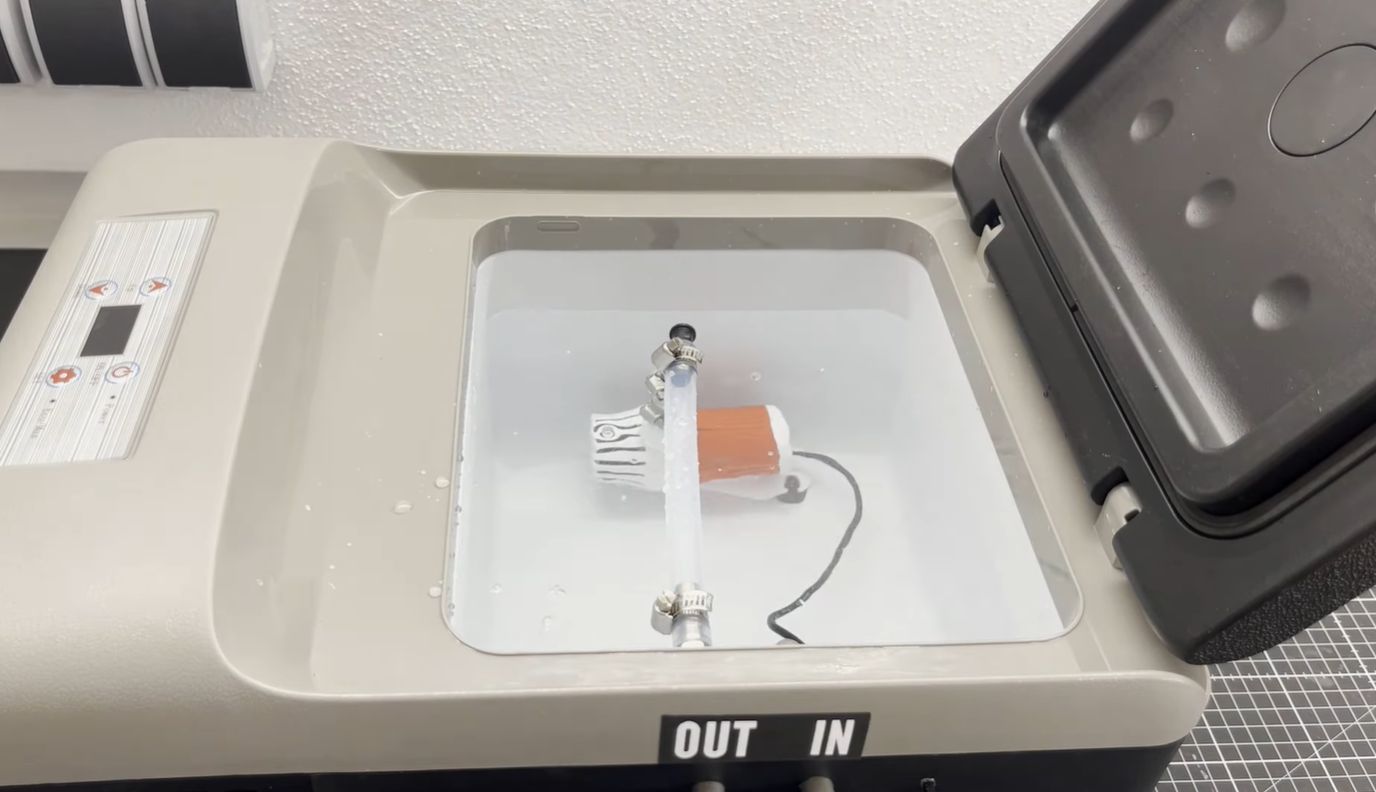
The simplest version begins with a portable compressor freezer designed to operate from a 12 VDC supply. Two coolant lines pass through sealed openings into the insulated compartment. A submerged 12V water pump draws chilled liquid from the reservoir and sends it through the outlet line. After passing through the laboratory apparatus, the warmer liquid returns through the second line.
A pulse-width modulation speed controller can regulate the pump, allowing the operator to adjust flow without repeatedly pinching tubing or changing pumps. The controller, fuse, connectors, and electrical junctions should remain outside the wet compartment in an appropriately enclosed housing.
The refrigeration system removes heat from the reservoir while the pump carries that cooling capacity to the experiment. The result is a small recirculating cooling system that can run from a vehicle electrical system, portable battery bank, or regulated 12V power supply with sufficient current capacity.
The clever part is that the refrigeration hardware is already engineered, insulated, and packaged. Instead of building a vapor-compression system from loose componentswhich is not a casual weekend activitythe project modifies only the liquid-circulation side.
Research basis:
Why a Compressor Freezer Beats a Typical Peltier Cooler
Many DIY cooling projects begin with a Peltier module because it is compact, inexpensive, and happy to consume direct current. Thermoelectric cooling also has no compressor, refrigerant tubing, or moving parts other than the fans and pump. For small instruments, modest heat loads, and precise electronic control, it can be an excellent technology.
However, a Peltier device does not simply make heat disappear. It moves heat from its cold face to its hot face while generating additional resistive heat. The hot-side heat sink must therefore reject the original process heat plus the electrical energy consumed by the module. As the temperature difference between the hot and cold sides increases, useful cooling capacity and efficiency generally decline.
A compressor-based portable freezer is usually better suited to chilling several liters of water or handling the continuing heat from a condenser. Vapor-compression refrigeration can offer substantially better efficiency near ordinary laboratory temperatures. Thermoelectric systems remain attractive when silence, compact construction, refrigerant-free operation, or very fine control matters more than raw efficiency.
In other words, Peltier cooling is elegant, but a compressor often wins the argument by arriving with a larger thermal hammer.
Research basis:
Essential Components
Portable 12V Compressor Freezer
Choose a unit intended for mobile operation rather than attempting to power an ordinary household freezer directly from a vehicle socket. Check its input-voltage range, maximum current, startup behavior, low-voltage cutoff, ventilation requirements, and stated operating temperature range.
The freezer must have enough internal space for the desired coolant volume while leaving room for circulation. Its condenser vents also need unobstructed airflow. Packing the compressor compartment against a wall is an excellent way to build a portable water warmer instead.
Submersible 12V Water Pump
The pump must provide adequate flow at the actual system resistance, not merely an impressive zero-head flow number printed on a product page. Long tubing, narrow fittings, condenser coils, elevation changes, and quick-connect couplings all create pressure loss.
A variable-speed brushless DC pump is often a good choice because it is compact and easy to control. Confirm that its wetted materials are compatible with the coolant. The pump should also tolerate continuous duty at the expected liquid temperature.
Reservoir and Coolant
The freezer compartment may serve directly as the reservoir, although a removable covered tank can make cleaning and maintenance easier. Use a coolant compatible with the pump, tubing, seals, heat exchanger, and laboratory apparatus.
Water provides excellent heat-transfer performance for temperatures safely above freezing. Where freezing is possible, an inhibited propylene glycol and water mixture may be appropriate. Increasing glycol concentration lowers the freezing point but also raises viscosity, which can reduce pump flow and heat-transfer performance. Do not assume that automotive antifreeze, uninhibited glycol, highly purified water, or a random chemical mixture is automatically safe for every loop.
Tubing, Fittings, and Insulation
Select flexible tubing with suitable temperature, pressure, and chemical-resistance ratings. Secure connections with proper hose barbs and clamps rather than laboratory optimism. Install bulkhead fittings where lines enter the freezer whenever the wall construction permits it.
Insulate cold supply tubing when operating below the room’s dew point. Otherwise, condensation may form on the tubing, drip onto the bench, and create the exciting but undesirable combination of water, electricity, and hurried paperwork.
Electrical Protection and Controls
A practical electrical package includes a correctly rated fuse near the power source, suitable wire gauge, protected connectors, a pump switch, a speed controller, strain relief, and separate switching where needed for the freezer and pump. A temperature display and low-coolant sensor are worthwhile upgrades.
Research basis:
Estimate the Cooling Load Before Building
A freezer’s lowest advertised temperature does not reveal how much heat it can remove continuously. Cooling capacity, usually expressed in watts, is the more important specification. Commercial laboratory chillers are selected according to process heat load, coolant temperature, ambient temperature, flow, pressure, and required stability.
For an initial reservoir pull-down estimate, the energy that must be removed can be approximated with:
Energy = mass × specific heat capacity × temperature change
Suppose the reservoir contains 5 liters of water and must cool from 25°C to 10°C. Using approximately 4.18 kilojoules per kilogram-degree Celsius for water:
5 kg × 4.18 kJ/kg°C × 15°C = 313.5 kJ
Removing that energy in 30 minutes would require an ideal average cooling rate of about 174 watts. Real equipment would need additional capacity because heat enters through the walls, tubing, pump, surroundings, and connected apparatus. A small portable freezer may therefore require a much longer pre-chilling period.
Steady-state operation is a separate question. Once the reservoir reaches its target temperature, the refrigeration system must remove heat as quickly as the experiment adds it. A mild condenser load may be manageable, while a vigorously boiling solvent can overwhelm the same chiller even though the reservoir began ice-cold.
Cooling capacity also falls under demanding conditions. Manufacturers commonly publish performance at specific coolant and ambient temperatures because a chiller that performs well at 20°C may provide far less capacity at 0°C. Hot ambient air further reduces the ability of an air-cooled condenser to reject heat.
Research basis:
Step-by-Step Construction Overview
1. Inspect the Freezer Before Drilling
Do not drill blindly through an insulated wall. Refrigerant lines, wiring, and structural components may be hidden inside. Review the unit’s construction and choose an entry path that does not threaten the sealed refrigeration circuit. Where uncertainty remains, route tubing through an existing drain opening or lid gap with a removable insulated insert.
2. Install the Supply and Return Lines
Fit two clearly labeled lines: cold supply and warm return. Seal penetrations against air leakage while avoiding rigid arrangements that transfer vibration or stress to the freezer wall. Position the return so that incoming warm coolant mixes through the reservoir instead of flowing directly back into the pump inlet.
3. Mount and Wire the Pump
Place the submerged pump where it will remain covered during operation. Route its low-voltage cable through a protected opening and connect it to the external controller through a fuse. Keep exposed terminals, switches, and circuit boards away from splash zones.
4. Add a Filter or Strainer
A small inlet strainer protects the pump and condenser passages from debris. It is especially helpful in an open reservoir where dust, tubing fragments, sealant, and the occasional unidentified laboratory crumb may appear.
5. Leak-Test at Room Temperature
Fill the system with its intended coolant and run the pump before activating refrigeration. Inspect every fitting, bend, bulkhead, and equipment connection. Correct leaks while the liquid is warm and comfortable to handle rather than after everything is cold, wet, and surrounded by condensation.
6. Measure Performance
Record reservoir temperature, supply temperature, return temperature, flow behavior, ambient temperature, and electrical current. Test first with no process load, then with a controlled heat load. The data will reveal whether the system is genuinely useful or simply making reassuring compressor noises.
Research basis:
Laboratory Applications
Distillation and Reflux Condensers
A portable chiller can supply reusable coolant to a Liebig, Allihn, Graham, or coil condenser when tap water is unavailable. Flow should normally enter the lower condenser port and leave from the upper port so the jacket fills completely and air pockets are minimized.
Rotary Evaporators
Small rotary evaporators may benefit from closed-loop cooling, particularly when processing solvents that condense at moderate temperatures. Chiller sizing must reflect vapor load and required condenser temperature. A colder setpoint is not automatically better if it sharply reduces available cooling capacity.
Reaction Temperature Control
Coolant may circulate through a jacketed vessel or external coil to moderate an exothermic reaction. A DIY system should not be treated as the sole safety control for a hazardous reaction. Independent temperature monitoring, appropriate addition control, emergency shutdown procedures, and professional risk assessment remain necessary.
Analytical and Workshop Equipment
The same portable cooling loop can serve small vacuum pumps, laser modules, instrument heat exchangers, fermentation experiments, environmental test fixtures, or other equipment whose heat load fits the chiller’s measured capacity.
Research basis:
Safety Considerations That Are Not Optional
Keep the cooling loop physically isolated from process chemicals. The reservoir should contain only the approved heat-transfer fluid; it should not collect solvents, reaction mixtures, corrosive liquids, or unknown waste.
Do not place open chemical containers inside a consumer freezer. Ordinary portable freezers are generally not designed as explosion-proof or hazardous-location equipment. Flammable vapor can reach switches, relays, motors, or other ignition sources.
Use grounded or appropriately protected power equipment, inspect cords and connectors, and keep electrical controls dry. When an AC power supply is used near water, connect it through properly installed ground-fault protection as required by applicable rules and laboratory policy. Never handle energized connectors with wet hands.
Provide secondary containment beneath the chiller and experiment. Secure hoses so a bump cannot pull them from the condenser. A flow indicator or low-flow alarm can prevent unnoticed pump failure, while an over-temperature alarm can warn that the process is outrunning the refrigeration system.
Finally, label the equipment as a laboratory device. Do not use the same reservoir for food, drinks, or ice storage. The joke about keeping ice cream beside the chemistry coolant stops being funny shortly before the incident report begins.
Research basis:
Practical Experience: What the First Few Runs Teach You
The following field notes summarize recurring lessons from DIY cooling projects and everyday laboratory chiller operation. They are the details that rarely look important during construction but become extremely interesting once the experiment is running.
Pre-Chilling Is More Valuable Than Brute Force
The first lesson is that cooling several liters of water takes time. Turning on the freezer at the same moment a distillation begins usually forces the refrigeration system to fight the warm reservoir and the process load simultaneously. The temperature may fall painfully slowlyor begin climbing while the compressor runs continuously.
Pre-chilling the reservoir transforms the experience. Starting with cold coolant gives the system stored thermal capacity, allowing it to absorb short peaks in vapor load. For planned work, cooling the reservoir well in advance is often more effective than installing an unnecessarily powerful pump.
Maximum Pump Speed Is Rarely the Best Setting
A pump operating at full speed can create noise, vibration, splashing, bubbles, and unnecessary electrical heating. It may also raise pressure beyond what delicate glass condenser fittings or loose tubing connections can tolerate.
Begin with a moderate flow and observe the condenser. If the jacket is completely filled and the outlet remains meaningfully warmer than the inlet, heat transfer is occurring. Increase flow only when the return temperature rises excessively or vapor begins escaping the condenser. The goal is effective cooling, not recreating a municipal water main on the benchtop.
The Return Line Is an Excellent Diagnostic Tool
Touching laboratory equipment is not a measurement method, but inlet and return temperature sensors can reveal a surprising amount. A large temperature difference may indicate high heat load or insufficient flow. Almost no difference may indicate low process load, excessive flow, poor thermal contact, or a temperature sensor installed in the wrong place.
Watching the reservoir temperature together with the supply-return difference helps distinguish between a refrigeration problem and a circulation problem. When the reservoir stays cold but the apparatus overheats, inspect flow and plumbing. When the entire reservoir steadily warms, the process probably exceeds the chiller’s capacity.
Condensation Appears in Unexpected Places
Cold tubing can produce enough condensation to wet clamps, benchtops, cables, connectors, and the underside of glassware. The first run may look perfectly dry because the room has low humidity. The next run, on a humid day, can create a miniature weather system.
Closed-cell insulation on the supply line greatly reduces dripping and unwanted heat gain. Seal insulation joints rather than leaving gaps around fittings. Position electronics above the liquid level and outside any route water might follow.
Small Restrictions Have Large Effects
A pump that looks powerful in a bucket may deliver disappointing flow through several feet of narrow tubing and a condenser. Sharp bends, undersized barbs, partially closed valves, dirty strainers, and mismatched quick-connects can quietly consume most of the available pressure.
Using shorter tubing, smooth curves, full-bore fittings, and a clean filter often improves performance more than buying a faster pump. Commercial chillers specify pressure and flow because both matter; a DIY system obeys the same physics even when assembled with bargain-bin hose.
Reservoir Cleanliness Becomes a Maintenance Job
Warm periods, light exposure, dust, and incompatible materials can lead to cloudy coolant, deposits, odor, corrosion, or biological growth. A covered reservoir, clean tubing, an appropriate coolant treatment, and scheduled fluid replacement help maintain reliable circulation.
Before storage, drain and clean the loop according to the materials and coolant used. Water left in low sections can encourage growth or freeze during transport. Label the coolant and record when it was replaced; “probably changed sometime last semester” is not a maintenance program.
Portability Depends on More Than Voltage
A 12V label does not guarantee effortless mobile operation. The complete load includes the freezer, pump, controller, fans, and any monitoring electronics. Cable resistance matters at low voltage, so a long, thin power lead can produce voltage drop, poor compressor startup, and overheated connectors.
Measure operating current and confirm that the vehicle outlet, battery, fuse, wiring, and connectors are properly rated. For battery operation, estimate runtime from usable watt-hours rather than the largest marketing number on the battery case. Leave enough reserve to avoid damaging the battery or discovering that the vehicle no longer feels like starting.
Simple Instrumentation Changes Everything
A basic system can run with one thermometer and an on-off switch, but three temperature sensorsreservoir, supply, and returnmake troubleshooting far easier. A flow indicator, voltmeter, ammeter, and low-level alarm turn the chiller from a mysterious cold box into measurable laboratory equipment.
After several runs, record a small performance chart showing pull-down time, stable reservoir temperature, typical flow setting, process type, ambient temperature, and maximum manageable load. That information is more useful than an optimistic product specification because it describes the assembled system under real operating conditions.
Research basis:
Advantages and Limitations
The portable 12 VDC water chiller is appealing because it reuses coolant, works away from building plumbing, uses readily available hardware, and can be moved between small experiments. A compressor-based design generally provides better cooling efficiency than low-cost thermoelectric coolers and avoids the complexity of constructing a refrigeration circuit from scratch.
Its limitations are equally important. A modified freezer usually lacks calibrated temperature stability, certified pressure protection, automated flow alarms, validated chemical compatibility, and published performance curves. It may cycle over a broad temperature range, and its cooling capacity may be difficult to predict.
Use the DIY design for appropriate moderate-risk applications after measuring its performance. Choose a commercial laboratory recirculating chiller when the work requires validated temperature accuracy, high pressure, large heat removal, continuous unattended operation, regulatory compliance, or dependable protection for expensive equipment.
Conclusion
A portable 12 VDC water chiller can turn an off-the-shelf compressor freezer into a useful closed-loop cooling source for the chemistry lab. The core design is refreshingly straightforward: chill a reservoir, circulate the coolant with a 12V pump, return the absorbed heat to the freezer, and adjust the flow to match the experiment.
Successful construction depends less on flashy components than on honest thermal calculations, careful plumbing, adequate electrical protection, coolant compatibility, insulation, leak testing, and performance monitoring. The system should be treated as real laboratory equipment rather than a cooler with a hose casually poking out of the lid.
Built and operated responsibly, it can support distillation, reflux, reaction cooling, analytical equipment, and field experiments without consuming a continuous stream of tap water. It is portable, practical, and slightly more dignified than assigning a graduate student to replace melting ice every fifteen minutes.